Introduction
Poor packaging causes 65% of all cargo damage claims in international shipping, with inadequate securing and moisture protection as the primary culprits. For steel reels carrying wire, cable, and rope products, the stakes are even higher.
These heavy, cylindrical loads face export challenges domestic shipments never encounter. Extended transit times span weeks or months. Ocean freight exposes reels to salt air and extreme humidity, while multiple handling points increase damage risk.
This guide covers the packaging strategies, reel selection criteria, and corrosion protection methods that prevent rust damage, structural failure, and costly border rejections.
Key Takeaways
- Wooden reels (ISPM 15 certified) handle loads under 5-6 tonnes; steel reels support 30+ tonnes
- Wrap reels in VCI film and add calculated desiccant packets to prevent "container rain" corrosion during ocean transit
- Verify ISPM 15 heat treatment certification for all wooden components and prepare complete export documentation
- Inspect flange integrity, drum condition, strapping security, and labeling before shipment
- Use minimum 4-6 steel straps plus blocking to prevent container shifting
Understanding Export Requirements for Steel Reels
What Makes Export Different from Domestic Shipping
Export packaging operates in a completely different environment than domestic freight. Your reels face transit times of 30-60 days instead of 3-5 days, giving moisture and corrosion far more time to develop.
Each shipment passes through multiple handling points—origin terminal, port of loading, ocean vessel, destination port, customs warehouse, and final delivery—multiplying the risk of rough handling or improper storage.
Temperature fluctuations during ocean transit create "container rain," where moisture condenses on cargo surfaces when warm air inside the container cools below its dew point. This condensation accelerates rust formation on both steel reels and wire products, particularly when relative humidity exceeds 40%.
Customs inspections add another layer of complexity. Inspectors may open containers, unwrap packaging, or reject shipments entirely if documentation doesn't match physical cargo or if wooden materials lack proper treatment certification.
ISPM 15 Requirements for Wooden Reels
The International Standards for Phytosanitary Measures No. 15 (ISPM 15) prevents the spread of plant pests and diseases through wood packaging materials crossing international borders.
This regulation applies to all raw wood packaging, including wooden cable drums, reels, spools, dunnage, pallets, and crates.
Treatment requirements include:
- Heat Treatment (HT): Wood heated to minimum 56°C core temperature for 30 continuous minutes
- Methyl Bromide Fumigation (MB): Wood fumigated in enclosed area for 16+ hours, then aerated
- Dielectric Heating (DH): Wood heated using microwaves/radio waves to 60°C for one minute throughout
Important exemptions: Steel reels are completely exempt from ISPM 15 since they contain no wood. Plywood and processed wood products are also generally exempt, though regulations vary by destination country.
Every compliant wooden reel must display a permanent mark containing the IPPC logo, two-letter ISO country code, unique producer number, and treatment code (HT, MB, or DH).
NARCo manufactures heat-treated wooden reels with proper ISPM 15 certification, and can recondition existing wooden reels to meet compliance standards—critical for companies managing both new and existing reel inventory for international shipments.

Country-Specific Regulations and Documentation
Beyond ISPM 15, different countries impose additional requirements. Some nations restrict container weights to protect road infrastructure—even if your container is rated for 30,480 kg, road limits may cap actual weight at 24,000 kg. Certain wire products may require hazardous material classifications if coatings contain regulated substances.
Critical documentation includes:
- Commercial invoice with accurate product descriptions
- Detailed packing list specifying reel dimensions, weights, and contents
- ISPM 15 certificates for wooden reels
- Material certifications if required by destination country
- Bill of lading with correct weight declarations
Proper Labeling for International Success
Labels must survive harsh marine conditions. The BS 5609 standard ensures labels remain legible after three months of seawater immersion—essential for identification if containers are exposed to weather or ocean spray.
Use weatherproof materials and include:
- Total weight (including reel and product)
- Country of origin and destination
- Handling instructions with ISO 780 pictograms (universally understood symbols like "This Way Up" or "Fragile")
- Multilingual text when shipping to non-English speaking countries
Stencil identification marks directly onto reel flanges when possible, or use durable tags securely attached to prevent loss during handling.
Financial Risks of Non-Compliance
Improper documentation or non-compliant packaging creates expensive problems. Shipments with non-compliant wooden reels face immediate rejection at borders, forcing you to choose between expensive re-export ($3,000-8,000), destruction of the reels, or emergency fumigation at destination ports ($2,000-5,000 plus storage fees).
Delays trigger demurrage charges—daily fees for containers sitting at port beyond free time, usually $75-150 per day for standard containers. For a two-week delay, you're looking at $1,050-2,100 in demurrage alone, not counting the operational disruption to your customer's production schedule.
Missing or incorrect SOLAS VGM (Verified Gross Mass) declarations prevent container loading entirely, as carriers face liability for improperly weighted cargo that could destabilize vessels.
Choosing the Right Reel Type for Export
Wooden Reels vs. Steel Reels: Export Comparison
| Feature | Wooden Reels | Steel Reels |
|---|---|---|
| Load Capacity | 1-6 tonnes | 20-30+ tonnes (up to 157 tonnes for specialized reels) |
| Initial Cost | Lower ($150-600) | Higher ($800-3,000+) |
| ISPM 15 Requirement | Yes—must be heat treated | No—exempt from phytosanitary rules |
| Durability | Vulnerable to humidity, impact damage | Highly durable, weather-resistant |
| Reusability | Limited (2-5 uses) | High (20+ uses with maintenance) |
| Weight | Lighter (easier handling) | Heavier (requires equipment) |
| Best Export Use | Medium loads, cost-sensitive shipments, single-use applications | Heavy loads, long-distance ocean freight, return/reuse programs |
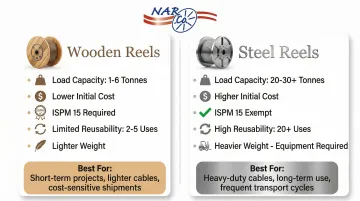
Wooden reels work best for:
- Loads under 5-6 tonnes where cost is a primary concern
- Wire rope diameters of 12-32mm
- Single-use applications without reel return
- Shipments to destinations with good handling infrastructure
Ensure your supplier provides proper ISPM 15 certification. NARCo manufactures nailed wooden reels using heat-treated softwoods (Southern Yellow Pine, Spruce, Pine, or Fir) in compliance with NEMA WC26 standards and international export requirements.
Steel reels are mandatory for:
- Loads exceeding 6 tonnes
- Wire rope diameters above 32mm
- Reel return and reuse programs where higher initial cost is justified
They eliminate ISPM 15 compliance concerns entirely and withstand the rough handling and humid conditions of ocean freight far better than wood.
Reel Selection Based on Load Specifications
Once you've identified the appropriate reel material, match the specific reel dimensions to your load requirements:
Match barrel diameter to wire diameter: The reel barrel must be at least 20 times the wire rope diameter to prevent bending stress that permanently deforms the wire. For a 25mm rope, minimum barrel diameter is 500mm.
Calculate total load capacity: Add the weight of your wire product to the reel's tare weight. Ensure this total stays within the reel's rated capacity with a safety margin of 10-15%.
Consider disposal vs. return: If you're shipping to a location where reel return is impractical, wooden reels make economic sense. For established trade routes with return logistics, steel reels offer better long-term value.
Account for handling equipment: Heavier steel reels require forklifts or cranes at both origin and destination. Confirm your customer has appropriate equipment before specifying steel.
When Reconditioned Reels Make Sense for Export
Professionally reconditioned reels offer significant cost savings—typically 40-60% less than new reels—while meeting the same structural and compliance standards. This makes them attractive for export applications where budget constraints are tight but quality can't be compromised.
Key advantages:
- Reduced environmental impact through reuse
- Faster availability than custom-manufactured reels
- Proven durability (reconditioned reels have already survived multiple use cycles)
- Full compliance capability when professionally restored
NARCo's reconditioning process includes:
- Flange straightening and press work
- Rim repairs and welding reinforcements for structural integrity
- Dynamic balancing for smooth operation
- Complete blasting and painting for corrosion protection
- ISPM 15-compliant heat treatment for wooden components
- Structural reinforcements to handle international shipping stresses
The critical factor is professional reconditioning. Amateur repairs or reels with unaddressed structural damage will fail during ocean transit, resulting in wire damage and costly claims.
Composite and Plastic Reels for Lighter Products
Plastic and composite reels offer advantages for lighter wire products (typically under 2 tonnes):
- Complete corrosion resistance (no rust concerns)
- Lighter weight reduces shipping costs
- ISPM 15 exempt
- Lower moisture absorption than wood
However, they have limitations: lower load capacities compared to steel, limited availability for heavy-duty applications, and higher costs than wooden reels in some size ranges. They work best for electrical cables, lighter gauge wire, and applications where corrosion resistance is paramount.
Essential Packaging and Protection Methods
Preventing Moisture and Corrosion in Ocean Freight
Corrosion is the number one cause of wire product damage during international shipping. Temperature fluctuations—from 40°C in tropical ports to 5°C in northern waters—cause condensation inside containers.
This "container rain" creates moisture that settles on steel surfaces, triggering rust formation within days.
When relative humidity exceeds 40%, ferrous metals face increased corrosion risk. Unprotected steel wire ropes frequently arrive with surface rust that renders them unusable, leading to total loss claims.
Barrier Protection Methods
VCI (Vapor Corrosion Inhibitor) Technology: VCI wrapping is your primary defense against corrosion.
VCI films and papers release vapor molecules that form a protective molecular layer on metal surfaces, inhibiting rust formation for up to five years. Wrap the entire reel—including flanges and exposed wire ends—in VCI film, then heat-shrink or tape securely to create a sealed barrier.
Layered protection approach:
- Inner layer: VCI paper or film in direct contact with wire and reel surfaces
- Middle layer: Heavy-duty polyethylene or heat-shrink wrap to seal moisture out
- Outer layer: Waterproof tarp or foil vapor barrier for high-value products
- Edge protection: Cardboard or foam edge protectors where strapping contacts the wrap
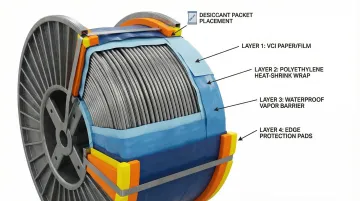
Desiccant Application Strategy
Desiccants absorb moisture inside sealed packaging, reducing relative humidity below the corrosion threshold. However, they only work when used correctly.
Critical rules:
- Seal the environment first: Desiccants are useless without a moisture barrier. Wrap the reel completely before adding desiccants.
- Calculate quantity needed: Use manufacturer calculators based on enclosed volume and transit duration (typically 30-60 days for ocean freight).
- Strategic placement: Hang silica gel packets or clay desiccant strips inside the wrapped reel, positioning them near the top where warm air rises.
- Use the right type: Silica gel for high absorption capacity, calcium oxide for maintaining very low humidity levels.
For a typical 1.5m diameter reel wrapped in VCI film, expect to use 2-4 kg of desiccant for 60-day ocean transit.
Physical Protection During Handling
Beyond moisture control, physical damage during handling poses a significant risk to reel integrity.
Protect vulnerable points:
- Flange corners: Apply reinforced corner protectors to prevent cracking if reels are stacked or bumped
- Arbor holes: Install protective caps to prevent damage that would make the reel impossible to mount
- Strapping contact points: Use edge protectors where steel straps cross the reel to prevent crushing damage
- Between stacked reels: Place cushioning materials (foam, cardboard sheets) between reels if stacking is unavoidable
Proper Strapping and Securing
Steel strapping must conform to ASTM D3953 specifications. Apply minimum straps per reel based on size:
| Reel Size | Diameter | Minimum Straps |
|---|---|---|
| Small | <1m | 4 straps |
| Medium | 1-2m | 5 straps |
| Large | >2m | 6+ straps |
Strapping best practices:
- Position straps around the reel barrel, not over wire product
- Tension straps firmly to prevent shifting without crushing flanges
- Use cross-battens on wooden flanges to distribute pressure
- Apply anti-slip material on flanges to prevent rotation
Never secure reels by tying straps through arbor holes unless the reel is specifically designed with reinforced tie-off points. This can cause structural failure.
Pre-Shipment Inspection and Preparation
Reel Structural Inspection Checklist
Before loading any reel for export, conduct a thorough structural inspection:
Flange inspection:
- Check for cracks, splits, or delamination in wooden flanges
- Look for warping or "dishing" (concave deformation) in steel flanges
- Ensure flanges are securely attached to the drum with no loose bolts or welds
- Confirm flanges can support the wire load without flexing
Drum/barrel inspection:
- Examine wooden drums for moisture damage, rot, or loose staves
- Inspect steel drums for warping, dents, or corrosion
- Verify the drum is round and true (not oval or deformed)
- Ensure drum surface is smooth without protruding nails or sharp edges
Arbor hole inspection:
- Confirm arbor holes are round and undamaged
- Check for cracks around arbor hole edges
- Verify arbor tube is securely welded (steel reels) or properly seated (wooden reels)
- Measure arbor hole diameter matches customer's handling equipment
Fastener inspection:
- Ensure all nails, bolts, and welds are tight
- Look for rust or corrosion on metal fasteners
- Confirm no fasteners protrude into the wire winding area
Professional inspection services, such as those offered by NARCo, can identify and repair structural issues before export.
Their reconditioning capabilities include flange straightening, arbor tube repairs, welding reinforcements, and complete structural restoration. This prevents costly failures during transit that would result in wire damage and insurance claims.
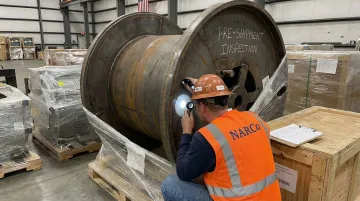
Wire Product Inspection on the Reel
Reel integrity is only half the equation. The wire product itself needs equally careful inspection to ensure safe delivery:
Winding tension check:
- Wire should be wound with consistent, moderate tension
- Too loose: layers will shift and tangle during transit
- Too tight: can deform the wire or stress the reel structure
Layer integrity:
- Verify proper layering without crossovers where wire crosses between layers
- Check for gaps or uneven winding that allows wire to shift
- Ensure each layer is complete before the next begins
Wire condition:
- Inspect for kinks, bends, or surface damage
- Check for rust or corrosion already present
- Verify protective coatings (if applicable) are intact
End terminations:
- Confirm wire ends are securely fastened to prevent unwinding
- Check that termination points won't damage adjacent wire during transit
- Verify end caps or protective wrapping covers sharp wire ends
Documentation and Labeling Preparation
Attach weatherproof tags with:
- Complete product identification (type, size, grade, length)
- Total weight (product + reel)
- Country of origin and destination
- Reel number or unique identifier
- Handling instructions with ISO 780 pictograms
Prepare certificates and documentation:
- ISPM 15 certificates for wooden reels (verify heat treatment stamp is clearly visible)
- Material certifications if required by destination country (mill test reports, chemical composition certificates)
- Detailed packing lists with reel dimensions, weights, and wire specifications
- Commercial invoices with accurate HS codes for customs classification
Label durability: Use BS 5609-compliant labels that can withstand three months of seawater immersion. Apply labels to flat surfaces or use reinforced tags attached with wire (not plastic ties that can break).
Container Loading and Securing Best Practices
Calculating Container Utilization
Maximize space while maintaining stability:
- Measure accurately: Include flange diameter, traverse width, and all protective packaging thickness
- Account for clearance: Leave 50-100mm clearance between reels and container walls for blocking materials
- Plan loading pattern: Sketch the layout before loading to optimize space and weight distribution
- Consider accessibility: Position reels so strapping points and arbor holes are accessible for securing
For standard 20ft containers (internal dimensions approximately 5.9m × 2.35m × 2.39m), you can typically fit 4-6 medium-sized reels depending on orientation. 40ft containers (12m × 2.35m × 2.39m) can hold 10-15 reels with proper arrangement.
Reel Orientation: Vertical vs. Horizontal
Horizontal orientation (rolling position):
- Generally preferred for unwinding at destination
- Requires substantial wedging to prevent rolling
- Better weight distribution across container floor
- Easier to inspect wire condition during loading
Vertical orientation ("eye to the sky"):
- More stable without extensive blocking
- Requires pallets or skids under each reel
- Can damage wire if reels weren't designed for vertical storage
- Uses vertical space more efficiently
Critical warning: Never flip loaded reels from horizontal to vertical (or vice versa) if they weren't designed for it. The sudden weight shift can damage wire layers and crack reel structures.
Choose orientation based on reel design, wire type, and customer's unloading equipment. When in doubt, consult the reel manufacturer or use the orientation in which the reel was wound.
Securing Methods Inside Containers
The CTU Code (IMO/ILO/UNECE Code of Practice for Packing of Cargo Transport Units) mandates proper blocking, bracing, and lashing to prevent cargo shifts that can destabilize containers.
Effective blocking and bracing includes:
- Timber beams filling gaps between reels and container walls
- Blocking positioned to transfer forces to container corner posts and bottom rails (the strongest structural points)
- Dunnage bags (inflatable airbags) filling voids between reels
- Wedges with minimum height of R/3 (one-third of reel radius) to prevent rolling
Lashing adds another layer of security:
- Anchor straps to container tie-down points (typically rated for 1,000-2,000 kg each)
- Use minimum 2 lashing straps per reel in addition to blocking
- Cross-lash reels to prevent lateral movement
- Avoid over-tensioning which can deform reels or pull out anchor points
Anti-slip materials prevent shifting during transit:
- Rubber mats or textured pads under reel flanges
- Friction-enhancing materials between stacked reels
- Anti-slip coating on container floor in reel contact areas
Weight Distribution Strategy
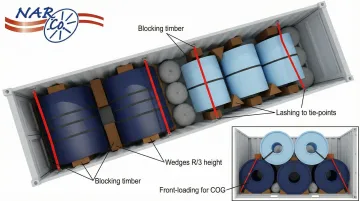
Improper weight distribution can cause container instability, axle overloading, or even tipping during transport.
Apply these weight distribution principles:
- Heavier reels at bottom: Place heaviest reels on the container floor, lighter reels on top if stacking
- Front-loading preference: Position heavier cargo toward the front (door end) of the container to maintain proper center of gravity
- Balanced left-right: Distribute weight evenly across both sides to prevent listing
- Stay within limits: Verify total weight doesn't exceed container rating (typically 30,480 kg for standard containers) or road/rail limits in transit countries
SOLAS VGM compliance: Since July 2016, you must provide Verified Gross Mass before container loading. Use Method 1 (weigh the complete packed container) or Method 2 (weigh all components individually and add container tare weight).
Missing or incorrect VGM declarations prevent loading and trigger delays and demurrage charges.
Common Export Packaging Mistakes to Avoid
Using Non-Compliant Wooden Reels
Shipping wooden reels without valid ISPM 15 certification is the most expensive mistake you can make. Customs authorities at destination ports will reject the shipment immediately.
You'll face three costly options:
- Re-export the entire shipment back to origin ($3,000-8,000)
- Destroy the reels and repackage the wire ($5,000-12,000)
- Emergency fumigation at the port ($2,000-5,000 plus storage fees)
Even if the wooden reel appears treated, missing or incorrect certification markings (IPPC logo, country code, producer number, treatment code) trigger rejection. Always verify visible, permanent ISPM 15 stamps before shipping.
Inadequate Corrosion Protection
Using domestic-grade plastic wrap or basic tarps won't protect against ocean freight conditions. Standard polyethylene doesn't provide vapor corrosion inhibition, and basic wraps often tear during handling or develop condensation inside.
The result: steel wire ropes and reels arrive with surface rust, discoloration, and corrosion that renders products unusable.
With steel prices up 60% in recent years, corrosion claims have become increasingly expensive—often exceeding the original product value when you factor in replacement costs, shipping, and customer downtime.
Prevention: Use VCI technology specifically designed for marine transport, seal packaging completely, and add calculated desiccant inside the moisture barrier.
Insufficient or Improper Strapping
Inadequate securing is the leading cause of cargo damage claims. Reels that shift during transit suffer multiple types of damage:
- Flange deformation or breakage from impact
- Wire damage from layers shifting and tangling
- Reel drum collapse from uneven pressure
- Container wall damage from heavy reels breaking loose
Using too few straps, incorrect strap placement (over the wire product instead of around the barrel), or insufficient tensioning allows movement that worsens with each handling event—truck transport, crane lifts, vessel motion, and final delivery.
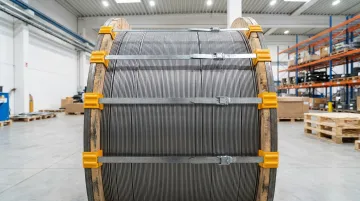
How to prevent this: Apply minimum 4-6 steel straps per reel according to size, use edge protectors at contact points, and supplement strapping with proper blocking and bracing inside containers.
Incomplete or Incorrect Labeling and Documentation
Missing or inaccurate documentation causes customs delays, inspection holds, and makes products impossible to identify upon arrival. Common errors include:
- Weight discrepancies between documentation and actual cargo
- Missing SOLAS VGM declarations
- Incorrect HS codes causing customs classification issues
- Illegible labels damaged by moisture or handling
- Missing handling instruction pictograms causing improper storage
Each day of delay triggers demurrage charges ($75-150 per day), storage fees, and operational disruption for your customer. Multiply this by multiple containers and the costs escalate rapidly.
Avoid this by: Use weatherproof BS 5609-compliant labels, verify all documentation matches physical cargo exactly, include complete handling instructions with universal pictograms, and provide all required certificates before shipment.
Overloading Reels or Using Damaged Reels
Loading wire beyond a reel's rated capacity or using reels with pre-existing structural damage creates safety hazards and virtually guarantees product damage during export.
Overloaded reels exhibit:
- Flange bowing or collapse under excessive weight
- Drum deformation that crushes inner wire layers
- Fastener failure (broken welds, pulled bolts, split wood)
- Inability to lift safely with standard equipment
Using damaged reels—cracked flanges, warped drums, compromised arbor holes—worsens these risks. The extended handling and rough conditions of international shipping will exploit every structural weakness, leading to catastrophic failure.
Best practices: Verify reel load ratings before winding, maintain 10-15% safety margin below maximum capacity, and conduct thorough pre-shipment structural inspections to identify and repair damage before loading.
Frequently Asked Questions
What is ISPM 15 compliance and why does it matter for steel reel exports?
ISPM 15 requires heat treatment or fumigation of wooden packaging to prevent pest transfer between countries. Non-compliant shipments face immediate border rejection, resulting in $2,000-8,000 in re-export costs, fumigation fees, or destruction, plus significant delays.
How do I choose between wooden and steel reels for international shipping?
Wooden reels work for loads under 5-6 tonnes and wire diameters of 12-32mm when cost is a priority. Steel reels are better for loads over 6 tonnes, wire above 32mm, or when reusability justifies higher costs—plus they eliminate ISPM 15 compliance requirements.
What are the most common causes of steel reel damage during export?
Primary causes include inadequate strapping allowing transit shifts, improper container loading causing crushing, moisture exposure without VCI protection leading to corrosion, and pre-existing structural weaknesses. Rough handling at transfer points compounds these issues during international shipping.
Do reconditioned reels meet international export standards?
Yes, when structural integrity is restored, ISPM 15 compliance is ensured, and proper certification is provided. NARCo specializes in export-ready reconditioning including flange straightening, welding reinforcements, and compliance certification—offering 40-60% cost savings versus new reels.
How should steel reels be protected against corrosion during ocean freight?
Use VCI wrapping or heat-shrink film to seal the reel completely, add desiccant packets (2-4 kg for medium reels on 60-day transit) to reduce humidity below 40%, and store wrapped reels away from direct water exposure with waterproof outer layers for harsh conditions.
What documentation is required for exporting steel reels internationally?
Essential documents include:
- Commercial invoice with HS codes
- Packing list with reel dimensions and weights
- ISPM 15 certificates for wooden reels
- Material certifications (mill test reports) if required
- SOLAS VGM declaration with verified container weight
- Bill of lading with weight and handling instructions
Missing documentation causes customs delays and port storage fees.