Steel reel “size” is often treated as a catalog label. In multi-plant cable and wire programs, that assumption creates predictable exceptions: fit conflicts at receiving, improvised adapters on payoff stands, and reels that meet a nominal size but behave differently under load.
Dimensions should be managed as an interface specification. When the dimension set is not defined around mounting, clearance, handling method, and load envelope, the impact shows up as downtime, unstable payout behavior, loading failures, and inconsistent acceptance decisions across sites.
This guide is built for standardizing steel reels across plants and suppliers. It covers:
The dimension set that controls fit, run behavior, and handling,
A minimum spec packet that prevents “same size” misquotes,
A fit-first verification screen that teams can execute before purchase or at receiving,
A sizing workflow that protects cable integrity and avoids under/over-loading, and
An interchangeability framework that defines what must be locked versus what may vary.
Finally, if the fleet has drifted, the guide shows how to re-establish the dimension standard through verification and disciplined repair or replacement.
Steel Reel Dimensions That Control Fit, Run Behavior, and Handling
Steel reel compatibility is decided by a small set of dimensions and interface features that determine whether the reel mounts correctly, clears your equipment, carries the intended load, and supports stable payout under load.
The core dimension trio that defines the reel envelope
Most reels get described using three primary dimensions. They are useful, but only if everyone interprets them the same way.
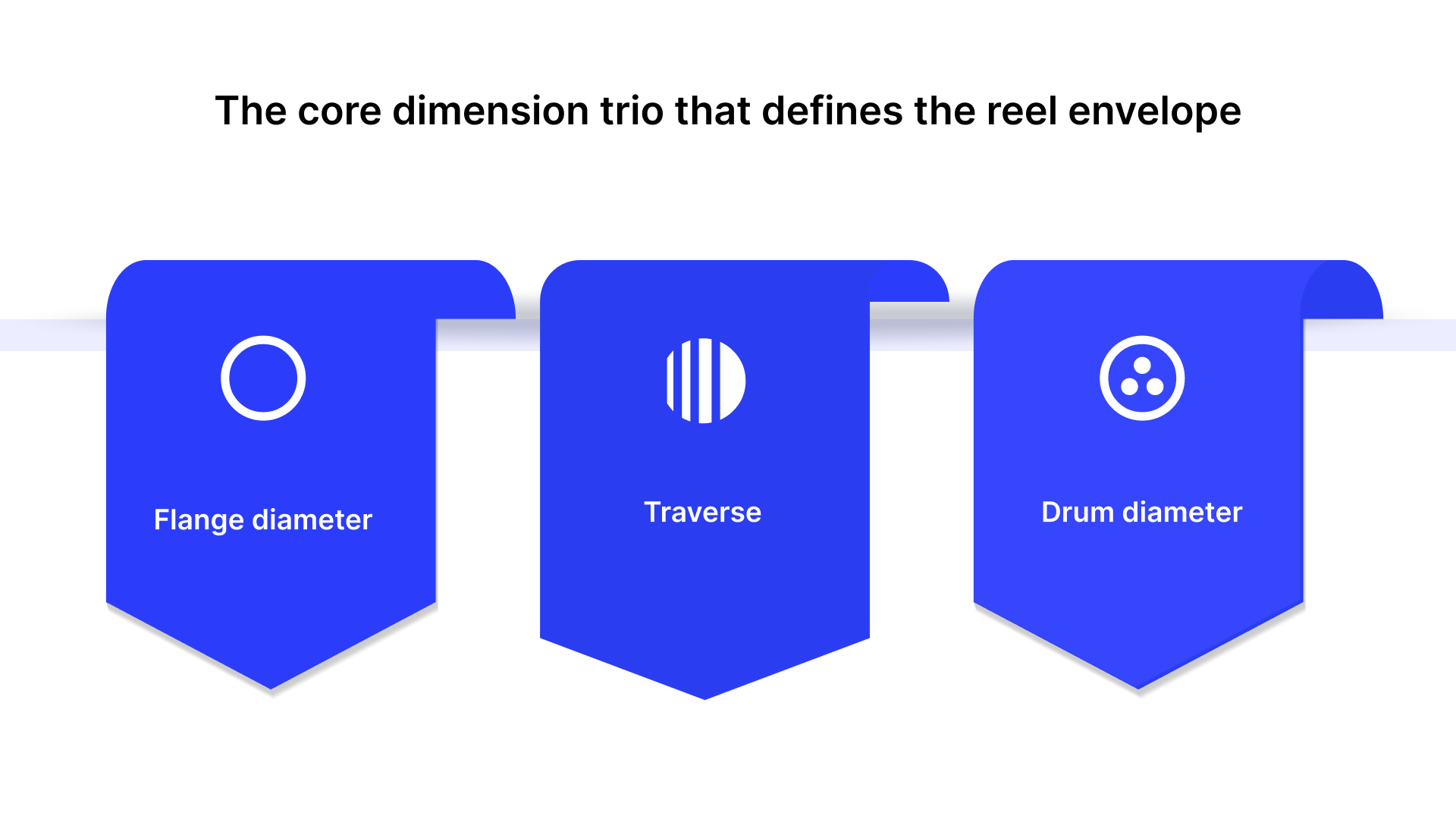
Flange diameter (F)
Sets the outer envelope and influences how the reel handles in storage, on racks, and during transport. It also affects clearance on payoff stands, trailers, and cradles.
Traverse (T)
Defines the usable winding width between flanges. It drives how the product packs and whether the reel matches the payout equipment’s traverse support and guarding.
Drum diameter (D)
Defines the base winding diameter. It is the anchor dimension for how the product sits on the reel and, operationally, is one of the first places a mismatch shows up when reels run differently under load.
The “quiet” dimensions that create most site-level problems
Two reels can share the same F × T × D description and still fail at receiving because of dimensions that are often omitted, assumed, or loosely controlled.
Overall width (W)
Captures the true side-to-side envelope. It affects stand spacing, rack fit, trailer constraints, and handling clearance. When W is not controlled, teams solve the mismatch with spacing changes, improvised supports, or different handling paths.
Clearance-critical geometry (practical envelope constraints)
This is not a single number. It is the set of physical clearances the reel must satisfy in your environment: stand arms, guards, lift paths, cradle pockets, rack uprights, and transport restraints. These are the dimensions that turn into “it fits on paper” failures in the yard.
Interface dimensions that decide whether the reel will run
If the interface is not defined, the reel stops being a standard and becomes a local workaround.
Arbor hole/bore (B)
Controls whether the reel seats properly on the arbor and whether engagement is repeatable across runs and across sites. Small inconsistencies here drive mounting slop, uneven seating, and site-to-site adapter behavior.
Drive holes/drive features (A)
Controls torque transfer and repeatable engagement. This includes hole patterns, keying features, pin engagement details, and any hub-driven geometry that must align with your payoff hardware.
Hub/engagement geometry (as applicable)
Any interface surface or feature that carries load, centers the reel, or transfers drive must be treated as part of the “dimension set,” not a vendor-specific detail.
Capacity parameters that must travel with the dimensions
Dimensions alone do not define whether the reel is appropriate for the program if the rated envelope is not clear.
Rated load/capacity
Defines the intended load envelope that the reel is expected to carry safely and consistently. If capacity is not treated as part of the dimensional definition, reels get substituted that fit physically but fail operationally.
Intended use class (process/reuse vs shipping)
This is the application context that determines how strictly the geometry and interface must hold over time. The label should travel with the size so procurement does not unintentionally mix application classes under the same nominal dimensions.
What to standardize?
At the definition level, separate what must be held stable for compatibility from what can be recorded for reference.
Must match (compatibility drivers): the dimensions and interface features that determine mounting, engagement, clearance, and load envelope in your network (typically the core trio plus W and the full interface set).
Informational (context drivers): markings, identification conventions, and descriptive attributes that help traceability and interpretation but do not define physical compatibility on their own.
A standard only holds when the purchase packet removes interpretation.
The Minimum Spec Packet That Prevents Dimension Drift Across Suppliers
If you want steel reels to be interchangeable across plants, the purchase document has to remove interpretation. The spec packet below is the minimum that keeps quotes comparable and prevents fit problems from surfacing at receiving.
The core way to express the reel
Use one consistent naming line in every PO and RFQ:
Flange × Traverse × Drum, plus overall width
Arbor/bore and drive features (pattern, location, engagement-relevant geometry)
Capacity (rated load) and use class (process/reuse vs shipping, if relevant to your program)
This keeps the “size” from being treated as a label and forces suppliers to acknowledge the interface and load envelope.
Add-on fields that stop misquotes
Add only what changes fit, safety, or repeatability.
Functional tolerances/geometry expectations
Define what must remain true for the reel to mount and run, without turning it into a metrology exercise. Examples: interface must seat without play; drive engagement must be repeatable; flange alignment must not induce mounting instability.
Finish/coating requirements only when they are functional
Specify coating/finish when it affects outdoor dwell, corrosion exposure, brake contact surfaces, or handling wear. If it does not affect function, leave it out.
Marking and identification
Require clear identification tied to your spec packet: size string, supplier ID, date/lot if you track it, and any asset ID scheme used in returns.
Drawing requirement
Do not rely on a catalog page alone. Require a drawing package with minimum views and callouts.
Views required
Face view (flange geometry and any hole patterns)
Side view (traverse, drum OD, overall width)
Interface detail (arbor/bore and drive features shown clearly)
Features that must be dimensioned
Flange OD, drum OD, traverse, overall width
Bore/arbor dimensions and fit-critical geometry
Drive feature pattern/location and engagement-relevant details
Any hub features that affect mounting or handling equipment contact points
Standards/spec reference micro-block
If you reference an internal interchange standard or an industry basis, cite it explicitly and state precedence so there is no argument later.
Precedence statement: The drawing and interface dimensions govern. Catalog shorthand is informational only.
Supplier confirmation requirement: Supplier must confirm that the as-built matches the packet (dimensions + interface) before shipment, not after receiving.
Acceptance language procurement can enforce
Keep acceptance criteria functional so it can be applied at receiving and during audits without specialized equipment.
Functional fit: mounts on the defined interface without forced adaptation
Engagement: drive features engage consistently and do not require improvised correction
Safe handling: can be lifted/handled as intended without instability introduced by geometry issues
Output artifact: Steel Reel Dimension Spec checklist
Use this as a standard block in RFQs/POs:
Size designation: Flange × Traverse × Drum + overall width
Arbor/bore dimensions + fit-critical interface geometry
Drive features: pattern/location/engagement details
Capacity rating + use class (process/reuse vs shipping if applicable)
Drawing required: face + side + interface detail with all fit-critical features dimensioned
Standards reference (if used) + precedence: drawing/interface govern; catalog shorthand informational
Supplier confirmation: as-built conforms to the packet prior to shipment
Acceptance: functional fit + engagement + safe handling (no improvised adapters at receiving)
With the spec packet set, you can validate fit quickly by checking the reel against payoff, handling, and mounting realities.
Fit Checks That Decide Whether the Reel Will Run on Your Equipment
A reel can meet the nominal dimension label and still fail in-service if the mounting interface, engagement features, or clearances do not match how your stands and handling equipment actually work. This section is a fit screen you can run before purchase, before shipment, or at receiving to avoid issues later.
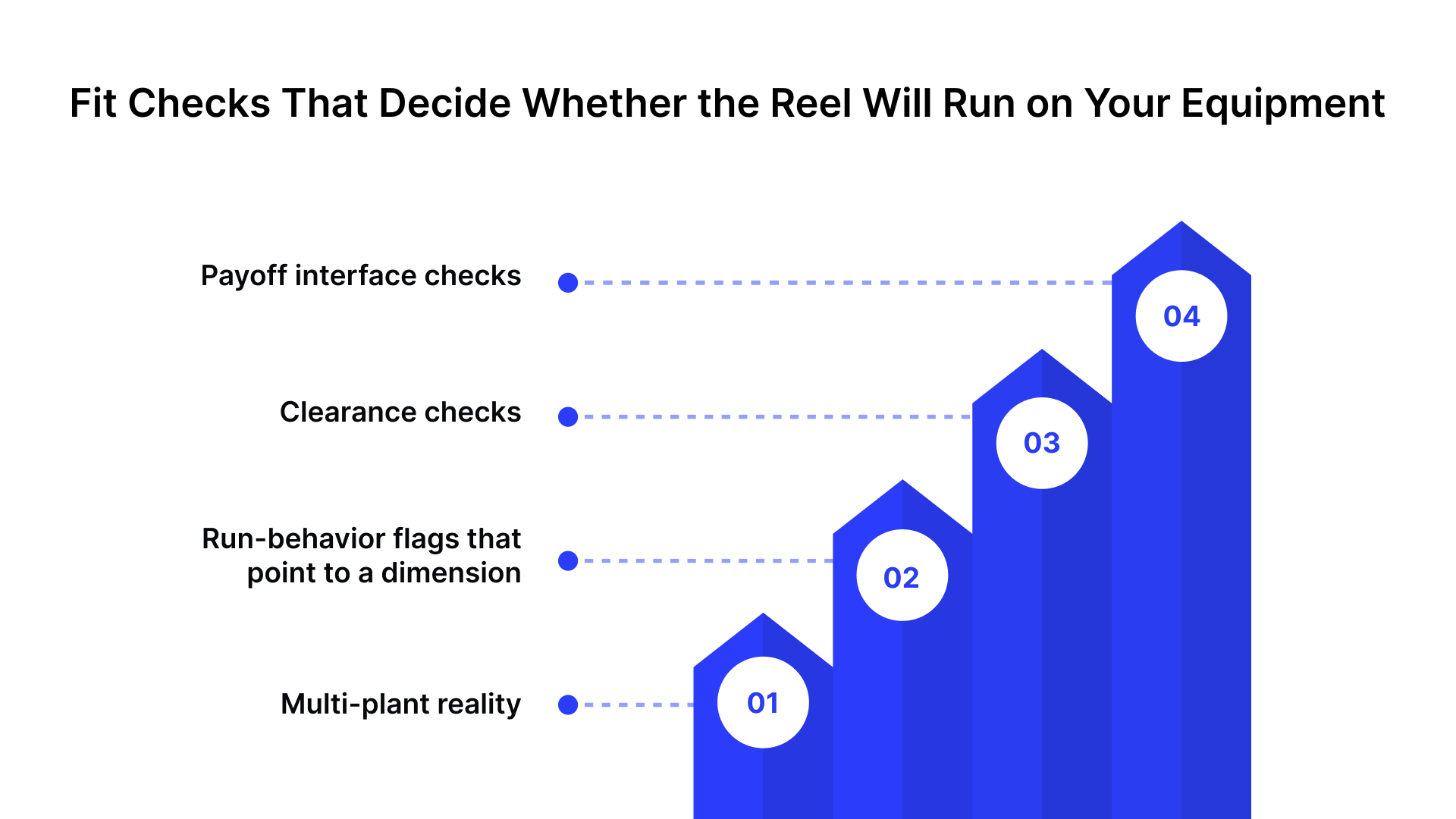
1) Payoff interface checks (mounting + engagement)
Use these checks to confirm the reel can mount cleanly and run without improvised fixes.
Arbor compatibility
Arbor hole size and fit match the stand/arbor standard used at that site.
Seating is stable under light rotation; no rocking, binding, or inconsistent contact.
Engagement depth
The reel seats to the intended datum (hub/face) and achieves full engagement where the system expects it.
No partial seating that changes alignment under load.
Drive feature alignment
Drive holes/features line up with the stand’s drive pins/keys without forcing.
Engagement is repeatable across multiple mount/unmount cycles.
Seating stability: With the reel mounted, check for slop at the interface (lateral play or axial drift) that will show up as run variability.
2) Clearance checks (equipment + handling envelope)
These checks prevent a reel that “fits on paper” from conflicting with stands, lifts, trailers, or staging racks.
Width and stand spacing
Overall width clears the stand uprights, restraints, and any brake assemblies.
The traverse area is not obstructed by stand geometry during payout.
Flange clearance: Flanges, clear guards, brackets, and any fixed points through the full payout path.
Lift/ram clearance
Fork pockets/lift points (or ram handling surfaces) are compatible with the site’s handling method.
The reel can be lifted and set without contacting critical surfaces.
Trailer/cradle constraints: If reels move on cradles or trailers, confirm flange diameter and width clear side rails and tie-down points.
3) Run-behavior flags that point to a dimension or interface mismatch
You are not diagnosing machine dynamics; you are screening for symptoms that typically trace back to geometry or interface issues.
Wobble/runout symptoms at normal operating speed: Visible oscillation or cyclic movement that wasn’t present with known-good reels.
Inconsistent payout behavior: Payout stability changes after mounting, even when line settings are unchanged.
Repeat the intervention to keep the run stable: Operators have to correct behavior that should be stable in the steady state.
Vibration that correlates with the mounting condition: If the symptom changes when re-mounted, treat it as an interface/fit issue first.
4) Multi-plant reality: avoid the “custom adapter trap.”
If plants use different stands/arbors, fit decisions tend to drift into local workarounds. That creates silent non-interchangeability.
Decide whether adapters are allowed at all: If allowed, they must be standardized artifacts, not site-built fixes.
Maintain a controlled adapter list: One part number per interface case, with defined use conditions.
Treat repeated adapter use as a signal: If more than one site needs the same workaround, it’s usually a spec/interface standard issue, not an “ops problem.”
Pass / Fail / Fix checklist
PASS (runs as-is)
Seats fully and repeatably on the arbor/stand
Drive features engage cleanly without forcing
Clears the stand geometry and handling method
No new wobble/runout symptoms at low-speed rotation
FAIL (cannot mount / unsafe / not compatible)
Cannot seat to datum or cannot engage drive features
Interferes with stand, brake, guards, trailer/cradle
Excessive slop or instability at the interface
FIX (runs only with a controlled standard)
Requires an adapter or interface modification that is standardized
Requires a defined clearance adjustment that can be repeated across sites
Requires documented handling method constraints (how it must be lifted/staged)
Once fit is confirmed, the next failures are usually set by the loading envelope: drum diameter, traverse, and capacity choices that protect the cable and prevent under- or over-loading.
Dimension Choices That Protect Cable Integrity and Prevent Loading Failures
A reel can pass every fit check and still fail operationally if drum diameter, traverse, capacity, and the handling envelope are not set around the cable and the way the reel will be used.
Drum diameter is the non-negotiable
Set a minimum drum diameter rule based on the cable’s handling limits. Treat this as a policy decision, not a debate at receiving. If the drum is undersized, you are designing bend stress and payout risk into the program.
What to lock:
A minimum drum diameter requirement tied to the cable family (not a one-off project).
A clear exception path (who approves, what proof is required).
Traverse drives payout behavior and pack stability
Traverse is not just a capacity number. It shapes how the cable lies, how stable the pack stays under movement, and how predictable the payout is under real handling conditions.
What to check:
Whether traverse supports stable layering for your cable type.
Whether payout stability changes as the reel approaches lower fill levels.
Whether traverse choices create edge pressure or packing irregularities that show up as intervention on the line.
Capacity must be treated as two constraints, not one
A reel can “hold the length” and still be wrong operationally if the load case is not controlled.
Separate:
Weight limit (what the reel is rated to carry safely).
Volumetric limit (what actually fits based on drum, traverse, and how the cable packs).
Then document the limiting case. That becomes the standard your plants can enforce without reworking assumptions locally.
Handling method sets practical minimums for flange and width
Your handling method often becomes the hidden sizing constraint. Forks, rams, cradles, and trailers impose clearance and stability requirements that are not obvious in a catalog label.
Lock what matters:
Minimum width and flange geometry that the handling method can lift, support, and secure without edge strikes.
Clearance rules that prevent contact damage during yard moves and transport.
Output: Steel reel sizing workflow teams can execute
Use this as the sizing screen before quoting, ordering, or accepting a reel:
Drum minimum met for this cable family
Traverse supports a stable pack and a predictable payout
The load case is defined (weight-limited or volume-limited) and stays within the rating
Handling method is compatible with flange/width and clearance constraints
With sizing decisions set, standardization becomes an interchangeability question: what may vary safely across suppliers, and what must stay locked to protect fit and run behavior.
Interchangeability Rules for Standardization Across Plants and Suppliers
Standardization fails when “same reel” means “close enough” in one plant and “won’t run” in another. The fix is not more vendor chasing. It’s one interchangeability rule set that procurement can buy into and operations can enforce, so every shipment lands inside a usable envelope.
Lock vs vary: define the program boundary
Start by splitting dimensions into two buckets.
Locked dimensions (must match): These are the dimensions that determine whether the reel mounts, clears, and runs without improvisation. If these drift, you get adapters, rework, and inconsistent acceptance.
Controlled variance (can vary within a range): These dimensions do not affect equipment compatibility when they move slightly, as long as they stay within a defined tolerance band.
This is also where you decide whether you are buying a single standard or accepting site-by-site variations with the cost that comes with them.
Interface lock policy: choose one reality and write it down
Interchangeability lives or dies at the interface.
If arbor size/fit and drive features differ across sites, you can still standardize, but only by standardizing the interface families (e.g., “Plant A standard” vs “Plant B standard”) and preventing cross-shipping between them.
If you want true network interchangeability, arbor + drive geometry becomes non-negotiable. Lock it. Treat deviations as out-of-standard, even if the reel looks “close.”
The goal here is simple: stop paying for downstream adaptation in labor, delay, and risk.
As-built verification triggers: decide when to measure vs when to trust
You do not need to measure everything on every inbound reel. You need triggers that tell you when verification is worth the time.
Use as-built verification when:
You are onboarding a new supplier or a new fabrication lot.
A lane is returning mixed-condition reels or showing unusual fit/run issues.
Operators report new instability, and the cause is not obvious damage.
A reel is repaired/refurbished and re-entering service under a locked interface standard.
Otherwise, rely on markings and documentation, as long as the supplier has confirmed conformance to the spec packet and you have a clean performance record.
Repair vs replace thresholds: protect the standard from drift
Dimension drift is only recoverable when the reel can be returned to the locked envelope.
Repair/restore when the reel can be brought back to locked interface geometry and functional run condition, and the lane’s handling profile won’t erase the work immediately.
Replace/retire when interface features cannot hold repeatable engagement, geometry cannot be brought back inside the locked boundary, or the same out-of-standard condition keeps recurring.
Industrial Steel Reel Dimension Interchangeability Table
Dimension / Feature | Must Lock or Can Vary | Why It Matters (failure mode prevented) | How to Verify (quick method) | Action if Out (reject / repair/rework/quarantine) |
|---|---|---|---|---|
Flange diameter | Controlled variance (within clearance limits) | Prevents clearance conflicts at stands/racks/trailers; avoids handling interference | Tape/OD check vs spec; spot-check against tightest known clearance | Quarantine → rework/replace if it creates clearance failures |
Traverse | Must Lock | Controls winding envelope and interaction with payout behavior | Measure usable flange-to-flange traverse | Quarantine → rework if recoverable; otherwise replace |
Drum diameter | Must Lock | Protects minimum bend requirements and loading integrity | Measure drum OD; compare to the minimum policy | Reject/replace if below minimum; do not run |
Overall width | Must Lock | Prevents stand spacing conflicts and transport cradle issues | Quick width check vs tightest equipment constraint | Quarantine → rework; or route to compatible lane only (if allowed by policy) |
Arbor hole (size + fit) | Must Lock | Drives mounting compatibility; prevents wobble, slop, and unsafe engagement | Gauge/ID check; quick mount trial where feasible | Reject/repair if recoverable; otherwise replace |
Drive holes/features (pattern + engagement) | Must Lock | Prevents payout instability and failed engagement under load | Visual pattern check + template/gauge; confirm engagement depth | Reject/repair; no ad hoc adaptation |
Capacity rating/class mark | Must Lock | Prevents overload and deformation; avoids “fits but fails” outcomes | Verify marking + documentation | Quarantine if unclear; reject if under-rated |
Critical clearances (stand/trailer/rack) | Must Lock (site's tightest constraint) | Stops dock exceptions and emergency rehandling | Clearance check against the tightest known constraint | Quarantine → reroute if permitted; otherwise rework/replace |
Geometry condition indicators (functional) | Must Lock (functional acceptance) | Catches drift that creates runout/instability even when nominal dims look right | Quick seat check + low-speed rotation; visual deformation screen | Quarantine → verify; repair or retire per threshold |
When the fleet is already mixed-condition or dimension drift is suspected, stabilization depends less on rewriting the spec and more on verification plus controlled repair or replacement to bring reels back inside the locked envelope.
Get Dimensions Verified and the Standard Stabilized With New American Reel Co LLC
At this stage, the goal is not another round of internal interpretation. It is to re-establish a dimension baseline that procurement can buy into, operations can accept consistently, and plants can run without adapters and exceptions becoming normal.
What Narco can do when the program needs stabilization
Supply new steel reels built to the dimension standard you lock
When the current fleet has drifted too far to recover cleanly, a reset only works if new units arrive built to the same interface and envelope assumptions across sites. The priority is build-to-spec consistency, not nominal “same size” labeling.
Verify and refurbish steel reels so serviceable units stay in circulation, and out-of-standard units stop re-entering the loop
Mixed-condition fleets fail when geometry is treated as “close enough.” Verification confirms which reels are inside your locked envelope. Refurbishment brings recoverable reels back to that envelope and removes repeat-failure candidates before they create line disruption.
Align interfaces to match mounting and drive realities across your equipment set
If the reel “fits” but engagement varies, performance problems are often driven by interface details. Fabrication or modification work can be used to align arbor/drive features to the payoff and handling configurations you run across plants, so the same reel behaves the same way in the field.
From a decision-grade review with Narco, you should expect these outcomes:
A clear separation between recoverable reels and retire/replace candidates based on functional geometry and interface condition.
A short list of interface requirements that must be held for repeatable mounting and payout across your equipment and sites.
Repair/replace thresholds that match your lane reality, so disposition decisions stop drifting by the plant.
A stabilization plan that supports your standardization effort without reopening the entire spec from scratch.
If you are in consideration mode and want the standard to hold across plants, request a short technical review from Narco focused on dimension verification and a standardization plan. Bring your current size range, interface/mounting details by site, and examples of repeat fit or run issues so the output is actionable.
Conclusion
In an industrial steel reel program, “size” cannot be managed as a catalog label. The standard has to be built around interface requirements and the operating constraints that control fit, clearance, handling method, and load envelope across your network.
Standardization holds when the spec packet removes interpretation and interchangeability is governed consistently across plants, so acceptance decisions do not shift by site, and dimension drift is corrected through verification and controlled repair or replacement rather than local workarounds.
FAQs
Which dimensions should be locked first for multi-plant steel reel standardization?
Lock the interface first: arbor/bore and drive features. Then lock the clearance-critical envelope (overall width and any stand/trailer constraints). After that, lock the core size set (flange, traverse, drum) so “same size” cannot be interpreted differently by the site.
What should the receiving verify when reels come from multiple suppliers?
Verify the features that determine mount and clearance: arbor/bore fit, drive pattern/engagement features, overall width, and any clearance-critical geometry called out in the packet. If those drift, quarantine before the reel touches the payoff line.
Do steel reel dimensions have to match exactly across suppliers?
Only the features tied to interchangeability must be exact: interface and fit-critical dimensions. Everything else should either be locked by policy or explicitly placed under controlled variance with a stated range and a defined action when out.
What is the most common reason a “same size” reel doesn’t fit?
Interface mismatch is the top cause—arbor/bore and drive feature differences. The next most common is overall width and clearance conflicts with stands, guards, brakes, trailers, or cradles.
When should we quarantine a steel reel instead of running it?
Quarantine when mounting engagement is not repeatable, visible deformation affects seating, or operators report new wobble/vibration/drift tied to that reel. The goal is to stop line disruption and prevent questionable units from re-entering circulation.
What should be included in a quote request for steel reels?
Include the full dimension set plus interface requirements (arbor/bore + drive features), capacity/use class, equipment constraints that matter for clearance/handling, and acceptance criteria. That keeps the quote fit-first and prevents pricing a reel that cannot run in your network.