Anyone responsible for moving, storing, or deploying cable knows how much it depends on the reel. A poor reel choice can lead to crushed flanges, tangled cable, unsafe handling, and expensive downtime. It can also shorten cable life and increase replacement costs.
In high-demand industries such as power transmission, construction, and telecommunications, the right reel makes every operation smoother. Steel cable reels stand out because they combine strength, balance, and longevity.
They are built to handle extreme weight, harsh environments, and repeated reuse without losing stability.
However, not all steel reels are the same. Design, dimensions, and configuration affect how they perform under load.
This guide explains how to select the correct steel cable reel for your application. It covers reel types, construction details, and the key specifications that determine performance, reliability, and total cost.
Key Takeaways
Know your cable. Match reel size and rating to cable type, diameter, and length.
Choose strong enough. Select a reel rated at least 10–15% above your total cable weight.
Get the sizing right. Flange and core diameters must fit the cable length and bending radius.
Pick the right style.
Fixed: Everyday heavy use
Collapsible: Space-saving and shipping
Machined: Precision and balance
Match to the environment. Use galvanized or stainless reels for outdoor, marine, or chemical areas.
Plan maintenance early. Reconditioning and repainting extend reel life and prevent downtime.
Think long-term cost. Durable, serviceable reels lower the total cost over the years of reuse.
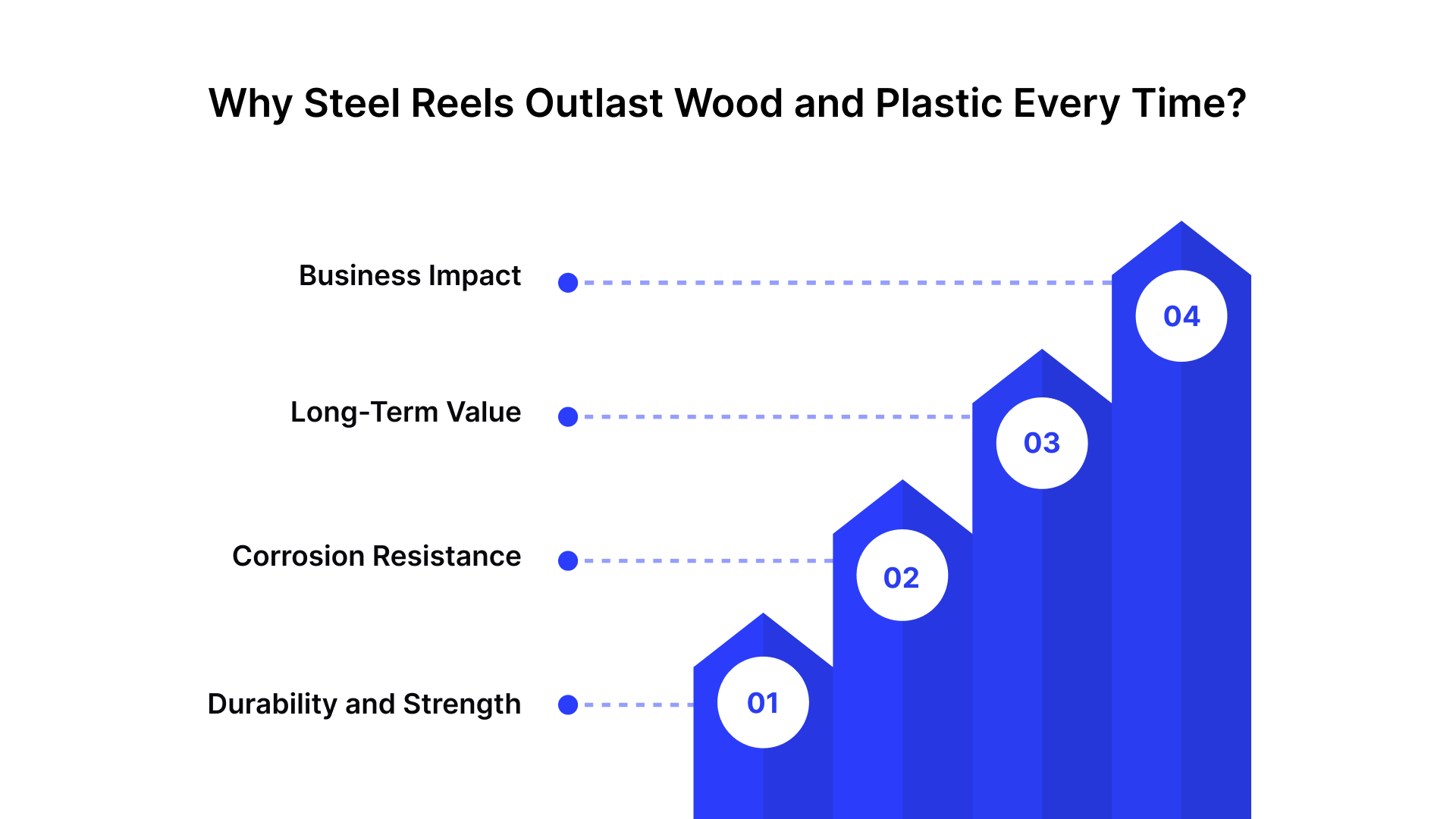
Why Steel Reels Outlast Wood and Plastic Every Time?
Cable reels come in steel, wood, or plastic. Each material performs differently under stress, load, and environmental exposure.
For heavy-duty manufacturing and shipping, steel consistently delivers the most reliable performance.
1. Durability and Strength
Steel reels resist bending, cracking, and torsion. Their rigid construction keeps flanges aligned under tension, ensuring smooth winding and payout. This reliability makes them suitable for continuous manufacturing and heavy cable transport.
2. Corrosion Resistance
Protective coatings such as hot-dip galvanizing, zinc plating, and powder coating keep steel reels functional even in wet or coastal conditions.
Wooden reels degrade with moisture, and plastic reels can warp in high temperatures. Proper coating maintenance allows steel reels to perform consistently for years.
3. Long-Term Value
Though steel reels cost more upfront, their ability to be repaired, repainted, and reused makes them more economical over time.
Reconditioning restores both surface finish and balance, cutting replacement costs while extending service life.
4. Business Impact
Selecting steel over lighter materials supports:
Higher uptime due to fewer reel failures
Improved safety through structural strength
Lower lifecycle cost via reconditioning and reuse
Steel’s durability and recyclability make it the clear choice for facilities prioritizing operational efficiency and reliability.
In demanding plants, this reliability supports consistent output and safe cable management.
The Main Types of Steel Cable Reels (and When to Use Each One)
Selecting the right reel begins with understanding how steel cable reels are built and how their configurations fit different operational needs.
Each type offers distinct advantages in terms of strength, storage, and handling efficiency.
1. Fixed Steel Cable Reels
Fixed steel reels are the most common in cable manufacturing. They are welded or bolted together to create a rigid, non-collapsible structure.
The flanges and core remain permanently joined, which ensures maximum stability during winding, payout, and transport.
Best suited for:
Continuous production lines
High-speed payout systems
Heavy or long cable applications
Advantages:
Strong and stable under load
Minimal vibration during operation
Long lifespan when properly maintained
Fixed steel reels are ideal for facilities where reels are reused frequently, and reconditioning is part of regular maintenance.
2. Collapsible Steel Cable Reels
Collapsible reels are designed for flexibility in transport and storage. Their flanges or barrel sections can fold or detach when the reel is empty, saving space and lowering return freight costs.
Best suited for:
Export operations and long-distance shipping
Cable distributors managing return logistics
Sites with limited storage capacity
Advantages:
Compact storage footprint
Easier bulk transport
Lower shipping cost per unit
Although collapsible models may require more maintenance than fixed ones, they provide significant logistical advantages in high-volume distribution.
3. Machined and Semi-Machined Reels
Steel reels can be either fully or semi-machined, depending on the precision required.
Fully machined reels are dynamically balanced, making them ideal for high-speed operations or multiwire processes.
Semi-machined reels feature machined contact surfaces only, which reduces cost while maintaining smooth cable handling.
Best suited for:
Wire drawing and extrusion lines
Plants requiring precision winding
Balanced payout systems
Machined surfaces prevent vibration and support even winding, reducing strain on both cable and machine.
4. Pressed Flange or Metal Flanged Reels
These reels use pressed or stamped steel flanges attached to a tubular barrel. They are lighter than fully fabricated models and cost-effective for process or shipping applications that still demand strength.
Best suited for:
Medium-duty cable handling
Shipping operations needing reusable reels
Advantages:
Durable under normal process loads
Easier to repair or replace components
Pressed flange reels meet DIN 46395 standards and offer a good balance of strength and affordability.
5. Specialized and Custom Reels
Some applications require custom-built steel reels with enhanced design elements.
Examples include:
Corrugated drums for cable shipping and long-distance transport
Structural drums for heavy conductor or submarine cable storage
Modified flanges for dynamic balancing or integration with automated handling systems
Custom fabrication allows manufacturers like Narco to design reels that meet specific customer drawings, load conditions, and process standards.
Steel reels differ not only by size but by the way they handle stress, movement, and environmental conditions. Understanding these configurations helps you match the right reel to your cable type, workload, and space constraints before reviewing mechanical and environmental specifications.
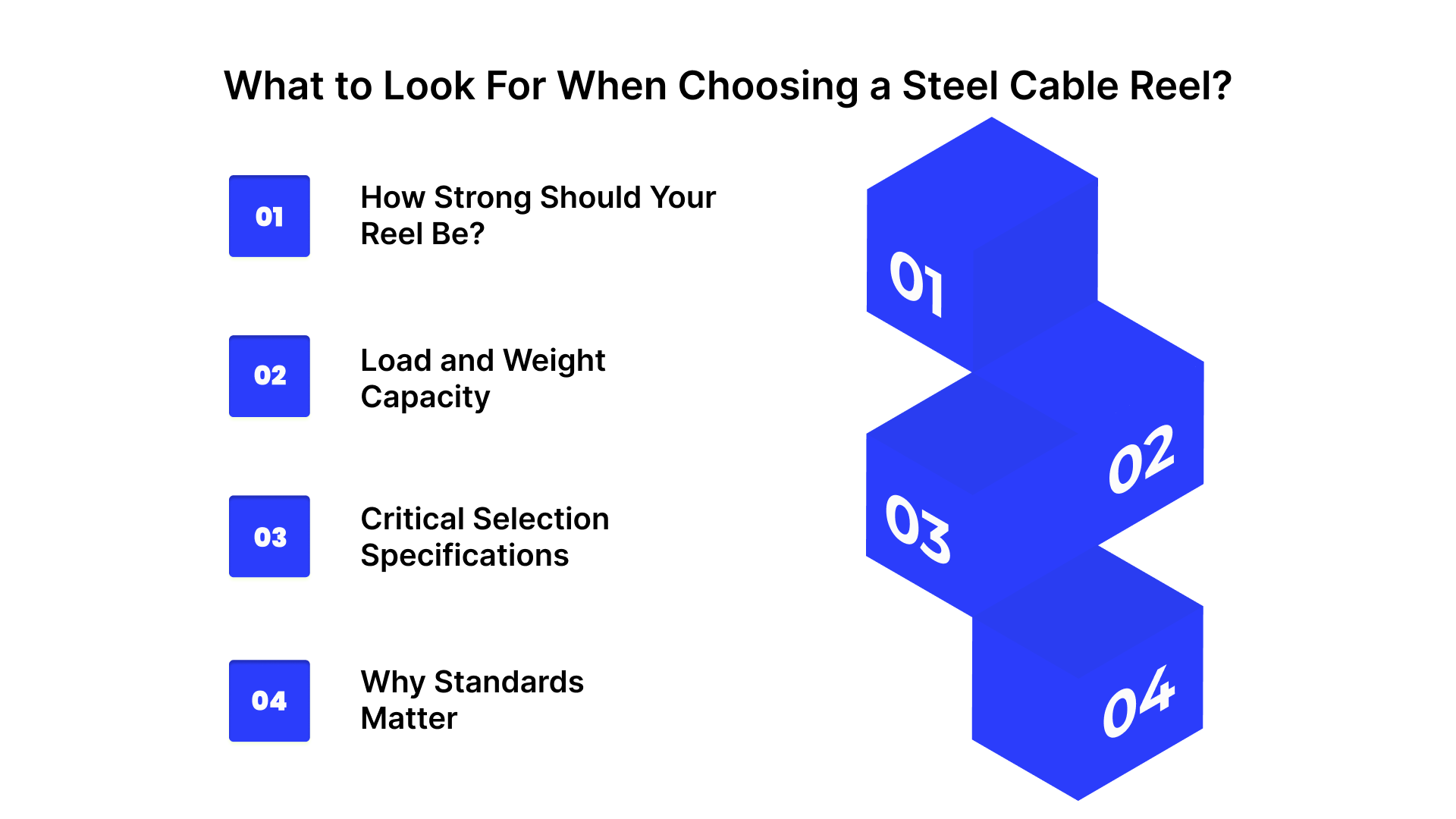
What to Look For When Choosing a Steel Cable Reel?
Choosing the right steel cable reel involves more than size and weight. Each reel’s material grade, mechanical strength, and design features determine how well it performs in your operation.
The following factors help you identify a reel that meets both technical and environmental demands.
1. How Strong Should Your Reel Be?
Steel cable reels are built for mechanical endurance. Their structure resists bending, crushing, and torsion, stresses common in heavy cable manufacturing and transport.
Key mechanical advantages:
Welded or bolted construction for long-term rigidity
Reinforced flanges that prevent warping under tension
Balanced design to reduce vibration during payout
Corrosion resistance is equally important. Reels used outdoors or near coastal and chemical environments require protective coatings such as:
Hot-dip galvanizing for marine and offshore use
Powder coating or epoxy paint for general industrial use
Zinc plating for moderate corrosion protection
Proper surface treatment ensures long service life, even in harsh climates. Narco supplies and reconditions steel reels to maintain protective coatings and balance, extending their operational lifespan.
2. Load and Weight Capacity
The primary advantage of steel over wood or plastic is its ability to carry heavy loads safely. Steel reels handle cables of all diameters and densities without deformation or imbalance.
Capacity advantages include:
Support for cables exceeding several tons in weight
Consistent tension across long cable lengths
Safe high-speed winding and unwinding without structural stress
When comparing materials, steel provides the highest load-to-weight ratio. Wooden reels may splinter or compress, and plastic alternatives can deform under continuous load.
Steel remains stable under temperature changes and vibration, making it ideal for high-volume, repetitive use.
For large-scale operations such as power transmission or subsea cable production, steel reels are the only reliable long-term option.
3. Critical Selection Specifications
Before finalizing a reel, check the key physical specifications that affect its performance.
Specification | Definition | Impact on Selection |
Flange Diameter | The outer circular face of the reel | Determines maximum cable diameter and total winding capacity |
Core Diameter | The central drum section, where cable wraps | Affects the bending radius and cable stress during payout |
Inside Traverse | The distance between flanges | Controls the length of cable that can be stored per layer |
Arbor Hole Size | The inner bore for mounting on machinery | Must match your winding or payout equipment for balance and safety |
Material Thickness | Gauge of steel used for barrels and flanges | Influences strength, weight, and lifespan |
For example, heavy-duty reels may use 11-gauge steel for frames and 14-gauge steel for discs, offering maximum rigidity with manageable weight.
Some premium models also feature 304-grade stainless steel for corrosion protection in marine or offshore environments.
Matching these specifications to your cable type, handling equipment, and environmental conditions ensures that the reel performs safely and efficiently over repeated cycles.
4. Why Standards Matter
Industry standards such as DIN 46395, DIN 46397, and NEMA WC 26 define the dimensional accuracy, balance, and safety limits for steel reels.
Choosing reels that comply with these standards ensures interchangeability, reduces handling risk, and simplifies maintenance planning.
In practice:
DIN 46395 governs pressed or metal flanged reels for bunching and shipping.
DIN 46397 covers fully machined reels for process operations.
NEMA WC 26 outlines U.S. specifications for corrugated and shipping reels.
Using compliant designs helps align your operation with international benchmarks for performance and reliability.
When comparing options, focus on:
Structural integrity and balance
Protective coatings for corrosion resistance
Correct dimensions and gauge for load type
Compatibility with your machinery and environment
Certification under recognized standards
A reel chosen with these factors in mind will deliver safe handling, predictable performance, and longer lifecycle value for your investment.
Modern Features That Make Steel Reels Safer and Smarter
Modern steel cable reels offer more than structural strength. Manufacturers continue to enhance design and usability with features that improve safety, efficiency, and security.
Understanding these advanced options helps you select reels that perform reliably in demanding conditions.
1. Anti-Slip and Safety Enhancements
Safety during reel handling depends on both operator skill and design quality. Anti-slip elements built into modern steel reels help prevent accidents during lifting, movement, or cable payout.
Common safety improvements include:
Anti-slip ribs or surfaces on flange edges to improve grip during manual handling.
Textured or coated lifting points for better traction under gloves or mechanical hooks.
Rounded or rolled edges on steel discs to eliminate sharp corners and reduce cable abrasion.
Precision balancing that minimizes vibration during rotation and high-speed operations.
These features reduce the risk of dropped reels, pinched cables, and impact injuries. They also make equipment easier to maneuver in wet or oily conditions commonly found in industrial plants.
2. Anti-Theft and Security Advantages
Steel reels offer inherent security advantages over wooden or plastic alternatives. Their weight, structural complexity, and recyclability make them less vulnerable to theft from worksites or shipping yards.
Key benefits:
Difficult to dismantle or repurpose, reducing unauthorized resale.
Heavy construction discourages casual removal from job sites.
Built-in identification options such as engraving, stamping, or stenciling for asset tracking.
For construction and temporary installations, secure steel reels help prevent material loss and delays. Narco can mark and stencil each reel with company logos, tare weights, or tracking codes to enhance traceability during multi-site projects.
3. Motorized and Spring-Loaded Systems
Certain steel cable reels come equipped with motorized or spring-driven mechanisms that control retraction and payout. These systems are commonly used in applications that demand precision, consistent tension, or automated retrieval.
Types of mechanisms:
Motorized reels: Use electric or hydraulic motors for controlled cable movement, ideal for long or heavy cable runs.
Spring-loaded reels: Use constant-force springs such as spirator or negator springs to retract cable smoothly without jerking.
Hybrid systems: Combine motor assistance with braking mechanisms for large-scale deployment or industrial automation.
Advantages:
Smooth and controlled retraction, reducing cable stress.
Consistent tension during payout and rewind.
Reduced operator fatigue and manual handling.
These advanced systems enhance productivity in plants and field operations where efficiency and safety must work together.
4. Integration with Handling and Maintenance Systems
Modern steel reels are increasingly designed to integrate with automated handling equipment and predictive maintenance systems. Features such as sensor mounts, lubrication points, and standardized arbor sizes allow easy connection to mechanical payoff or take-up lines.
In larger facilities, integration supports remote monitoring of reel condition, tension load, and operational cycles, reducing unplanned downtime.
Steel cable reels that include these functional upgrades provide measurable value. They improve worker safety, protect cable integrity, and optimize handling efficiency, all essential factors for high-output industrial operations.
Choosing the Right Reel for Your Work Environment
Not every steel cable reel faces the same operating challenges. The right choice depends on where and how the reel will be used. Environmental exposure, handling frequency, and compliance requirements all play a key role in long-term performance and safety.
1. Harsh and Extreme Environments
Steel cable reels are widely used in industries where exposure to saltwater, chemicals, or extreme weather can quickly degrade other materials.
Common sectors include:
Offshore energy and subsea cable installation
Oil and gas exploration
Mining and heavy construction
Marine and dockside operations
Key performance needs in these settings:
Corrosion protection: Hot-dip galvanizing or marine-grade coatings prevent rust and maintain surface integrity.
Temperature tolerance: Steel retains strength in both sub-zero and high-heat conditions.
Structural rigidity: Prevents deformation under constant load or high-torque winding.
For long-distance or subsea cable deployment, operators often rely on fully machined or stainless steel drums to maintain precision and durability throughout the process.
2. Indoor Manufacturing vs Outdoor Deployment
The environment directly influences which reel configuration performs best.
Indoor manufacturing applications:
Prioritize precision and balance for controlled winding and unwinding.
Benefit from semi-machined or fully machined reels that minimize vibration.
Often paired with automated machinery requiring tight arbor tolerances.
Outdoor deployment and storage:
Require weather-resistant finishes to withstand sunlight, rain, and temperature changes.
Use fixed steel drums or corrugated shipping reels with reinforced flanges for impact resistance.
Need stable stacking and lifting points to handle rough terrain.
When operations involve both indoor processing and outdoor delivery, selecting reels that can transition between environments reduces handling costs and damage risk.
3. Safety and Compliance Requirements
Safety standards guide every aspect of reel design and use. Selecting reels that meet recognized industrial codes ensures both operational safety and legal compliance.
Relevant standards include:
DIN 46395 and 46397: Define construction, balancing, and dimensional tolerances for steel reels.
NEMA WC 26: Governs corrugated and shipping reel design and performance in North America.
OSHA 1910.176 (Handling Material): Provides guidelines for lifting, securing, and stacking reels safely in workplaces.
Compliance benefits:
Ensures consistent quality and interchangeability.
Reduces workplace accidents and handling injuries.
Simplifies training for operators and maintenance teams.
Manufacturers such as Narco design and refurbish steel reels to meet these standards, helping clients maintain both operational efficiency and regulatory alignment.
4. Environmental and Operational Fit
Selecting the right reel is about matching mechanical design to the environment. Use this quick reference to align your application with the best reel type:
Environment | Recommended Reel Type | Key Features |
Offshore / Marine | Stainless or galvanized steel reel | Corrosion resistance, sealed coatings |
Mining / Heavy Construction | Fixed or corrugated drum | High load strength, impact resistance |
Manufacturing Plant | Fully machined or semi-machined reel | Precision balance, smooth payout |
Outdoor Storage / Shipping | Collapsible or pressed flange reel | Space saving, transport efficiency |
High-Temperature Zone | Heat-resistant coated steel reel | Maintains structure under thermal stress |
Matching the environment to the correct reel ensures operational reliability and extends the life of both the reel and cable.
Steel cable reels prove their value across diverse industries because they combine adaptability with durability. Selecting one based on environmental and safety requirements minimizes risk and ensures continuous, efficient cable handling.
How Steel Reels Support a More Sustainable Operation?
Sustainability is becoming a critical factor in industrial procurement. Manufacturers and plant operators are expected to choose equipment that supports efficiency while minimizing environmental impact.

Steel cable reels meet both objectives because they are designed for reuse, repair, and recyclability.
1. Long Lifecycle and Reusability
Steel reels are built for decades of use. Unlike wood or plastic reels that are often discarded after a few cycles, steel reels can be repaired, rebalanced, and recoated repeatedly. This long lifecycle reduces waste generation and lowers the need for new material production.
Key advantages:
Reconditioning extends lifespan and reduces landfill waste.
Structural integrity remains consistent after repair.
Suitable for multiple industrial applications without material fatigue.
Narco’s reconditioning services, including flange straightening, blasting, and repainting, help customers reuse reels safely, supporting sustainability through lifecycle management.
2. Recyclability and Material Recovery
Steel retains its quality even after recycling. When a reel reaches the end of its service life, the material can be fully recovered and reused.
This circular process minimizes landfill waste and lowers overall carbon emissions from manufacturing.
3. Sustainable Fabrication
Modern production methods now include:
Low-emission or water-based coating systems
Recycling of scrap metal from machining
Optimized logistics through collapsible reel designs to cut transport emissions
These practices make steel reels a sustainable long-term choice for companies balancing performance with environmental responsibility.
For clients seeking efficient, eco-conscious solutions, Narco’s steel reel repair, reconditioning, and storage programs help extend product life and reduce environmental impact.
How to Pick the Best Steel Cable Reel for Your Needs?
Selecting the correct steel cable reel starts with understanding your cable’s requirements and your operational conditions.
The process is straightforward when approached methodically. Follow these five steps to ensure the best match for performance, safety, and cost efficiency.
Step 1: Define Cable Type and Usage
Start with the cable itself. Every specification that follows depends on its physical and operational characteristics.
Check the following:
Cable type (power, data, fiber, or hybrid)
Diameter and length
Weight per meter and total load
Application (manufacturing, shipping, installation, or storage)
Different cable types exert different mechanical stresses on the reel. For example, armored cables need stronger flanges, while flexible data cables require smoother, machined surfaces to prevent twisting.
Step 2: Calculate Load and Capacity Requirements
Determine the total reel load by adding the cable’s weight and the reel’s own weight. The reel must maintain structural integrity during winding, lifting, and transport.
Tip: Always select a reel rated at least 10–15% above the expected maximum load. This margin allows for safe operation under variable tension and handling conditions.
Step 3: Match Flange, Core, and Traverse Dimensions
These dimensions define how much cable your reel can safely hold and how smoothly it releases during payout.
Dimension | What It Controls | Why It Matters |
Flange Diameter | Overall reel height | Determines maximum cable diameter and capacity |
Core Diameter | Inner winding surface | Affects the bending radius and cable life |
Inside Traverse | Space between flanges | Controls total cable length per layer |
For longer or heavier cables, larger flange diameters with thicker cores reduce strain and allow smoother winding. If reel-to-machine compatibility is critical, confirm the arbor hole size matches your handling equipment.
Step 4: Choose Configuration and Material
The right reel configuration depends on your workflow, space, and handling methods.
Operational Need | Recommended Configuration |
Frequent reuse or production line winding | Fixed or fully machined reel |
Export and return logistics | Collapsible or pressed flange reel |
Harsh or outdoor environment | Galvanized or stainless steel reel |
Automated payout or rewinding | Motorized or spring-driven reel |
Also consider material grade and thickness. Heavy-duty reels often use 11-gauge steel frames and 14-gauge discs for maximum load capacity and balance.
Step 5: Evaluate Environmental and Safety Factors
Think about where and how the reel will operate.
For indoor plants: Precision and balance matter most. For outdoor or field work: Corrosion resistance, coating quality, and secure lifting points are priorities.
Always check compliance with DIN 46395, DIN 46397, and NEMA WC 26 for build accuracy and handling safety. Proper standards compliance ensures long-term reliability and interoperability across your operations.
Step 6: Review Lifecycle Support and Maintenance
The most cost-effective reel is one that lasts the longest. Choose suppliers who can provide:
Reconditioning and repair services
Coating renewal and repainting
Balancing and dynamic testing
Storage and inventory support
Narco offers all these on demand, helping clients maintain optimal performance and safety while reducing replacement costs.
Step 7: Confirm Total Cost of Ownership
Finally, evaluate the full cost, not just the purchase price.
Factor in:
Expected lifespan
Reconditioning frequency
Transport and storage efficiency
Environmental compliance
A properly selected and maintained steel cable reel can last decades, lowering your total cost of ownership through safe reuse and consistent performance.
Following these steps ensures that each reel in your operation meets technical requirements, safety standards, and lifecycle goals. It turns a real selection from a cost-driven purchase into a reliable long-term investment.
Conclusion
Choosing the right steel cable reel is not about size alone. It is about matching design, strength, and features to your specific application.
When done correctly, the result is safer handling, smoother payout, and lower maintenance costs throughout the reel’s life.
A strong selection process starts with the right supplier. Narco helps wire and cable manufacturers choose, maintain, and manage their steel reels through:
Steel Reel Repair and Reconditioning
Custom Fabrication and Refurbishment
Steel Reel Warehousing and Storage
Steel Reel Inventory Support
These on-demand services help you maintain operational continuity while reducing material waste and replacement costs.
If you want guidance on selecting or reconditioning steel cable reels for your operation, reach out to the team today.
Contact Narco to discuss a reel solution tailored to your production, storage, or logistics needs.
FAQs
1. What are the main factors to consider when selecting a steel cable reel?
Check cable weight, diameter, and application. Match these to the reel flange, core size, and load rating. Consider the environment, coating type, and compliance with DIN or NEMA standards for safe, long-term use.
2. Why are steel reels better than wooden or plastic reels for heavy cables?
Steel reels offer higher load strength, longer lifespan, and resistance to impact and weather. They can be repaired, rebalanced, and reused many times, unlike wooden or plastic reels that degrade quickly under industrial stress.
3. What coating options protect steel cable reels from corrosion?
Common coatings include hot-dip galvanizing, zinc plating, and powder coating. Each provides different levels of moisture and salt resistance, especially for offshore or outdoor cable handling.
4. How do I know the right flange and core diameter for my cable?
Use your cable’s diameter and bending radius to determine core size. The flange must accommodate the full cable length without overfilling. Always follow DIN or manufacturer tables for accurate sizing.
5. When should a steel cable reel be reconditioned or replaced?
Recondition reels after visible flange distortion, surface rust, or balance issues. Replace only when the structural core or welds are beyond repair. Regular reconditioning, offered by Narco, helps extend reel life safely.