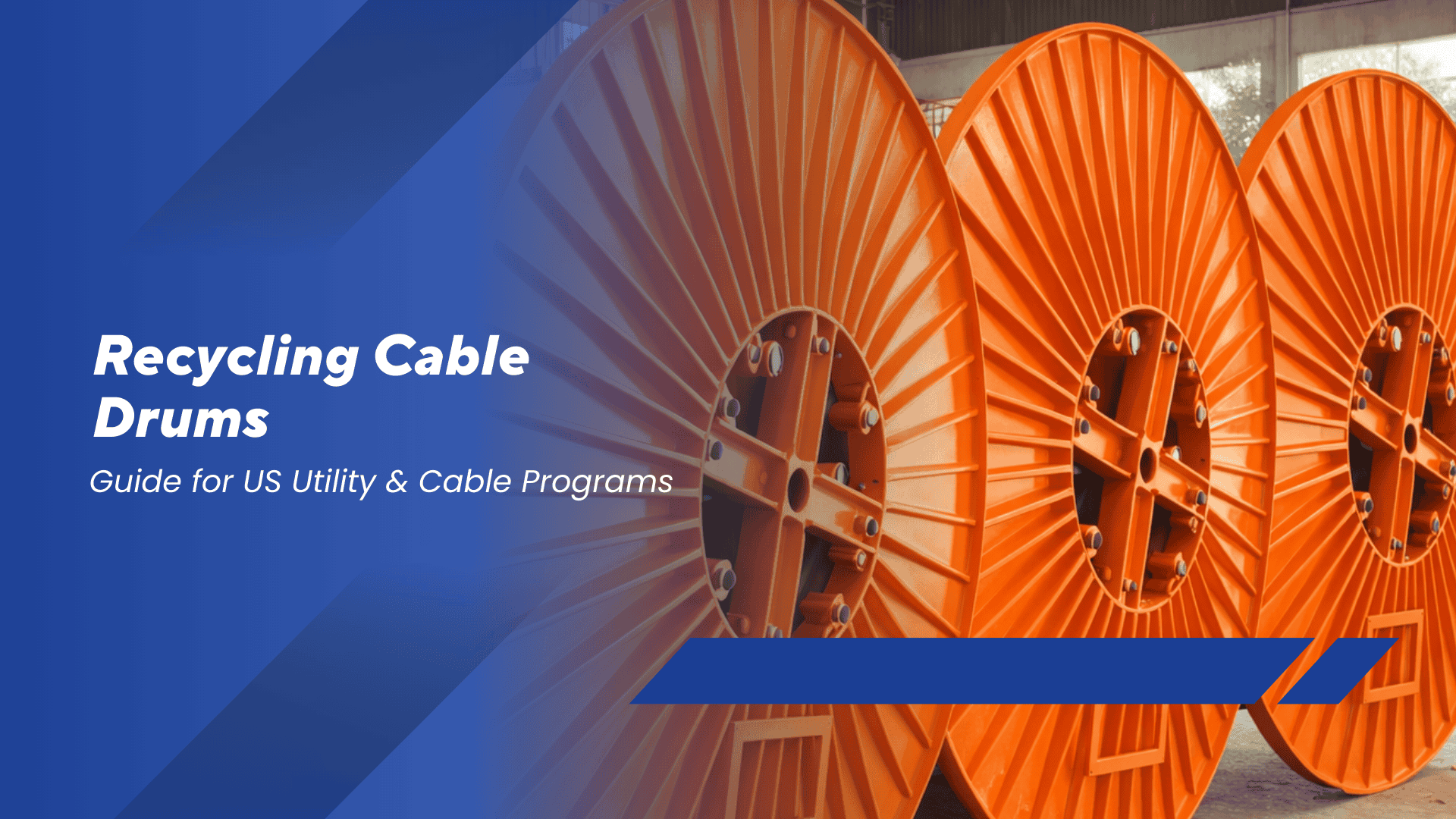
“Recycling cable drums” is a routing problem, not a sustainability label. In multi-site cable and utility programs, the same drum can be a returnable asset, a recoverable unit, a redeploy candidate, scrap value, or regulated disposal depending on ownership terms, material/treatment status, interface family, and condition.
Key Takeaways
Recycling cable drums works when you route every unit through the same three gates: ownership, treatment/material, and condition + interface family.
Capture a five-field drum passport before pickup so credits, custody, and lane assignment don’t drift by site.
Run reverse logistics with lane staging + custody controls so recoverables aren’t damaged into scrap and returnables don’t disappear.
Use a simple “total exposure” model to choose recover vs replace, with deposits/credits and downtime risk treated as real constraints.
When mixed-condition returns persist, stabilize with verification + disciplined recovery lanes instead of local workarounds.
How To Route Cable Drums Without Defaulting To Scrap
In multi-site programs, drums default to scrap when “recycling” is treated as a yard decision. Routing needs one method that every site follows so ownership, compliance, and recoverability are handled the same way.
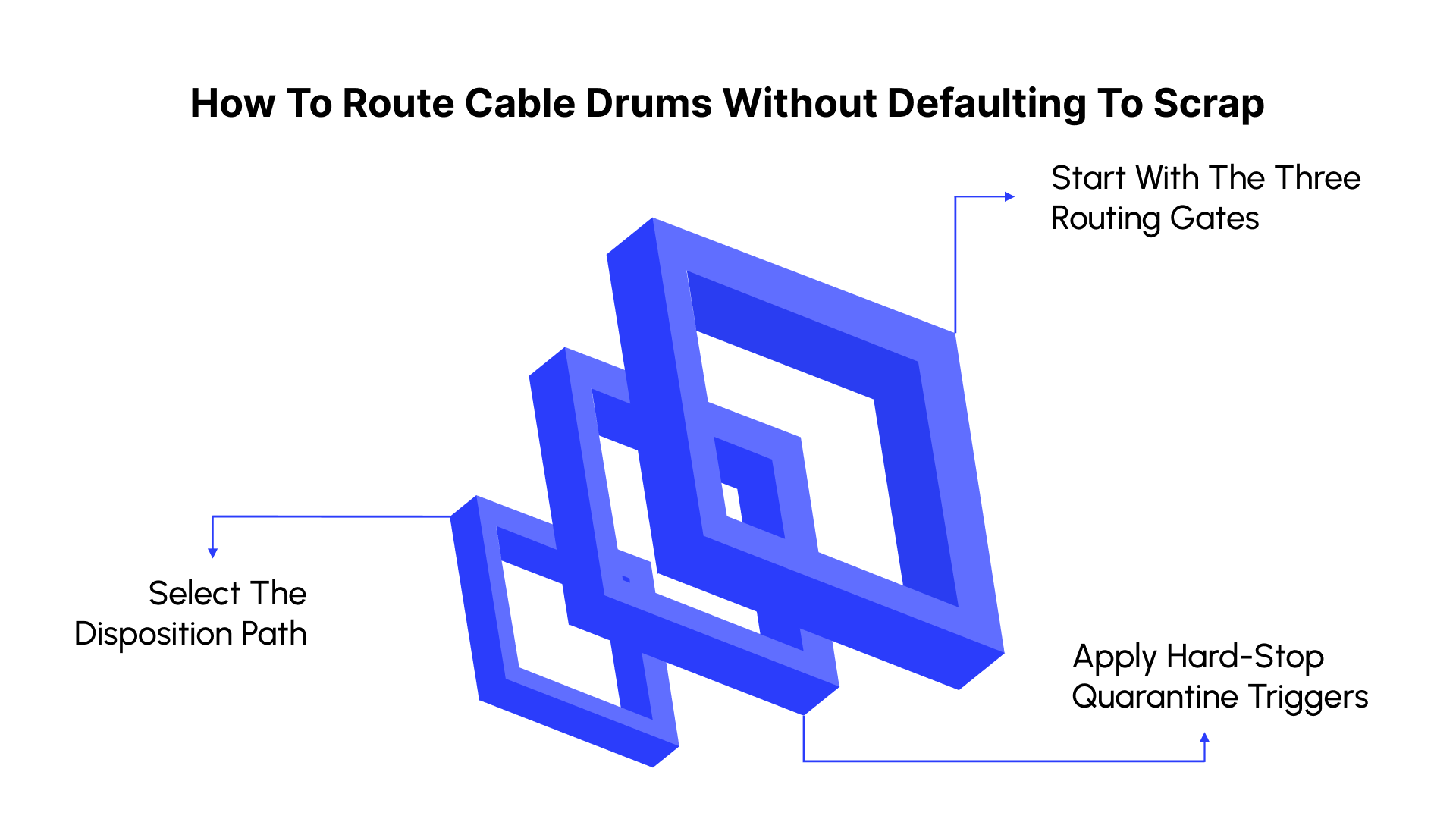
Step 1: Start With The Three Routing Gates
Use these gates in order. They cut out most debate fast.
Gate 1: Ownership/return terms
Decide if the unit is returnable/deposit-controlled or owned. Returnables do not enter scrap lanes without confirmed release.
Gate 2: Material/treatment status
Separate steel vs wood, then confirm treatment status where it matters. Unknown treatment is not a routing decision—it’s a hold.
Gate 3: Condition + interface family
Judge recoverability by interface integrity and lane compatibility (mounting/drive family), not cosmetics.
Step 2: Apply Hard-Stop Quarantine Triggers
Quarantine is a routing output. It prevents expensive “wrong moves.”
Unknown wood treatment or missing/unclear markings
Missing/illegible ID where ownership could be disputed
Deformed interface / failed engagement evidence (bore/drive/hardware)
Repeat operational failures tied to the unit (mounting inconsistency, run instability, repeated interventions)
Step 3: Select The Disposition Path
After the gates and any quarantines, pick one of the five outcomes below.
Cable Drum Disposition Decision Table
Path | Use when | Prereqs | Main risk if wrong | Proof/documentation |
|---|---|---|---|---|
Return-to-owner | Deposit/return terms apply; credits depend on returns | Ownership/ref confirmed; return lane defined | Scrapping a returnable asset → direct cost exposure + supplier disruption | Return terms ref; program ID; return authorization |
Refurbish/repair | Interface/geometry is recoverable; replacement lead time or downtime risk matters | Interface family known; condition supports recovery | Recovering a non-recoverable unit → repeat failures + rework | Condition grade; interface photos; failure notes (if any) |
Redeploy/rehome | Serviceable unit fits another lane/site with the same interface family | Receiving lane compatibility confirmed | Cross-shipping incompatibility → dock exceptions + adapters | Interface family tag; compatibility confirmation; internal move approval |
Material recovery | Not recoverable or not returnable, but material value recovery is allowed | Material/treatment confirmed; ownership release (if needed) | Restricted/unknown material shipped → compliance + disposal cost | Material ID/treatment status; release record; recycler receipt |
Disposal | True end-of-life, restricted material, or not suitable for recycling/reuse | Disposal path confirmed; documentation ready | Improper disposal → liability + audit failure | Disposal authorization; treatment notes; chain-of-custody record |
Governance Rule That Prevents Drift
Route by outcome class using defined triggers.
Block “scrap to clear the yard” unless the path is Material recovery or Disposal, and the prereqs are satisfied.
Where Routing Decisions Live
Assign a single routing owner pair: Operations + Procurement.
Define one exception approver for quarantine releases, scrap approvals on returnables, and non-standard redeploys.
Routing holds only when every drum carries the same minimum identifiers and condition evidence before pickup.
The Minimum “Drum Passport” Data That Prevents Misroutes
The passport is not a checklist for its own sake. It is the minimum information required to (a) prove ownership, (b) assign the correct disposition lane, and (c) avoid shipping a problem drum into someone else’s yard.
What The Passport Must Capture
Keep it to five fields. Everything else is optional and lane-specific.
Ownership / Returnability
Deposit/return program reference (or PO/contract hook) + a clear Returnable Do Not Scrap flag when applicable.
Material + Treatment Status
Steel vs wood vs composite, plus treatment stamp if present. If treatment is unknown, record Unknown Treatment → Quarantine.
Size + Interface Family
A practical size family (diameter/width class) and the interface/mounting family that determines where it can run. If the interface family is unknown, flag for verification rather than guessing.
Recoverability Grade
One-line condition grade tied to recoverability: interface integrity, deformation present/absent, and missing hardware noted.
Evidence Pack
Three photos only: ID/marking, interface close-up, damage (only if present). No photo set, no exception move.
What To Avoid Adding
Detailed compliance language in the passport itself (keep compliance as routing rules, not data entry).
Narrative notes. Use controlled flags and one short comment only when a hard stop is triggered.
“Nice to have” dimensions. The passport is for routing and custody, not engineering.
Output Artifact
A single mobile form that generates a Passport ID and links it to the pickup manifest. One template across all sites.
With the routing gates and passport standardized, the program lives or dies on controlled staging, segregation, and chain-of-custody across sites.
Reverse Logistics Controls For Multi-Site Drum Recycling Programs
Reverse logistics is where good routing breaks down: lanes get mixed, returnables disappear, and recoverables get damaged into scrap. These controls keep custody and condition intact across sites.
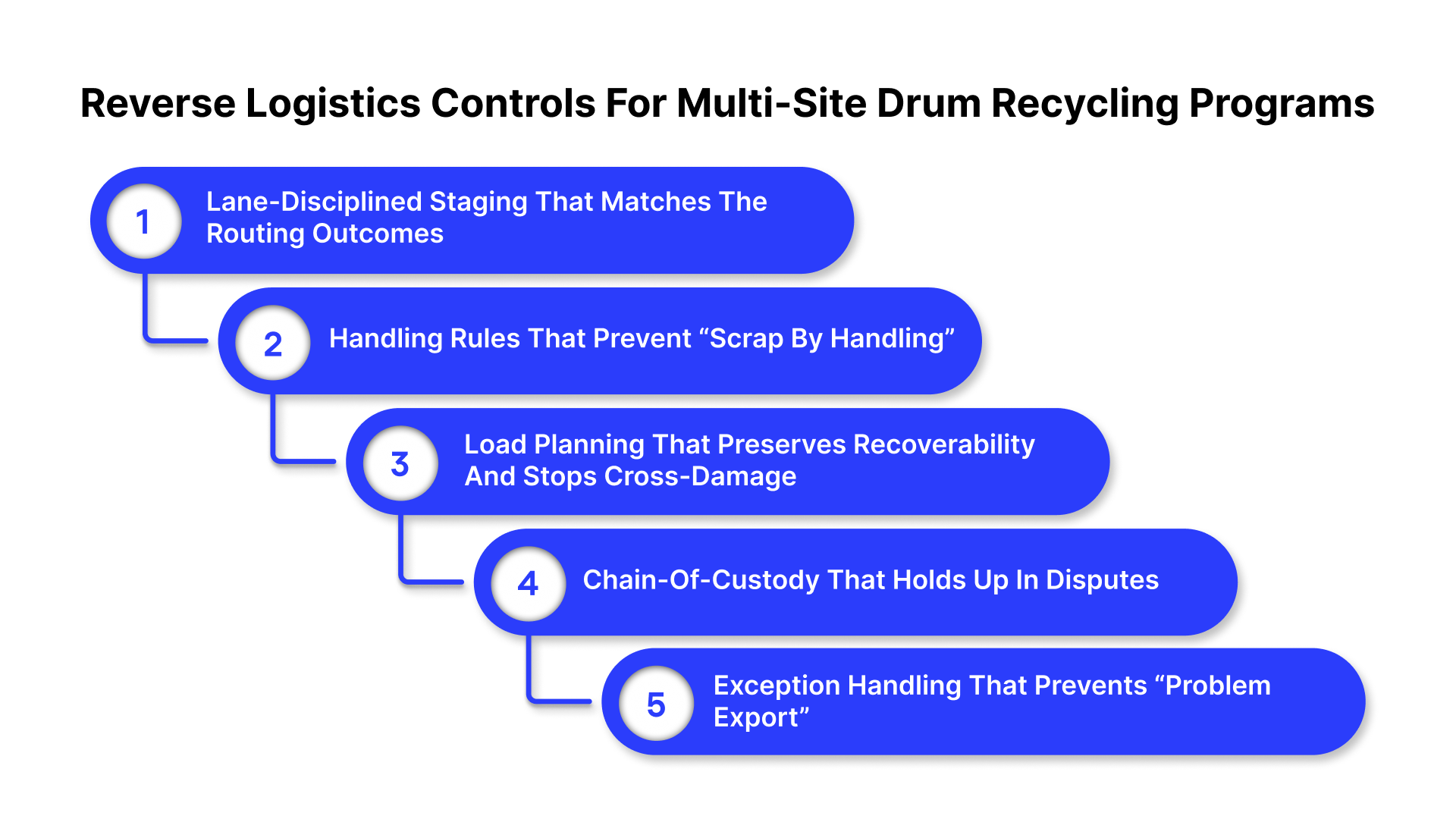
Control 1: Lane-Disciplined Staging That Matches The Routing Outcomes
Create physical lanes that mirror the five disposition paths so units do not get re-sorted by convenience at pickup time.
Protect returnables as controlled assets (segregated, secured, and clearly tagged) so they do not get swept into scrap loads during yard cleanup.
Run quarantine as a real holding lane with restricted access and a visible “no-move without release” rule so unknown treatment/ownership/interface cases do not travel.
Control 2: Handling Rules That Prevent “Scrap By Handling”
Standardize lift and contact points by drum type so pickups do not introduce damage that later gets blamed on the condition.
Set stacking and securement limits that avoid flange crush, edge damage, and shifting loads.
Control loose hardware by requiring either removal + bag/tag or a documented “missing hardware” condition downgrade before loading.
Control 3: Load Planning That Preserves Recoverability And Stops Cross-Damage
Avoid mixed-condition loads where distorted or end-of-life units can damage recoverables in transit.
Keep like-with-like loads wherever possible (same disposition lane per load, or at least hard-separated zones on the truck).
Stabilize the load for transport so units do not roll, slide, or rack against each other—especially for refurbish/redeploy candidates where interface integrity matters.
Control 4: Chain-Of-Custody That Holds Up In Disputes
Manifest discipline at pickup: count by lane, record Passport IDs, and capture exceptions at the moment of handoff.
Seal the load and document custody transfer so discrepancies are tied to a known point in the chain.
Receipt confirmation with a short discrepancy window: receiving confirms counts and exception status quickly, while investigation is still possible.
Control 5: Exception Handling That Prevents “Problem Export”
Define “stop-move” conditions at staging (quarantine units stay in place until released).
Define “ship-permitted-with-controls” conditions for known scrap/material recovery loads so they move with full documentation and do not contaminate other lanes.
Use a single exception code set across sites so every discrepancy has a consistent reason trail (damage-in-transit, missing unit, wrong lane, unknown treatment, ownership hold).
Minimum Program Reporting That Prevents Drift
Keep reporting tight and operational. Track only what prevents repeat failures:
Lane volumes and closure rate (return / refurbish / redeploy / material recovery / disposal)
Cycle time by lane (pickup-to-close)
Discrepancy rate (manifest vs receipt; missing units; wrong-lane arrivals)
Quarantine share and release time (unknowns that slow the system)
Shrink/loss rate (unaccounted units; uncredited scrap; returnables not returned)
With execution controlled, the remaining decision is economic when recovery is worth it versus when replacement or material recovery is the better program outcome, given deposits/credits and downtime exposure.
The Economics Model To Choose: Recycle vs Recover vs Replace
By now, you’ve already controlled routing and execution. Economics is the final filter: which outcome reduces total cost without increasing downtime risk or losing return credits.
The 3-Part Model Leadership Can Approve
1) Treat ownership as a hard constraint
If the drum is returnable or deposit-controlled, “scrap value” is usually the wrong lens. The default is return unless you have a documented release. This one rule prevents the most expensive failure mode: scrapping an asset you do not truly own.
2) Compare recovery vs replacement using “total exposure,” not unit cost
Don’t over-model. Use one comparison:
Recovery exposure = verification + repair/refurb + extra handling/touches + risk of repeat exceptions
Replacement exposure = purchase cost + lead-time risk + downtime/schedule impact
If recovery lowers total exposure and restores stable performance, it wins. If it only reduces spend on paper but increases rework and line risk, it loses.
3) Use material recovery when reliability is not salvageable
Scrap/material recovery is the right call when the unit is not realistically recoverable, or when the same unit keeps returning as an exception. The goal is to stop paying “hidden taxes” in re-handling, re-verification, and downtime.
What “Wins” Looks Like In Practice
Recover when verification supports a stable outcome, and lead time/downtime risk makes replacement expensive.
Replace when you need to reset the standard or the recovery cost is close to replacement with no reliability gain.
Material recovery when the unit is a repeat failure candidate or would consume multiple touches with low confidence of closure.
When mixed-condition inventory or interface drift already exists, stabilization depends on verification and controlled recovery execution, not more debate over routing.
Note: many programs use “cable drums” as the umbrella term, but steel reels are often the recoverable asset class where reconditioning changes total cost.
Stabilize Drum Recovery And Disposition With New American Reel Co LLC
When routing, passports, and reverse logistics are in place, the remaining failures usually come from units re-entering circulation with interface damage, drifted geometry, or inconsistent run behavior.
Narco’s core value is getting steel reels back to repeatable service condition through reconditioning and repair work that targets the failure points that create site exceptions.
Where Narco Helps In A Drum Recovery Program
Reconditioning and Repair of Steel Wire Reels/Bobbins to recover usable units instead of treating “mixed condition” as automatic scrap.
Interface and engagement restoration work when the failure mode is mounting/drive related, including repairs to drive pin holes, arbor tubes, and even changing arbor hole size when that is the practical fix.
Stability-focused services that reduce repeat run issues after recovery, including straightening/press work and dynamic balancing.
Finish and identification work that supports re-entry discipline (blasting/painting and stenciling, where used as an operational control).
If you’re seeing repeat exceptions across sites, request a short technical review with Narco focused on recoverability screening and repair scope for your highest-volume drum families so fewer units cycle back into the yard as “problems” again.
Conclusion
“Recycling cable drums” works when the program treats disposition as an operating system: routing is standardized, the drum passport is captured before pickup, and reverse logistics stays controlled across sites so ownership, recoverability, and documentation do not drift by yard.
When drift is already present, mixed-condition returns, interface inconsistencies, or repeated exceptions, the fastest way back to a stable standard is verification and disciplined recovery lanes that bring units back into a usable envelope or remove them cleanly, rather than letting local workarounds quietly become the process.
FAQs
Can wooden cable drums be recycled?
Sometimes. It depends on treatment/contamination status and what local recyclers accept. If treatment is unknown, route the drum to quarantine until verified.
Is it better to recycle steel reels or refurbish them?
Refurbish when interface engagement and functional geometry can be restored, and lead time/downtime risk is meaningful. Use material recovery when the unit is not recoverable, or repeat failures keep returning.
Who owns cable drums, and can we scrap them?
Ownership is set by return terms and deposit programs. Scrapping returnables can create direct cost exposure and disruption, so confirm ownership before disposition.
What should be on a cable drum pickup manifest?
Passport ID, ownership/return reference, material/treatment flag, size + interface family, recoverability grade, and linked photos. Keep it auditable and consistent across sites.
How do we prevent mixed-condition drums from circulating?
Separate lanes, quarantine unknowns, require verification before re-entry, and tie every move to a chain-of-custody so exceptions don’t become the process.
What causes “recycling” programs to fail in multi-site operations?
Unclear ownership, unknown treatment/material status, uncontrolled staging/pickups, and no verification gate for recovered units. The result is shrinkage, misroutes, and repeated failures.