Industrial cable drums are core material-handling assets across wire, cable, rope, and tubing operations. They directly affect winding efficiency, transport safety, installation speed, and damage-related scrap rates across manufacturing and infrastructure projects.
For industrial clusters in Ohio, Georgia, South Carolina, and Tennessee, selecting the right drum type impacts throughput KPIs, logistics costs, and field performance. Cable weight, length, duty cycle, and environmental exposure all influence drum choice.
Understanding the varieties of cable drums available helps procurement teams, plant engineers, and project managers align drum design with cable specifications, handling equipment, and lifecycle cost targets.
This article breaks down industrial cable drum types, their applications, features, and performance tradeoffs, with a focus on real operating conditions across power, telecom, construction, steel, rope, and tubing industries.
Key Takeaways
Wooden drums preserve bend radius and insulation integrity for medium-voltage and telecom cables during regional transport under moderate load.
Plywood drums are best suited for one-way export shipments of fiber and low-voltage cables where return logistics are eliminated.
Plastic drums work only for small-gauge wire, synthetic rope, and flexible tubing in controlled environments with low heat and stacking loads.
Steel drums are essential for extrusion, twisting, and continuous-duty payoff lines where high torque and tension stability are required.
Steel drums deliver lower lifecycle cost in heavy-cable and infrastructure projects by reducing flange failure, downtime, and scrap.
What Is the Purpose of an Industrial Cable Reel in Manufacturing and Installation?
Industrial cable reels are designed to store, transport, and use cables, hoses, and ropes efficiently while protecting them from damage. They also improve operational speed and material handling.
Key purposes of industrial cable reels include:
Damage Prevention: Protects conductor insulation, rope integrity, and tubing geometry during storage, transport, and field installation.
Efficient Application: Supports controlled payout, reducing installation time and minimizing labor fatigue in manufacturing and construction projects.
Operational Safety: Maintains stable cable handling, lowering ergonomic risk and avoiding accidents during high-load or repetitive tasks.
Throughput Optimization: Enables predictable and continuous cable feeding for power transmission, telecom rollout, and tubing production lines.
Material Cost Control: Reduces scrap, rework, and replacement costs by preserving cable and rope quality throughout the supply chain.
These benefits are especially critical for industries in Ohio, Georgia, South Carolina, and Tennessee, where uptime, safety, and cost efficiency are key KPIs.
Next, we’ll explore the types of industrial cable drums and their applications.
4 Major Types of Industrial Cable Drums and Their Applications
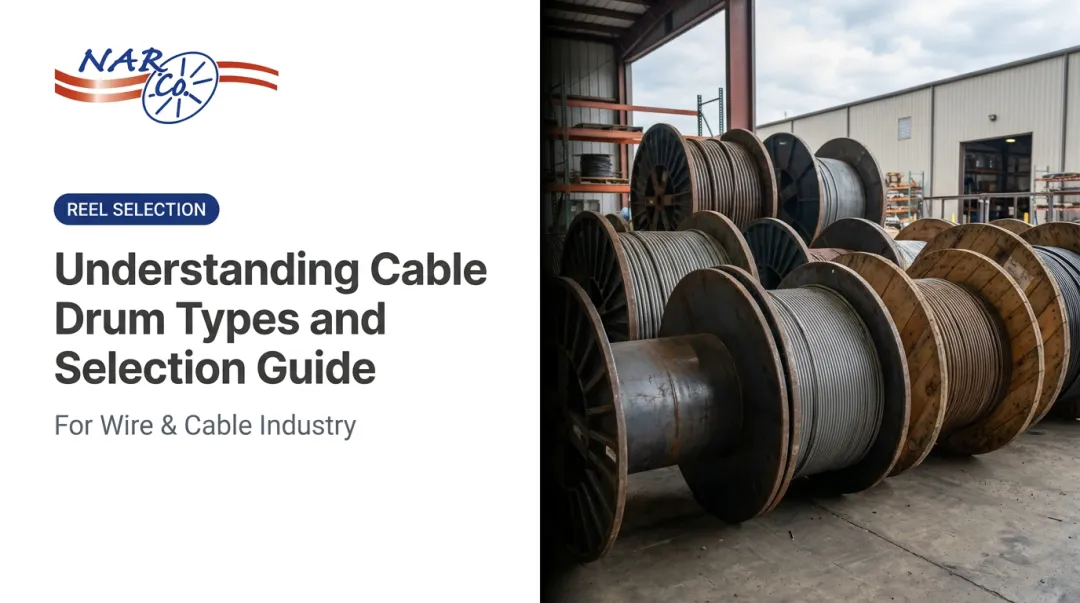
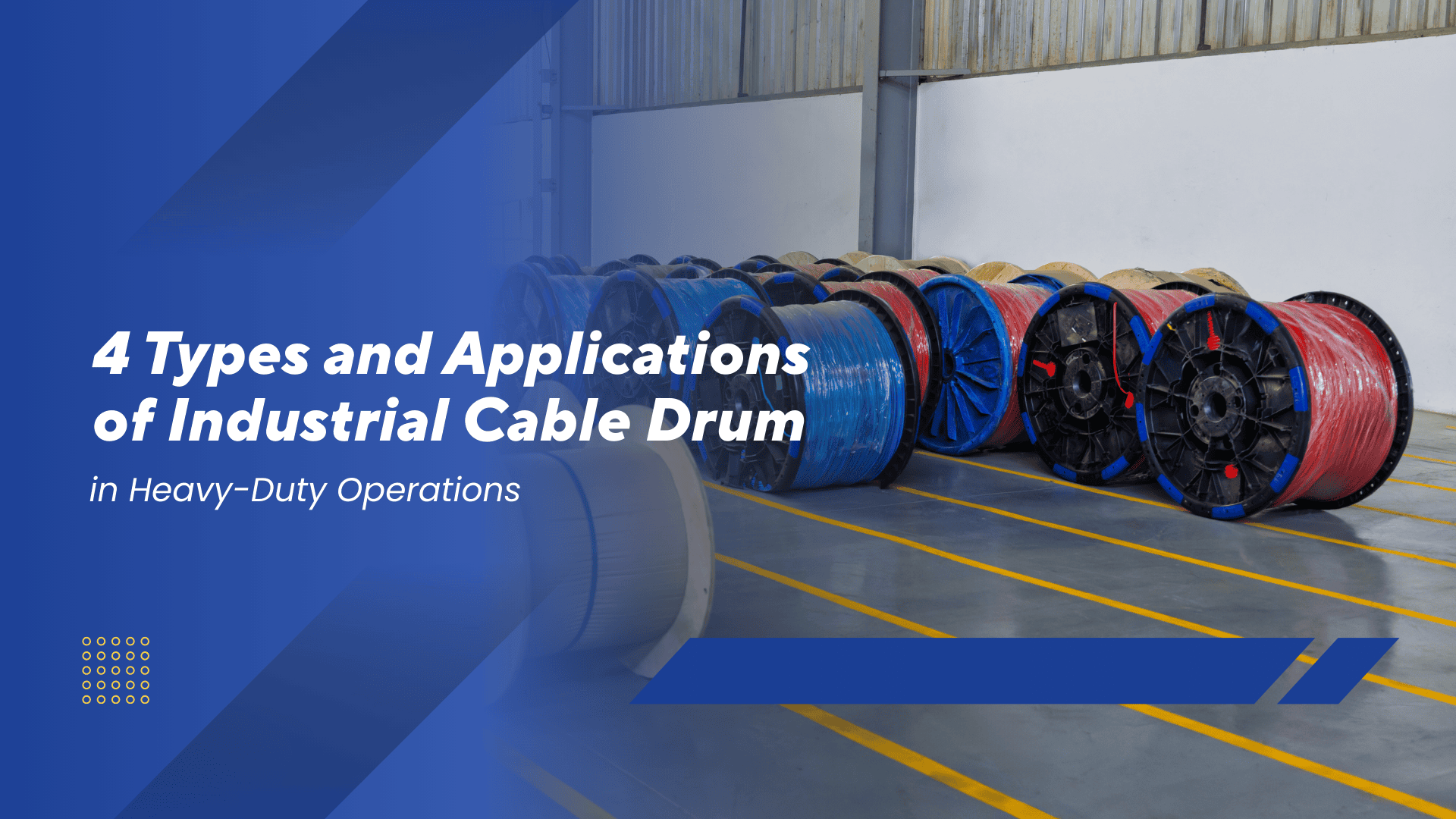
Industrial cable drums are engineered in multiple forms to support different load capacities, environments, and duty cycles. Selecting the right type ensures efficient handling, reduced damage, and consistent performance across manufacturing and field operations.
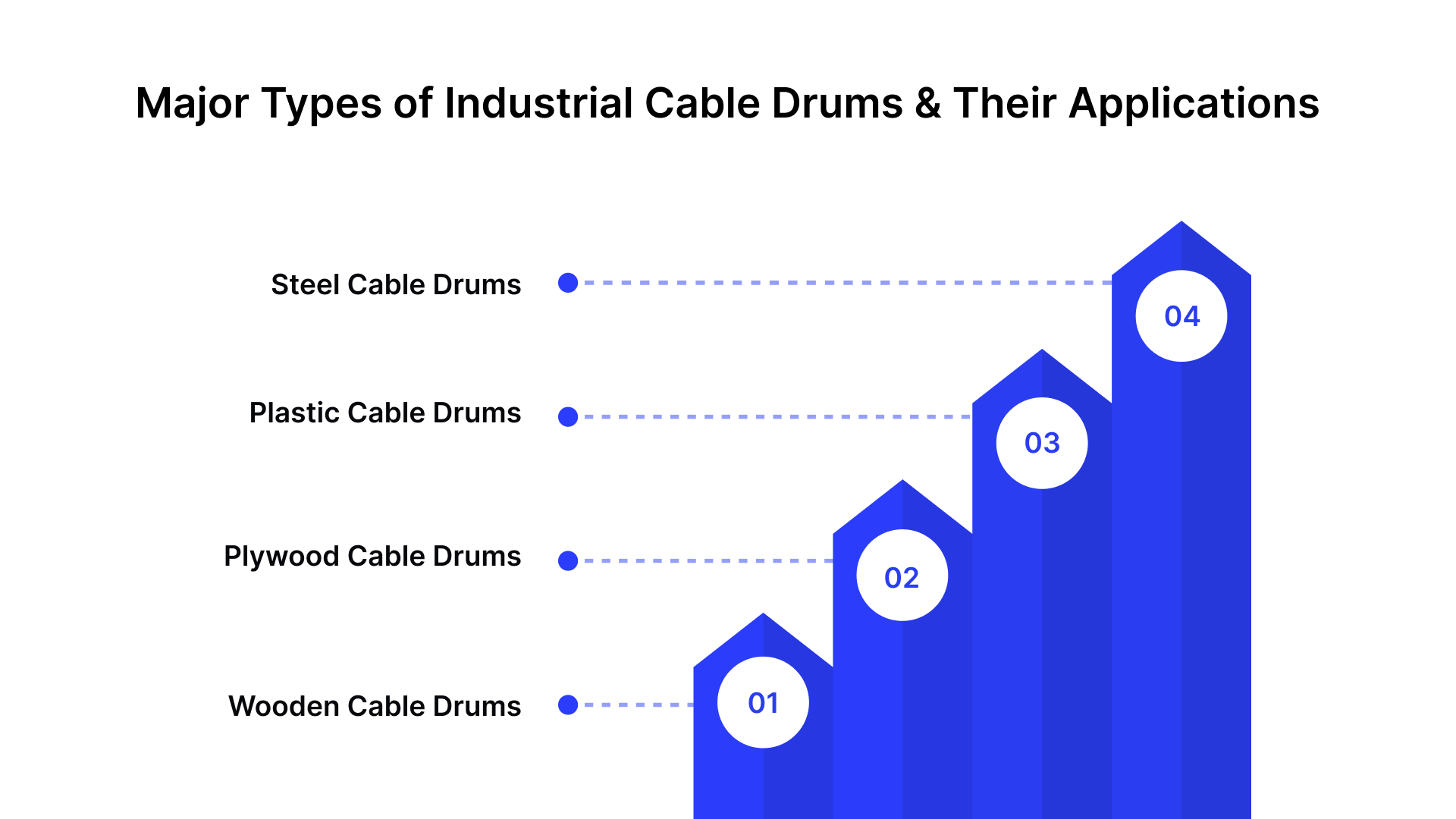
Wooden Cable Drums
Wooden cable drums are widely used across industrial cable handling due to their balance of strength, weight, and cost efficiency. Manufacturers source the wood from sustainably managed forests, enabling compliance with ISPM-15 export standards. These drums support both single-use and multi-use workflows across cable, telecom, rope, and tubing operations. Among the varieties of cable drums, wooden drums remain the most flexible option for moderate-load industrial applications.
Key Characteristics
Material Composition: Constructed from solid or engineered wood designed to handle moderate static and shifting cable loads.
Weight-to-Strength Ratio: Lighter than steel drums, enabling easier manual handling and lower freight costs.
ISPM-15 Compliance: Heat-treated wood supports international shipping without additional packaging constraints.
Cost Profile: Lower upfront cost compared to steel drums, supporting cost-sensitive production and distribution models.
Major Industrial Applications
Wire & Cable Manufacturing: Used for medium-voltage power cables, control cables, and copper conductors during production and regional distribution.
Telecommunications & Data Cable Manufacturing: Supports fiber optic and hybrid data cables where bend radius control and lightweight handling are critical.
Construction Materials & Infrastructure: Enables staging and installation of electrical cables on commercial and industrial job sites.
Rope Manufacturing: Suitable for natural and synthetic ropes requiring controlled winding without excessive drum weight.
Tubing Products: Handles flexible plastic and light-gauge metal tubing during storage and transport.
Operational Advantages for Industrial Buyers
Logistics Efficiency: Reduced drum weight lowers handling time and fuel costs across Ohio, Georgia, South Carolina, and Tennessee supply routes.
Production Flexibility: Supports fast changeovers between cable sizes and batch runs without specialized handling equipment.
Lower Scrap Risk: Properly sized wooden drums maintain cable geometry, reducing deformation and insulation damage.
Limitations to Consider
Load Capacity Constraints: Not suitable for very heavy cables or high-tension retrieval applications.
Environmental Sensitivity: Prolonged exposure to moisture or harsh outdoor conditions can reduce service life.
Reuse Variability: Lifecycle depends on handling practices, load limits, and storage conditions.
Plywood Cable Drums
Plywood cable drums are designed for lightweight, disposable, and short-cycle industrial applications. They are commonly used when logistics efficiency and low unit cost outweigh long-term reuse requirements. Plywood drums are favored for export shipments and rapid installation scenarios. Their simple construction supports predictable performance in controlled handling environments.
Key Characteristics
Flange Construction: Manufactured from layered plywood panels that provide adequate strength with minimal material weight.
Core Material Flexibility: Core sections may be wood, board, aluminum, or plastic, depending on cable type and load requirements.
Lightweight Design: Easy to lift, move, and stage manually, reducing labor dependency on material-handling equipment.
Disposable Use Model: Optimized for single-use or limited reuse without refurbishment.
Major Industrial Applications
Telecommunications & Data Cable Manufacturing: Used for optical fiber, LAN cables, and low-voltage data lines requiring controlled bend radius during installation.
Wire & Cable Manufacturing: Supports installation of wires and small-gauge conductors for short production runs or project-based deliveries.
Construction Materials & Infrastructure: Enables quick cable placement on job sites where drum return logistics are impractical.
Tubing Products: Handles thin-wall plastic tubing and flexible conduits with minimal structural demand.
Operational Advantages for Industrial Buyers
Lower Freight Costs: Reduced drum weight improves pallet density and lowers per-shipment transportation expenses.
Faster Installation Cycles: Simplified handling reduces staging time at manufacturing plants and construction sites.
Export-Friendly Packaging: Works well for one-way shipments without requiring return programs.
Limitations to Consider
Restricted Load Capacity: Not suitable for heavy power cables, steel wire ropes, or high-tension winding operations.
Limited Environmental Resistance: Performance degrades under prolonged outdoor exposure or rough handling.
Short Service Life: Not designed for repeated industrial reuse.
Plastic Cable Drums
Plastic cable drums are engineered for small to medium-duty applications requiring corrosion resistance and low maintenance. They are commonly used in controlled environments where lightweight handling and cleanliness matter. Within the varieties of cable drums, plastic drums serve niche use cases rather than heavy industrial loads.
Material selection directly influences durability, cost, and environmental compatibility.
Key Characteristics
Material Composition: Manufactured from PVC or engineered plastics selected based on load, environment, and reuse requirements.
Corrosion Resistance: Immune to rust, moisture, and many chemicals, making them suitable for indoor and semi-outdoor use.
Lightweight Structure: Easy to transport manually, reducing dependence on forklifts or cranes.
Recyclability: Many modern plastic drums use water-based PVC and support recycling initiatives.
Major Industrial Applications
Rope Manufacturing: Used for synthetic ropes, hawsers, and textile bands requiring smooth winding surfaces.
Wire & Cable Manufacturing: Supports small-gauge wires, control cables, and low-voltage conductors.
Tubing Products: Handles flexible plastic hoses and light tubing without surface abrasion.
Telecommunications Support Operations: Used for patch cables and short-run data cable applications.
Operational Advantages for Industrial Buyers
Low Maintenance Overhead: No painting, treatment, or corrosion control required during storage or reuse.
Clean Handling: Suitable for environments where contamination control is important.
Reduced Injury Risk: Lighter weight lowers manual handling strain during staging and installation.
Limitations to Consider
Limited Load Capacity: Not suitable for heavy power cables, armored conductors, or steel wire ropes.
Thermal Sensitivity: Performance may degrade under high temperatures common in metal processing plants.
Lower Structural Rigidity: Deformation risk increases under stacked storage or uneven loading.
When extrusion, twisting, or lay-up lines suffer from vibration, uneven winding, or cable deformation, Narco addresses the root cause by supplying steel drums for extrusion and drum twisting and fully machined steel reels built to DIN 46397. For wire & cable manufacturers, rope producers, and tubing operations, these balanced drums are engineered to handle high torque, continuous duty cycles, and precise tension control.
Steel Cable Drums
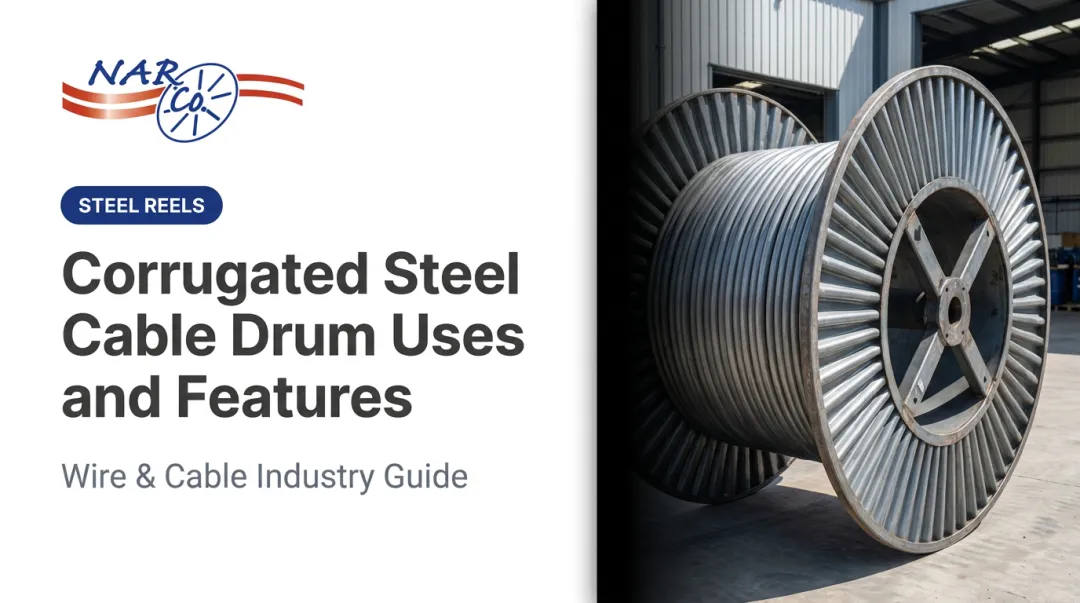
Steel cable drums are engineered for high-load, high-duty industrial environments where durability and control are non-negotiable. They are purpose-built to withstand extreme tension, heavy cable weights, and harsh operating conditions.
Key Characteristics
Material Construction: Fabricated from high-grade steel to maintain dimensional stability under heavy static and changing loads.
Load-Bearing Capacity: Supports long cable lengths, thick conductors, and steel wire ropes without flange deformation.
Environmental Resistance: Performs reliably in outdoor, abrasive, and high-impact environments common to construction and mining.
Reusability: Designed for repeated winding, transport, and installation across multi-year project lifecycles.
Major Industrial Applications
Electrical & Power Transmission Equipment Manufacturing: Used for high-voltage power cables, grounding conductors, and substation connections.
Construction Materials & Infrastructure: Supports controlled payout of heavy cables on large commercial and infrastructure projects.
Metal & Steel Processing: Handles steel wire, reinforced conductors, and heavy tubing products during production and staging.
Rope Manufacturing: Essential for winding steel wire ropes used in cranes, elevators, and hauling systems.
Operational Advantages for Industrial Buyers
High Duty-Cycle Performance: Maintains structural integrity across continuous payout and retrieval operations.
Improved Safety Metrics: Reduces sudden cable release and uncontrolled tension during heavy-load handling.
Lifecycle Cost Efficiency: A higher upfront cost is offset by reduced replacement frequency and lower failure rates.
Limitations to Consider
Higher Initial Investment: Steel drums cost more than wooden or plastic alternatives.
Weight and Handling Needs: Requires forklifts, cranes, or payoff systems for safe handling.
Logistics Planning: Heavier drums increase freight planning complexity.
Next, we’ll evaluate which design features determine performance, safety, and lifecycle cost in heavy-duty operations.
6 Key Features to Consider When Choosing a Cable Drum for Heavy-Duty Industrial Operations
In wire, cable, rope, and tubing operations, cable drum selection directly impacts payout stability, scrap rates, uptime, and cost per kilometer or ton produced. These features must be evaluated against real production and lifecycle KPIs.
Load Rating vs. Static Weight: Drums must withstand winding torque, braking forces, and transport shock loads to prevent flange deflection, layer collapse, and unplanned downtime in HV cable and steel rope handling.
Core and Barrel Size vs. Minimum Bend Radius (MBR): Undersized cores distort conductors, compress insulation, and cause micro-cracking or tubing ovality, increasing installation failures and electrical performance risk.
Flange Stiffness and Geometry: Proper flange diameter and radial stiffness preserve layer integrity under tension, reducing telescoping, edge damage, and unstable payout on extrusion and rewinding lines.
Material Selection by Duty Cycle: Steel supports multi-ton and outdoor use, wood balances cost and mid-load needs, and plastic prevents corrosion and contamination in lighter, controlled environments.
Machining, Balance, and Rotation Quality: Machined balanced drums minimize vibration, bearing wear, and speed variation, enabling higher RPMs and tighter quality tolerances.
Handling Interface and Reuse Economics: Correct arbor sizing, lifting points, and repairability lower changeover time, handling risk, and cost per reuse cycle across long-term programs.
With core features set, application-specific demands drive how those features deliver results.
5 Industry-Specific Applications of Cable Drums Across Heavy-Duty Industries
Cable drums are load-bearing, quality-critical assets that directly influence install speed, failure rates, and lifecycle cost. Each industry applies drum types to manage risk and throughput.
Construction and Infrastructure Projects: Steel and reinforced wooden drums handle LV/MV power and grounding cables in rough terrain, where flange stiffness and shock resistance reduce crush damage and site delays.
Electrical and Power Transmission: Precision-machined steel and engineered plastic drums ensure controlled payout for MV/HV conductors, lowering insulation damage, joint failures, and rework rates.
Telecommunications and Data Networks: Lightweight plastic and stable wooden drums protect fiber and data cables by maintaining bend radius and smooth rotation, preventing microbending and signal loss.
Wire, Rope, and Tubing Manufacturing: Balanced process drums with controlled arbor interfaces stabilize line speeds, prevent telescoping, and maintain winding accuracy at high RPMs.
Metal and Heavy Industrial Operations: Steel drums dominate armored cable and wire rope handling, where thermal exposure, mechanical abuse, and repeated reuse demand maximum structural integrity and repairability.
After matching drums to use cases, dimensional accuracy becomes the next performance constraint.
Industrial Cable Drum Dimension Criteria for High-Precision Operations
Cable drum dimensions directly control bend integrity, payout stability, handling efficiency, and cost per meter installed. Incorrect sizing increases insulation damage, conductor deformation, scrap rates, and install-time delays.
Flange Diameter vs. Minimum Bend Radius (MBR): Flange OD must exceed cable MBR to prevent insulation compression, fiber microbending, and tubing ovality during storage, transport, and payout.
Core (Barrel) Diameter and Load Distribution: Undersized barrels concentrate stress on inner layers, causing conductor flattening and permanent set in HV cables, steel wire rope, and thick-wall tubing.
Drum Width and Layer Control: Insufficient width forces excessive layering and edge loading, increasing telescoping risk and payout instability on high-speed extrusion and pulling lines.
Loaded Weight and Handling Compatibility: Total drum mass must align with crane limits, forklift ratings, reel stands, and transport rules to avoid handling delays and safety incidents.
Space Utilization vs. Transport Efficiency: Oversized drums raise freight costs and reduce yard density, directly impacting logistics KPIs and cost per installed meter.
With sizing optimized, lifecycle impact, and sustainability, complete the selection criteria.
Sustainability and Environmental Impact of Industrial Cable Drums
Cable drum sustainability depends on sourcing, reuse cycles, logistics efficiency, and end-of-life recovery rather than material alone; FSC wooden drums offer renewability but limited reuse; plastic drums reduce transport emissions but require recycled content and closed-loop recovery, while steel drums offset higher embodied energy through long service life, repairability, and near-total recyclability, making lifecycle management, refurbishment, and traceable reuse metrics the lowest-CO₂ and most ESG-aligned approach across power, telecom, construction, and manufacturing projects.
Now we’ll see how to select the right industrial cable drum for every application with Narco.
Choose the Right Industrial Cable Drum for Every Application With Narco
Selecting the wrong industrial cable drum often leads to payout instability, cable deformation, and avoidable downtime across manufacturing and field operations. New American Reel Co LLC helps wire, cable, rope, and tubing manufacturers match the right drum type to the right application, based on load, process, and environment.
With deep experience in drum fabrication, reconditioning, and standards compliance, Narco supports both in-process and shipping applications. From extrusion lines to heavy haul and storage, Narco ensures drum performance aligns with throughput, safety, and lifecycle cost targets.
Industrial Cable Drums and Solutions Available from Narco
Steel and Plastic Drums for Extrusion and Drum Twisting: Designed for lay-up, twisting, and high-tension cable processes requiring dimensional stability and strength.
Fully Machined Steel Reels (DIN 46397): Balanced multiwire reels for precision winding and high-speed manufacturing environments.
Metal Flanged and Enhanced Metal Flange Reels (DIN 46395): Suitable for heavy cable, wire, and rope in both process and shipping applications.
Corrugated Shipping Reels (NEMA WC 26 – RM/RMT): Lightweight, high-capacity drums for cost-efficient transport and storage.
Custom and Collapsible Drums: Engineered to customer specifications with drawings supplied to ensure fit, function, and application clarity.
Reconditioning and Drum Repair Services: Flange straightening, arbor tube repair, welding, machining, blasting, painting, and balancing for drums from 3” to 96”.
By aligning drum type, construction, and service strategy to your application, Narco helps reduce damage, improve payout consistency, and maximize ROI across industrial cable drum systems.
Conclusion
For wire, cable, power, telecom, rope, and tubing manufacturers, understanding the varieties of cable drums helps align equipment decisions with throughput, safety, and quality KPIs. Mismatched drum selection often results in higher scrap, slower installs, and avoidable downtime.
Across Ohio, Georgia, South Carolina, and Tennessee, industrial buyers benefit most by matching drum construction to application intensity. When drum type, twisting method, and installation conditions align, operations achieve predictable performance, lower lifecycle cost, and scalable growth.
When flange damage, arbor wear, or drum collapse increases freight losses, Narco supports power transmission, telecommunications, and construction materials teams with metal flanged and enhanced metal flange reels built to DIN 46395 and corrugated shipping reels compliant with NEMA WC 26 (RM/RMT). These drum systems are designed for repeat shipping cycles, while Narco’s flange straightening, arbor tube repair, welding, machining, and balancing services extend usable life.
Contact Narco to recondition industrial cable drums engineered for wire, cable, rope, and tubing applications across manufacturing, shipping, and infrastructure environments.
FAQs
1. What specifications should engineering teams finalize before approving an industrial cable drum purchase?
Specify maximum cable weight, outer diameter tolerance, payoff speed, forklift interface points, and environmental exposure to ensure drum compatibility with winding lines and installation equipment.
2. How can procurement teams quantify lifecycle cost differences between drum types?
Procurement teams should track damage-per-mile rates, return logistics costs, reuse cycles, and handling labor hours to calculate true lifecycle cost across projects and multi-site installations.
3. Which operating conditions most accelerate industrial cable drum wear?
High ambient heat, abrasive dust, moisture exposure, and continuous duty cycles accelerate flange wear and bearing fatigue, requiring higher-grade materials and maintenance planning schedules proactively.
4. How does drum design influence downstream cable performance metrics?
Drum geometry controls bend radius compliance, layer uniformity, and payout tension, directly affecting conductor micro-cracking, insulation deformation, and downstream electrical performance during installation phases consistently.
5. Can industrial cable drums integrate with existing automated payoff systems?
Yes, standardized lifting eyes, mandrel bores, and rotation tolerances allow integration with payoff stands, cranes, and automated winding systems without costly retrofits across multiple plants.