Most reel standard debates are framed as “wood is cheaper” versus “steel lasts longer.”
That framing misses the real question program owners must answer: which standard lowers total cost per successful turn in your lanes without increasing downtime, exceptions, and rework.
Wood and steel can both be correct. The difference is what your network demands. In shipping-only lanes, the reel behaves like packaging, and replacement is built into the model.
In return and reuse lanes, the reel behaves like an asset, and condition variance becomes the cost driver. In payout-sensitive operations, even small condition changes show up as intervention time and instability.
This guide provides a decision structure for standardizing wooden vs steel reels across plants and suppliers.
It ties the material default to your operating model, identifies the constraints that actually drive loss, and gives one matrix that procurement and operations can use to stop buying to different definitions of “success.”
Key Takeaways
Standardize based on what drives losses: handling damage, outdoor dwell, return condition variance, and payoff sensitivity.
Steel fits return/reuse lanes where the condition must hold across turns, and repair is part of the program.
Wood fits shipping lanes where turns are low, returns are unreliable, and disposal is built into the cost model.
The standard only holds with basic governance: handoff ownership, fast quarantine, and clear refurb-or-replace triggers.
Use one matrix so procurement and ops stop solving different problems with the same Purchase Order(PO).
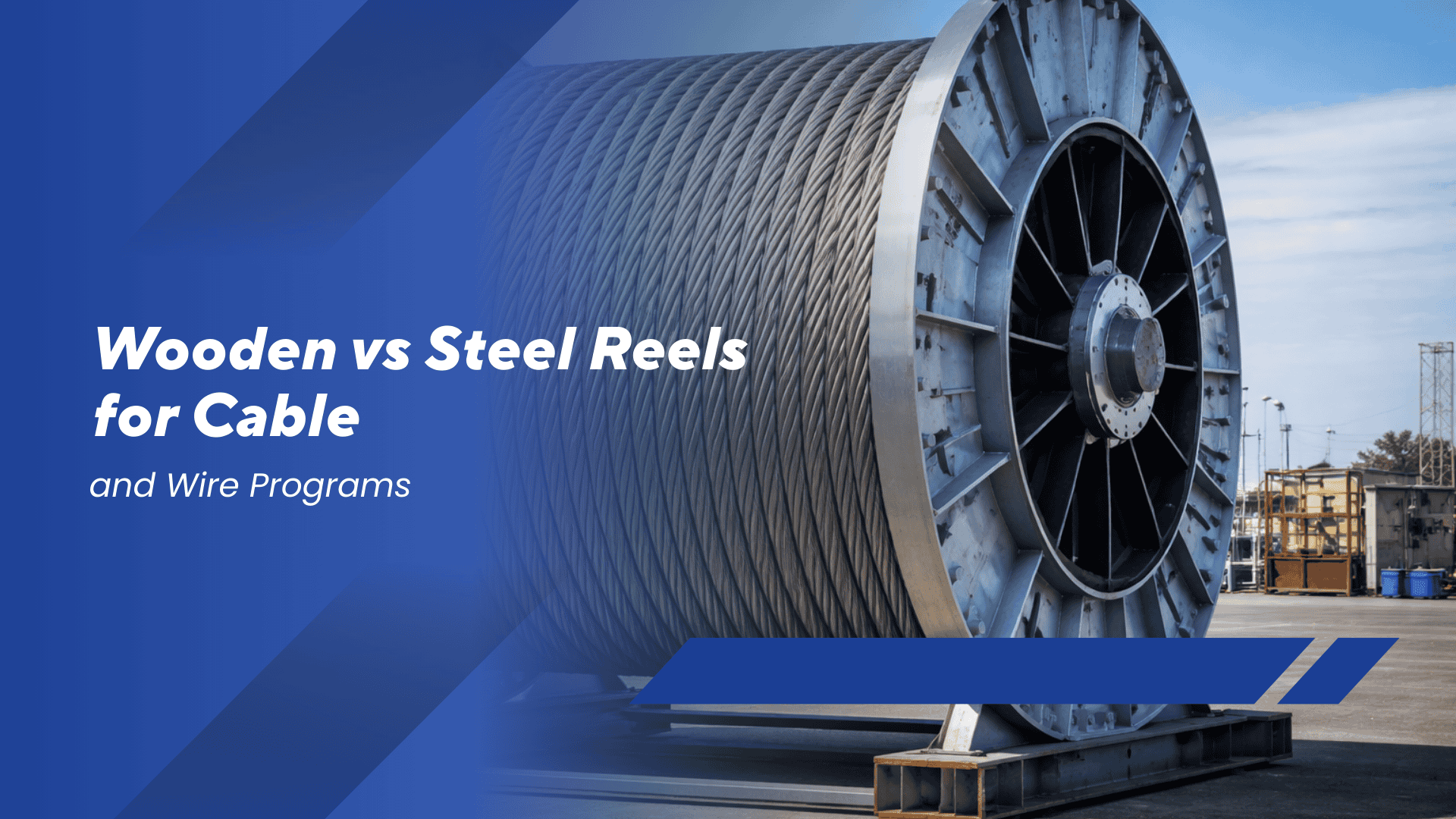
Wooden vs Steel Reels: Durability, Versatility, and Cost Tradeoffs
Most reel standards fail because teams compare unit price and ignore what the lanes impose: outdoor dwell, handling severity, payout sensitivity, and return condition variance. The practical decision is not “wood vs steel.” It is whether your lanes behave like packaging (one-way shipping) or an asset loop (returns/reuse).
Use the comparison below to set an initial default. Then, validate it against your operating model in the next section.
Attribute | Wooden Reels | Steel Reels |
|---|---|---|
Best Fit Use Case | One-way shipping lanes where returns are unreliable or not enforced | Controlled returns and reuse loops where the reel is treated as a managed asset |
Durability Over Time | Higher risk of condition change under moisture + long dwell | Holds geometry longer when handled and stored under defined rules |
Storage Horizon Tolerance | Best fit for short, predictable storage; risk rises with long outdoor dwell | Better fit for longer storage horizons when corrosion exposure is managed |
Handling Severity Tolerance | Lower tolerance when handling varies by site; damage often becomes replacement-driven | Higher tolerance under routine industrial handling; still requires impact discipline |
Load / Capacity Range | Suited to many standard shipping scenarios; heavy loads increase the risk of damage and condition drift | Often used for heavier bulk handling; capacity depends on reel design and specification. |
Payout Sensitivity Fit | Works best when payout is not sensitive to condition variance | Better fit when payout stability depends on consistent reel geometry across turns |
Repair / Refurb Leverage | Limited in many programs; replacement is often the practical path | Strong leverage when refurbishment and verification gates exist |
Cost Reality | Lower unit price; total cost rises if damage + replacement volume climbs | Steel unit price is higher, but the economics improve when the turns are real, and refurbishment is used. |
Default Rules That Hold In Most Networks
Default to wood when the reel behaves like shipping packaging: low turns, unreliable returns, short storage horizon, limited payout sensitivity.
Default to steel when the reel behaves like a governed asset: controlled returns/reuse, higher handling severity, longer dwell, measurable downtime cost, and repair/refurb used consistently.
Misuse Warning: Selecting steel while the lane behaves like an uncontrolled one-way shipping often increases cost without improving predictability. You end up paying for a reusable-asset standard while operating it as disposable packaging.
With the baseline tradeoffs set, the correct default depends on the operating model you are actually running: one-way shipping, controlled returns, or true reuse.
Which Operating Model Are You Running?
Choose the operating model first. It sets what “success” means in your network: lowest delivered cost, or stable turns with predictable conditions.

Most reel programs fall into one of three operating models.
One-Way Shipping
The reel functions as a shipping container. Returns are unreliable, not required, or not economical to enforce. The program is optimized for delivery protection and low friction at the destination, not long reuse life.
Controlled Returns
Returns are expected on defined lanes. Condition is owned at handoff, and reels come back often enough that return behavior and condition affect total cost. The program behaves like an asset loop, even if turns are not formally tracked.
True Reuse
Reuse is planned. Turns are expected and measurable. The program assumes repeatable performance across cycles and maintains a serviceable standard to keep the fleet usable over time.
These models fail in different ways:
In one-way shipping, failure shows up as transit or jobsite damage, missing returns that drive disposal, and lane friction that increases delays and unplanned replacement volume.
In controlled returns and reuse, failure shows up as payout instability, repeat damage patterns across cycles, downtime tied to reel condition, and a shrinking usable fleet.
After the model is set, the decision becomes a lane diagnosis: what keeps creating exceptions, and where does that show up first?
What Constraints Decide the Outcome in Your Program?
Use this as a quick lane diagnostic. Pick the top two drivers you see most often, then stress-test your material default.
The Four Constraints:
Storage horizon and exposure
Do reels sit outdoors or in uncontrolled conditions often enough that moisture or corrosion shows up at re-entry?
Do you see condition changes after dwell (swelling, warping, corrosion, degraded markings)?
Handling severity
Are there frequent yard moves, transfers, stacking, or inconsistent forklift practices across sites?
Are impact signatures common (flange hits, rim damage, bent structure, crushed packaging)?
Payout sensitivity
Does reel condition affect tension behavior, payout stability, or intervention time at the point of use?
Do you log downtime or operator intervention tied to reel run behavior?
Return predictability
Do reels return late, through third parties, or in unknown condition without ownership at handoff?
Does “incoming condition variance” force ad hoc decisions at re-entry?
Selection rule
If your top constraints are return predictability + short storage horizon, wood often remains rational.
If your top constraints include handling severity, payout sensitivity, or long/variable storage, steel tends to hold up better, but only when re-entry and refurbishment decisions are governed.
Once your top constraints are clear, the decision can be defended with one metric: cost per successful turn.
Lifecycle Economics That Settle It: Cost per Successful Turn
A material default is only defensible if it reduces total cost under the way your lanes actually operate. The cleanest way to evaluate that is cost per successful turn.
The Metric
Cost per successful turn = (purchase + damage + scrap + downtime + repair/refurb) ÷ usable turns delivered.
“Usable turns” means turns that complete without reel-condition issues that force intervention, downtime, scrap risk, or early retirement.
When Wood Stays Economically Rational
Wood tends to remain a rational default when the program behaves like short-horizon shipping:
Turns are low or inconsistent, and returns are not worth enforcing.
Storage exposure is limited, and dwell time is predictable.
The program is not payout-sensitive enough for condition variation to show up as downtime or quality risk.
Replacement is cheaper than managing return condition, repair decisions, and supplier controls.
When Steel Becomes Economically Rational
Steel tends to become rational when the program is a governed asset loop:
Higher turns are expected and achievable on defined lanes.
A repair or refurbishment path exists and is used consistently.
Downtime sensitivity is high enough that payout instability carries a measurable cost.
Condition governance exists, so usable turns do not collapse due to uncontrolled damage and unknown returns.
Minimum Tracking Set
To avoid “payback” claims that cannot be defended, track only four metrics:
Damage rate per 100 turns or shipments (consistent denominator by lane type)
Quarantine rate (percent pulled from service due to condition)
Repair/refurb rate (percent routed to repair, plus time-to-return if available)
Downtime minutes attributable to reel condition or payout instability
If these cannot be tracked, payback becomes an assumption rather than an operating result.
The model stays true only when the loop is governed, which is why the control plan matters regardless of material.
Control Plan That Prevents Drift
Most reel standards fail at re-entry. Units return in mixed condition, screening gets inconsistent, and the fleet drifts until instability shows up on the line. These controls keep the condition predictable without turning it into a compliance project.
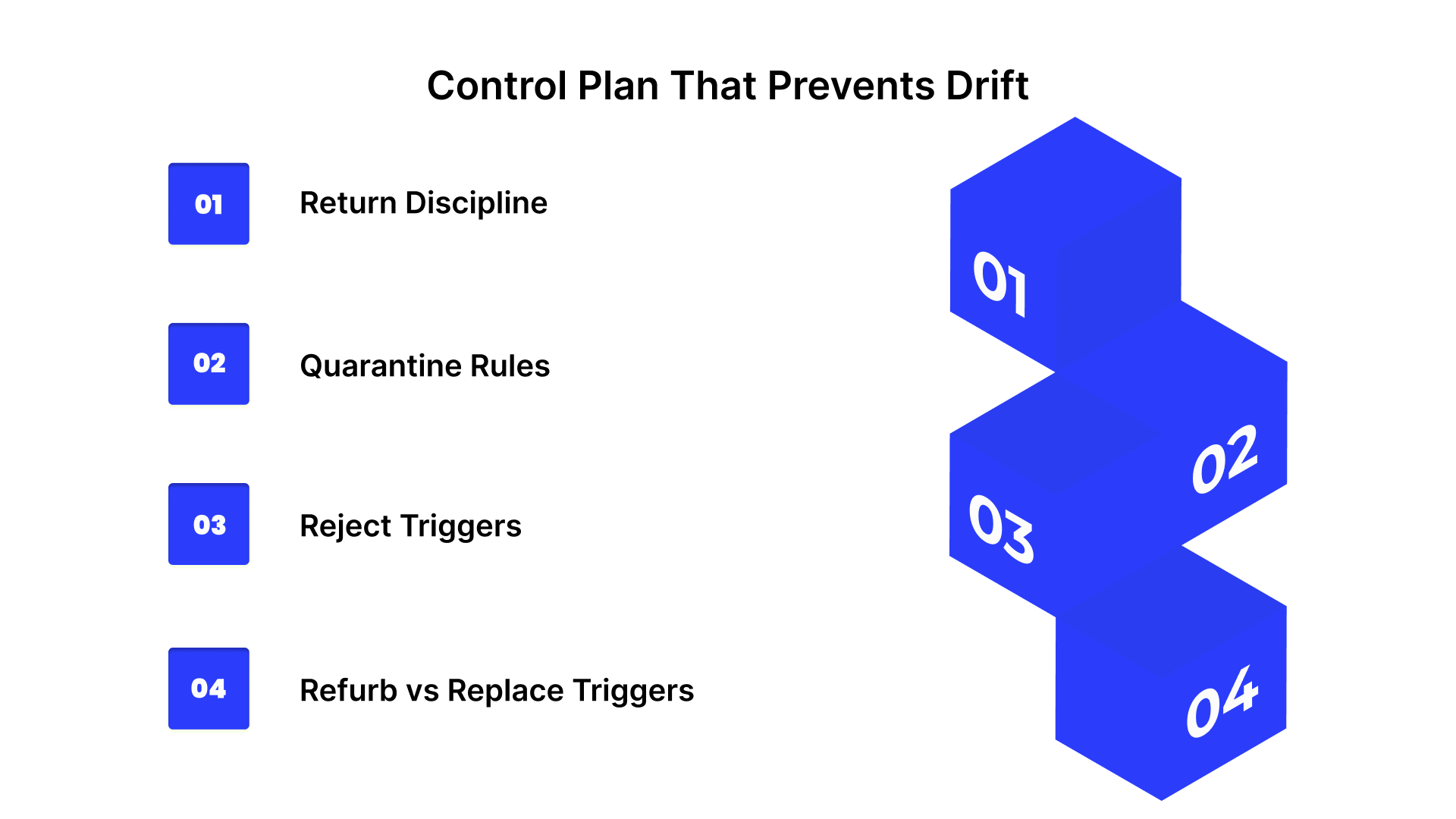
Return Discipline
Log only what changes decisions: lane, event type, damage category.
Treat “unknown condition” as a lane flag. If a lane can’t provide basic visibility, don’t manage it like reuse.
Quarantine Rules
Quarantine is the fast, low-argument screen. Pull a reel before it reaches production if you see:
Obvious deformation (out-of-plane flange, warped barrel, does not sit flat on the floor/stand).
Interface uncertainty (mounting slop, inconsistent engagement, damaged bore/drive features).
New payoff instability reports (vibration, drift, repeated manual correction).
Rim/edge strikes that can worsen under tension.
Reject Triggers
Reject is the point where serviceability is no longer defensible. Remove from circulation when:
Structural integrity is compromised (cracks, broken members, permanent deformation affecting fit/stability).
Interface features cannot hold repeatable engagement.
The same instability pattern returns after a prior intervention.
Normal handling creates a safety risk (stacking instability, lift-point compromise, uncontrolled rolling).
Refurb vs Replace Triggers
Use refurb when you can restore function and regain predictable turns. Use replace when restoration won’t hold under the lane reality.
Refurb when
Damage is repairable, and repeatable mounting/payoff behavior can be restored.
Regained turns justify the work.
The lane’s handling profile is stable enough that repaired units won’t immediately re-fail.
Replace when
Recurrence is fast (same defect returns within a short turn window).
Return condition remains highly variable, and screening load keeps rising.
Repair cannot restore repeatable interface fit, payoff stability, or safe handling.
If instability persists after this control set is running, the bottleneck usually shifts from internal rules to verification and a repair path that can be applied consistently across the fleet.
Stabilize Steel Reel Turns With Verification, Repair, and Fabrication Support
New American Reel Co LLC is the right operator partner at this point because they cover the full steel program problem in one place: supply when you need to reset, repair when you can recover turns, and custom fabrication when interface details are the root cause. That combination is what prevents a steel standard from turning into a mixed-fleet problem.
What Narco Solves at This Stage
Condition Uncertainty
Narco helps you separate serviceable reels from repeat-failure candidates, so unstable units stop re-entering circulation, and recoverable units are not retired early.
Interface-Driven Variability
When payout instability ties back to engagement details, Narco can fabricate or modify to your drive/arbor/bore requirements so the reels match how your equipment mounts and runs in practice.
Fleet drift
Narco can keep the fleet inside a usable envelope over time by pairing refurbishment with disciplined replacement, so you do not end up with a patchwork of substitutes across plants.
From a Decision-Grade Review With Narco, You’ll Get
A clear call on which reels are worth recovering versus which ones should be removed from the loop.
The minimum interface requirements that must be met for repeatable mounting and payout.
Practical thresholds for repair, replace, and retire that match your lanes and handling reality.
A short list of the inputs your team must control to keep the turns stable after the decision.
If you are already running steel or leaning steel, request a short technical review from Narco, focused on verification and repair/replace thresholds. Share the lane profile and damage pattern, and get a direct recommendation on the fastest path to stabilize turns and cost.
Conclusion
Material standardization works when the decision follows the operating model and the constraints that actually drive outcomes in your lanes. Preferences and supplier habits should not be setting the default.
The standard holds only when the loop is governed. Damaged units must stay out of circulation, and refurbishment or replacement decisions must be applied consistently so that the condition does not drift back into the system.
FAQs
Are Wooden Reels Or Steel Reels Better For Cable And Wire Programs?
The better default is the one that matches your operating reality. Steel tends to win when returns and conditions are managed. Wood often remains rational when reels behave like shipping packaging and replacement is expected.
Do Steel Reels Need Special Storage If We Keep Inventory Outdoors?
Outdoor dwell time can become the limiter if corrosion exposure is uncontrolled. Covered storage, drainage (no standing water), and defined maximum outdoor time usually prevent storage from becoming the failure driver.
What Is The Fastest Way To Reduce Reel-Related Variability Without Changing The Standard?
Tighten re-entry. A simple quarantine rule for obvious deformation and interface wear typically cuts repeat instability faster than switching materials.
Can A Steel Reel Program Work Without Refurbishment?
It can, but replacement frequency becomes the cost lever. Refurbishment matters most when turns are meaningful, and you want to protect usable capacity instead of continually resetting the fleet.
Should We Allow Both Wood And Steel In The Same Network?
Only with explicit lane rules and interface requirements. Without lane discipline, mixed fleets tend to increase exceptions and reduce repeatability across plants.
What Information Makes A Steel Reel Or Refurb Quote Actionable?
Provide reel size range, load expectations, interface requirements, handling profile, return lanes, and your definition of a successful turn. That enables fit-first pricing instead of generic unit quotes.