You are usually asked one simple question and still get it wrong later. “What size reel do we need?”
That question sounds basic. In practice, it leads to damaged cables, reels that do not fit equipment, and repeated reorders when sizing assumptions break down.
Cable reel size and dimensions are not fixed numbers you memorize once. They depend on how cable bends, how much weight you load, how you handle reels, and how you ship and store them.
This guide explains how cable reel sizing really works. You will see what dimensions matter, which size families exist across common industrial reel types, and how to choose a size that fits your cable, equipment, and operation without guesswork.
Key Takeaways
Cable reel sizes are not universal. Industry uses common-size families and charts, but final dimensions always depend on cable bend limits, length, weight, and handling method.
Core diameter matters more than flange size. Start sizing with bend radius protection. Then adjust flange and traverse for capacity and footprint.
Charts guide you; they do not replace validation. Use standard reel size charts as a reference, then confirm arbor fit, edge clearance, and real handling conditions.
Sizing errors show up later and cost more. Most damage, rework, and delays trace back to ignoring core size, cable OD tolerance, or equipment fit during sizing.
Why Cable Reel Size Causes Costly Mistakes
A cable reel looks like simple hardware. You still pay for sizing mistakes fast. A reel that runs too small forces a tight bend on the cable. A reel that runs too large wastes space, increases handling risk, and raises freight costs.
You may also face fit problems on the payoff stands when the arbor hole or overall width does not match your equipment.
You can avoid most of these issues when you size reels with three outcomes in mind:
Protect cable condition
keep handling safe and predictable
ship and store reels without damage
Once you understand the dimension terms, you can read specs correctly and choose sizes with confidence.
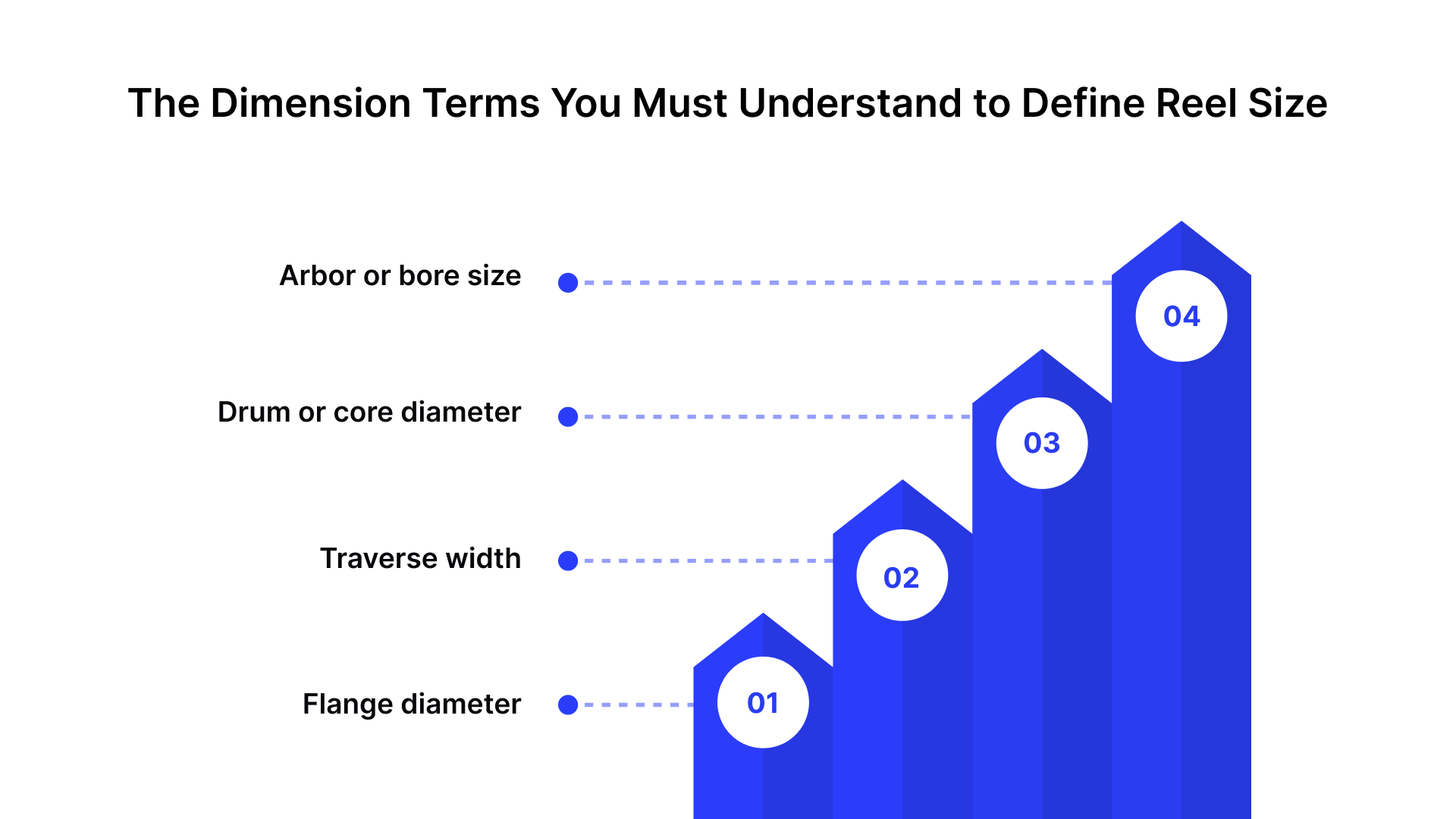
The Dimension Terms You Must Understand to Define Reel Size
Most industrial reel sizing comes down to four main dimensions. You will see these on drawings, quotes, and purchase orders.
1. Flange diameter
Flange diameter tells you the outer size of the reel. It drives footprint, stack height, and how much room you need in storage and transport. A larger flange can increase capacity, but it also increases weight and handling risk.
2. Traverse width
Traverse is the inside width between flanges. It sets the winding width available for the cable.
When the traverse runs too narrow, layers build up faster and create side pressure near the flanges. That pressure can deform outer layers during shipping.
3. Drum or core diameter
Core diameter sets the bend the cable takes at the first wrap. This dimension often controls cable safety more than any other.
When the core runs too small, the cable bends tighter than recommended, and you risk jacket distortion or long-term performance issues.
4. Arbor or bore size
Arbor size controls equipment fit. If the bore does not match your payoff stand, shaft, or lifting fixture, the reel can wobble, bind, or require adapters.
You should confirm this dimension early because it affects handling and plant workflow.
Two supporting dimensions that reduce confusion
Overall width: includes flanges. This matters for palletization, rack fit, and trailer loading.
Edge clearance: You need space between the cable pack and the flange edge. Do not plan to wind all the way to the flange.
If you source steel reels for demanding cycles, a manufacturer like Narco can help you confirm these dimensions before you lock a build, especially when you need custom bores, traverse widths, or modifications for existing equipment.
Are Reel Sizes Fixed in the Industry?
Industrial cable reels do not follow a universal size list. Manufacturers build reels to match cable type, required length, handling method, and shipping constraints.
That said, many industries still treat certain reel size sets as standard because they repeat across purchasing programs and distributor catalogs.
What “standard reel size” usually means
In most industrial settings, “standard” means one of these:
a manufacturer’s common-size family that they produce frequently
a reel size your company already uses across multiple products
a packaging size that fits your pallet, rack, and trailer limits
So you may see the same flange diameters and widths appear again and again. You will still see variation in core diameter, bore size, flange thickness, and build style because those details must match the load and the handling cycle.
Why reel size vary by type and use
Reel size changes when any of these change:
minimum bend radius requirements for the cable
total weight per reel and how often forklifts handle it
payout method at the destination site
storage duration and stacking height in yards or warehouses
return and reuse cycles that put more stress on flanges and rims
When custom sizes become the safer choice
You usually need a custom build when you:
Your payoff equipment needs a non-standard arbor fit
need higher strength for repeated shipping and handling
need a specific traverse to control layer build and stability
need modifications to match existing the fleet reels
In these cases, a supplier that can fabricate and modify steel reels, like Narco, can help you align reel dimensions to your handling setup and reduce rework later.
Common Industrial Reel Types and Typical Size Families
You will see two common sizing patterns in the U.S. market. Some suppliers use lettered reel codes for small to mid reels.
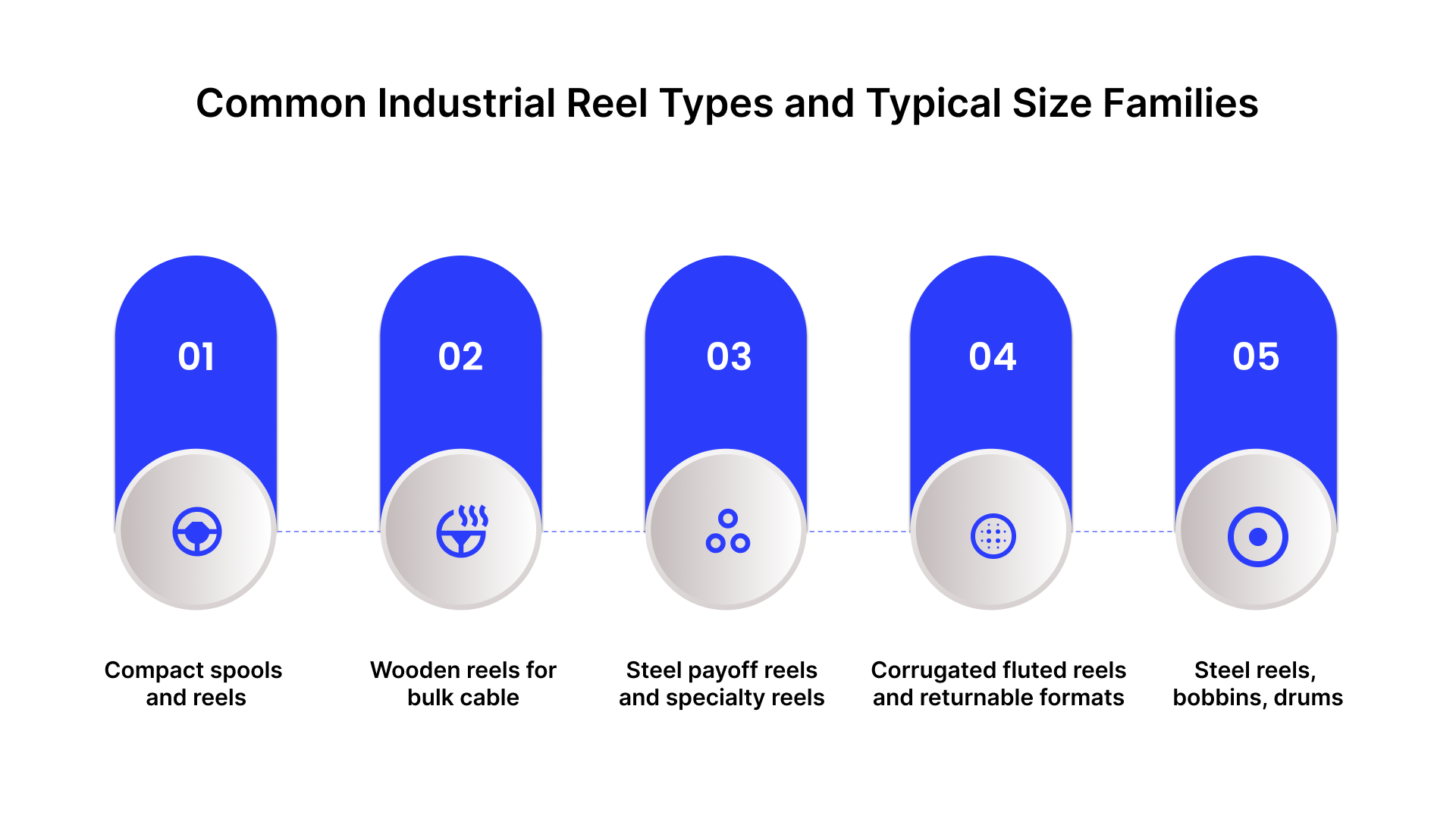
Others use named wood reel families for bulk shipping reels. Use these as reference points, then confirm bend limits and equipment fit.
1. Small spools and small reels for smaller cable and wire
You will often see small reels grouped into lettered or coded families. These reels usually share:
smaller flange diameters for compact handling
shorter traverse widths for controlled layer build
smaller arbor or bore sizes to match lighter payoff setups
These families fit building wire, hook-up wire, control cable, and similar products where shipment weight stays lower, and equipment footprints stay tight.
Many wire and cable suppliers use lettered reel codes. The code maps to a standard dimension set.
Example lettered size family (selected sizes)
Reel code | Flange | Traverse | Drum | Arbor |
W | 12 | 11 | 8 | 3 |
X | 24 | 14 | 5 | 3 |
O | 32 | 22 | 14 | 3 |
P | 36 | 22 | 14 | 3 |
Q | 42 | 23 | 16 | 3 |
R | 48 | 23 | 16 | 3 |
U | 72 | 36 | 40 | 3 |
V | 78 | 48 | 40 | 3 |
This type of chart helps when you inherit a reel code on a PO and need to understand the physical size quickly.
What stays consistent in this chart
The chart keeps a constant arbor size for many reel codes.
Flange and traverse increase in steps, which creates a predictable footprint change.
2. Wood shipping reels are used for bulk cable
Wood shipping reels often follow named size sets used across the wire and cable market. These sets typically scale by flange diameter while allowing flexibility in:
flange thickness
core build style
traverse width
Wood reel sizing varies more than buyers expect. Two reels with the same flange diameter can carry different lengths because the traverse and core diameters vary by design and by load rating.
Example named wood reel set (RH series)
Reel | Flange | Traverse | Drum | Flange thickness | Overall width |
RH36 | 36 | 16 | 15 | 2 | 20 |
RH45 | 45 | 28 | 21 | 2 | 32 |
RH60 | 60 | 32 | 26 | 3 | 38 |
RH72 | 72 | 36 | 36 | 3 | 42 |
RH84 | 84 | 36 | 44 | 3 | 42 |
RH96 | 96 | 40 | 44 | 3 | 46 |
This shows why wood reel sizing varies even inside a standard family. Traverse and drum changes can shift capacity and bend behavior even when the flange stays within a familiar range.
3. Large steel payoff reels and specialty large reels
Large industrial reels often use model ranges instead of one universal chart. Suppliers publish flange and width ranges by model type.
Example model range approach (selected specs): A published comparison chart lists these example ranges:
Flange diameter: 45 to 57, 50, up to 48, and 61
Reel max width: 31.5, 32, 42, and 37 to 55
This approach helps when you choose among engineered reel models rather than a fixed letter code.
These reels often serve plant take-up and pay-off lines, large construction cable shipments, or heavy industrial applications.
4. Corrugated and fluted shipping reels and returnable formats
Corrugated or fluted shipping reels show up in programs that reuse reels and expect rough handling.
You may see RM or RMT language in packaging discussions tied to industry guidance. Manufacturers build these reels across a wide range of sizes because the design scales with:
required capacity
stack and impact expectations
return freight and storage constraints
This category often prioritizes durability and repeat cycles over the lowest initial cost.
Narco states that corrugated shipping reels can follow NEMA WC 26 RM or RMT types and come in a wide range of sizes and capacities.
5. Steel reels, bobbins, and drums for process and shipping
Steel reels and bobbins often follow specification-driven sizing. Buyers specify flange diameter, traverse, and bore to match equipment and shipping needs.
Steel drums typically enter when loads get heavier and long lengths drive higher strength requirements.
Narco supports steel reel sizes from 3 inches to 96 inches, which covers small process reels through large shipping reels and drums. This range helps when you need consistency across multiple product lines and reuse cycles.
How to use a reel size chart to pick the right reel
A reel size chart gives you a starting point. You still need to map the chart to your cable and your handling setup. Use this simple sequence so you avoid the most common sizing errors.
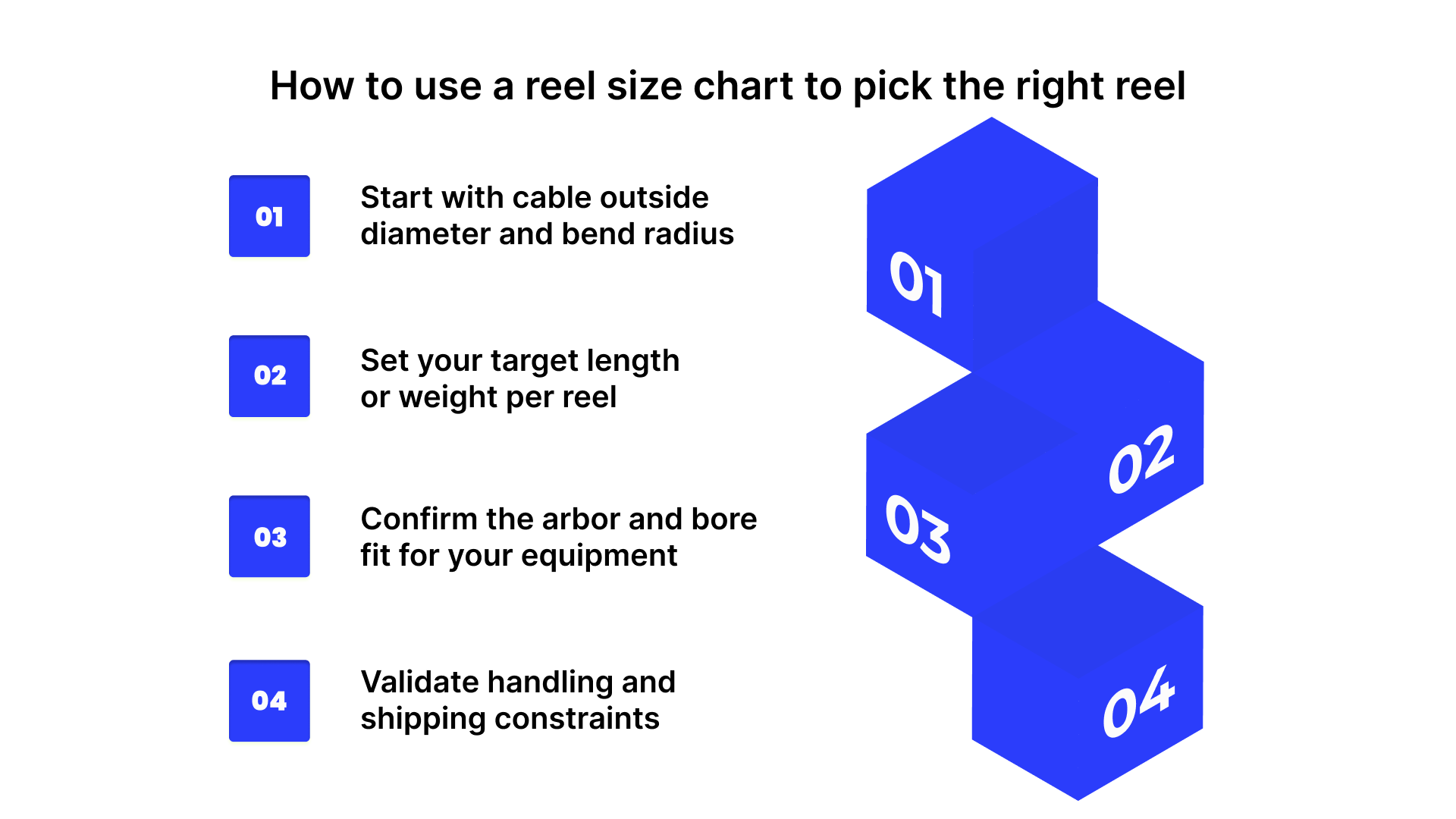
Step 1: Start with cable outside diameter and bend radius
Core diameter drives the tightest bend in the first wrap. Pick a reel family that gives you a core that protects the cable. If you guess here, you risk jacket stress and long-term performance issues.
Step 2: Set your target length or weight per reel
Now match capacity needs.
Increase flange diameter when you need more length, and you can handle the footprint.
Increase traverse when you need more length but want to limit flange growth.
Keep edge clearance so you do not pack cable tight against the flange.
Step 3: Confirm the arbor and bore fit for your equipment
Check the bore size against:
Payoff stands
take up equipment,
lifting fixtures, and shafts
A mismatch forces adapters, creates wobble, or slows handling.
Step 4: Validate handling and shipping constraints
Ask two practical questions:
Can your team move this reel safely with your forklift and storage layout
Can you stack and ship it without flange damage
If you use steel reels in repeat cycles, Narco can help you validate bore fit, traverse needs, and repair options before you lock a reel size across a program.
Capacity Basics: Why Two Reels With the Same Flange Can Hold Very Different Lengths
Many buyers assume flange diameter defines capacity. It does not. Two reels with the same flange can hold very different lengths because core diameter and traverse change the usable space.
The three capacity drivers
Core diameter: A larger core reduces capacity but protects the bend radius.
Traverse width: A wider traverse increases capacity by adding usable winding width.
Cable outside diameter: A thicker cable fills the reel faster, even if the reel size stays the same.
Real capacity is always lower than “full to the edge.”
In real operations, you need clearance.
You leave space near the flange edge to prevent crushing and abrasion.
You account for uneven layering, stiffness, and handling movement in transit.
When you should trust a chart more than a calculation
Use a published reel chart when:
You match a common product and a known reel family,
you want consistent purchasing and repeatable footprints.
Use an engineered estimate when:
you change cable construction or jacket thickness
you push the load weight near the handling limits
you need a custom bore, traverse, or core size.
If you see frequent cable pack shift or flange contact in transit, treat that as a sizing signal. Check traverse, core diameter, and edge clearance before you change cable handling steps.
Quick sizing mistakes that cause damage or rework
Sizing mistakes usually come from one wrong assumption. Fix them early, and you save time across purchasing, production, and shipping.
Mistake 1: You pick the flange diameter first and ignore the core diameter
What happens: the cable takes a tighter bend on the first wrap than it should.
Fix: start with the core diameter based on the bend radius needs, then size the flange and traverse for capacity.
Mistake 2: You assume cable outside diameter stays constant
What happens: the actual cable packs tighter or wider than planned, and the reel overfills or underfills.
Fix: confirm cable OD range, jacket type, and tolerance. Size the reel with a margin, not the minimum.
Mistake 3: You ignore arbor fit until the reel arrives
What happens: the reel wobbles on the payoff stand or needs adapters that slow handling.
Fix: lock bore size and hub length in the RFQ and confirm it matches your shafts and fixtures.
Mistake 4: You plan to fill cable up to the flange edge
What happens: outer wraps rub the flange, crush during transit, or shift in storage.
Fix: leave edge clearance and treat maximum fill as a limit, not a goal.
Mistake 5: You size for capacity but forget handling reality
What happens: forklifts struggle, storage racks do not fit, and loading gets slower.
Fix: Confirm footprint, overall width, and stack limits before you approve large flange sizes.
If you run reusable steel reels, Narco can repair bent flanges, damaged rims, and bore wear. That support helps you keep sizing consistent across reuse cycles.
Conclusion
Cable reel sizing works best when you treat it as an operating decision, not a guess. Start with the core diameter to protect the bend radius.
Then match the flange and traverse to the length you need.
Confirm bore fit early so the reel runs cleanly on your equipment. Leave edge clearance so the cable pack stays stable in storage and transit.
If you require steel reels that are compatible with your cable specifications and handling arrangements, Narco is prepared to assist you.
Narco manufactures steel reels and drums and supports reel programs with:
Steel reel repair and custom modification
Steel reel reconditioning and refurbishment
Blasting, painting, stenciling, and dynamic balancing
Used steel reel sales and redistribution
Share your target dimensions, cable details, and handling requirements, and request a quote so you can lock the right reel size with fewer reorders and fewer shipping issues.
FAQs
How do cable reel sizes affect freight and shipping costs?
Larger reel diameters increase pallet footprint and trailer space usage. Oversized reels often raise freight costs even when the cable weight stays the same.
Do cable reel sizes impact warehouse storage planning?
Yes. Reel diameter and overall width determine rack spacing, stacking height, and aisle clearance. Poor sizing reduces usable warehouse capacity.
Can you reuse the same reel size for different cable products?
Sometimes. You can reuse a reel size when cable bend limits and weight stay within range. Different jackets or constructions may still require size changes.
How often should reel sizes be reviewed in long-term programs?
Review reel sizes when cable design changes, handling methods change, or damage patterns appear. Static sizing often causes issues over time.
Do reel size changes affect automation or winding speed?
Yes. Larger or heavier reels increase inertia and can limit line speed or tension control on automated winding and payoff systems.