Introduction
Every wire and cable manufacturer faces the same sourcing question at some point: buy reels from a domestic supplier or go overseas for a lower unit price? Overseas pricing looks attractive on a spreadsheet. The complications show up later.
The wrong decision shows up later — in spec mismatches that stall winding lines, replacement orders triggered by QC failures, and reconditioning support that simply doesn't exist once reels are in the field.
The stakes are real. According to MarketsandMarkets, the global industrial reels market is projected to grow from $0.50 billion in 2025 to $0.62 billion by 2030 at a 4.4% CAGR — growth that's drawing more scrutiny to sourcing decisions across the supply chain.
This article breaks down domestic versus overseas reel sourcing across cost, lead time, quality consistency, customization, and lifecycle support. Each factor carries different weight depending on your production volume, tolerance requirements, and how much downtime you can absorb.
Key Takeaways
- Domestic sourcing delivers shorter lead times, tighter spec consistency, and access to full lifecycle services including reconditioning and repair.
- Overseas sourcing offers lower upfront unit costs, but tariffs, freight, and hidden rework costs narrow the price gap fast.
- For high-cycle reel programs, domestic sourcing typically delivers better total cost of ownership.
- The right choice depends on reel type, order volume, customization requirements, and whether lifecycle support is part of your program.
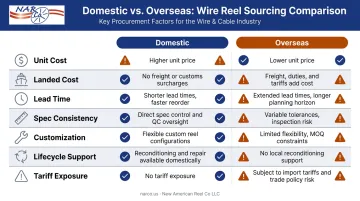
Domestic vs. Overseas Wire Reel Sourcing: Quick Comparison
| Factor | Domestic | Overseas |
|---|---|---|
| Unit Cost | Higher upfront | Lower upfront |
| Landed Cost | Predictable | Rises with freight, tariffs, duties |
| Lead Time | Weeks | 30–60+ days (best case) |
| Spec Consistency | Tight, repeatable across reorders | Variable between batches |
| Customization | Flexible, lower MOQs | Possible at scale, slow turnaround |
| Lifecycle Support | Reconditioning, repair, balancing | Generally unavailable |
| Tariff Exposure | None | Significant — see 2025 steel tariff section |
Cost
Domestic reels carry a higher unit price driven by U.S. labor and compliance standards. That cost looks different when you factor in reconditioning — flange straightening, rim repair, recoating, and dynamic balancing can restore a reel at a fraction of its replacement cost, extending useful life across multiple production and shipping cycles.
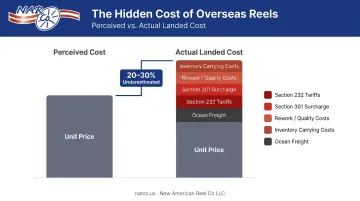
Overseas reels appear cheaper per unit. But the actual landed cost includes ocean freight (Asia to U.S. West Coast was running around $2,096/FEU as of late 2025 per Freightos), import duties, Section 232 steel tariffs, and potential replacement costs when batches don't meet spec. Once those layers are accounted for, the per-unit cost advantage narrows considerably — and disappears entirely when a batch fails inspection.
Lead Time and Supply Chain Risk
Domestic suppliers typically deliver in weeks. Overseas ocean freight runs 30–40 days under normal conditions — but normal conditions are not guaranteed. Sea-Intelligence reported that global container schedule reliability stayed largely in the 50–55% range throughout 2024, with December 2024 reliability at just 53.8%. Nearly half of all vessels arrived late.
For wire and cable plants where production schedules run tight, a month-long slip on a reel order is a meaningful disruption.
Quality and Spec Consistency
Domestic manufacturing gives you direct oversight of tolerances — bore diameter, flange dimensions, traverse width — with reorders reliably matching previous production runs. When a spec issue does occur, it's resolvable through a direct conversation with the manufacturer's engineering team.
Overseas batches introduce more dimensional variability. Without the ability to audit facilities or quickly address deviations, bore and flange inconsistencies can cause fitment failures and unstable rotation on winding lines before the problem is identified.
Customization and Lifecycle Support
Domestic suppliers can accommodate non-standard bore sizes, arbor configurations, and custom flange designs with relatively low minimum order quantities and faster design change turnaround. Overseas custom work is possible, but MOQs are typically higher and design changes require longer lead times.
Lifecycle support is where the gap is clearest. Domestic manufacturers can recondition reels to extend their useful life; overseas suppliers generally cannot. That means overseas reels are replaced when worn — not restored. Reconditioning services typically include:
- Flange straightening and rim repair
- Recoating and stenciling
- Dynamic balancing for stable rotation on winding lines
What Domestic Steel Reel Sourcing Actually Means
Domestic sourcing in the reel context isn't just about geography. It means buying from a manufacturer whose engineering team, quality controls, and service programs are directly accessible — which matters considerably when reels are high-cycle assets circulating through production, shipping, and return use.
Process vs. Shipping Reels: Where Proximity Pays Off
Process reels running on take-up and pay-off winding lines need to be balanced and dimensionally consistent. An out-of-spec bore or uneven flange creates wobble, uneven payout, and fitment problems that slow production. Domestic sourcing keeps spec verification and reorder repeatability within reach.
Steel reels cycling between manufacturers, distributors, and end customers benefit in a different way. Rather than replacing reels after each cycle, a domestic reconditioning program — covering flange straightening, rim repair, repainting, and rebalancing — keeps the fleet usable and cost-controlled over the long term.
Narco has supported wire and cable manufacturers across the U.S. since 1999, handling reconditioning, repair, and custom fabrication for reel sizes from 3 to 96 inches.
Standard reconditioning services include:
- Flange straightening and press work
- Rim repair, blasting, and painting
- Stenciling and dynamic balancing
Custom fabrication extends to:
- Arbor tube replacement and bore size modification
- Drive pin hole repair
- Full welding and machining work
Drawings are provided with quotes and orders, so custom specs are confirmed before production begins.
What Overseas Steel Reel Sourcing Actually Means
Overseas sourcing — primarily from manufacturers in China or India — offers lower per-unit pricing driven by lower labor and production costs. For large, one-time orders of standard-dimension reels used as single-use shipping assets, that pricing can be genuinely attractive. The structural limitations, however, show up quickly in production environments:
- Dimensional inconsistency between batches — bore and flange tolerances vary more, and there's limited ability to audit or verify specifications remotely.
- No reconditioning support — once reels enter the field, repair and restoration options don't exist through the overseas supplier.
- High-speed winding lines are unforgiving — variation that might be acceptable in a low-stakes shipping application causes real problems at production speed.
The Hidden Cost Problem
The Reshoring Initiative notes that companies routinely miscalculate offshoring costs by 20–30% when focusing only on unit price — overlooking freight, quality costs, inventory carrying costs, and rework. For steel reels specifically, tariff exposure adds another layer of cost that can shift unpredictably across a multi-year procurement program.
Where Overseas Sourcing Makes Sense
Overseas sourcing is most defensible when:
- Reels are treated as fully disposable (no return or reuse cycle)
- Dimensions are standard and tolerance requirements are loose
- Order volume is very high, one-time, and not time-sensitive
- You have adequate lead time buffer built into your procurement schedule
Outside those conditions, the operational friction and total cost reliably erode the unit price advantage.
Which Sourcing Strategy Is Right for Your Wire Operation?
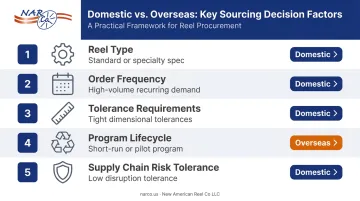
The decision framework comes down to five factors:
- Reel type — process reels running winding lines need tighter spec control than single-cycle shipping reels
- Order frequency — recurring programs benefit more from domestic spec repeatability than one-time buys
- Tolerance requirements — higher precision demands favor domestic manufacturing oversight
- Program lifecycle — reusable reel programs gain more from domestic reconditioning support
- Supply chain risk tolerance — if production downtime from late deliveries is costly, overseas lead time variability is a genuine exposure
The 2025 Tariff Reality
Steel tariffs have materially shifted the cost math. Under Proclamation 10947, Section 232 steel and aluminum tariffs increased to 50% ad valorem effective June 4, 2025 for most countries. The U.S. Department of Commerce also added 407 product categories to the steel and aluminum derivative tariff list in August 2025, with covered steel content subject to the 50% rate.
Steel reels imported from China carry an additional Section 301 tariff layer on top of Section 232. Reuters reported that after the 50% tariff announcement, U.S. hot-rolled coil steel prices rose 7.4% almost immediately. Mid-program tariff changes of this magnitude can close the apparent price gap between domestic and overseas reels faster than procurement teams anticipate.
Total Cost of Ownership: Reconditioning vs. Replacement
The clearest TCO argument for domestic sourcing is the reconditioning math. When a domestic steel reel requires flange straightening, rim repair, recoating, and rebalancing, those services restore it for continued use at a fraction of the cost of a new reel (domestic or overseas).
Reels sourced overseas that degrade through normal cycling have no equivalent restoration path. They're replaced entirely. For a high-cycle reel fleet — where the same reels move through production, ship to distributors, and return for reuse — the cumulative cost of repeated overseas replacement versus domestic reconditioning favors domestic sourcing over the life of the program.
That math points toward a clear split between programs. Here's how to apply it:
Choose domestic sourcing when:
- Your program requires custom bore or flange specifications
- Reels circulate through multiple production and shipping cycles
- Production downtime from late deliveries carries real cost
- Reconditioning and repair support are part of your fleet cost strategy
Consider overseas sourcing only when:
- Standard-dimension reels are sufficient with no customization required
- Order volumes are very high and one-time
- Reels are treated as disposable with no return program
- You have adequate lead time buffer for shipping variability and customs
Wire and cable manufacturers evaluating their reel sourcing strategy can contact Narco to discuss custom fabrication options, reconditioning programs, or reel fleet assessments — reach the team at mark@narco.us or 419-258-2900.
Conclusion
There's no universal winner — the right answer depends on your program. Domestic sourcing consistently outperforms overseas for wire reel programs that require custom specs, repeatable reorders, and lifecycle support. Overseas sourcing can serve narrow use cases: standard dimensions, very high volume, fully disposable applications where upfront cost and availability are the only criteria.
The real cost of a sourcing decision doesn't appear at the point of purchase. It accumulates across the life of the program through factors most buyers underestimate:
- Production consistency and run quality
- Downtime frequency from reel failures
- Rework costs tied to dimensional non-conformance
- Reel replacement rates over time
Buyers who account for those factors — plus the current 50% steel tariff environment — often discover the price gap between domestic and overseas narrows quickly. For industrial wire and cable operations that require reliable reorders and custom specs, Narco has supported that kind of sourcing decision since 1999.
Frequently Asked Questions
Is overseas steel reel sourcing actually cheaper when you factor in tariffs and shipping?
Per-unit overseas prices are lower, but once you add ocean freight, Section 232 steel tariffs (now 50% for most countries), import duties, and potential rework costs from spec failures, the gap closes considerably. Total landed cost frequently meets or exceeds domestic pricing, especially on recurring programs.
How do lead times compare between domestic and overseas steel reel suppliers?
Domestic suppliers typically deliver in weeks with lower variability. Ocean freight from Asia to the U.S. runs 30–40 days under normal conditions, but global schedule reliability ran just 50–55% throughout 2024, meaning nearly half of shipments arrived late — a meaningful risk when production timelines are tight.
Can overseas reel manufacturers match the custom fabrication capabilities of U.S. suppliers?
Overseas suppliers can produce custom reels at scale, but minimum order quantities are higher, design changes take longer to implement, and the buyer has limited oversight over tolerances during manufacturing. Domestic suppliers typically offer more flexibility on smaller custom runs with faster turnaround.
What are the quality control risks of sourcing wire reels from overseas?
The primary risks are batch-to-batch dimensional inconsistency and limited ability to audit overseas facilities remotely. Bore or flange variations that slip through can cause fitment failures or unstable rotation on high-speed winding lines — often before the defect is caught.
How do tariffs and trade policy changes affect the cost of importing steel reels?
Section 232 steel tariffs rose to 50% ad valorem in June 2025, with 407 derivative categories added in August 2025. China-sourced reels also carry a Section 301 surcharge on top of that. Mid-program policy shifts can make overseas sourcing significantly more expensive before supplier pricing can be renegotiated.
When does reconditioning domestic reels make more financial sense than buying new overseas reels?
Reconditioning makes sense when the reel structure is sound and services (flange straightening, rim repair, recoating, and dynamic balancing) can restore fit and performance at a fraction of replacement cost. For high-cycle programs where the same reels circulate repeatedly, reconditioning typically delivers stronger long-term value than buying new overseas.