If your line runs wire, cable, or welding wire, the wrong plastic spool creates fast problems. You see uneven winding, cracked flanges, bore fit issues, and damaged product during shipping. Those issues raise scrap and slow output.
This guide lists 10 plastic spool manufacturers in the USA. You will also get a simple comparison table and a short checklist to help you pick the right supplier for your spool type, material, and volume.
Use this list to shortlist two to three companies, then request quotes with clear specifications.
Key Takeaways
Fit drives performance. Bore size, traverse, and flange diameter decide winding stability, payout control, and scrap rates.
Material choice matters. Resin type and consistency affect spool strength, warping risk, and handling damage during storage and shipping.
Compare suppliers on repeatability. Ask about tolerances, inspection checks, and change control so reorders match your first run.
Use a clear RFQ sheet. Standard specs and packaging details help you compare quotes fairly and avoid delays from missing information.
What You Should Demand From a Plastic Spool Manufacturer
A good plastic spool supplier protects your process and your shipments. You should evaluate suppliers based on repeatability, fit, and support, not price alone.
What matters most in day-to-day operations
Dimensional consistency: Flange diameter, traverse, and hub bore must stay consistent across runs.
Stable winding performance: The spool must hold tension without flexing, warping, or wobbling.
Material reliability: The resin must match your heat exposure, handling stress, and storage conditions.
Clean surfaces: Smooth contact surfaces reduce scuffing and help protect insulation and jacket materials.
What matters for logistics and storage
Stack strength and packaging durability: Spools must resist deformation in pallets and transit.
Clear identification options: Marking or labeling support helps your team track sizes and reorders.
Repeat order control: The supplier should manage change control so you get the same spool again.
What you should ask before you shortlist
What tolerances do you hold on bore and traverse?
What materials do you offer for your spool type?
What is your typical lead time for repeat orders?
What happens if a spool fails fit or arrives damaged?
If a supplier answers these clearly, you reduce spec errors, cut scrap, and keep production stable.
Top 10 Plastic Spool Manufacturers in The USA
When you compare plastic spool manufacturers, focus on repeatability, material control, and support for your exact spool specifications.
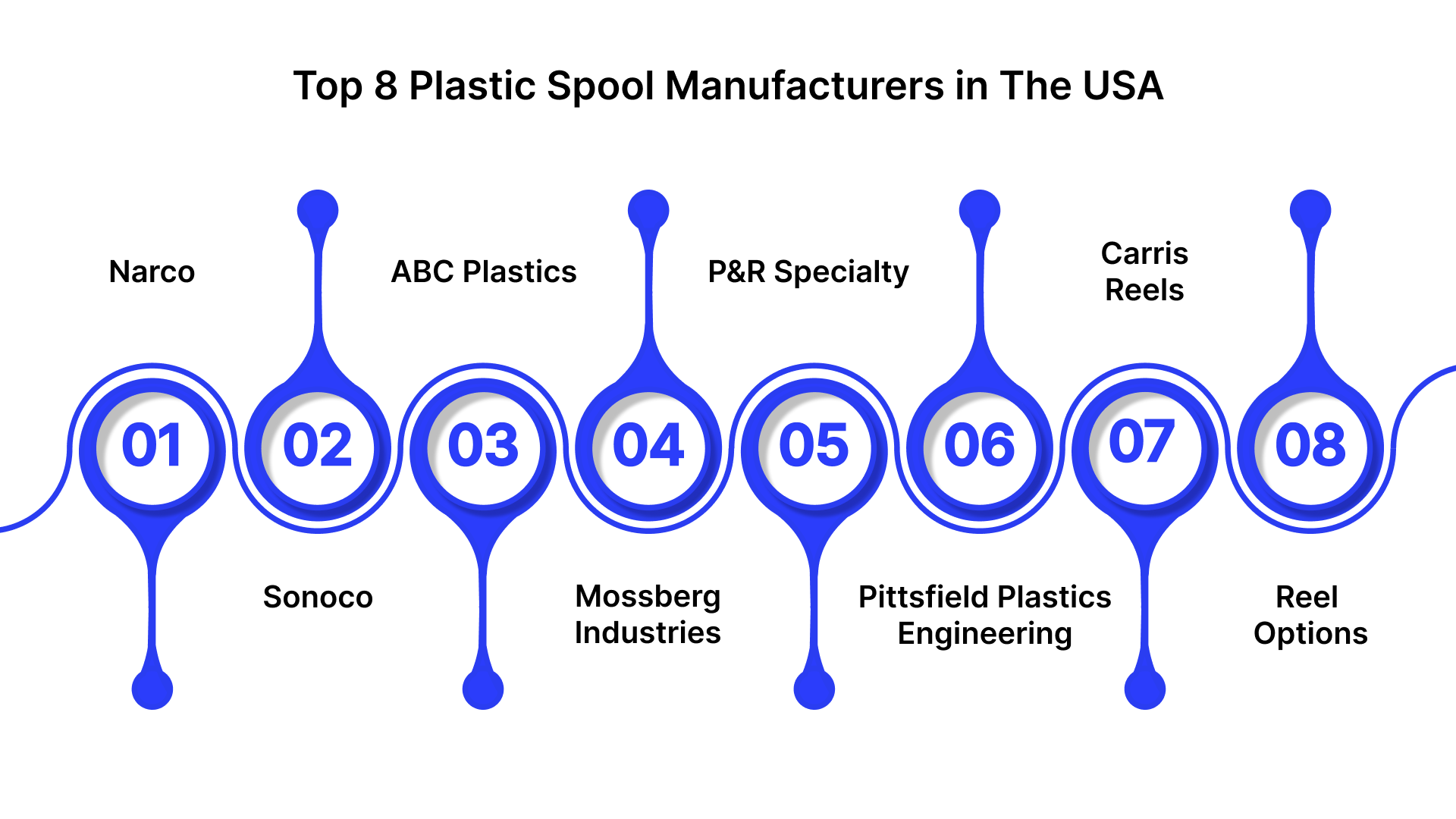
The right partner helps you reduce scrap, prevent winding issues, and keep reorders consistent. Here's the list of the best spool manufacturers:
Narco
Sonoco
ABC Plastics
Mossberg Industries
P&R Specialty
Pittsfield Plastics Engineering
Carris Reels
Reel Options
Foundation Industries
Conneaut Industries
1. Narco: Best Plastic Spool and Reel Manufacturer In The USA
Narco is the top U.S.-based reel and spool manufacturer that supplies both engineered steel reels and custom plastic reels/spools to industrial wire, cable, rope, and packaging operations. With over 25 years of experience, Narco offers custom manufacturing, dynamic balancing, repair, and refurbishment services across a full size range (3″–96″) to meet exact customer specifications.
Key capabilities and what they make
Narco manufactures both steel and plastic reels and spools used for common industrial winding and packaging needs, including:
Process reels for in-plant winding and controlled payout
Welding wire spools for consistent tension and handling
Fine wire reels for smooth surfaces and stable winding
Magnet wire reels for controlled build and repeat use
Packaging spools for shipping and storage
Data cable spools for organized payout and transport.
Customization and materials
Narco supports custom spool specifications based on how you run your line and how you ship product.
Plastic spools made from new ABS plastic
Standard colors include black and natural, with custom color options available
Specifications can align to your flange diameter, traverse width, hub bore, and hub length needs
Options can support repeat orders by locking part details and maintaining consistency.
Industries served
Narco supports plastic spool needs across industries that rely on consistent winding and safe cable handling:
Wire and cable manufacturing
Electrical and power transmission equipment supply chains
Telecommunications and data cable operations
Metal processing and industrial packaging environments.
If your team needs a plastic spool manufacturer that supports clear specifications and repeatable results, Narco is a strong first option to shortlist.
2. Sonoco
Sonoco is a large U.S. packaging company that supplies reels and spools used for industrial winding and shipping programs. It supports buyers who need a consistent supply across multiple locations.
Key capabilities and what they make
Plastic reels and spools are used for industrial packaging and handling
Program-based supply suited to repeat orders and standardized requirements
Broad packaging portfolio that can support multi-site procurement needs.
Sonoco is typically relevant when you need a standardized reel and spool supply as part of a broader packaging program.
3. ABC Plastics
ABC Plastics is a U.S. manufacturer focused on plastic reels and spools used in wire, cable, and related winding applications, with options suited for both process and packaging needs.
Key capabilities and what they make
Plastic spools and reels for wire and cable handling
Product lines are often used for welding wire, building wire, and industrial winding
Manufacturing support for common sizes and application-driven requirements.
ABC Plastics is commonly used for plastic reels and spools in wire, cable, and related winding applications.
4. Mossberg Industries
Mossberg Industries is a U.S. manufacturer that produces reels and spools used to wind, store, and ship industrial materials. Their product range often supports multiple material types beyond wire and cable.
Key capabilities and what they make
Plastic spools and reels are used for winding and payout
Product designs used for wire, cable, hose, tubing, tapes, and similar materials
Manufacturing support for both standard catalog items and application-driven requirements
Mossberg Industries is commonly considered when you need spool options for multiple industrial materials and winding applications.
5. P&R Specialty
P&R Specialty is a U.S. supplier known for plastic molding capability and specialty components, including spool-related parts used in industrial winding and packaging workflows.
Key capabilities and what they make
Plastic spools and molded components are used in packaging and handling
Tooling and mold support that can help when requirements move beyond standard sizes
Production processes focused on repeatable molded part output
P&R Specialty is often relevant when the spool requirement depends on molded part control and tooling support.
6. Pittsfield Plastics Engineering
Pittsfield Plastics Engineering is a U.S. manufacturer that produces plastic spools used across industrial winding, storage, and material handling applications, including utility-style spool formats.
Key capabilities and what they make
Plastic spools designed for winding and controlled payout
Industrial and utility spool formats used for wire and related materials
Molding capability to support standard products and selected custom requirements.
Pittsfield Plastics Engineering is commonly used when buyers need durable plastic spools for industrial handling and repeatable winding.
7. Carris Reels
Carris Reels is a U.S. reel supplier focused on packaging solutions for wire and cable. Their product line includes reel formats used for storage, shipping, and handling across cable supply chains.
Key capabilities and what they make
Plastic reels used for wire and cable packaging and transport
Reel designs intended for controlled payout and safe handling
Options that may include plastic and hybrid reel formats, depending on the application.
Carris Reels is often referenced in wire and cable packaging contexts where reel design supports shipping and payout needs.
8. Reel Options
Reel Options is a U.S. supplier that provides reels and spools used for industrial winding, packaging, and distribution workflows, supporting common requirements in wire, cable, and related materials.
Key capabilities and what they make
Plastic reels and spools for winding, storage, and shipping use
Product lines suited to standardized sizes used in recurring orders
Packaging-focused designs that support handling and logistics needs
Reel Options is typically used when buyers need repeatable reel or spool formats for industrial packaging and distribution.
9. Foundation Industries
Foundation Industries presents itself as a full-service wire and cable reel and spool manufacturer, with divisions that include plastic spools.
Key capabilities and what they make
Plastic spool packages in flange diameters from 2-1/8 inches to 13 inches
Plastic spool designs aligned to industry standard specifications, using materials such as HIPS, PP, and HDPE
Contract molding capacity is part of its plastic division offering.
Foundation Industries is referenced for plastic spool packages tied to wire and cable manufacturing and packaging requirements.
10. Conneaut Industries
Conneaut Industries offers plastic serving packaging, including plastic serving spools designed for the magnet wire industry's needs.
Key capabilities and what they make
Plastic serving spools engineered for magnet wire serving package applications
Packaging types that include plastic serving spools and plastic bobbins as part of broader industrial packaging options
Focus on packaging that integrates into manufacturing processes for consistent handling.
Conneaut Industries is typically associated with magnet wire serving package needs, where plastic serving spools or plastic bobbins are used.
Before You Request Quotes, Confirm These Spool Specs
A quote only helps if the supplier prices the same spool you actually need. Confirm these details before you send an RFQ. It reduces rework, delays, and reorder errors.
The core dimensions you must provide
Flange diameter: Controls spool capacity and handling clearance.
Traverse width: Controls how much material fits between flanges.
Hub bore size: Controls fit on your arbor, payoff stand, or winding equipment.
Hub length: Affects stability and alignment during winding.
Cable and process details that change the spool design
Material type: wire, cable, welding wire, fine wire, or data cable
Outside diameter and stiffness: affects core diameter needs
Total weight per spool: impacts flange strength requirements
Winding tension: impacts rigidity and repeatability needs.
Material and performance requirements
Resin type you want, such as ABS or PP
Color requirement for identification or internal control
Exposure risks like heat, chemicals, UV, or long storage periods.
Packaging and delivery details
Pallet requirements and stack height
Shipping method and handling risks
Labeling needs for part number and lot traceability.
How to Choose The Best Plastic Spool Manufacturer
Start with your use case, then work backward to the supplier capability. This keeps your shortlist tight and your quotes accurate.
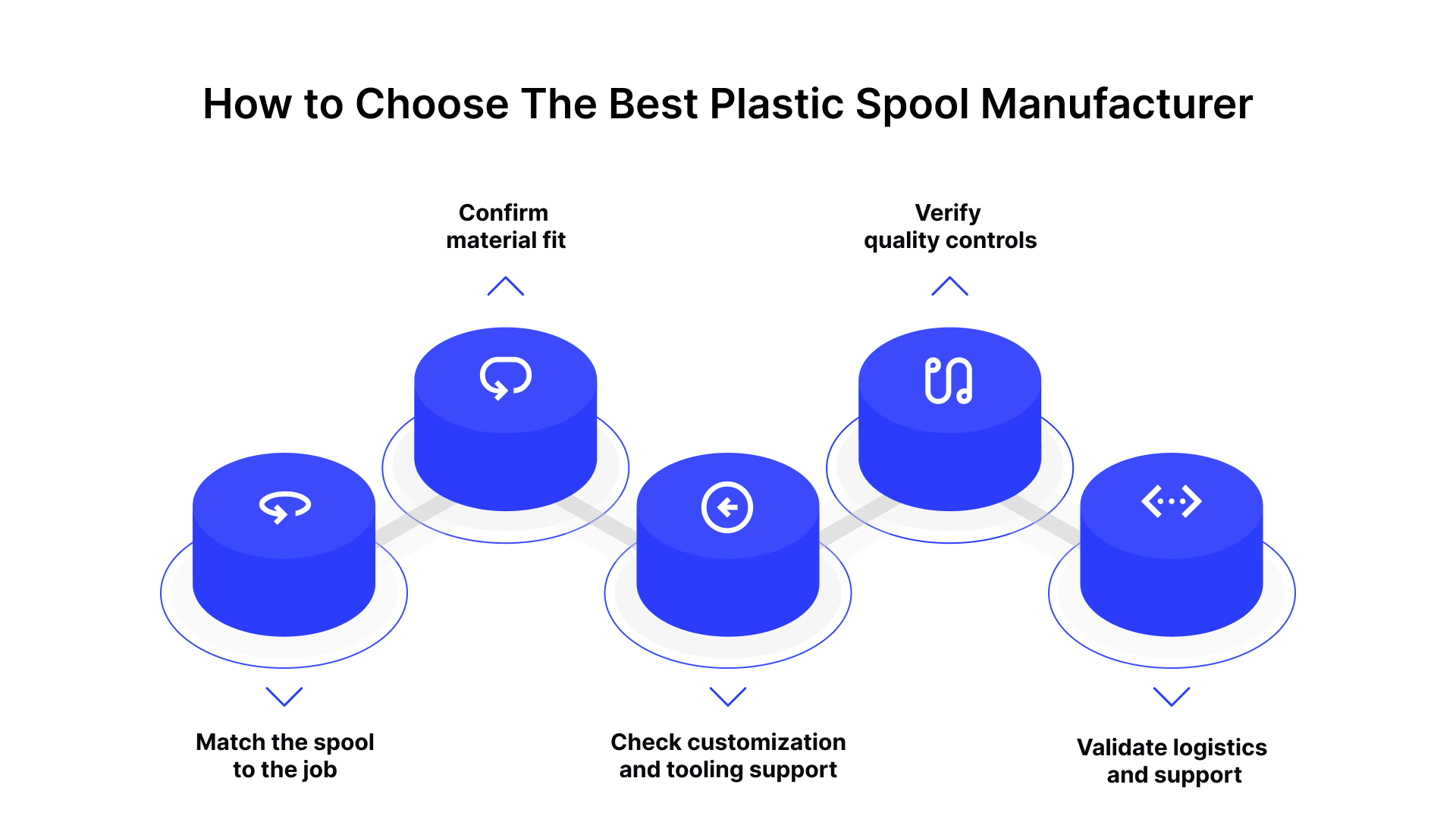
Step 1: Match the spool to the job
Process spools: Prioritize balance, consistent bore fit, and smooth flanges.
Shipping spools: Prioritize stack strength and impact resistance.
Welding wire spools: Prioritize consistent flange spacing and stable winding under tension.
Fine wire spools: Prioritize smooth surfaces and tight tolerances.
Step 2: Confirm material fit
Ask what resin the supplier uses for your spool type. Confirm it fits your environment.
ABS often supports rigidity and repeatability.
PP often supports chemical resistance and lighter weight.
Recycled resin can reduce cost, but you should confirm consistency across lots.
Step 3: Check customization and tooling support
If you need a non-standard bore, flange, or traverse, confirm the supplier can:
Build or modify molds
Maintain tight tolerances after tooling changes
Support repeat production runs without drift.
Step 4: Verify quality controls
Ask how they prevent variation across batches.
Incoming resin checks
In-process dimensional checks
Final inspection and traceability.
Step 5: Validate logistics and support
Lead time for first order and repeat orders
Minimum order quantities
Packaging method and damage prevention
U.S. support for changes and reorders.
Quick checklist for your RFQ
Spool type and application
Flange diameter, traverse, hub bore
Resin and color requirements
Load weight and winding tension
Order quantity and delivery timeline.
Common Mistakes Buyers Make When Choosing Plastic Spools And How to Prevent Them
Mistakes happen when the spool spec is incomplete or when the supplier cannot hold repeatable dimensions. Use the fixes below to prevent scrap, downtime, and reorder problems.
Mistake 1: Choosing based on price only
What goes wrong: Low-cost spools can crack, flex, or warp. Cable layers shift, and you lose winding control.
How to prevent it:
Ask for the resin type and impact rating used for your spool line.
Confirm flange and hub thickness for your load weight.
Request sample spools for a short winding and payout trial.
Mistake 2: Missing bore fit and traverse details
What goes wrong: Poor bore fit causes wobble, vibration, and uneven winding. Wrong traverse causes overfill and flange contact.
How to prevent it:
Provide bore size, hub length, and arbor fit requirements in the RFQ.
Share your equipment details, including shaft size and locking method.
Ask the supplier what tolerances they hold on bore and traverse.
Mistake 3: Ignoring resin choice and temperature exposure
What goes wrong: Some plastics soften in heat or become brittle in cold storage. Chemical exposure can weaken the spool over time.
How to prevent it:
List your environment: indoor, outdoor, heat zones, chemicals, UV exposure.
Match resin to conditions, such as ABS for rigidity or PP for chemical resistance.
Ask for material data sheets and lot consistency practices.
Mistake 4: No plan for repeat orders and change control
What goes wrong: A reorder arrives with small dimensional drift. Your line sees fit issues and winding problems.
How to prevent it:
Lock critical dimensions and tolerances in writing.
Confirm the supplier uses documented change control for molds and resin.
Request a consistent part number system tied to a revision level.
Mistake 5: Sending a vague RFQ
What goes wrong: Suppliers quote different assumptions, so pricing and lead times are not comparable.
How to prevent it:
Use a simple RFQ sheet with flange diameter, traverse, bore, material, load weight, and quantity.
Add packaging needs, pallet limits, and label requirements.
Ask for a quote that lists the exact assumptions used.
Quick correction tip
If you see cracking, wobble, or uneven winding, do not adjust your process first. Confirm bore fit, traverse, resin choice, and load rating. These four items cause most spool failures.
If you want a second check before quoting, Narco can review your spool requirements and help reduce preventable ordering mistakes.
Conclusion
Choosing the best plastic spool manufacturer comes down to fit, repeatability, and consistent supply. When you lock your dimensions, resin choice, and load needs upfront, you reduce scrap, prevent winding issues, and avoid reorder delays.
If you want a plastic spool supplier built for wire and cable operations, start with the best in the industry, Narco.
Request a quote from Narco today to get a spool solution that fits your equipment and supports repeatable production.
FAQs
1. What minimum order quantity should you expect for custom plastic spools?
MOQ depends on whether you choose a standard spool or a custom mold. Custom tooling usually requires higher MOQs to justify setup and production runs.
2. Can you request samples before placing a large order?
Yes. Many suppliers provide samples so you can test bore fit, winding stability, and packaging strength before committing to production quantities.
3. What should you ask about mold ownership for custom spools?
Ask who owns the mold, where it is stored, and how revisions are controlled. This helps protect continuity if you reorder later or change suppliers.
4. How do you verify a plastic spool meets tight tolerances?
Request inspection methods and the tolerance range for bore and traverse. Some suppliers provide dimensional reports or first-article inspection data.
5. What packaging options reduce transit damage for plastic spools?
Ask about pallet patterns, edge protection, and stretch wrap methods. Packaging changes often reduce cracked flanges and shipping-related defects.