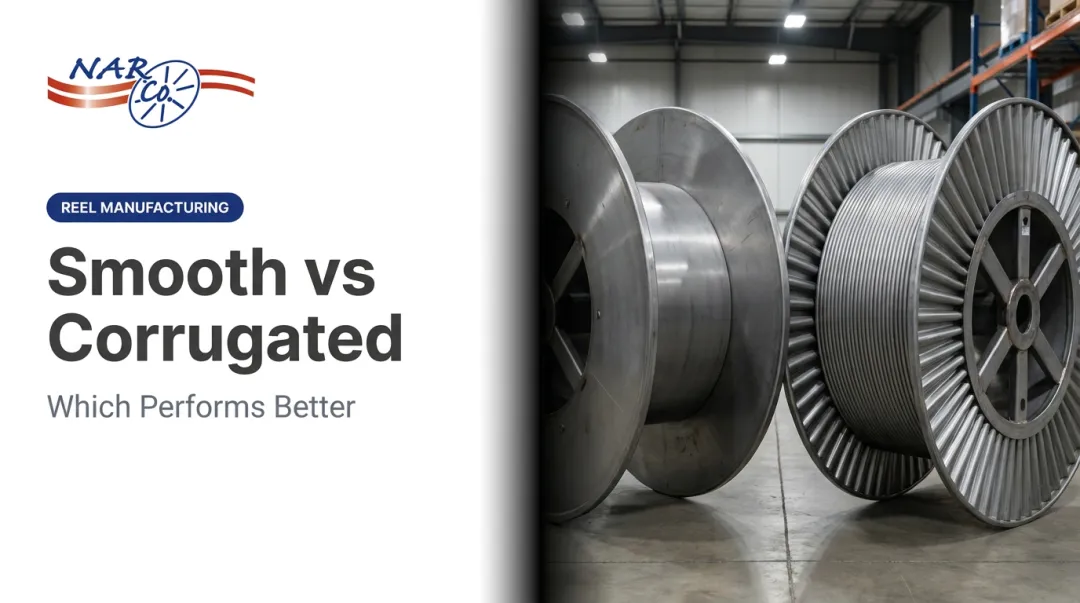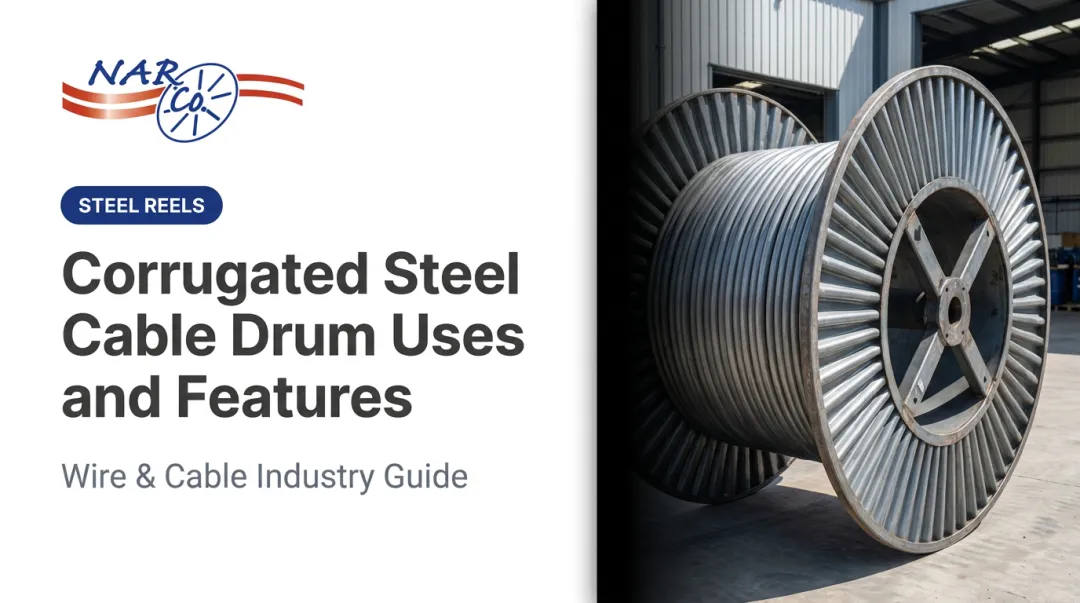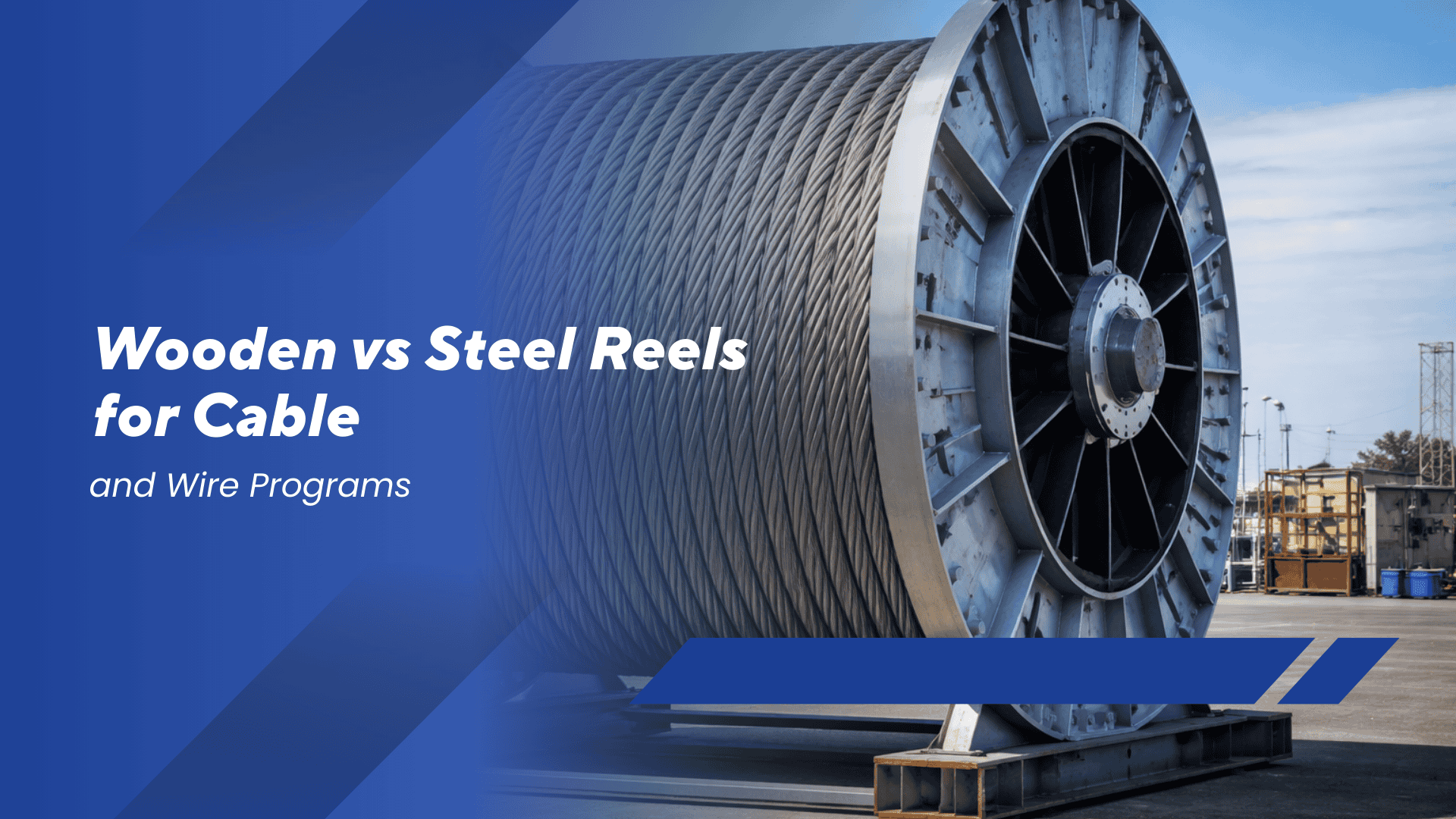
Corrugated reels occupy a specific, well-defined niche: lightweight, recyclable, cost-effective packaging for one-way shipments of wire, cable, rope, and similar flexible materials. They're not a universal solution, but for the right application, they're hard to beat on economics.
This article breaks down what corrugated reels are, how they're built, where they're used across industries, and how to decide whether they're the right fit — or whether steel or wood is the better call.
Key Takeaways
- Corrugated reels use fluted fiberboard flanges and barrels instead of wood or steel — lighter, cheaper, recyclable
- Best suited for one-way domestic shipments of light-to-medium loads where return logistics aren't practical
- Used widely in wire, cable, rope, textile, and flexible conduit packaging
- Not ideal for heavy loads, humid environments, or applications requiring powered payoff equipment
- Steel reels remain the better choice for multi-trip use, high tension, and heavy-duty winding
What Are Corrugated Reels?
A corrugated reel is a spool or drum whose flanges and/or barrel (core) are constructed from corrugated fiberboard — layers of fluted paperboard glued between flat linerboard sheets — rather than wood, plywood, or steel.
How the Structure Creates Strength
The Fibre Box Association explains it clearly: the wavy inner fluting layer acts as a series of structural arches that resist bending and pressure from all directions. When board is placed on edge, those arches form rigid columns. The flutes also keep linerboard sheets separated, maximizing bending rigidity. The result is a construction that achieves meaningful compressive resistance relative to its weight, without depending on raw mass to do it.
Terminology to Know
Before getting into how they're built, it helps to know what they're called. Corrugated reels go by several names in the industry:
- Fiber reels or fibre reels
- Cardboard reels or cardboard spools
- Paper reels
- Polyfiber reels (Sonoco's branded term)
One important distinction: these are not the same as the large kraft paper rolls — also called "reels" — that feed corrugated box manufacturing machines. Those are raw material rolls. Corrugated reels are finished packaging components designed to carry wound product.
Anatomy of a Corrugated Reel
Most corrugated reels share the same basic structure:
- Flanges — the two circular or hexagonal side discs that keep wound material from spilling off the edges
- Barrel or core — the cylindrical center section the material actually winds around
- Arbor hole — a center opening that mounts onto a payoff or take-up spindle (on designs that use one)
- Board construction — typically single-wall, double-wall, or triple-wall corrugated board with kraft linerboard facings
- Hub inserts — optional plastic or metal reinforcements at the spindle interface, added where wear concentrates
Together, these components determine how much load a reel can carry and how it performs during payout.
Types of Corrugated Reels
By Structural Design
Three main structural configurations exist:
- Solid-flange reels — entire flange is laminated layers of corrugated board, offering maximum rigidity
- Open-hub designs — reinforced center hole with a lightened flange area, reducing material cost while maintaining spindle integrity
- Tubular-core reels — corrugated barrel with flanges made from a different material (molded fiber, thin plywood), common where the core needs tight dimensional tolerances
By Wall Construction
Wall construction directly determines load capacity and rigidity:
| Wall Type | Construction | ECT Performance Range |
|---|---|---|
| Single-wall | One medium between two linerboards | 23–55 lb/in ECT |
| Double-wall | Two mediums, three linerboards | 42–82 lb/in ECT |
| Triple-wall | Three mediums, four linerboards | 700–1,300 in-oz/in tear puncture |
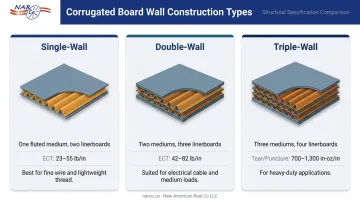
Performance data per Uniform Freight Classification 6000-M, Rule 41. These are board-level specifications, not reel-level safe winding ratings — actual reel capacity depends on geometry, flange design, and winding conditions.
Heavier or longer winding runs require double-wall or triple-wall construction. Single-wall suits fine wire and lightweight thread applications. Wall construction choice also ties directly to reel size — larger reels handling heavier product almost always step up to double- or triple-wall.
By Size and Application
- Small traverse-wound reels — fine wire, thread, monofilament
- Medium reels — electrical cable, magnet wire
- Large fiber drums — rope, hose, flexible conduit
Sonoco's technical line card lists corrugated reels with flange diameters from 6.5 in to 24 in and traverse lengths from 1 in to 18 in. Pop-up corrugated reel designs run from 15 in to 30 in flange diameter, with non-standard sizes available for specialized winding applications.
Key Uses of Corrugated Reels Across Industries
Wire and Cable
This is where corrugated reels are most prevalent. NEMA WC 26-2008 — the binational wire and cable packaging standard — specifically addresses reel and spool capacity in the context of conductor and cable packaging, and the Wire Association International's supplier directory maintains dedicated categories for "Reels-fiber" and "Spools-fiber."
The economics are straightforward: electrical wire, magnet wire, and communication cable are typically shipped on reels that never come back. The customer unwinds the product and discards or recycles the reel. Corrugated wins here on cost and recyclability versus wood.
Rope, Cordage, and Braided Products
Manufacturers of synthetic rope, twine, and braided cord wind product onto corrugated reels for retail and wholesale distribution. The lightweight flange matters here — production floor workers handle reels repeatedly, and shaving several pounds per reel adds up across a shift.
Textile and Thread
Corrugated cores and small corrugated reels are standard in yarn, thread, and monofilament winding. Key advantages in this application:
- Consistent core diameter supports even winding tension throughout the run
- Lower cost than plastic or metal cores at equivalent performance
- Crushes flat after unwinding for easy recycling
Flexible Conduit, Hose, and Tubing
For domestic shipments of flexible conduit, hose, or tubing, corrugated reels offer a practical solution when the reel doesn't need to survive a return trip. The priority is protecting the wound product through a single transit cycle — not reel longevity.
Protective Packaging Rolls
Worth clarifying: corrugated material is also wound into roll format for surface protection, void filling, and wrapping fragile items during shipping. These are rolls of corrugated sheet — not reels designed to carry another product wound around them. The distinction matters when sourcing: packaging rolls and winding reels come from different product categories, even though both use corrugated board.
Corrugated Reels vs. Wood and Steel Reels
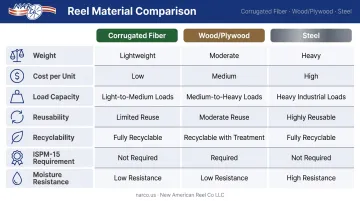
Choosing the right reel material comes down to load requirements, reuse expectations, and total cost. This table breaks down how corrugated fiber stacks up against wood and steel across the factors that matter most.
| Attribute | Corrugated Fiber | Wood/Plywood | Steel |
|---|---|---|---|
| Weight | Lightest | Medium | Heaviest |
| Cost per unit | Lowest | Medium | Highest |
| Load capacity | Light to medium | Medium to heavy | Heavy to very heavy |
| Reusability | Single/limited use | Multi-trip | Multi-trip, longest life |
| Recyclability | Standard cardboard stream | Landfill or specialty | Metal recycling |
| ISPM-15 phytosanitary treatment | Not required (no wood) | Required for export | Not required |
| Moisture resistance | Poor | Moderate | Good |
When corrugated makes sense:
- One-way domestic shipments of light-to-medium loads
- Applications where the end user recycles or discards the reel
- Operations cutting per-unit packaging costs where light-duty protection is sufficient
- International export where avoiding ISPM-15 compliance costs on wood packaging
When steel or wood is the better choice:
- Heavy loads or high-tension winding applications
- Multi-trip distribution where the reel is returned and reused repeatedly
- Environments with moisture, temperature extremes, or rough handling that fiberboard can't survive
- Powered payoff systems that apply significant lateral flange pressure
Benefits and Limitations of Corrugated Reels
Corrugated reels offer a compelling tradeoff: lower cost and weight against reduced durability. Understanding where each side of that equation matters most helps narrow down the right reel for a given application.
Key Benefits
- Weight reduction — significantly lighter than wood or steel, lowering freight cost and reducing manual handling strain
- Lower unit cost — makes economic sense for single-use or short-cycle applications
- Recyclability — fully recyclable through standard cardboard streams; AF&PA reports 69–74% of cardboard available for recovery was recycled in the U.S. in 2024
- No phytosanitary treatment — fiber reels with no wood components fall outside ISPM-15 scope, eliminating that compliance cost for international shipments
- Custom sizing with shorter lead times — fiber reel manufacturers generally offer made-to-order dimensions with faster turnaround than steel tooling
Key Limitations
- Load capacity ceiling — corrugated reels cannot match the load ratings of plywood or steel reels for heavy or dense wound products
- Moisture vulnerability — fiberboard compression strength decreases measurably as relative humidity rises above 30% RH, which can cause flange deformation or core collapse in humid storage or transit conditions
- Limited reuse — designed for single or short-cycle use; reconditioning corrugated reels isn't practical the way it is for steel
- Payoff equipment constraints — powered payoff machines applying lateral flange pressure can damage corrugated flanges; these applications generally require wood or steel
When the product is lightweight, the run is short-cycle, and conditions are controlled, corrugated reels are often the most cost-effective choice. For heavier products, humid environments, or powered payoff lines, wood or steel reels are the more reliable option.
Choosing the Right Reel for Your Application
Work through these variables before specifying a reel:
- Total wound weight — get the actual product weight, not an estimate; this is the most common source of mismatches
- Transit conditions — domestic only, or international? Exposure to moisture or temperature extremes?
- Reel disposition — will it be returned, reused, or discarded at delivery?
- Payoff method — manual handling vs. powered spindle equipment changes the flange stress picture entirely
- Total cost of ownership — unit purchase price is only part of it; factor in freight weight, disposal cost, and whether the receiving end has recycling infrastructure

For light-to-medium domestic shipments on non-return reels, corrugated typically wins on economics. For anything involving return logistics, heavy loads, powered payoff, or outdoor/humid exposure, the math shifts toward wood or steel.
When steel reel performance is required but new reel costs are a concern, professional reconditioning is worth evaluating. Narco (New American Reel Co LLC) has specialized in reconditioning and repairing steel wire reels, bobbins, and spools since 1999, covering reel sizes from 3 in to 96 in. Services available to wire manufacturers and cable producers across the United States include:
- Flange straightening and rim repair
- Dynamic balancing
- Arbor tube replacement
- Custom welding and machining
Reconditioning costs a fraction of buying new, and a properly reconditioned reel performs the same function across many additional cycles.
Frequently Asked Questions
Does corrugation add strength?
Yes. The fluted inner layer forms structural arches that distribute compressive forces and resist bending from multiple directions — giving corrugated constructions significantly better rigidity than flat paperboard of comparable weight.
What are corrugated reels made of?
They're made from kraft or test linerboard bonded to a fluted medium — the same corrugated fiberboard used in shipping boxes — laminated into multiple plies to form flanges and barrels. Some designs include plastic or metal hub inserts at the arbor interface for added strength at wear points.
What is the difference between corrugated reels and wooden reels?
Wood reels are heavier, more durable, and suited for multi-trip use and heavier loads. Corrugated reels are lighter, lower-cost, recyclable, and better suited for one-way shipments of lighter products. Wood reels used in international export also require ISPM-15 phytosanitary treatment; fiber reels without wood components do not.
Can corrugated reels be reused or recycled?
They're designed for single or limited-cycle use — reuse isn't practical for most designs. Recycling is straightforward: corrugated reels go into standard cardboard/paper streams, making disposal simpler and more sustainable than wood or steel.
What industries commonly use corrugated reels?
The main sectors are wire and electrical cable manufacturing, rope and cordage production, textile and thread winding, flexible conduit and hose packaging, and general industrial shipping where a low-cost, disposable reel is the practical choice.
How much weight can a corrugated reel hold?
Capacity depends on flange diameter, core size, wall construction, winding tension, and moisture conditions. Single-wall board rates 23–55 lb/in ECT; double-wall rates 42–82 lb/in ECT — but reel-level limits vary by design. Always request a load rating from your supplier before specifying a corrugated reel for a new application.