For plant managers and procurement teams, the smooth vs. corrugated decision isn't about which design is better overall. It's about which design is right for a specific job. These two reel types are engineered for fundamentally different roles, and matching the wrong reel to an application creates measurable operational and financial consequences.
This article breaks down the structural differences, performance characteristics, compliance standards, and decision factors that determine which reel type belongs in your operation — and where.
Key Takeaways
- Smooth steel reels are built for in-plant production: bunching, stranding, fine wire drawing, and applications where speed, tension control, and conductor surface integrity matter most.
- Corrugated (fluted) steel reels are built for shipping: their fluted barrel reduces reel weight, improving freight cost per unit of wire shipped.
- Neither type is universally superior — most wire plants use both simultaneously at different stages.
- Selection depends on line speed, wire gauge, applicable standard (DIN or NEMA WC 26), and your reconditioning strategy.
Smooth vs. Corrugated Steel Reels: Quick Comparison
This comparison applies specifically to steel wire and cable reels used in manufacturing and shipping — not hand tools, hose reels, or other industries where these terms carry different meanings.
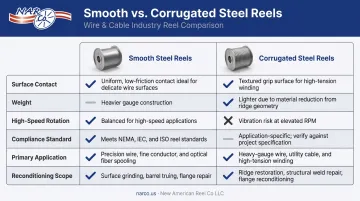
| Factor | Smooth Steel Reels | Corrugated Steel Reels |
|---|---|---|
| Surface contact | Uniform barrel contact | Reduced contact via fluted profile |
| Weight | Heavier (full-wall barrel) | Lighter (fluted construction) |
| High-speed rotation | Designed and balanced for process RPM | Not designed for rotational process use |
| Compliance standard | DIN 46395, DIN 46397 | NEMA WC 26 (RM and RMT types) |
| Primary application | In-plant winding, bunching, stranding | Wire and cable shipping/distribution |
| Reconditioning scope | Broad: re-balancing, arbor work, rim repair, surface restoration | More limited; structural repair possible |
Surface Contact and Wire Interface
Smooth reels provide continuous, uninterrupted barrel contact throughout the winding and payoff cycle. That uniformity matters most for fine-gauge conductors and specialty alloys, where even minor surface irregularities can cause tension variation or marking.
Corrugated reels have a reduced contact surface by design. The fluted ridges and channels hold wire effectively under shipping loads — but they're not appropriate for precision winding applications where consistent contact is required at speed.
RPM Compatibility and Balance
That surface limitation connects directly to how each reel type handles rotational stress.
Pentre Group's BP wire drawing reel — manufactured to DIN 46397 and dynamically balanced to ISO 1940 — is rated for operation above 40 m/sec, with optional balancing for speeds up to 60 m/sec. CNC machining minimizes flange distortion for uniform traversing and high-speed payoff.
Corrugated reels have no equivalent rotational rating. Their structure is built for compression strength under pallet stacking and transit handling, not dynamic balance under process RPM.
What Are Smooth Steel Wire Reels?
Smooth steel reels have a fully or semi-machined barrel and flanges that provide a consistent, uninterrupted contact surface for wire during winding, storage, and payoff. Within that category, there are meaningful differences between variants.
Construction Variants
Narco (New American Reel Co.) supplies several distinct smooth reel types through its Inosym product line, covering the full range of in-plant process applications:
- Fully machined reels — dynamically balanced, manufactured to DIN 46397, also referred to as multiwire reels. Built to customer specifications for demanding high-speed applications.
- Semi-machined reels — feature double-wall curled flanges, machined on all product contact surfaces, and dynamically balanced to DIN 46397. The curled flange construction adds durability for continuous process use.
- Metal flanged reels (pressed flange/buncher reels) — can be manufactured to DIN 46395. Common for both process and shipping needs across a wide range of sizes.
- Enhanced metal flange reels — designed for the most demanding heavy cable, wire, or rope applications.
All variants are available from 3" to 96" (75mm to 2,400mm) in diameter.
Why Precision Machining Matters at Speed
At high winding speeds, small deviations in flange concentricity or arbor bore geometry translate directly into runout, vibration, and tension variation. For fine-gauge magnet wire or high-purity copper applications, that variation directly degrades product quality at the conductor level.
Dynamic balancing addresses rotational imbalance that machining alone doesn't eliminate. Narco's dynamically balanced reels are built to handle the RPM demands of modern high-speed spooling equipment — a capability that becomes critical as line speeds increase and tolerance for vibration shrinks.
Where Smooth Reels Are Used
Smooth machined reels are the standard choice for:
- Bunching and stranding lines — where rotational speed and dynamic balance directly affect output consistency
- Fine wire drawing — where surface contact and tension consistency directly affect conductor integrity
- Magnet wire winding — tight tolerance winding on precision-machined surfaces
- Extrusion payoff and take-up — consistent tension at varying speeds
- Lay-up process drums — requiring precise flange geometry and arbor fit

What Are Corrugated Steel Wire Reels?
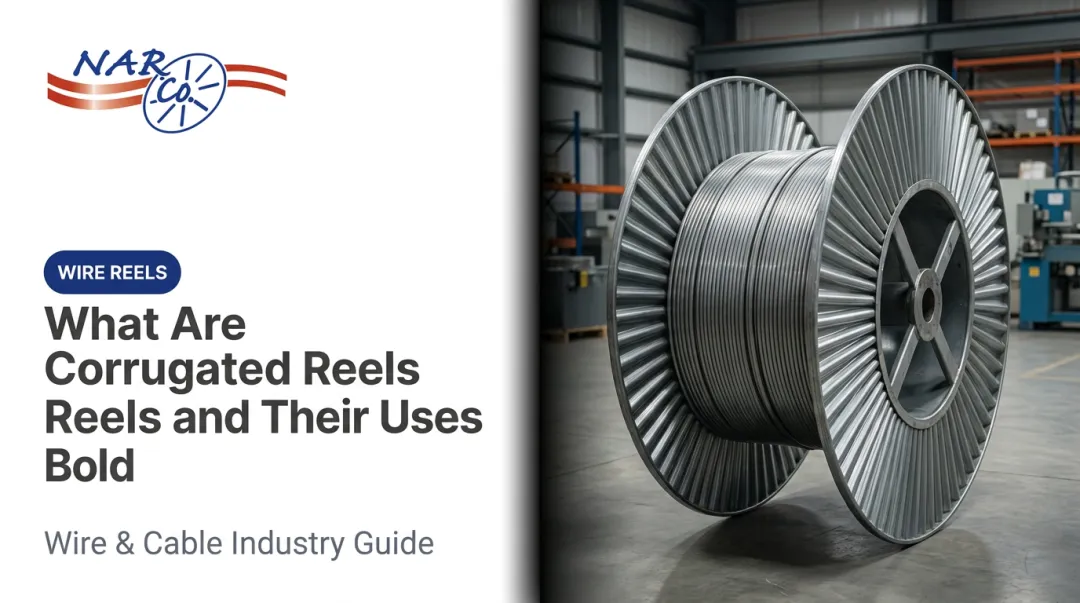
Corrugated steel reels — also called fluted reels — feature a barrel with a series of longitudinal ridges and channels rather than a smooth cylindrical wall. That profile reduces material volume and overall reel weight without sacrificing the structural load capacity needed for shipping.
The NEMA WC 26 Standard
Corrugated shipping reels in the U.S. wire and cable industry are manufactured to NEMA WC 26 (WC 26-2008 / EEMAC 201-2008) — the binational wire and cable packaging standard covering uniform packaging requirements for the North American market.
NEMA WC 26 defines two steel fluted returnable reel types:
- Type RM — flat-bar-tire fluted steel reel
- Type RMT — I-beam-tire fluted steel reel
These classifications define flange diameter, traverse width, arbor diameter, and loading specifications, so they work with standard carrier handling equipment. Narco supplies corrugated reels in both RM and RMT configurations to NEMA WC 26 standards, manufactured to customer specifications across a range from 3" to 96".
Structural Capability and Freight Role
The corrugated profile is engineered specifically for compression strength under pallet stacking and transit handling loads. Southwire's published reel data illustrates the weight range involved: steel reel weights in their lineup run from approximately 895 lb for an S-120/RMT 84.36 to over 4,500 lb for larger configurations — and the reel's own weight is a direct freight cost factor on every shipment.
The fluted construction reduces that weight relative to a comparable solid-wall barrel, which directly affects freight cost calculations. NMFTA defines density — weight divided by volume — as a core freight classification driver, meaning lighter reels improve density calculations and can lower LTL freight class.
What corrugated reels are not built for: high-speed rotation. There is no dynamic balance rating, no RPM specification, and no precision machining on the barrel surface. Using them in process applications would create both quality and safety problems.
Where Corrugated Reels Are Used
Corrugated reels are the standard choice for:
- Outbound shipping of wire and cable to distributors, contractors, and OEM customers
- Utility cable and building wire on standard pallet configurations
- Armored cable, control cable, and industrial wire where cube efficiency and freight cost per unit affect margin
- Used reel procurement — Narco maintains inventory of used corrugated reels (RM and RMT types) as a cost-effective option for shipping-only applications
Smooth vs. Corrugated: Which Performs Better for Your Operation?
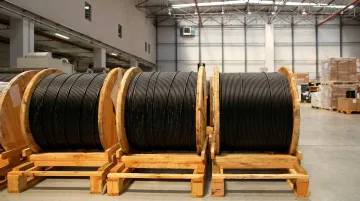
"Better" is the wrong frame. These are purpose-built tools for different stages of the same product's journey. Many wire plants run smooth machined reels on every process line and corrugated reels on every outbound shipment — using both simultaneously without conflict.
Decision Framework for Plant Managers
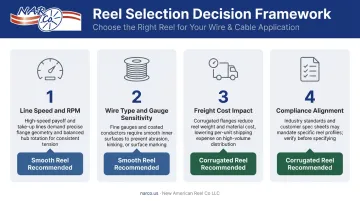
Work through these four factors to determine which reel type a given application requires:
Line speed and RPM — If the application involves high-speed bunching, stranding, or drawing, smooth machined reels with dynamic balancing are required. Corrugated reels are not a viable alternative.
Wire type and gauge sensitivity — Fine-gauge magnet wire, specialty alloys, and high-purity copper require the uniform surface contact and tension consistency of smooth reels. Standard building wire, utility cable, and armored cable going out on pallets don't need it.
Freight cost impact — If reel weight is a measurable line item in your shipping cost, corrugated reels deliver a direct advantage. The fluted barrel construction reduces reel tare weight, which improves freight density calculations on every outbound load.
Compliance alignment — Specify DIN 46397 for precision process reels; specify NEMA WC 26 (RM or RMT) for shipping reels. These aren't interchangeable standards.
Lifecycle Cost Perspective
Smooth precision reels carry a higher upfront cost, but that cost spreads across multiple reconditioning cycles. Narco's steel reel refurbishment services cover a wide range of recoverable damage, including:
- Dynamic re-balancing and arbor tube restoration or replacement
- Arbor hole size modification and rim repair
- Flange straightening and welding for cracked flanges
- Blasting, painting, and stenciling
A well-maintained smooth reel can return to spec repeatedly rather than being replaced.
Corrugated shipping reels can also undergo structural refurbishment — welding, machining, and restoration work are available — but the economics are different. Shipping reels see rougher handling in transit and at job sites, and the cost-per-use calculation often favors replacement, particularly for smaller sizes. Narco's used corrugated reel inventory provides a cost-effective procurement path for operations that need NEMA WC 26-compliant reels without new-reel pricing.
Situational Guidance
| If your priority is... | Choose... |
|---|---|
| High-speed bunching or stranding precision | Smooth machined reel (DIN 46397) |
| Fine-gauge or specialty conductor integrity | Smooth machined reel |
| Outbound shipping cost efficiency | Corrugated reel (NEMA WC 26 RM/RMT) |
| NEMA WC 26 compliance for pallet shipping | Corrugated reel |
| Long-term asset lifecycle with reconditioning | Smooth machined reel program |
| Cost-effective shipping reel supply | Used corrugated reel inventory |
Conclusion
Smooth and corrugated reels are engineered for different jobs. Putting the wrong type in the wrong role creates real, avoidable costs.
Using smooth process reels in shipping applications adds unnecessary reel weight to every load. Using corrugated reels in high-speed process applications creates conductor damage and balance problems. Both are avoidable errors with real cost consequences.
Narco manufactures and supplies both smooth steel reels (DIN 46397 and DIN 46395) and corrugated shipping reels (NEMA WC 26, RM and RMT types) across sizes from 3" to 96", with reconditioning services including dynamic re-balancing and arbor restoration.
For help selecting the right reel for your production or distribution operation, contact Narco at 419-258-2900 or Mark@Narco.us.
Frequently Asked Questions
What is the main difference between smooth and corrugated steel wire reels?
Smooth reels have a uniform machined barrel surface designed for in-plant precision winding and high-speed process use, where consistent wire contact and dynamic balance are critical. Corrugated (fluted) reels are engineered for wire and cable shipping, reducing reel weight through their ridged barrel profile to improve freight efficiency.
When should a wire manufacturer use corrugated reels instead of smooth reels?
Corrugated reels are the right choice when the reel is part of the outbound product packaging — shipping wire or cable to distributors, contractors, or OEMs. They're especially appropriate when NEMA WC 26 compliance is required and when reel tare weight affects LTL freight classification and cost.
Are corrugated wire reels NEMA WC 26 compliant?
Yes. NEMA WC 26 (WC 26-2008 / EEMAC 201-2008) defines Type RM and Type RMT fluted steel reels, covering flange dimensions, traverse width, and load ratings. It is the governing standard for wire and cable shipping reels across North America.
Do smooth or corrugated reels last longer in high-speed winding operations?
Smooth machined reels (DIN 46397) are the only design built for high-speed bunching, stranding, or drawing lines. Corrugated reels aren't rated for rotational process use and don't support the reconditioning cycles that extend smooth reel service life across multiple production runs.
Can smooth steel wire reels be reconditioned more effectively than corrugated reels?
Smooth precision reels support a full reconditioning menu: dynamic re-balancing, arbor resizing, rim repair, flange restoration, and welding. For corrugated shipping reels, structural refurbishment is possible, but replacement or sourcing used inventory typically makes more economic sense.
How does reel surface type affect wire tension and payout consistency?
Smooth reel surfaces provide uniform contact across the wire barrel, minimizing tension variation and reducing the risk of conductor marking during payoff. This is especially critical for fine-gauge or specialty conductor applications where surface integrity directly affects product quality downstream.