This article breaks down the key differences between plastic and metal wire reels across durability, load capacity, cost, and repairability — and gives you a clear framework for matching the right reel to your specific operation.
Key Takeaways
- Plastic reels are lightweight, corrosion-resistant, and lower cost upfront — best for light-gauge wire packaging and single-use shipping applications
- Metal (steel) reels handle heavy wire payloads, sustained production winding, and repeat-use shipping where structural integrity is non-negotiable
- Damaged plastic reels get discarded; damaged steel reels can be welded, machined, and dynamically rebalanced, making them significantly more cost-effective across a long production lifecycle
- The right choice comes down to wire type, load weight, production frequency, and whether reel reuse is part of your operating model
Plastic vs Metal Wire Reel: Quick Comparison
The right reel depends on your load, reuse expectations, and total cost over time. Here's how plastic and steel options stack up across the factors that matter most in wire and cable operations.
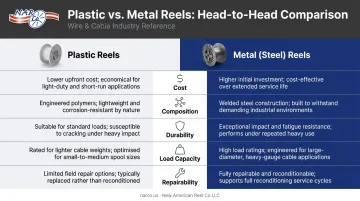
| Factor | Plastic Reels | Metal (Steel) Reels |
|---|---|---|
| Cost | Lower purchase price; limited reuse raises per-cycle cost | Higher upfront; reconditioning extends life across many cycles |
| Composition | ABS or PP polymers; lightweight, non-metallic | Carbon or galvanized steel; welded flanges, machined arbors |
| Durability | Adequate for light loads; cracks or warps under heavy tension | Engineered for mechanical stress, high-tension winding, industrial handling |
| Load Capacity | Light-gauge wire, thin cable, small spools | Heavy steel wire, armored cable, rope — without structural deformation |
| Repairability | Generally not repairable; treated as disposable | Flanges, arbors, and cores can be welded, straightened, and remachined |
What Is a Plastic Wire Reel?
Plastic wire reels are spools molded from polymer materials — most commonly ABS (acrylonitrile butadiene styrene) or polypropylene — used to wind, store, and ship wire or cable. In wire manufacturing, they fill a specific role: lightweight, low-cost spooling for applications where structural demands are moderate.
Their practical advantages in wire operations include:
- Corrosion immunity — no rust in humid factory conditions or outdoor storage
- Low shipping weight — lighter reels reduce freight costs on outbound product
- Molding flexibility — plastic forms easily into varied spool sizes without heavy tooling investment
- Color options — can be produced in black, natural, or custom colors for identification
Plastic reels are available from small bobbins for fine wire up to larger spools for cable packaging. They're designed for wire packaging and distribution — not for the mechanical demands of heavy production winding.
Use Cases for Plastic Wire Reels
Plastic reels fit where the spool ships with the product and isn't expected to return. Common applications include:
- Telecommunications cable packaging
- Magnet wire and fine wire reels
- Welding wire spools (one verified model: 15 kg / 33 lb capacity per ISO 544:2018)
- Data cable spools and fiber optic cable packaging
Structural limits are well-documented. Spazzolplastica's plastic welding-wire spool specification explicitly states that PC/ABS spools are not recommended for winding stainless steel wires, warns that heat can permanently warp plastic, and limits storage and transport temperatures to 41–113°F. Direct sunlight alone can compromise the spool before reaching a production floor.
What Is a Metal Wire Reel?
Metal wire reels are fabricated from steel — typically carbon steel or galvanized steel — and serve as the primary spooling medium in industrial wire manufacturing, heavy cable production, and commercial wire shipping. Unlike plastic reels, they're engineered to precise dimensional tolerances to fit industrial winding and pay-off equipment.
Core operational advantages:
- Withstands sustained wire tension without deformation
- Maintains consistent layer winding geometry across a full spool
- Steel flanges protect wire edges during transport and rough handling
- Fits drawing machines, stranding equipment, and pay-off systems to precise dimensional specs
NEMA WC 26-2008 — the North American standard for wire and cable packaging reels — defines "maximum strength capacity" as the total conductor or cable weight a reel can carry and covers returnable, reusable, and non-returnable reel classifications. Steel reels built to these standards, or to DIN 46395/46397 for process applications, are purpose-built for heavy-duty production environments.
Use Cases for Metal Wire Reels
Steel reels dominate wherever wire tension, weight, and handling demand exceed what plastic can support:
- Wire drawing and bunching — continuous production on high-speed drawing machines
- Steel wire stranding and rope manufacturing
- Bare copper and aluminum conductor production
- Armored cable (medium and high voltage)
- Welding wire shipment at commercial volumes
Narco has been fabricating and reconditioning steel wire reels since 1999, covering sizes from 3" to 96" (75mm to 2400mm). Their steel reel product range includes:
- Fully machined reels built to DIN 46397
- Semi-machined reels with double-wall curled flanges
- Metal flanged (buncher) reels to DIN 46395
- Corrugated shipping reels per NEMA WC 26
- Heavy-duty enhanced flange reels for cable and rope applications
- Custom configurations including collapsible bobbins and non-standard arbor dimensions
With periodic reconditioning, a steel reel can return to full spec and run through many additional production cycles — making it a long-term capital asset rather than a consumable.
Plastic vs Metal Wire Reel: Which Is Better?
The comparison isn't simply price versus weight. The right answer depends on your specific situation.
Choose Plastic When:
- The wire is light-gauge — hookup wire, telecom cable, magnet wire, data cable
- The spool ships with the product and won't return for reuse
- Corrosion resistance matters more than structural strength
- Upfront cost per unit is the primary constraint
Choose Metal When:
- The wire is heavy gauge — steel wire rope, thick copper, armored cable
- The reel runs repeatedly on industrial winding and pay-off equipment
- Total cost of ownership over the reel's service life matters more than unit price
- Dimensional precision and machine compatibility are non-negotiable
The Repairability Factor
In high-volume wire manufacturing, reel damage is routine. Flanges get bent during handling, arbors wear from repeated mounting cycles, and dynamic balance shifts after impact. What happens next is where plastic and steel part ways.
Plastic reels that crack or warp are discarded. There's no cost-effective repair path.
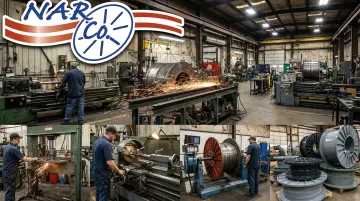
Steel reels can be restored. Narco's steel reel reconditioning services cover the full range of common damage:
- Bent flanges straightened and pressed back to spec
- Damaged rims repaired structurally
- Worn arbor tubes repaired or replaced
- Worn drive pin holes machined or replaced
- Dynamic balancing included as standard — critical on high-speed equipment where minor imbalance causes vibration and layering problems
Based on Narco's reconditioning work since 1999, refurbishing a steel reel typically costs 40–70% less than buying a new one — a figure consistent with the labor-versus-materials reality of repair over replacement.
Operations running dozens or hundreds of reels through repeated cycles don't just save on per-reel cost. They cut the procurement cycle, reduce inventory carrying costs, and avoid the production interruptions that come with waiting on replacement stock.
Conclusion
Neither material wins universally. Plastic reels are a legitimate, well-suited choice for light-gauge wire packaging, single-use distribution, and environments where corrosion resistance and low weight define the requirement. Metal reels are the operational backbone of industrial wire manufacturing — the right choice wherever wire weight, production frequency, and multi-cycle reuse are in play.
That distinction becomes clearest when you look past the purchase price.
Load performance, downtime from reel failures, and the ability to recondition rather than replace all factor into total cost of ownership. On that basis, steel reels consistently outperform plastic for high-volume industrial operations. For wire manufacturers running multi-cycle production, reconditioning a steel reel rather than replacing it is often where the real cost advantage is realized — something Narco has built its services around since 1999.
Frequently Asked Questions
Is plastic heavier than metal?
No — steel is significantly denser than plastic. ASTM A36 carbon steel has a density of approximately 7.80 g/cc, compared to 1.01–1.20 g/cc for ABS and 0.886–0.90 g/cc for polypropylene. A steel reel of equivalent dimensions will weigh considerably more, which directly affects freight costs and handling logistics.
How strong is plastic compared to steel?
The gap is substantial. ABS plastic has an ultimate tensile strength of 22.1–74.0 MPa; ASTM A36 steel reaches 400–550 MPa. For wire reels, that difference is practical — high-tension winding and heavy wire payloads deform or crack plastic flanges under conditions that steel handles without issue.
Are plastic reels good?
Yes, for the right application. Plastic reels are well-suited for light-gauge wire packaging, single-use shipping, and environments where rust resistance and low weight are priorities. They're not the right choice for heavy industrial winding, high-tension applications, or operations that require reels to return and run again.
Can plastic wire reels be repaired or reconditioned?
Generally, no. Once a plastic reel cracks, warps, or suffers structural damage, it's discarded. Metal reels, by contrast, can be welded, straightened, machined, and dynamically rebalanced — restoring them to serviceable condition at a fraction of replacement cost.
Which type of wire reel is better for heavy gauge wire?
Metal reels. Steel wire rope, thick copper conductor, and armored cable generate wire tensions and payload weights that plastic reels are not rated for. Steel construction — with proper flange geometry and arbor tolerances — maintains structural integrity under the loads these products demand.
How long do metal wire reels last compared to plastic?
Steel reels, with proper maintenance and periodic reconditioning, can remain in production-ready condition across many cycles. Plastic reels have shorter, less predictable service lives under industrial conditions and are rarely, if ever, reconditioned.