Introduction
Wire manufacturers, cable producers, and shipping companies face the same choice on every order: plastic or steel? Choose wrong, and the consequences are immediate — product damage, reel failures mid-shipment, inflated freight costs, and unplanned downtime on the floor.
Load capacity sits at the center of this decision. An undersized reel risks structural failure under the weight of wound product. An oversized or wrong-material reel simply adds unnecessary cost.
Beyond raw capacity, material choice shapes reusability, handling requirements, and how long a reel stays in service before it needs replacing.
This article breaks down the key differences between plastic and steel wire reels — covering load capacity, durability, cost economics, and real-world use cases — so operations teams can match the right reel to the right application.
Key Takeaways
- Plastic reels suit lighter applications — fine wire, automotive harness, monofilament — and work well as one-way or short-cycle shipping reels
- Steel reels handle a far broader load range, from standard wire coils up to heavy power cable drums rated for multiple tons
- Steel reels can be reconditioned — welded, machined, rebalanced — and reused across many cycles, lowering cost-per-use over time
- Plastic wins on upfront cost and weight; steel wins on load tolerance, durability, and long-term fleet economics
- The right choice hinges on product weight, use frequency, and whether the reel serves production or shipping
Plastic vs. Steel Wire Reels: Quick Comparison
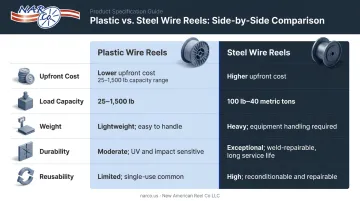
| Factor | Plastic | Steel |
|---|---|---|
| Upfront Cost | Lower per unit; economical for one-way use | Higher upfront; cost-per-use drops significantly with reconditioning |
| Load Capacity | Suited for lighter gauge wire; plastic spool ratings range from 25–75 lb (Gibbs), up to 1,000 lb (Sonoco), and up to 1,500 lb (Mossberg R2) | Broader heavy-duty range; steel spools rated 100–1,000 lb (Gibbs); fabricated reels reach up to 40 metric tons (~88,000 lb) |
| Weight | Significantly lighter; Gibbs plastic spools weigh 1.5–4 lb empty | Considerably heavier; Gibbs steel spools weigh 15–75 lb empty — mechanical handling required |
| Durability | Susceptible to cracking, warping, and UV degradation; shorter service life | Resistant to impact and load deformation; can be galvanized and reconditioned |
| Reusability | Some collapsible/nestable designs allow return shipping; Mossberg R2 rated for years and hundreds of trips | Designed for repeated industrial use; demountable versions allow compact return; repairable when damaged |
What Are Plastic Wire Reels?
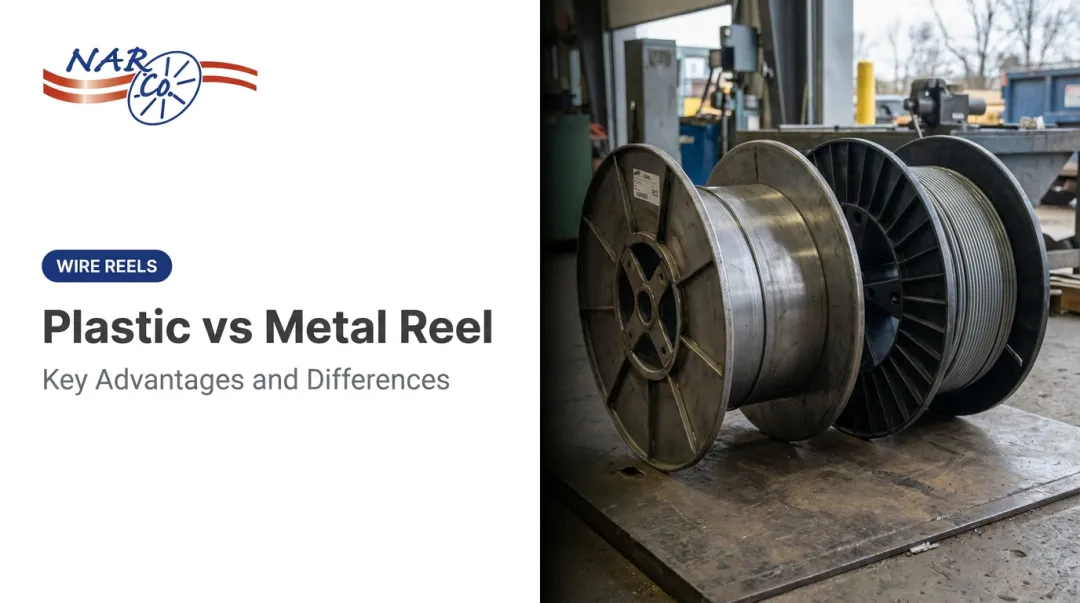
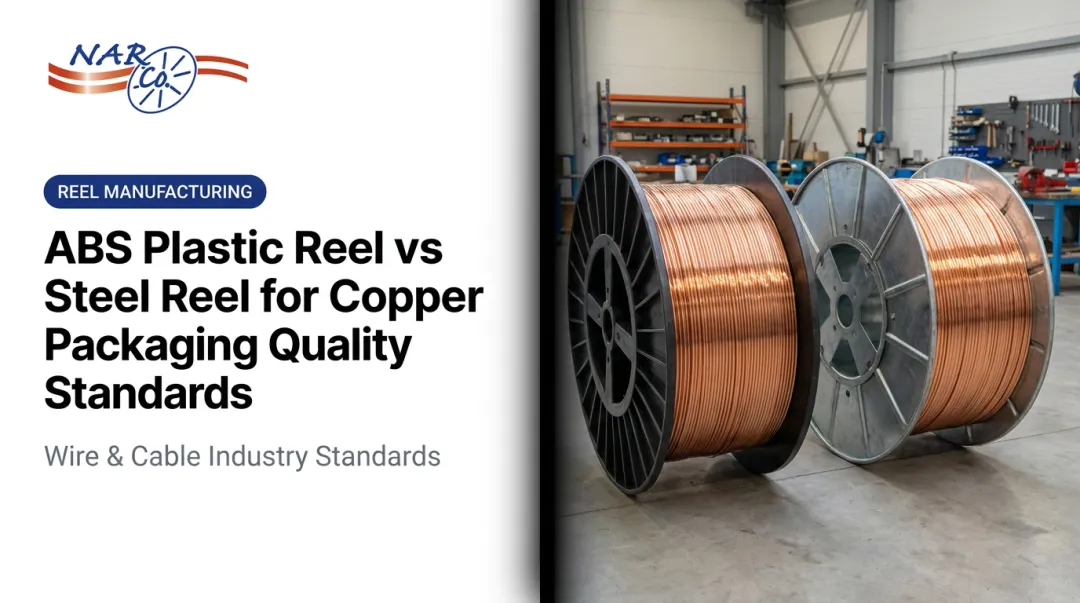
Plastic wire reels are spooling carriers made from injection-molded thermoplastics — most commonly ABS, polystyrene (PS), polypropylene (PP), and nylon (PA).
Narco, acting as a Midwest sales agent for Inosym, supplies plastic reels made from 100% new ABS plastic. Available options cover process reels, magnet wire reels, welding wire spools, and data cable spools for both process and shipping applications.
Design Categories
Plastic reels fall into two design categories:
- One-way — single-use shipping reels designed for cost-effective outbound delivery with no return logistics
- Reusable — collapsible or nestable designs that disassemble for compact return shipping; Mossberg's R2 heavy-duty cable reels, for example, are rated for hundreds of trips, with disassembled components requiring one-third the storage space of an assembled unit
Load Capacity and Typical Sizes
Published manufacturer ratings vary considerably by size and design. Representative capacity benchmarks:
| Manufacturer / Product | Capacity Range | Notes |
|---|---|---|
| Gibbs Wire plastic spools | 25–75 lb | Small flange sizes |
| Sonoco product line | 50–1,000 lb | Multiple process reel classes |
| Mossberg R2 Gen II | 1,500 lb | Upper limit for reusable plastic designs |
Sonoco's Reel Tough process reels come in 18 in, 22 in, and 30 in flange diameters, replacing steel process reels at one-third the cost and weight while fitting 12% more wire per shipment.
Use Cases
Plastic reels are most common in:
- Automotive wire harness manufacturing (light-gauge insulated wire)
- Telecommunications cable distribution (fiber and copper distribution cable)
- Consumer electronics (fine wire, magnet wire, data cable)
- Textile and monofilament applications
- Light building wire shipping to downstream assemblers
What Are Steel Wire Reels?
Steel wire reels are heavy-duty cylindrical spooling devices constructed from welded or demountable steel — featuring a steel barrel (core), steel flanges, and an axial arbor hole for mounting on a production axle or crane shaft. Narco manufactures steel reels from 3 in to 96 in (75 mm to 2,400 mm) in diameter, covering everything from standard process reels to large shipping drums.
Construction Types
Narco's steel reel line includes several construction approaches, each suited to different load and application requirements:
- Fully Machined Reels — dynamically balanced, manufactured to DIN 46397; designed for high-speed production line use
- Semi Machined Reels — double-wall curled flanges, machined on all product contact surfaces, dynamically balanced
- Metal Flanged Reels — pressed flange or buncher reels, made to DIN 46395; common for both process and shipping
- Enhanced Metal Flange Reels — built for the most demanding applications involving heavy cable, wire, or rope
- Steel Drums — suited for extrusion, drum twisting, and lay-up processes
- Corrugated Shipping Reels — manufactured to NEMA WC 26 standards in a wide range of sizes
Load Capacity Range
Steel reels span an enormous load range depending on construction:
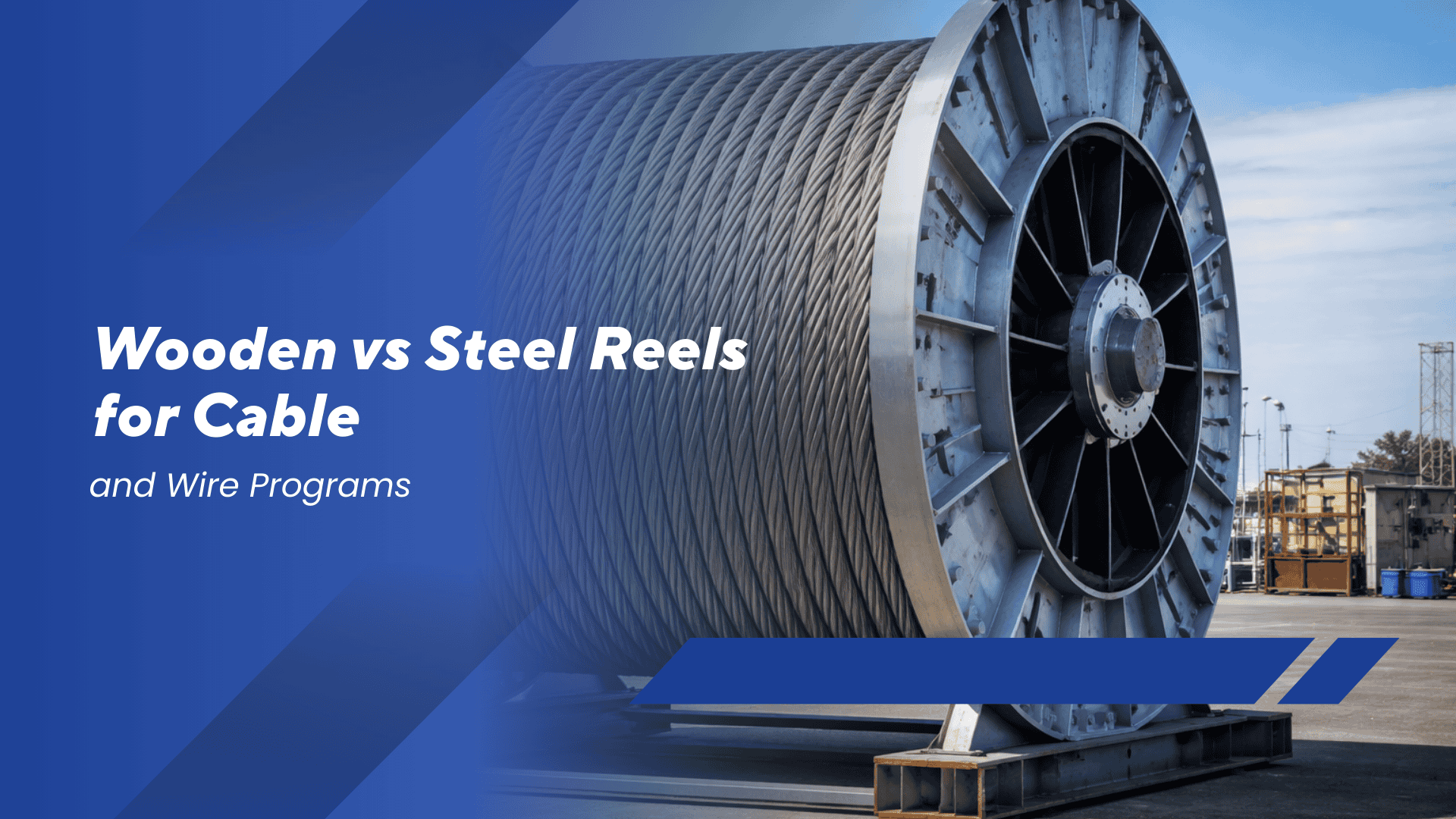
- One-piece welded-up reels — flange diameters from 48 in to 14 ft, capacity up to 40 metric tons; used for large-diameter power and submarine cable
- Standard steel wire spools (per Gibbs) — 100 lb, 500 lb, and 1,000 lb capacities across 12 in to 30 in flange sizes
Dynamic Balancing
For production-line steel reels, dynamic balancing is a firm production requirement. An unbalanced reel running at speed creates vibration and runout — leading to inconsistent winding, equipment wear, and potential wire damage.
ISO 1940-1:2003 defines balance-quality requirements for rigid rotors, specifying tolerances, correction planes, and residual unbalance verification methods. Narco's fully machined and semi-machined reels are dynamically balanced during manufacturing, and balancing is also available as part of reconditioning — restoring production-ready performance to reels that have experienced deformation or uneven wear.
Reconditioning and Repairability
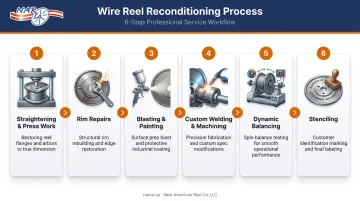
Unlike plastic reels that are typically discarded after damage, steel reels can be structurally repaired and returned to service. Narco's standard reconditioning process includes:
- Straightening and press work — corrects flange deformation from impact or overloading
- Rim repairs — restores structural integrity at the flange edge
- Blasting and painting — removes corrosion and applies a protective finish
- Custom welding and machining — addresses damaged drive pin holes, arbor tubes, or out-of-spec dimensions
- Dynamic balancing — confirms spin performance before the reel re-enters production
- Stenciling — reapplies logo, tare weight, and customer markings
Narco has been providing this specialized reconditioning work for U.S. wire and cable manufacturers since 1999.
Use Cases
Steel reels are the standard choice for:
- Heavy-gauge wire drawing operations
- Large-diameter power cable manufacturing and shipping
- Steel wire rope production and shipping
- Submarine and underground cable programs
- Utility and construction project supply (overhead transmission, structural wire)
Plastic vs. Steel Wire Reels: Which Is Right for Your Operation?
Four variables should drive this decision:
- Wire or cable weight — does it fall within plastic reel rated capacity, or does it exceed what plastic can reliably support?
- Production vs. shipping function — process reels in high-speed lines require dynamic balance; outbound shipping reels do not
- Use cycle frequency — is the reel used once, or returned and reused across many shipments?
- Environmental conditions — outdoor storage, humidity, and handling intensity all affect service life differently for each material
The Load Threshold
Plastic reels perform well within their rated capacity — and the capacity ceiling has risen with heavier-duty reusable designs. For lighter-gauge products (automotive wire, fine cable, monofilament), plastic delivers sufficient structural performance at a lower cost.
Once load requirements push beyond what plastic reliably supports — particularly for heavy-gauge wire, large cable drums, or production-line applications with centrifugal stress — steel is the practical choice. CED Engineering's power cable documentation lists common failure concerns under heavy loads including flange cracking, barrel deformation, cable crushing, and reel collapse risk during storage. Each failure mode is a direct consequence of mismatched reel capacity and product weight.
Cost-Per-Use Economics
Load capacity determines which reel material is structurally viable — but once that's settled, cost-per-use determines which is economically sound. Unit price favors plastic, but that metric only holds when reuse isn't in play.
Consider the difference over time:
- A one-way plastic reel at a lower per-unit cost is consumed with each shipment — every delivery requires a new reel
- A steel reel reconditioned 10+ times spreads the original purchase price plus reconditioning costs across many cycles, often reaching a lower cost per reel-use than continuous plastic reel purchases
Narco's reconditioning and repair services support exactly this model — extending reel service life through welding, machining, and refurbishment so operators get more cycles from each steel reel in their fleet.
Situational Recommendations
Choose plastic when:
- Shipping lighter wire products with no reel return program in place
- Minimizing reel tare weight is a freight priority
- Single-use or limited-cycle distribution is the operating model
- Upfront per-unit cost is a priority over long-term reusability
Choose steel when:
- Handling heavy-gauge wire, large cable, or wire rope
- Running high-speed production lines requiring dynamic balance
- Operating in harsh, corrosive, or outdoor storage environments
- Reconditioning and multi-cycle reuse is part of the logistics model
Real-World Scenarios: Choosing the Right Reel
Scenario 1: Automotive Wire — Plastic Is the Right Call
A wire manufacturer producing automotive harness wire ships finished product directly to vehicle assemblers. The wire is light gauge, the shipments are one-way, and there's no reel return program with the customer. Plastic reels — sized appropriately for the product weight — reduce freight cost through lower tare weight, eliminate return logistics complexity, and cost less per unit than steel alternatives. The supply chain stays simple, and reel cost per shipment stays low.
Scenario 2: Heavy Cable — Structural Failures From an Undersized Reel
A power cable manufacturer experiences recurring reel failures — flange cracking, barrel deformation, and occasional cable damage — after loading large-diameter cable onto reels originally specified for lighter product. The load exceeds what the reel design was rated for. Switching to properly rated steel reels, engineered and dynamically balanced for the actual cable weight and winding tension, eliminates the structural failures and reduces product damage incidents. Replacement costs fall because steel reels aren't discarded after a single deformation event.
Scenario 3: Steel Reel Reconditioning Program
A wire manufacturer operates a fleet of steel process and shipping reels that cycle through production, ship to customers, and return for reuse. Rather than purchasing new reels every time flanges are bent or rims damaged, the manufacturer sends damaged reels through reconditioning — straightening, welding, machining back to dimensional tolerance, and dynamic rebalancing before returning to service.
That reconditioning cycle — welding, machining, and dynamic balancing — is what Narco has delivered to U.S. wire and cable manufacturers since 1999, keeping reel fleets productive without the overhead of constant new-reel purchases.
For light product and one-way logistics, plastic makes sense. For heavy loads, production-line use, and long-term reel costs, steel paired with a reconditioning program is the more durable and cost-efficient path. If you're evaluating steel reel repair, reconditioning, or custom fabrication options, contact Narco to discuss your specific requirements.
Conclusion
Plastic reels are a sound choice for lighter wire and cable applications where one-way shipping and reel disposal fit the operating model. Steel reels belong in operations where load demands, production-line intensity, environmental conditions, or multi-cycle reuse are factors — particularly for heavy cable, wire rope, and power transmission applications.
Quick reference:
- Plastic: Lighter loads, one-way shipments, disposable-reel workflows
- Steel: Heavy cable, wire rope, high-cycle production, outdoor or harsh environments
Reel selection comes down to total operational cost, not unit price. That means weighing product protection, reel longevity, and reconditioning value against the demands of your specific application. Match the material to the load, and both cost efficiency and uptime follow.
Frequently Asked Questions
Frequently Asked Questions
Are plastic reels good?
Plastic reels work well for lighter-weight wire and cable applications, offering lower cost, reduced tare weight, and solid performance within their rated load range. For heavy-gauge wire or high-load production environments, steel reels are required.
Is steel heavier than plastic?
Yes. Steel reels weigh considerably more than plastic reels of the same size, which increases handling requirements and freight costs. That extra mass is what allows steel to safely support much higher wire and cable loads without deforming.
What is the load capacity difference between plastic and steel wire reels?
Plastic reels handle lighter loads, with published ratings from 25 lb (small spools) up to 1,500 lb for heavy-duty reusable designs. Steel reels span a much wider range: from 100 lb standard wire spools up to 40 metric tons for large welded cable drums.
When should you choose a plastic reel over a steel reel?
Choose plastic for lighter wire products, one-way outbound shipping with no reel return program, freight-weight-sensitive logistics, or lower-volume applications where upfront reel cost takes priority over long-term reusability.
Can steel wire reels be repaired and reused?
Steel reels can be reconditioned through welding, machining, and dynamic rebalancing, restoring their original strength and dimensional accuracy for continued service. That multi-cycle reuse makes steel more cost-effective over time than plastic, which is typically replaced after damage.
What does dynamic balancing mean for wire reels?
Dynamic balancing ensures a reel spins without vibration or runout at operating speed. For high-speed production lines, it's essential to prevent wire damage, equipment wear, and inconsistent winding — and it's a standard part of Narco's steel reel manufacturing and reconditioning work.