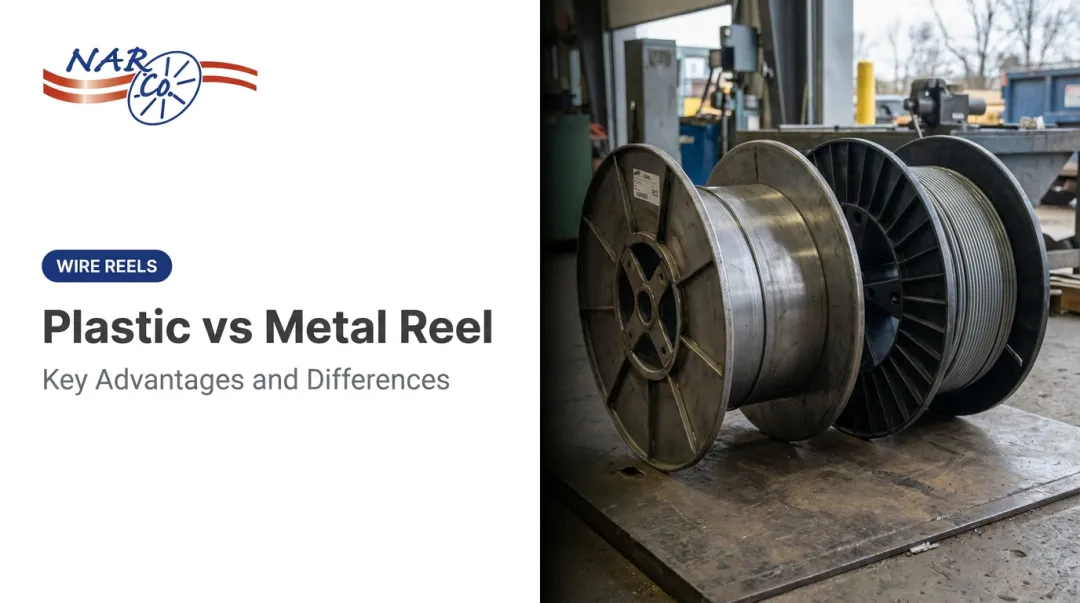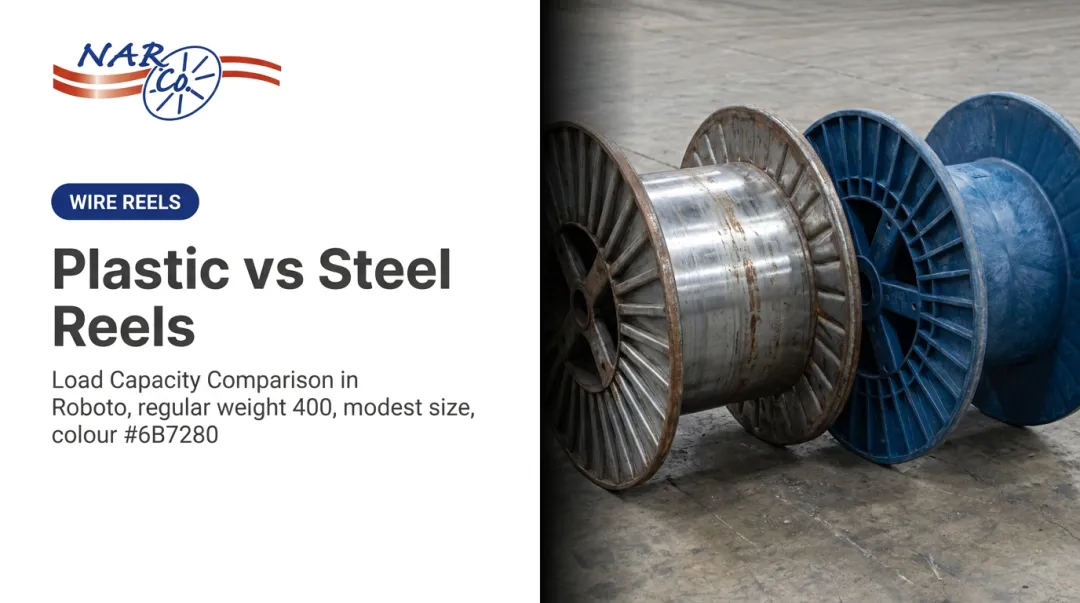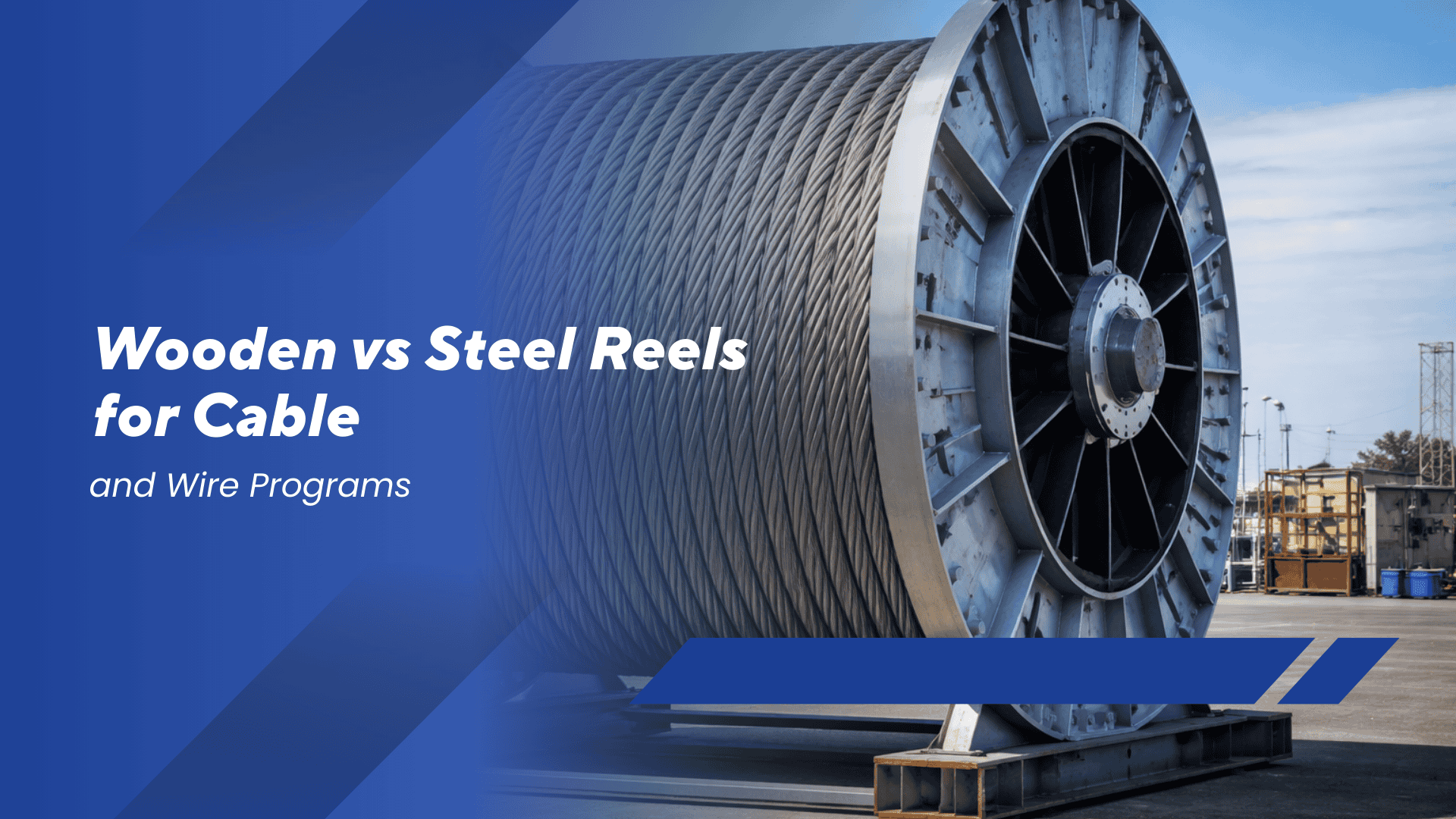
For copper wire specifically, the stakes are higher than in general-purpose packaging. Copper's conductivity value, broad gauge range, and winding precision requirements make reel material selection more consequential than it might appear. A reel that's adequate for packaging rope or fiber is not necessarily adequate for bare copper conductors destined for production lines with strict quality tolerances.
This article compares ABS plastic reels and steel reels across the dimensions that matter most for copper wire packaging: material properties, quality standard alignment, load capacity, cost tradeoffs, and practical guidance for matching the right reel to the right application.
Key Takeaways
- ABS plastic reels work well for fine-gauge or insulated copper wire in one-way or lower-volume shipping applications
- Steel reels deliver superior load capacity, dimensional precision, and dynamic balance for heavy-gauge copper wire and production-line use
- Quality standards prioritize concentricity, smooth flanges, and dynamic balance — areas where steel consistently outperforms ABS
- Plastic reels cost roughly one-third of steel upfront, but reconditioned steel reels typically deliver lower cost per use over multiple cycles
- Neither material is universally better — wire gauge, line speed, and operating conditions drive the right choice
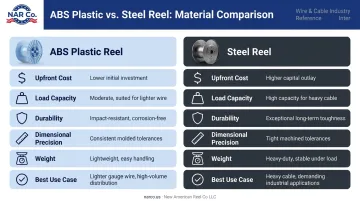
ABS Plastic Reel vs. Steel Reel: Quick Comparison
The table below breaks down the key differences between ABS plastic and steel reels across the factors that matter most for copper wire packaging.
| Factor | ABS Plastic Reel | Steel Reel |
|---|---|---|
| Upfront Cost | Lower (approx. one-third the cost of steel) | Higher initial investment |
| Construction | Injection-molded thermoplastic polymer | Welded, machined, or pressed carbon/galvanized steel |
| Load Capacity | Light to medium wire gauges | Heavy-gauge wire and large cable drums |
| Weight | Substantially lighter; reduces freight costs | Heavier; requires standard industrial handling equipment |
| Durability | Limited reuse; susceptible to UV and heat degradation | Highly durable; repairable and reconditionable over many cycles |
| Dimensional Precision | Adequate for lower-speed, lighter-load applications | CNC-machined for concentricity, flange flatness, and dynamic balance |
| Best For | Fine-gauge/insulated wire, one-way shipment | Heavy-gauge copper, high-speed production lines |
What Is an ABS Plastic Reel?
ABS plastic reels are injection-molded wire carriers made from Acrylonitrile Butadiene Styrene, a thermoplastic polymer valued for its impact resistance, rigidity, and dimensional consistency. They are designed as direct alternatives to steel process reels in specific applications.
Core Operational Benefits
The case for ABS reels comes down to three practical advantages:
- Weigh significantly less than steel equivalents, reducing freight costs and handling labor
- According to Sonoco's technical product line card, plastic process reels replace steel reels at one-third the cost and weight while allowing 12% more wire per shipment
- Resist oils and lubricants common in wire drawing environments without surface degradation
For one-way or non-returnable shipping programs, these savings are most pronounced — reel return logistics are eliminated, and per-unit packaging costs drop substantially.
Key Limitations for Copper Wire
ABS has real constraints that matter in wire manufacturing environments:
- Heat sensitivity: ABS resin reaches its heat deflection temperature well below 100°C. LG ABS HI121 datasheet data shows deflection at approximately 87–91°C depending on load conditions — a meaningful threshold in high-speed wire drawing environments
- UV degradation: Extended UV exposure causes embrittlement in ABS. University of Mississippi research documented a measurable drop in peak load strength after just 15 days of accelerated UV exposure
- Load ceiling: ABS reels handle light-to-medium loads effectively but are not engineered for heavy-gauge copper wire winding where tensile and centrifugal forces are significant
Common Use Cases for ABS Plastic Reels
ABS plastic reels are the standard packaging format for:
- Magnet wire (enameled copper wire) — NEMA MW 01000 covers magnet wire packaging, and Elektrisola lists copper wire net weights by spool type including biconical spools at 25 kg and tapered spools up to 85 lb
- Automotive wire harness and building wire in fine and medium gauges
- Retail and distribution packaging where one-way shipment eliminates reel return costs
Narco supplies ABS plastic reels through its role as Midwest sales agent for Inosym Reels. Available types include process reels, magnet wire reels, big bore reels, fine wire reels, welding wire spools, and data cable spools — all manufactured to customer specifications with drawings supplied at quoting stage.
What Is a Steel Reel?
Steel reels are precision-manufactured wire carriers constructed from carbon or galvanized steel, produced through welding, machining, pressed-flange fabrication, or a combination of these methods. They range from small bobbins to large cable drums and come in fixed or demountable (take-apart) configurations — covering everything from small-diameter process reels to drums built for heavy cable laying.
Why Steel Performs Better for Copper Wire Production
Steel reels earn their place on production lines because their physical properties align directly with what copper wire packaging demands:
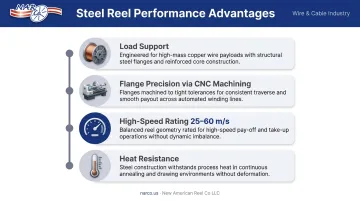
- Supports the winding weights and tensile forces generated during heavy-gauge copper wire production
- Minimizes flange distortion through CNC machining, ensuring uniform traversing and consistent wire layering — a quality benefit Pentre Group's BP wire drawing reels specifically attribute to lathe machining
- Rated for operational speeds of 25–50 m/s in drawing, stranding, and bunching applications, with some configurations reaching 60 m/s (per Inosym's dynamic balance specifications) — speeds plastic reels cannot reliably sustain
- Resists deformation under the heat generated in high-speed winding environments
The Reconditioning Advantage
Steel reels offer something no other reel material can match: when they wear out, they can be reconditioned back to production-ready condition rather than discarded.
Narco's steel reel reconditioning process covers:
- Flange straightening and press work
- Damaged rim repairs
- Drive pin hole and arbor tube repair or replacement
- Arbor hole resizing
- Welding, fabricating, and machining to specification
- Blasting, painting, and stenciling
- Dynamic balancing
This capability turns a worn reel back into a production-ready asset rather than a line item on a replacement purchase order. Narco has been providing these services since 1999, handling reel sizes from 3" to 96" (75mm to 2400mm) across wire, rope, and cable manufacturing applications. The Wire Association International recognizes that proper reel maintenance and reconditioning protect productivity and product quality while controlling costs — a principle Narco's entire service model is built around.
Steel Reel Configurations at Narco
Narco manufactures and reconditions multiple steel reel types to match different production requirements:
- Fully Machined Reels — dynamically balanced, made to DIN 46397 standards for multiwire applications
- Semi Machined Reels — double wall curled flanges, machined on all product contact surfaces, dynamically balanced
- Metal Flanged / Buncher Reels — available to DIN 46395, common for both process and shipping
- Enhanced Metal Flange Reels — for the most demanding heavy cable, wire, or rope applications
- Steel Drums — for extrusion, drum twisting, and lay-up processes
- Corrugated Shipping Reels — manufactured to NEMA WC 26 in RM and RMT types
- Custom/Collapsible Bobbins — built to customer specifications with drawings supplied
Which Reel Is Right for Your Copper Wire Application?
The right reel material depends on five key factors:
- Wire gauge and winding weight — heavy-gauge copper wire demands steel
- Production line speed — high-speed bunching and stranding require dynamically balanced steel reels
- Operating temperature — environments near or above ABS deflection thresholds eliminate plastic as an option
- Reel program type — one-way shipment favors ABS; returnable programs with reconditioning favor steel
- Total cost of ownership horizon — the longer the program, the more steel's reconditioning advantage compounds
Quality Standards: What Copper Wire Packaging Actually Requires
NEMA WC 26-2008, the North American Binational Wire and Cable Packaging Standard, defines maximum strength capacity as the total conductor or cable weight a reel must carry — and requires that gross cable weight be verified against the selected reel's load rating. Beyond load, quality-grade copper wire packaging demands:
- High concentricity — no barrel wobble during winding, which causes uneven tension and wire displacement
- Straight, smooth flanges — prevents wire scoring, edge damage, and tangled payoff
- Dynamic balance — mandatory for high-speed line operation; off-balance reels create vibration that damages wire surface finish and machine components
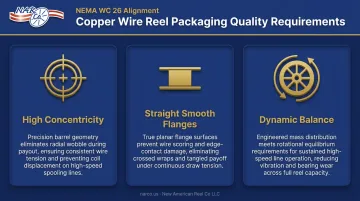
Steel reels are engineered to meet all three. ABS plastic reels handle lower-speed applications where these tolerances are less critical, but they cannot be machined or rebalanced once they degrade.
Situational Guidance
Choose ABS plastic reels when:
- Packaging fine-gauge or insulated copper wire for one-way shipment
- Reel weight is a logistics constraint affecting freight cost
- A non-returnable packaging program eliminates reel return logistics
- Wire weights fall within the 50–1,000 lb range that plastic taper reels are rated for
Choose steel reels when:
- Winding heavy-gauge copper conductors where load exceeds plastic capacity
- Running high-speed bunching, stranding, or drawing lines (630 buncher configurations and similar)
- Operating in elevated-temperature environments where ABS deformation risk exists
- A returnable reel program with periodic reconditioning can reduce long-term packaging cost
Total Cost of Ownership
The upfront cost difference is real: plastic reels run roughly one-third the price of steel. That gap narrows considerably over a multi-year program.
A steel reel reconditioned across multiple cycles — flanges straightened, rims repaired, dynamic balance restored — builds a cost-per-use that falls well below repeatedly purchasing disposable plastic replacements. For manufacturers running continuous production programs with returnable reel assets, steel's per-cycle cost drops further with each reconditioning pass. Shops working with a reel reconditioning provider (such as Narco, which has offered dynamic balancing and steel reel repair services since 1999) can extend asset life across many production cycles, compounding that cost advantage.
Real-World Considerations: Applying This Decision
Scenario 1 — High-speed bunching line, heavy-gauge copper conductor:
A copper wire manufacturer running a 630 buncher configuration needs reels that can handle the centrifugal forces at operating speed, maintain barrel concentricity under full winding load, and withstand repeated production cycles without dimensional degradation. ABS cannot meet these requirements reliably. The load demands, speed ratings, and precision requirements all point to steel — specifically fully machined, dynamically balanced reels rated to the line's operating speed. When those reels wear, reconditioning restores them to spec rather than replacing them outright.
Scenario 2 — Distribution shipment of pre-packaged insulated copper wire:
A smaller distributor shipping pre-packaged building wire or automotive wire to installers and contractors has a different set of priorities. The wire is insulated, the loads are lighter, and the reels aren't coming back. In this case, ABS plastic reels protect the product adequately, reduce outbound freight weight, and eliminate the cost and complexity of a reel return program entirely. The lower upfront cost is a genuine advantage, not a compromise.
For manufacturers already running steel reel programs, the more pressing question shifts from material selection to maintenance: keeping existing reels production-ready. If your steel reels are showing any of the following, reconditioning is likely the right next step:
- Flange damage from handling or repeated production cycles
- Concentricity loss affecting winding precision
- Balance issues that create vibration at operating speed
Contact Narco at 419-258-2900 or mark@narco.us to discuss reconditioning, welding, machining, and dynamic balancing services. Narco handles reel sizes from 3" to 96" and has been restoring reels to production-ready condition since 1999.
Conclusion
ABS plastic reels and steel reels are not competing for the same applications — they serve different segments of copper wire packaging, and treating them as interchangeable leads to either overspending or under-specifying.
Manufacturers handling heavy copper wire on production lines will find steel reels more aligned with quality standards, speed requirements, and long-term cost efficiency. Lighter-duty or distribution applications can benefit from the convenience and lower cost of ABS. Knowing which material fits your application reduces waste, protects product integrity, and keeps packaging costs from quietly eroding margins over multiple reel cycles.
If you're still weighing options — or need reels reconditioned, repaired, or custom-fabricated — Narco has been working with wire and cable operations across the U.S. since 1999 and supplies both steel and plastic reels alongside full reconditioning services.
Frequently Asked Questions
Which is better for copper wire packaging: ABS plastic reels or steel reels?
Neither is universally better. Steel reels are the right choice for heavy-gauge copper wire, high-speed production lines, and applications requiring strict concentricity and dynamic balance. ABS plastic reels are practical for fine-gauge, insulated, or one-way shipping applications where those tolerances aren't critical.
What quality standards should wire reels meet for copper wire packaging?
Reels must meet requirements for concentricity, flange flatness, dynamic balance, and load capacity. NEMA WC 26-2008 is the North American reference standard; individual manufacturers and OEMs layer additional specifications on top for specific applications.
How does reel material affect copper wire surface quality during winding?
Flange flatness, barrel concentricity, and surface finish directly affect wire condition during winding and payout. Warped or rough-surfaced reels cause wire scoring, uneven tension, and tangling — failures that are especially costly with bare copper conductors.
Can ABS plastic reels be reused in copper wire manufacturing?
ABS plastic reels have limited reuse cycles. They can handle light-duty reuse in lower-temperature environments, but are susceptible to deformation under heat and embrittlement from UV exposure over time. They're better suited for one-way or short-cycle use rather than long-term returnable reel programs.
What is the load capacity difference between ABS plastic and steel reels?
Plastic taper reels typically handle 50 to 1,000 lb — suitable for fine and medium-gauge wire. Steel reels are built to spec around conductor weight and reel dimensions, with large cable drums routinely exceeding those limits by a wide margin.
Can steel wire reels be reconditioned instead of replaced?
Yes. Steel reels can be reconditioned through flange straightening, rim repair, welding, machining, and dynamic balancing — restoring them to production-ready condition across multiple service cycles. This reconditioning capability is a primary total-cost-of-ownership advantage over ABS plastic reels, which must typically be discarded when damaged.