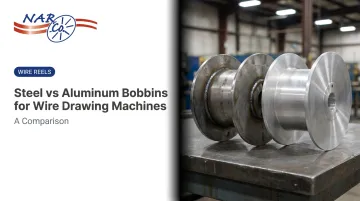
The choice affects more than upfront cost. It influences machine spindle wear, changeover ergonomics, production throughput, and how you manage bobbin assets over their full service life. A wire manufacturer running multi-shift rod breakdown operations has different requirements than a fine wire facility pulling magnet wire at high speed — and the right bobbin material for each can differ considerably.
This guide breaks down the physical properties, performance differences, and practical use cases for both materials to help wire drawing operations make a more grounded selection.
Key Takeaways
- Steel bobbins offer superior load capacity, durability, and repairability , making them ideal for heavy-gauge wire and high-tension drawing applications.
- Aluminum bobbins are roughly 2.9x less dense than steel, reducing spindle stress and improving changeover ergonomics in fine wire and high-speed operations.
- Steel bobbins can be reconditioned through welding, machining, and coating , which cuts long-term replacement costs and extends asset life.
- Aluminum naturally resists corrosion without coatings but is harder to repair when damaged. Damaged aluminum bobbins usually require full replacement rather than repair.
- Neither material wins universally. Wire gauge, drawing speed, production environment, and budget structure all shape the right decision.
Steel vs Aluminum Bobbins: Quick Comparison
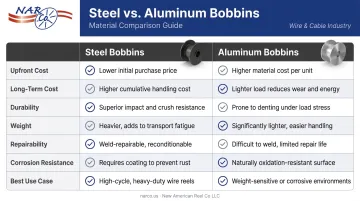
| Factor | Steel | Aluminum |
|---|---|---|
| Upfront Cost | Generally lower | Typically higher |
| Long-Term Cost | Reduced through reconditioning cycles | Higher; damaged bobbins typically require full replacement |
| Material | Carbon or alloy steel, often with protective coatings | Aluminum alloy with naturally forming oxide layer |
| Durability | High — handles heavy loads, tension, and impact | Moderate — susceptible to denting and deformation under heavy use |
| Weight | ~2.9x denser than aluminum; increases spindle bearing load | Substantially lighter — reduces spindle bearing load |
| Repairability | Weldable, machinable, reconditionable | Requires specialist welding; field repair is rarely practical |
| Corrosion Resistance | Coating-dependent; requires maintenance | Inherent oxide film resists corrosion without treatment |
What Are Steel Bobbins for Wire Drawing Machines?
Steel bobbins are cylindrical spools made from carbon or alloy steel, designed to hold drawn wire wound under tension as it exits the drawing die. Their structural integrity has made them the standard choice across most wire manufacturing environments, and that standing is backed by decades of performance data in production settings.
Physical Properties That Drive Performance
The properties that make steel bobbins reliable in wire drawing are straightforward:
- High tensile strength — resists deformation even under sustained wire tension loads
- Impact resistance — handles the mechanical stress of industrial handling without cracking or bending
- Dimensional stability — maintains flange geometry through repeated high-tension winding cycles
- Standardized sizing — available to DIN 46395 and DIN 46397 specifications, covering flange diameters from 100 mm to 1250 mm
That combination of strength and dimensional consistency is what keeps steel bobbins the dominant material in conventional wire plants — but it comes with one notable tradeoff.
Corrosion Risk and Coating Options
Steel's primary weakness is corrosion. In humid facilities, wet-draw lubrication environments, or where bobbins sit in outdoor storage between production runs, uncoated steel will rust. Protective treatments — powder coat, paint, zinc plating, or hot-dip galvanizing — extend service life, though results depend on the coating system and exposure conditions.
Surface condition matters operationally. A compromised coating puts both the bobbin and the wire wound on it at risk, so consistent inspection is a practical requirement in corrosive environments.
The Repairability Advantage
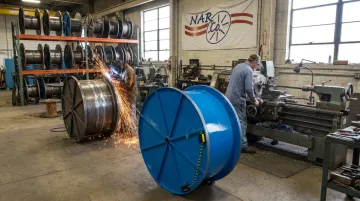
Steel bobbins earn their long-term value through repairability. When flanges crack, hubs wear, drive pin holes degrade, or arbor tubes need replacement, the bobbin can be repaired rather than scrapped — through welding, machining, flange straightening, and recoating.
Narco (New American Reel Co.), based in Antwerp, Ohio, has specialized in exactly this type of work since 1999. Their reconditioning services cover reel sizes from 3" to 96" (75 mm to 2,400 mm) and include:
- Flange straightening and press work
- Rim and hub repairs
- Drive pin hole and arbor tube replacement
- Welding and machining to specification
- Blasting, painting, and dynamic balancing
For wire manufacturers running large bobbin fleets, this reconditioning pathway lowers total cost of ownership significantly compared to continuous replacement purchasing.
Use Cases for Steel Bobbins
Steel bobbins are the standard choice for:
- Heavy-gauge wire drawing — copper rod, steel wire, aluminum rod, and armored cable where wire tension during winding is substantial
- Multi-shift, high-volume plants — where durability and consistent performance across production cycles outweigh changeover speed
- Operations prioritizing repairability — facilities that want to manage bobbin assets through reconditioning rather than continuous replacement purchasing
What Are Aluminum Bobbins for Wire Drawing Machines?
Aluminum bobbins are cylindrical spools machined from aluminum alloy, used where reducing rotational mass or maintaining corrosion resistance without coatings is a priority. Weight is their primary advantage.
The Weight Difference and What It Means
Carbon steel has a density of approximately 7,850 kg/m³, while aluminum alloys run around 2,700 kg/m³. For the same bobbin geometry, steel is roughly 2.9x denser than aluminum. Lower rotational mass means:
- Reduced load on machine spindles and bearings during high-speed winding cycles
- Lower rotational inertia — the bobbin accelerates and decelerates more responsively
- Easier manual handling during changeovers
On changeover ergonomics, OSHA and NIOSH manual handling guidelines recommend limiting single-person lifts to around 50 lbs (23 kg) under ideal conditions. Many steel bobbins in the 400–630 mm range exceed these thresholds; aluminum equivalents are more likely to fall within manageable limits for manual handling without mechanical assist.
High-speed wire drawing reels are designed for surface speeds over 40 m/s and up to 60 m/s with dynamic balancing — at those speeds, every kilogram of rotating mass matters.
Corrosion Resistance
Aluminum alloys rely on a naturally occurring aluminum oxide film for corrosion protection. According to ASM International, this film is adherent, self-healing, and stable across a pH range of approximately 4 to 9 — covering most industrial wire drawing environments. No additional coatings are required to maintain basic corrosion protection.
The caveat: the oxide film is not impervious. Chloride exposure or highly alkaline conditions can cause localized pitting. Aluminum is corrosion-resistant, not corrosion-proof.
Repairability Limitations
Repairability is where aluminum loses ground to steel. The aluminum oxide layer melts at approximately 2,060°C while the parent alloy melts around 660°C — a mismatch that creates process complexity standard field welding can't handle. Hydrogen porosity risk, high thermal conductivity, and strict shielding gas requirements (argon or helium) add further barriers.
In practice, a damaged aluminum bobbin — dented flange, deformed hub, cracked core — typically means full replacement rather than repair.
Use Cases for Aluminum Bobbins
Aluminum bobbins work best in:
- Fine wire drawing (magnet wire, light-gauge copper for electronics) where wire tension during winding is lower
- High-speed drawing lines running at elevated RPM, where reduced rotational inertia improves responsiveness
- Electronics and telecom manufacturing, where corrosion resistance and fast changeovers outweigh maximum load-bearing needs
- Humid or wet-draw environments where maintaining steel coatings is impractical
Steel vs Aluminum Bobbins: Which Is Better for Your Wire Drawing Operation?
No single material is correct for all operations. The decision comes down to a handful of variables.
Key Decision Factors
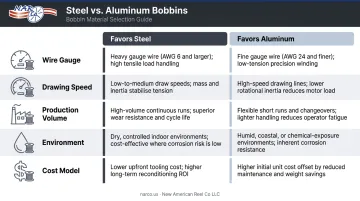
| Variable | Favors Steel | Favors Aluminum |
|---|---|---|
| Wire gauge | Heavy or medium gauge | Fine wire |
| Drawing speed | Moderate-speed, high-tension | High-speed, lower-tension |
| Production volume | Multi-shift, continuous production | High changeover frequency |
| Environment | Controlled, coatings maintainable | Humid, wet-draw, or corrosive |
| Cost model | Recondition and extend life | Buy and replace |
Durability and Lifecycle Cost Under Heavy Use
For rod breakdown operations and heavy-gauge drawing, steel's load-bearing advantage is clear. The stronger case for steel, though, isn't just initial durability — it's what reconditioning makes possible after wear accumulates.
A steel bobbin that's absorbed two years of production stress can be straightened, welded, recoated, and dynamically balanced back to specification. That same bobbin might complete multiple reconditioning cycles before reaching end of life. An aluminum bobbin with comparable damage is a disposal decision.
At fleet scale — hundreds or thousands of bobbins — the math shifts decisively. The upfront price gap between steel and aluminum narrows considerably once lifecycle cost includes replacement frequency.
Speed and Ergonomics in High-Throughput Fine Wire Settings
When drawing speed, spindle longevity, and changeover labor are the primary concerns, aluminum's weight advantage delivers real operational benefits. Fine wire facilities running high-speed lines can experience meaningful reductions in spindle and bearing load over time, and changeover ergonomics improve when operators aren't lifting steel bobbins repeatedly across a shift.
For operations with frequent reel changes — especially where manual handling is the norm — the weight differential between steel and aluminum is worth taking seriously.
Making the Call
Choose steel bobbins if your operation:
- Draws heavy or medium-gauge wire at high tension
- Runs multi-shift or continuous production schedules
- Wants to leverage reconditioning to extend asset life and reduce capital replacement spend
- Operates in environments where coating maintenance is manageable
Choose aluminum bobbins if your operation:
- Draws fine wire at high speeds where rotational inertia matters
- Has frequent changeovers where ergonomics affect throughput or injury risk
- Operates in humid or wet-draw conditions where sustaining steel coatings is impractical
- Accepts replacement-over-repair as the damage management model
Conclusion
Steel bobbins are the more versatile, repairable, and load-bearing choice for most conventional wire drawing environments. Aluminum bobbins offer specific advantages in fine wire, high-speed drawing, and corrosion-prone settings where their lighter weight and passive corrosion resistance justify the trade-offs.
Lifecycle cost is the factor most bobbin decisions underweight. A bobbin's true cost includes maintenance, reconditioning potential, and replacement frequency, not just the purchase price. Wire manufacturers who build a bobbin management strategy around those factors are better positioned to control capital costs and reduce unplanned downtime.
For steel reel fleets specifically, working with a reconditioning specialist like Narco means wear and damage don't automatically trigger replacement. They trigger a repair cycle — one that extends asset life and keeps more capital out of the scrap pile.
Frequently Asked Questions
Does bobbin material (steel or aluminum) matter for a wire drawing machine?
Yes — material directly affects load capacity, rotational dynamics, corrosion resistance, and repairability. For industrial wire drawing, steel and aluminum are the two practical choices, each optimized for different production conditions.
What are metal bobbins used for in wire drawing machines?
Metal bobbins receive and store drawn wire as it exits the drawing die, holding it under controlled tension during the winding process. The wound bobbin then moves to transport, payoff, or further processing downstream.
Can steel wire drawing bobbins be reconditioned or repaired?
Yes. Steel bobbins can be repaired through welding, machining, flange straightening, and recoating. This reconditioning pathway significantly extends service life and reduces capital replacement costs compared to buying new.
Which bobbin material is better for high-speed wire drawing?
Aluminum is generally preferred for high-speed fine wire drawing. Lower rotational mass reduces inertia, decreases spindle bearing stress, and improves machine responsiveness at elevated drawing speeds.
How does bobbin weight affect wire drawing machine performance?
Heavier steel bobbins increase load on spindles and bearings, which can accelerate wear in high-cycle applications. Lighter aluminum bobbins reduce that load and improve changeover ergonomics, particularly in operations with frequent reel changes.
Are aluminum bobbins more corrosion-resistant than steel bobbins?
Aluminum naturally forms a protective oxide film that resists corrosion without coatings, stable across a broad pH range. Steel requires protective treatments — galvanizing, powder coat, or paint — to reach comparable resistance in humid or wet-draw environments.