Introduction
Bobbin selection rarely gets treated as a critical engineering decision — but it should. Pick the wrong type for your wire gauge, drawing speed, or payoff method, and you're looking at wire spillage, tangled coils, and unplanned line stops that drive up per-unit costs across every production run.
The two dominant categories in industrial wire drawing are flanged bobbins and open (or open-carrier) bobbins. They look similar at a glance, but they serve fundamentally different operational roles. WAI's guidance on reels and bobbins treats bobbin geometry as a process variable — one that directly affects winding stability, payoff behavior, and line efficiency.
This guide compares both types head-to-head and gives you a practical framework for matching bobbin design to your process requirements.
Key Takeaways
- Flanged bobbins contain the wire coil between raised end walls: best for fine-to-medium gauge wire, high-speed lines, and precision payoff.
- Open bobbins/carriers have no side walls: lighter, higher fill ratio, suited for coarser gauges with enough stiffness to hold their wound pack.
- Wire gauge and payoff method are the two primary selection filters — cost alone should not drive the decision.
- Steel flanged bobbins support repeated reconditioning (flange straightening, barrel repair, dynamic balancing), so lifecycle cost runs lower than unit price implies.
- Neither type is universally superior — the correct choice is process-dependent.
Flanged vs. Open Bobbins: Quick Comparison
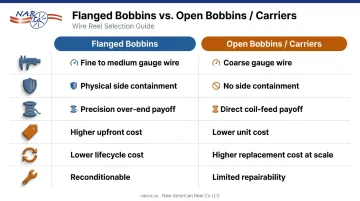
| Factor | Flanged Bobbins | Open Bobbins / Carriers |
|---|---|---|
| Wire Gauge | Fine to medium (for example, AWG 10–30+; 0.1 mm–5 mm) | Coarser gauges where wire stiffness holds the pack |
| Wire Containment | Flanges physically prevent wire from escaping the barrel | No side containment; relies on wire stiffness and tension |
| Payoff Quality | Clean over-end or side payoff; compatible with stranding, insulating, spooling | Less controlled; better for direct coil-to-process or manual feed |
| Upfront Cost | Higher (especially steel) | Lower per unit |
| Lifecycle Cost | Lower when reconditioned and reused across campaigns | Higher at scale if replaced rather than repaired |
| Repairability | Steel flanged bobbins: flange straightening, barrel repair, dynamic rebalancing | Limited; typically replaced when worn |
| Standards | DIN 46397, DIN 46395, NEMA WC 26 | No universal standard term or category |
What Are Flanged Bobbins?
A flanged bobbin is a cylindrical barrel with two raised disc-shaped flanges fixed at each end. In wire drawing, those flanges do more than passively contain wire. They enable traverse winding at production speeds without coil climb, and they create the consistent package geometry that precision over-end payoff demands.
Flanged bobbins span a wide size range in practice. Narco's catalog alone runs from 3" to 96" flange diameter — reflecting how differently fine copper magnet wire winding and heavy industrial cable drawing are served by the same basic format.
Key Operational Benefits
- Wire containment — flanges prevent coil migration during winding, transport, and payoff
- Tension uniformity — consistent package geometry reduces tension variation at the payoff creel
- Speed compatibility — enables higher traverse speeds on fine-wire drawing exits without coil collapse
- Downstream compatibility — required for stranding machines, insulating lines, and double-twist machines where over-end payoff precision is non-negotiable
Material and Construction Variants
Steel flanged bobbins dominate in industrial wire drawing. They withstand high winding tensions, survive rough handling in plant environments, and — critically — can be reconditioned when damaged rather than discarded.
Narco manufactures and reconditions steel bobbin configurations to DIN 46397 and DIN 46395 standards across three primary types:
- Fully machined reels — dynamically balanced, suited for multi-wire drawing
- Semi-machined reels — double-wall curled flanges for robust everyday use
- Metal flanged (pressed flange/buncher) reels — for both process and shipping applications
Sizes run from 3" to 96" flange diameter.
Plastic flanged bobbins exist for lighter applications — magnet wire reels, fine wire reels, welding wire spools — but they are not rated for high-tension industrial drawing environments.
Where Flanged Bobbins Are Used
Flanged bobbins are the standard take-up format at fine and medium-wire drawing machine exits. Applications include:
- Copper and aluminum magnet wire production
- Communication cable conductor winding
- Spring wire drawing
- Any downstream process requiring precision over-end payoff — stranding, bunching, insulating, armouring
What Are Open Bobbins?
Open bobbins (also called open carriers, wire carriers, stem packs, or formers depending on the manufacturer) consist of a bare cylindrical barrel with no flanges or side walls. There is no physical containment for the wound wire package. The coil maintains its shape purely through wire stiffness, wound tension, and careful handling.
"Open bobbin" is not a universal industry term — public sources and OEM documentation more commonly reference stem packs, formers, or wire coil carriers for this category.
Wyrepak's stem pack/former payoff system, for example, handles solid steel wire up to 4 mm diameter, using an inverted cone to guide wire off-end during payoff, with snagger switches that stop the line if a tangle develops.
Bending stiffness in a circular wire cross-section scales with the fourth power of diameter — a wire twice as thick is sixteen times as stiff in bending. Coarser wire holds its wound shape without needing flanges to enforce it.
Core Advantages
- Lower unit cost with no flange material
- Higher wire fill ratio relative to total bobbin weight
- Simpler handling logistics for single-pass or shipping applications
- Adequate for direct coil-to-process feed where precision payoff isn't required
Where Open Carriers Fall Short
Without flanges, wire can shift or loosen during transport and handling. This makes open carriers unsuitable for:
- Fine or medium gauge wire (too flexible to hold a pack)
- High-speed drawing exits where traverse forces would displace the coil
- Any downstream process requiring tension-controlled, tangle-free payoff
Common Applications
Open carriers are used in coarse wire drawing exits, as shipping vessels for heavy-gauge wire or rod products, and in direct-feed scenarios — straighten-and-cut lines, structural wire, fencing wire, welding wire distribution — where precision payoff is not a requirement.
Choosing Between Flanged and Open Bobbins
The selection decision comes down to four filters, applied in order.
Filter 1: Wire Gauge and Flexibility
Fine and medium gauge wire — roughly AWG 10 and finer, though this varies by material and temper — lacks the stiffness to hold a wound pack without side containment. Flanged bobbins are the correct choice. Coarser gauges can often use open carriers because the wire's inherent rigidity holds the pack.
No authoritative industry standard defines a hard AWG cutoff, so treat your OEM's specified bobbin range and process trial data as the real guide.
Filter 2: Downstream Payoff Method
If your downstream process requires over-end or precision side payoff — stranding machines, coil winding lines, insulating lines, armouring machines — flanged bobbins are mandatory. Wyrepak's Tyltbak payoff stand, which is designed for insulating, bunching, tinning, and patenting, handles 16" to 24" flange diameter reels precisely because those downstream processes require the tension control that flanged payoff enables.
Open carriers work only for direct coil-feed or manual payoff situations where tension variation won't damage the product or the process.
Filter 3: Volume and Lifecycle Cost
Open bobbins have a lower purchase price per unit. Treated as single-use or low-reuse, though, the per-cycle cost rises quickly at production volume.
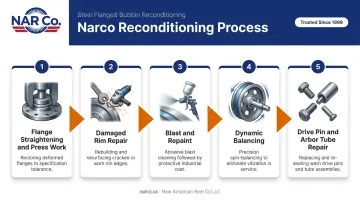
Steel flanged bobbins cost more upfront, but they can be reconditioned repeatedly — flange straightening, damaged rim repair, arbor tube replacement, dynamic rebalancing — and returned to service.
As Narco's maintenance guidance notes, damaged flanges lead to unstable winding and uneven payout, while imbalance causes vibration that damages both wire and machinery. Catching those issues early and reconditioning rather than replacing is where the lifecycle cost advantage accumulates.
Narco's standard reconditioning package includes:
- Flange straightening and press work — corrects distortion from handling impacts
- Damaged rim repair — restores edge geometry for clean winding
- Blast and repaint — addresses corrosion before it becomes structural
- Dynamic balancing — performed on all reconditioned steel bobbins
- Drive pin hole and arbor tube repair — available for more extensive damage
Filter 4: Situational Recommendations
Choose flanged bobbins when:
- Drawing fine or medium gauge wire at production speeds
- Downstream payoff precision is required (stranding, insulating, bunching)
- A reuse and reconditioning program is part of your cost model
- Running DIN 46397 or DIN 46395 bobbin formats
Choose open carriers when:
- Handling coarse or stiff wire where self-supporting coil geometry is reliable
- Shipping rather than precision feeding is the primary use case
- Single-cycle economics favor a lower-cost disposable carrier
When to Recondition vs. Replace a Flanged Bobbin
Even the best-maintained steel flanged bobbins degrade over time. Knowing when to act is what separates proactive maintenance from costly production disruptions. Running a damaged bobbin past its serviceable condition costs more in wire breaks and machinery wear than the reconditioning itself.
Key indicators that a bobbin needs inspection and likely reconditioning:
- Visible flange distortion or cracking — bent or cracked flanges create uneven wire packing and increase break risk
- Barrel out-of-round or dented — affects traverse uniformity and wire tension
- Wire spillage during winding that wasn't present in previous campaigns
- Vibration or imbalance during drawing — dynamic balancing in wire drawing machinery directly links imbalance to increased wear, higher breakage risk, and shorter component service life
- Arbor hole distortion — affects bobbin seating on the take-up mandrel
Any of these signs warrant pulling the bobbin from rotation for a closer look. If your operation runs flanged steel bobbins at volume and hasn't audited the fleet recently, there's a reasonable chance some units are past their serviceable condition. A scheduled fleet inspection — even once per quarter — catches deterioration early, before a single damaged bobbin drives up break rates across an entire production run.
Frequently Asked Questions
What are the main types of bobbins for wire drawing?
Flanged bobbins have raised disc walls at each end that physically contain the wire package during winding, handling, and payoff. Open bobbins (also called open carriers, stem packs, or formers) have only a bare cylindrical barrel with no side containment. The right choice depends on wire gauge, drawing speed, and how the wire will be paid off downstream.
Which bobbin type is better for wire drawing — flanged or open?
Flanged bobbins are the standard choice for fine and medium gauge wire drawing where wire containment and controlled payoff are critical. Open carriers suit coarse wire or shipping applications where the wire's own stiffness holds the pack. Neither is universally better — the decision is process-specific.
Does material matter — steel vs. plastic bobbins for wire drawing?
Yes. Steel bobbins handle high winding tensions, survive rough production environments, and can be reconditioned when damaged. Plastic bobbins are suited to lighter-duty applications like magnet wire or welding wire spools — not high-tension industrial drawing lines.
Can flanged wire drawing bobbins be reconditioned?
Yes. Steel flanged bobbins can be reconditioned through flange straightening, barrel repair, rim replacement, arbor tube work, and dynamic rebalancing. Reconditioning restores service life at a fraction of new-unit cost — especially valuable in high-volume drawing operations.
What wire gauges work best with flanged vs. open bobbins?
Wire finer than approximately AWG 10–12 typically benefits from flanged bobbins to prevent coil migration and ensure clean payoff — the exact threshold shifts with material and temper. Coarser gauges can often run on open carriers because the wire's stiffness holds the wound pack without side support.
How do I know when a flanged bobbin needs reconditioning?
Watch for visible flange distortion or cracking, barrel out-of-round, new wire spillage during winding, and vibration or imbalance during drawing. Any of these warrant pulling the bobbin for inspection — running damaged bobbins accelerates machinery wear and increases wire break frequency.
Conclusion
Flanged bobbins are the right call for fine and medium gauge wire running at production speeds with precision downstream payoff. No other carrier reliably handles that combination. Coarse wire shipping and direct-feed applications can operate effectively on open carriers where wire stiffness provides sufficient pack support.
Beyond the initial selection, the lifecycle cost model matters. Steel flanged bobbins that are reconditioned and reused across multiple campaigns deliver a lower per-cycle cost than repeated replacement. The key is catching damage early — flange distortion, barrel wear, imbalance — and reconditioning before it affects production.
If your operation is evaluating bobbin type, managing an aging fleet, or tracking down quality issues that trace back to bobbin condition, Narco offers reconditioning, repair, and custom fabrication for exactly these situations. Contact Narco at 419-258-2900 or mark@narco.us to discuss your bobbin inventory.