This post covers the warning signs of a weight mismatch, what happens when it goes unaddressed, and how to match reel weight to support equipment correctly — including when reconditioning or custom fabrication is the right fix.
Key Takeaways
- A steel reel's total loaded weight (reel + wire) must stay within the support rod's rated capacity
- Early warning signs include visible rod deflection, excessive vibration, abnormal bearing heat, and reel wobble
- Ignoring a mismatch causes permanent rod deformation, drivetrain damage, wire quality failures, and safety risks
- Apply a 1.5x–2x dynamic load factor to static reel weight when evaluating rod suitability for operating conditions
- Solutions include upgrading the spindle, reconditioning oversized reels, or ordering custom-fabricated reels built to the correct weight spec
Understanding Reel Weight Ratings and Support Rod Capacity
Every support rod — whether called a spindle, arbor, or shaft — has a rated load capacity based on its diameter, material, length, and mounting configuration. A loaded reel that exceeds that rating puts the rod into stress territory it was never designed to handle.
The Loaded Weight Problem
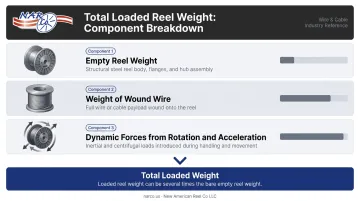
Many operators check the empty reel weight and stop there. That's a significant error. The total load on the support rod includes:
- Empty reel weight
- Full weight of wound wire
- Dynamic forces from acceleration, deceleration, and rotation
A wire-loaded reel can weigh several times more than the bare steel structure. Industrial payoff and take-up equipment can be rated for reel weights up to 40,000 lb — but that rating applies to the complete loaded system, not the reel chassis alone.
How Rod Capacity Is Calculated
Rated capacity depends on the rod's material strength, its unsupported span between mounts, and the bending moment created by the reel's load. A longer span or an off-center load increases the bending moment even if the total weight stays the same.
The bearings at each end carry their share of this load. According to NSK's bearing engineering guidelines, bearing life follows a power law relationship with load. Doubling the load doesn't just double the wear — it multiplies it:
| Bearing Type | Load Doubled → Life Reduced By |
|---|---|
| Ball bearings | Factor of 8 |
| Roller bearings | Factor of 10 |
Overloading is a bearing life problem measured in millions of revolutions, not calendar years.
The rule: Total loaded reel weight must stay well below rated capacity — operating at the limit leaves no margin for the dynamic forces that occur during every start, stop, and rotation cycle.
Warning Signs Your Steel Reel Is Too Heavy for the Support Rod
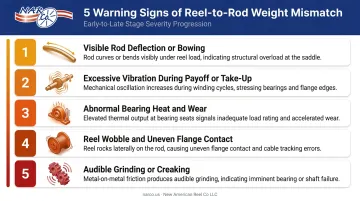
Weight mismatches rarely fail silently. These signs typically appear in this order — and each one is worth taking seriously:
Visible Rod Deflection or Bowing
The most direct physical indicator. A support rod under excessive load will visibly sag or curve between its mounting points. This is not normal elastic deflection — it signals that the rod is operating near or beyond its design limit, and the deflection will worsen over repeated load cycles.
Excessive Vibration During Payoff or Take-Up
An overloaded rod vibrates at frequencies outside its normal operating range. That vibration transmits directly into the wire being paid off, creating erratic tension. As Novo Precision notes, improper payout conditions can cause fine wire to snap or stretch — consequences that show up as scrap, not as equipment alerts.
Abnormal Bearing Heat and Wear
Overloaded support rods push excess force into the bearing housings at each end, causing accelerated wear and elevated operating temperatures. SKF rates standard deep-groove ball bearings to withstand 120°C / 250°F.
That ceiling matters because Timken's technical data shows grease breakdown rate doubles for every 18°F / 7.8°C rise in temperature. Bearings running hot from overload are consuming lubrication life far faster than any scheduled maintenance interval assumes.
Reel Wobble and Uneven Flange Contact
A deflecting rod causes the reel's flanges to sit unevenly against the support structure. That wobble disrupts winding uniformity and can damage wire edges or distort coil geometry.
Audible Grinding or Creaking
Metal-on-metal friction sounds from the rod, bearings, or mounting hardware are a late-stage warning. By the time a support system is making these noises, significant mechanical distress is already in progress.
What Happens When the Weight Mismatch Goes Unaddressed
Leaving a weight mismatch unaddressed compounds the damage at every stage of operation.
Permanent Rod Deformation
Steel has a yield strength. Load a support rod beyond it, and the deformation becomes permanent. The rod retains its bent shape even after the reel is removed. A permanently deformed rod cannot be trusted to hold its original rated capacity and must be replaced — there's no straightening a rod that has taken a plastic set.
Cascading Equipment Failure
A deflected rod throws off the alignment of the entire drive system. The motor, gearbox, clutch, and brake components of the payoff or take-up machine all operate under assumptions about shaft alignment. Once that alignment drifts, stress concentrations appear in components never designed to absorb them — turning a rod problem into a drivetrain rebuild.
Wire Quality and Production Losses
Reel wobble and erratic tension directly affect wire consistency. Uneven payoff tension produces twisted, kinked, or unevenly laid wire that may fail quality inspection entirely. The Wire Association International identifies high-speed payoff and tension control as core wire quality variables — a mismatched reel undermines both simultaneously.
Safety Hazards
A severely overloaded rod can fracture. A reel that becomes dislodged from its support during operation is a serious workplace incident. OSHA 1910.212 requires machine guarding to protect operators from exactly these kinds of rotating equipment hazards — but guarding doesn't substitute for operating within rated load limits. Load capacity checks should be part of every reel mounting procedure, not an afterthought.
The Cost of Unplanned Downtime
Emergency rod or bearing replacement during active production costs far more than proactive equipment matching. Siemens Senseye's 2024 downtime report puts the cost of an idle production line at a large manufacturing plant at $695 million per year — 1.5x higher than five years prior. Wire manufacturing lines have their own specific cost structures, but the principle holds: planned equipment matching is always cheaper than unplanned failure response.
How to Match Reel Weight to Your Support Equipment
Getting this right before mounting a reel takes less time than diagnosing a failure after one.
Step 1: Get the Rod's Published Load Rating
Start with the OEM engineering specification sheet for the spindle, arbor, or payoff/take-up stand. This document lists maximum static and dynamic load capacity. If it's unavailable, a qualified engineer can calculate capacity from the rod's material grade, diameter, and unsupported span length.
Step 2: Calculate Total Loaded Weight
Use this framework:
Empty reel weight + weight of wire to be wound = total loaded weight
The total must remain well below the rod's rated capacity — not at it. Operating at exactly the rated limit leaves no margin for dynamic forces.
Step 3: Apply a Dynamic Load Factor
Reels in motion create forces that exceed their static weight. Acceleration, braking, and rotational inertia all add to the load the rod actually experiences.
A standard engineering screening range for rotating and shock-loaded equipment is 1.5x to 2x the static load, supported by coupling and drive system service factor tables from manufacturers including Timken and Regal. If your loaded reel weighs 5,000 lb and your spindle is rated for 6,000 lb, that's not sufficient margin once dynamic factors are applied.
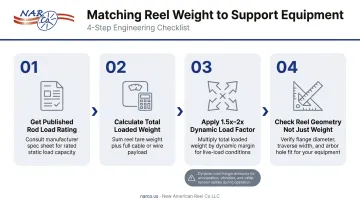
Step 4: Check Reel Geometry, Not Just Weight
A reel's flange diameter and traverse width determine how load is distributed across the rod's span. Two reels at identical weight can place very different stresses on the same rod depending on geometry:
- A wider reel creates a higher bending moment than a narrower one at the same weight
- Flange diameter affects load distribution across the rod's unsupported span
- Geometry must be included in the compatibility check — weight alone won't tell the full story
Solutions When Your Reel Is Too Heavy for the Rod
Upgrade the Support Rod or Spindle
The direct engineering solution is replacing an undersized rod with one properly rated for the actual loaded weight. This typically also involves upgrading bearing housings and end supports to match the new rod's capacity.
Recondition the Reel to Reduce Weight
Reels that have accumulated excess mass through repair weld buildup, flange deformation, or accumulated material can often be reconditioned back to their original design weight and geometry. Narco has been handling steel wire reel reconditioning since 1999, with services that include:
- Flange straightening and press work
- Damaged rim repairs
- Dynamic balancing
All services are aimed at restoring a reel to its original spec. When the weight mismatch is marginal, reconditioning is frequently the most cost-effective fix.
Commission a Custom-Fabricated Reel
When existing reels consistently exceed the support system's capacity, the most durable solution is a reel built to the right spec from the start. Narco designs and fabricates custom steel reels to customer-specified flange diameter, traverse width, arbor size, and weight requirements.
Available sizes run from 3" to 96" (75mm to 2400mm) across fully machined, semi-machined, and enhanced metal flange configurations. Custom fabrication eliminates the guesswork of retrofitting standard reels into applications they weren't designed for.
Apply Dynamic Balancing for Vibration Issues
A reel within its weight limits but still causing vibration may have uneven mass distribution. Dynamic balancing (defined by ISO 1940-1:2003 as adjusting mass distribution so residual unbalance meets specified tolerances) corrects this by aligning the reel's rotational center of mass with the support rod's axis. This is part of Narco's standard reconditioning process. Note that balancing addresses rotational imbalance, not static weight — so an overweight reel still requires a properly rated rod regardless of how well it's balanced.
Frequently Asked Questions
What size reel is suitable for a given support rod?
The reel's total loaded weight (empty reel plus wound wire) must fall within the rod's rated capacity, with margin left for dynamic loading. Reel geometry also matters — a wider flange diameter or traverse width creates higher bending moments, even at the same static weight.
How do I find the weight capacity of my support rod?
Check the OEM engineering specification sheet for your spindle or payoff/take-up stand. If that documentation isn't available, a qualified engineer can calculate capacity from the rod's material, diameter, and unsupported span length.
Can a reel that's too heavy permanently damage the support rod?
Yes. Loads that exceed the rod's yield strength cause permanent plastic deformation — the rod stays bent even after the reel is removed. A rod in this condition cannot be relied upon for its original rated capacity and must be replaced.
What is dynamic balancing, and does it help with heavy reels?
Dynamic balancing corrects uneven mass distribution so a reel spins without wobble or vibration. It reduces bearing stress from rotational imbalance, but it does not reduce the reel's static weight. An overweight reel still requires a support rod rated for its actual loaded weight; balancing and load capacity are separate issues.
How often should steel wire reels be inspected for weight-related issues?
Inspect reels before each deployment, checking for weld buildup, flange damage, or accumulated material that may have added weight since the last use. A formal dimensional and weight check should also be part of any scheduled reconditioning cycle.
Can reconditioning reduce a reel's weight enough to fix a mismatch?
Reconditioning can remove excess weld material, straighten deformed flanges, and restore a reel to its original design weight — a practical fix when the mismatch is marginal. Severe mismatches may require a custom-fabricated reel built to the correct weight and geometry spec from the start.