Introduction
Most wire and tube drawing operations have strong opinions about die angles, lubrication chemistry, and drawing speeds. The packaging decision — steel reel or cardboard tube — gets far less scrutiny. That's a mistake.
The wrong call here creates real operational pain. A crushed cardboard core on a payoff stand means unplanned downtime. A steel reel with a bent flange throws off wire layering and tension consistency. And the "cheaper" option upfront often isn't cheaper when you account for the full production cycle.
Manufacturing downtime carries steep consequences — some estimates put productivity losses at 5–20% for facilities experiencing recurring equipment issues. Packaging failures that trigger line stoppages are a solvable part of that equation.
This article breaks down both options across cost, durability, load capacity, reusability, and fit — giving wire and cable manufacturers a concrete basis for choosing what actually fits their operation.
Key Takeaways
- Steel reels are built for repeated, high-load use — cardboard tubes are single-use cores for lighter applications
- Steel reels cost more upfront but lower total cost of ownership through reuse and reconditioning
- Cardboard tubes work for one-way distribution, light-gauge wire, and short runs where reel return logistics don't make sense
- High-volume drawing operations — steel wire, copper cable, stainless tubing — consistently benefit from steel reels
- Match your choice to production volume, tension requirements, shipping model, and cost horizon
Steel Reel vs Cardboard Tube: Quick Comparison
| Dimension | Steel Reels | Cardboard Tubes |
|---|---|---|
| Upfront Cost | Higher per unit | Lower per unit |
| Durability & Lifespan | Many cycles with maintenance | Single-use; prone to moisture and crush damage |
| Reusability | Reconditioned and repaired repeatedly | Discarded after one use |
| Load Capacity | High-tension, heavy wire and cable | Limited to lighter gauges and lower tension |
| Logistics Impact | Requires return logistics; reduces long-term waste | No return needed; generates recurring disposal volume |
What Are Steel Reels in Wire and Tube Drawing?
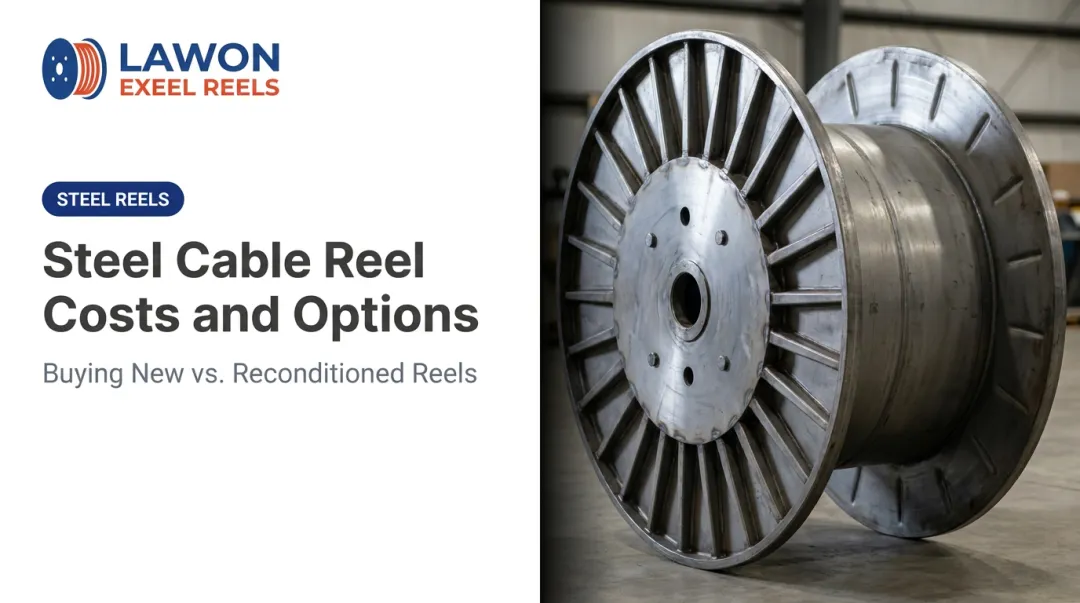
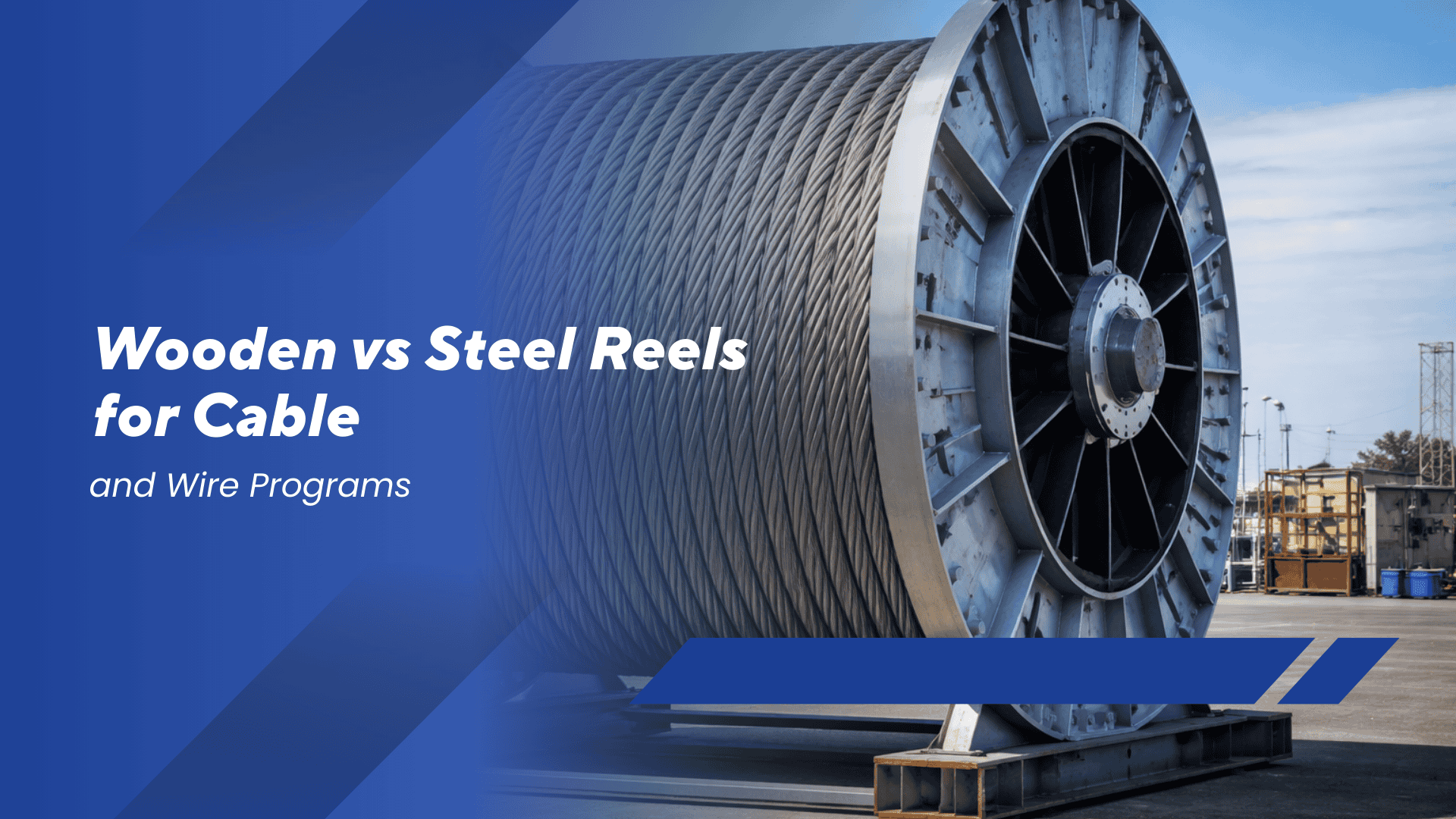
Steel reels — also called steel bobbins or wire drums — are welded steel structures used to wind, store, and transport drawn wire, cable, rope, or tube products. They're not just shipping containers. On a draw bench or winding line, they interface directly with payoff and take-up equipment, making their geometry and balance critical to production quality.
Structural Advantages
The core engineering benefits are what separate steel from disposable alternatives:
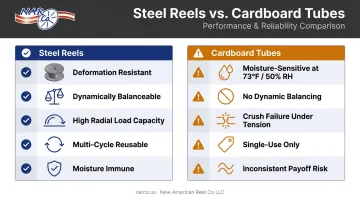
- Deformation resistance under heavy radial and lateral loads
- Consistent flange geometry that supports even wire layering — critical for preventing cross-winds and snags on payoff
- Dynamic balancing capability, with industrial reels balanced to standards like ISO 1940 for high-speed operations
- High-speed compatibility — some steel wire drawing reels are rated for operation up to 60 m/s
Cardboard cannot be dynamically balanced. At production speeds, that matters.
Reconditioning and Repair
Steel reel economics hinge on one factor: repairability. Steel reels can be repaired after damage that would retire a cardboard core instantly. Narco (New American Reel Co LLC) — a Wire Association International member specializing in reel reconditioning since 1999 — provides services covering:
- Flange straightening and press work
- Damaged rim repairs
- Arbor tube restoration and arbor hole modifications
- Drive pin hole repair or replacement
- Blasting, industrial paint, and stenciling
- Dynamic balancing
Each reconditioning cycle extends the reel's service life at a fraction of new purchase cost. A reel that would otherwise be scrapped gets returned to spec and put back into production.
Reel Variations
Understanding which reel type fits your process matters as much as the decision to use steel. Configurations vary by draw speed, wire gauge, and line setup:
- Fully machined reels — dynamically balanced, manufactured to DIN 46397; standard for multiwire and high-speed drawing
- Semi-machined reels — double wall curled flanges, also dynamically balanced
- Metal flanged reels (pressed flange / buncher reels) — manufactured to DIN 46395; common in bunching and stranding
- Enhanced metal flange reels — built for high-load applications: heavy cable, large-diameter wire, and rope
- Steel drums — used in extrusion, drum twisting, and lay-up processes
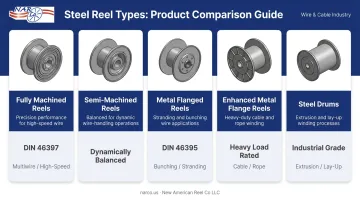
Flange diameters in industrial wire drawing reels range from roughly 400 mm to 1250 mm (16 in. to 48 in.), depending on the application.
Where Steel Reels Dominate
Steel reels are the standard choice for:
- High-volume continuous drawing operations (steel wire, copper cable, stainless tubing)
- Operations with dedicated payoff and take-up equipment requiring precise reel tolerances
- Manufacturers running the same reel through production and shipping cycles repeatedly
- Any application where dynamic balance and flange geometry affect product quality
Narco serves wire and cable manufacturers across the U.S. with repair, dynamic balancing, welding, and custom fabrication. For operations cycling the same reels through production and shipping repeatedly, reconditioning typically costs a fraction of new reel purchase — keeping more reels in service rather than in the scrap pile.
What Are Cardboard Tubes in Wire and Tube Drawing?
Cardboard tubes — also called fiber cores or paper cores — are cylindrical spools made from wound paperboard, bonded with adhesive. They're disposable winding cores designed for finished wire packaging and single-pass shipping, not for production environments. Understanding that distinction upfront prevents costly mistakes on the draw floor.
Core Benefits
- Low cost per unit — minimal capital investment for short runs or one-way shipments
- No return logistics — leave with the product, no retrieval required
- Lightweight — favorable for shipping weight calculations
- Wide availability in standard sizes, with inside diameters from under 1 inch to 24 inches or more
Inherent Limitations
Cardboard tubes have physical constraints that disqualify them from industrial drawing lines:
- Susceptible to moisture — paper cores require 73°F and 50% relative humidity to hold dimensions, conditions most plant floors don't provide
- Cannot withstand high radial loads without deforming
- No dynamic balancing possible
- Crush failure under tension causes inconsistent payoff and wasted wire
Cardboard tubes are end-packaging formats, not payoff or take-up spools for industrial draw benches. Using them under production tension leads directly to crush failure, inconsistent payoff, and scrapped wire.
Where Cardboard Tubes Make Sense
- Distribution-level packaging for consumer or contractor wire
- One-way export shipments where reel return is logistically impractical
- Light-gauge wire — fine copper, aluminum wire — with low winding tension
- Short-run or specialty production where steel reel capital investment isn't justified
Steel Reel vs Cardboard Tube: Which Is Right for Your Operation?
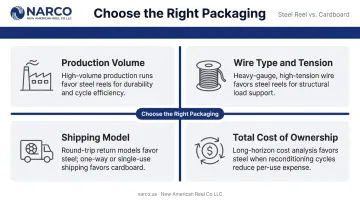
The decision comes down to four variables. Getting the answer right means looking at all four together, not just the unit price.
The Four Decision Variables
Production volume — High-volume continuous operations amortize steel reel costs across more cycles. Low-volume or sporadic runs may not generate enough cycles to justify the upfront investment.
Wire type and tension — Heavy-gauge steel wire, copper cable, and stainless tubing generate radial and tensile loads that cardboard cores cannot handle reliably. Light-gauge fine wire with low tension is a different calculation.
Shipping model — Round-trip logistics (reel returns to the manufacturer) favor steel. One-way distribution favors cardboard. The shipping model determines whether you can capture the reusability benefit of steel at all.
Total cost of ownership horizon — A steel reel costs more on day one. Across multiple production cycles — with reconditioning extending service life each time — the per-cycle cost drops substantially compared to buying and discarding cardboard cores continuously.
The Cost Math in Practice
Consider a simple illustration: a steel reel costs 10–15× more than a cardboard tube upfront. But across dozens of production cycles — with reconditioning costing a fraction of a new reel each time — the per-cycle cost of steel drops well below what cardboard costs on a continuous replacement basis.
The economics worsen for cardboard when you add:
- Disposal or recycling logistics
- Wire waste from inconsistent payoff or core failures
- Line stoppages from crushed cores
Situational Recommendations
Choose steel reels when:
- Running high-volume, high-tension drawing operations
- Equipment precision (dynamic balance, consistent flange geometry) affects product quality
- Round-trip reel logistics are feasible
- Sustainability and waste reduction are operational goals
Choose cardboard tubes when:
- Handling light-gauge, low-tension wire for distribution packaging
- Fulfilling one-way shipments where reel return isn't practical
- Managing short production runs where steel reel capital isn't justified
The Hybrid Approach
Many wire manufacturers use both. Steel reels handle in-plant production — payoff and take-up on the draw bench — where performance and durability matter most. Cardboard tubes or plastic cores handle final packaging and outbound distribution, where one-way economics make more sense.
The most practical reel strategy usually isn't either/or — it's matching the format to the actual requirement at each stage of production.
A Representative Scenario
That hybrid logic plays out clearly in practice. Take a mid-size wire manufacturer running a continuous drawing line for copper wire with recurring core failures: crushed cardboard cores on payoff stands, inconsistent tension during payout, and wire waste from tangled or misaligned layers. Each failure means stopping the line to clear the problem.
After switching to reconditioned steel reels for in-plant winding — sourcing from a reconditioning provider rather than buying all new — the operation sees fewer line stoppages, more consistent wire layering, and lower per-cycle packaging costs once the reconditioning cycle is established.
The cardboard tubes didn't disappear from the operation. They moved to their appropriate role: outbound distribution packaging, where the one-way economics made them the right tool.
Manufacturers evaluating their reel strategy can contact Narco to discuss new steel reels, reconditioned bobbins, or custom fabricated drums matched to their specific production requirements.
Conclusion
Steel reels and cardboard tubes both have legitimate roles in wire and tube drawing operations. The problem isn't using either format — it's using the wrong one for the stage or scale of production it's handling.
For high-volume, high-tension drawing operations, steel reels with a reconditioning strategy consistently deliver better long-term economics and fewer line disruptions. Light-gauge, one-way distribution is where cardboard tubes remain practical and cost-effective.
Audit your current reel usage against your actual production volume, tension requirements, and shipping model. If you're running industrial-scale wire drawing on cardboard cores, or paying full new-reel prices when reconditioning would serve the same purpose, there's room to cut costs without changing your output. Narco's reconditioning and custom fabrication services are built specifically for wire and cable operations looking to get more from their existing reel inventory — reach out to discuss what makes sense for your setup.
Frequently Asked Questions
What is the difference between wire drawing and tube drawing?
Wire drawing pulls solid metal rod through progressively smaller dies to reduce its cross-sectional area and produce wire. Tube drawing does the same for hollow metal stock, often using an internal mandrel to control wall thickness and inner diameter precisely. Both are cold-working metalforming processes.
What is the wire drawing effect?
The wire drawing effect refers to the increase in tensile strength and hardness that results from cold working the metal during drawing. Plastic deformation realigns the grain structure, improving mechanical properties, but at the cost of reduced ductility.
What are the different types of wire drawing processes?
The main types include single-block drawing, continuous (multi-pass) drawing, wet drawing (with lubricant), and dry drawing. Each suits different wire diameters, materials, and production volumes — multi-pass wet drawing for fine wire, dry drawing for coarser gauges and certain alloys.
What is the difference between wire drawing and extrusion?
Wire drawing pulls metal through a die under tension; extrusion pushes it through under compressive force. Wire drawing delivers better dimensional accuracy and surface finish, while extrusion suits complex cross-sections and larger stock.
Can cardboard tubes replace steel reels in high-volume wire production?
No. Cardboard tubes cannot withstand the radial loads and repeated payoff tension cycles of industrial wire drawing. They're suited to distribution packaging and light-gauge applications — not as payoff or take-up spools on production draw benches.
How long do steel wire reels last compared to cardboard tubes?
Cardboard tubes are single-use and discarded after one cycle. Steel reels serve many production cycles, and professional reconditioning — flange straightening, hub repair, and dynamic rebalancing — extends their service life further, driving the per-cycle cost well below that of disposable packaging.