Introduction
Steel cable reels sit at an odd intersection in industrial procurement: critical to operations, but rarely given the budget scrutiny they deserve. For wire manufacturers, cable shippers, and heavy industrial operations, reel decisions affect far more than a line item on a purchase order. The wrong spec can mean reel failure under load, unplanned downtime, or a replacement cycle that costs more than buying right the first time.
Steel reel pricing isn't standardized. Costs shift based on dimensions, steel grade, load requirements, and whether you're buying new, used, or reconditioned — there's no single price sheet covering that range.
This guide covers:
- Realistic price ranges anchored in published industry data
- The key factors that move costs up or down
- A full lifecycle cost breakdown
- Practical guidance for building an accurate budget
Key Takeaways
- Steel cable reels range from roughly $1,200 for smaller returnable reels to $21,000+ for large heavy-duty drums
- The biggest cost drivers are flange diameter, traverse width, steel grade, load capacity, and customization requirements
- Factor in freight, maintenance, and reconditioning — sticker price rarely reflects true lifecycle cost
- Reconditioned reels often deliver the best value for wire and cable operations running high reel volume
How Much Do Steel Cable Reels Cost?
No manufacturer publishes a universal price list for steel cable reels — manufacturers quote on request because the variables are too significant to standardize. A 60-inch returnable reel and a 158-inch offshore drum share a product category but almost nothing else in terms of material, labor, or engineering.
The most reliable public benchmark data comes from Southwire's published returnable reel charge schedules, which function as real-world proxies for steel reel valuation at scale.
Typical Price Ranges by Tier
| Tier | Example Specs | Approximate Price Range |
|---|---|---|
| Entry-level / light-duty | 60–68" flange diameter, 340–444 lb reel weight | $1,200 – $1,500 |
| Mid-range / standard industrial | 90–110" flange, 45–70" traverse, up to ~1,770 lb | $2,500 – $4,200 |
| Heavy-duty / large-capacity | 158"+ flange, 4,000–7,000 lb reel weight | $14,000 – $21,000+ |
| Custom offshore / high-capacity | Up to 185" flange, loads up to 40 metric tons | Quote-based only |
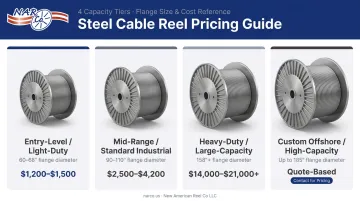
A few clarifications on what these ranges typically cover:
- Included: Reel construction, standard flanges, drum core, standard arbor configuration
- Quoted separately: Freight (significant for heavy drums — more on this below), custom arbor sizes, surface coatings or powder coating, non-standard stave configurations
Within any tier, three factors drive the final price: flange diameter, total reel weight, and construction complexity (standard vs. corrugated vs. custom stave). Fabricators like Narco, based in Antwerp, Ohio, work across the full size spectrum — from 3-inch process bobbins to 144-inch corrugated shipping reels — and determine pricing based on your specific dimensional requirements, construction type, and order volume.
Key Factors That Affect the Cost of Steel Cable Reels
Pricing is shaped by a combination of physical specifications, material choices, and production requirements. Understanding these factors prevents both over-specifying and under-specifying.
Reel Size and Dimensional Specifications
Three dimensions drive material usage and fabrication time directly:
- Flange diameter — the single biggest cost lever; larger flanges require more steel plate and more fabrication labor
- Drum (core) diameter — sets the minimum bend radius for the cable being wound; sized using NEMA WC 26 guidelines (minimum drum diameter = cable diameter × construction factor)
- Traverse (inside width between flanges) — determines cable capacity and overall reel weight
Doubling flange diameter doesn't double cost: steel plate area scales with the square of diameter, so costs compound faster than the dimensional increase suggests.
Steel Grade and Wall Thickness
Heavier gauge steel and higher-strength alloys raise both material cost and machining time. Standard mild steel handles most wire manufacturing and cable shipping applications. Operations involving corrosive environments — offshore installations, outdoor storage in coastal regions — require coated or stainless-grade construction, which raises unit cost noticeably.
Load Capacity and Engineering Requirements
Steel grade gets you the right material. Load capacity determines the structural design. Reels built for high cable weights require:
- Reinforced flanges (heavier gauge, gusseted construction)
- Stronger drum cores capable of handling lateral forces from wound cable tension
- Dynamic balancing for reels used in high-speed production environments
NEMA WC 26-2008 defines "maximum strength capacity" as the total conductor or cable weight a specific reel size and construction can carry. Use this as your starting point for matching reel spec to actual load.
One published example: an RMT-type reel with a 108-inch flange and 74-inch traverse is rated to 30,000 lb. Underspecified reels fail under load; overspecified reels inflate per-unit cost unnecessarily — always verify rated capacity against your heaviest expected cable run.
Level of Customization
Off-the-shelf standard reels (RM/RMT types in NEMA configurations) cost less than custom-fabricated designs. Custom work — non-standard arbor holes, specialized stave configurations, collapsible bobbins, multiple drum compartments — adds design time, machining setup, and per-unit labor that standard production runs don't carry.
Narco provides drawings with every quote and order specifically to prevent misalignment on what's being built.
Order Volume
Per-unit cost decreases with larger orders. Setup and programming time is amortized across the production run, and material purchasing at volume carries better economics. A single custom fabrication carries a real premium over the same reel ordered in quantity — plan accordingly if your operation has predictable annual reel consumption.
Steel Cable Reel Cost Breakdown
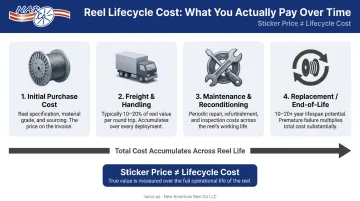
Purchase price is only part of the picture. Buyers who evaluate reels on sticker price alone routinely encounter unexpected costs across the reel's lifecycle.
Initial Purchase Cost
The reel itself — new, used, or reconditioned — is the largest single line item. Budget this against expected reel lifespan, not just the current procurement cycle.
Freight and Handling
Steel reels are heavy. A mid-range industrial reel can weigh 1,000–2,000 lb; large drums can exceed 6,000 lb. Some practical freight considerations:
- Standard LTL carriers typically accept freight up to 15,000 lb, but heavy reels often trigger volume or specialized handling rates
- Oversized pieces (flanges exceeding standard pallet height or length) can incur overlength fees of $75 to $250 per shipment and may require flatbed or specialized equipment
- Freight cost for a single large steel reel shipped across the country can represent 10–20% of the reel's value — a meaningful consideration for small-batch or single-unit orders
Maintenance and Reconditioning
Steel reels in active use require periodic attention:
- Flange straightening and press work
- Weld repair for cracked flanges, damaged arbor tubes, or broken drive pins
- Surface blasting and repainting to prevent corrosion and maintain structural integrity
- Dynamic balancing after repairs, particularly for reels used in high-speed wire manufacturing
Skipping maintenance doesn't avoid these costs. It defers them until the reel fails prematurely, at which point replacement runs higher than a repair program would have.
Replacement and End-of-Life
Well-maintained steel reels outlast wooden alternatives by a significant margin. According to BHS, steel reels can hold cable weights exceeding 11,000 lb, and wooden reels are more likely to warp when stored for more than six months.
The upfront premium for steel pays back across multiple use cycles. Capturing that longevity requires a reconditioning program — weld repair, repainting, and periodic dynamic balancing — to keep reels serviceable rather than pulling them from rotation early.
New vs. Used vs. Reconditioned Steel Reels
Three purchasing paths exist, each with a distinct cost-performance profile:
| Option | Cost Level | Best Fit |
|---|---|---|
| New (custom or standard) | Highest upfront | Non-standard specs, critical applications, longest initial lifespan |
| Used (as-is) | Lowest upfront | Low-demand or temporary use; unknown remaining service life |
| Reconditioned | Mid-range | Ongoing production operations; known quality at reduced cost |
For most wire manufacturing and cable shipping operations running reels on a continuous cycle, reconditioned reels represent the strongest value. The key is knowing what reconditioning actually includes — and what condition a reel needs to be in to qualify.
Narco's reconditioning services address the full range of common reel issues, restoring equipment to operational specification at a fraction of new-reel cost:
- Flange straightening and press work
- Weld repair for structural failures
- Arbor tube restoration and drive pin replacement
- Surface blasting and painting
- Dynamic balancing
Before assuming a used reel is serviceable, request a condition assessment. Reels with flattened or cracked flanges, compromised arbor plates, or excessive structural rust may require reconditioning before they're safe to run — or may be beyond economical repair.
Dura-Line's published inspection criteria reject reels with bent flanges, cracked welds, torn spokes, or rust that compromises structural integrity — a practical benchmark for any incoming used inventory.
Narco also maintains access to used steel wire reels through its network of industrial facilities and can help locate suitable used inventory or provide warehousing while supply is sourced.
How to Estimate Your Budget and Avoid Common Mistakes
The most common budgeting error in steel reel procurement is buying to a price point rather than buying to a specification. The sequence matters:
Define your operational requirements first:
- What cable type and diameter will the reel carry? (Determines minimum drum diameter per NEMA WC 26 formula)
- What is the maximum cable weight per reel? (Sets minimum load capacity requirement)
- How frequently will reels cycle? (Affects maintenance interval and total reel quantity needed)
- What is the operating environment — indoor manufacturing, outdoor storage, offshore? (Determines material and coating requirements)
- Are reels single-trip or returnable/reusable? (Changes the total cost math significantly)
- Do you need standard NEMA configurations or custom arbor and dimensional specs?
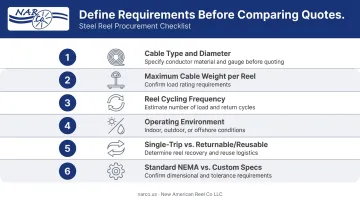
Once you've answered these questions, you're in a position to compare quotes meaningfully.
On lifecycle cost: A steel reel that costs $4,000 upfront and lasts 10+ years with periodic reconditioning delivers lower total cost than a $2,500 reel replaced every three years. The math is straightforward, but it requires treating reconditioning as a planned operational expense rather than an exception.
Steel reels outlast wooden alternatives in demanding applications, but only with consistent maintenance. Narco has worked with wire manufacturers and cable companies on this tradeoff since 1999, offering reconditioning programs that restore reels to service without full replacement on every cycle.
Conclusion
Steel cable reel costs range from roughly $1,200 for smaller returnable reels to well over $20,000 for large custom drums — with freight, maintenance, and eventual reconditioning adding meaningfully to the total. The right choice depends on your application, load requirements, and operating environment — not just the unit price.
Total lifecycle cost is what actually matters. For operations running reels continuously, a professional reconditioning program can meaningfully reduce per-cycle costs while maintaining performance. If you're weighing new fabrication, used inventory, or reconditioning of your existing reel fleet, a condition assessment and quote before committing is the right first step. Narco has offered all three paths since 1999 — reach out to discuss which direction fits your operation.
Frequently Asked Questions
How much is a reel of wire?
The cost of wire on a reel and the cost of the reel itself are separate line items. Wire pricing depends on gauge, material (copper, aluminum, steel), and quantity purchased. Reel pricing follows the ranges outlined above — from roughly $1,200 for smaller steel returnable reels to $21,000+ for large industrial drums.
What is the difference between a steel cable reel and a wooden reel in terms of cost?
Steel reels cost significantly more upfront than wooden alternatives, but they support far higher load capacities (11,000 lb+), resist warping in outdoor storage, and are reusable across many cycles. For industrial, offshore, and repeat-use applications, the lifecycle economics favor steel.
How long does a steel cable reel last?
With proper maintenance and periodic reconditioning, steel reels typically last 10–20+ years, far outlasting wooden or plywood alternatives. Actual service life depends on load cycles, environmental exposure, and whether a maintenance program is in place.
Is it worth reconditioning a steel cable reel instead of buying new?
For reels with structural integrity intact, reconditioning is usually the more cost-effective path. Professional repair work — welding, flange straightening, arbor repair, dynamic balancing — typically restores a reel to operational spec at 30–60% of new-reel cost.
What factors most affect the price of a custom steel wire reel?
Flange diameter, traverse length, steel gauge, load capacity rating, arbor configuration, and surface treatment requirements are the primary cost drivers. Non-standard configurations add design and machining costs on top of raw material.
Do steel cable reels need to meet any industry standards?
NEMA WC 26 (the Binational Wire and Cable Packaging Standard) covers sizing and construction specifications for steel reels used in wire and cable packaging. Buyers should verify reel dimensions and load ratings meet applicable NEMA requirements for their cable type and application.