Introduction
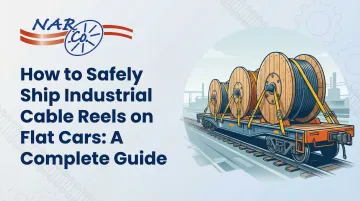
Shipping large industrial cable reels presents unique challenges. A single damaged reel can mean thousands of dollars in lost product and strained customer relationships. For cable manufacturers moving heavy loads, flat cars offer exceptional capacity (up to 210,000 lbs per car versus the 45,000 lb truck limit) and fuel efficiency that's 3-4 times better than trucking.
Successful rail shipment requires more than loading reels onto a flat car. The difference between smooth delivery and costly damage comes down to proper loading patterns, AAR-compliant securement, correct reel orientation, and strict adherence to railroad regulations.
Improper blocking leads to reel shifting during switching operations. Inadequate weather protection during multi-day transit results in moisture damage and customer rejection. This guide covers the complete process, from pre-shipment inspection to final documentation, explaining when flat car shipping makes sense, what preparations are mandatory, and which mistakes cause the most failures.
Key Takeaways
- Ensure proper weight distribution, AAR OTLR compliance, and upright positioning
- Use hardwood blocking, Grade 70 chains, and weatherproofing after inspection
- Get carrier pre-approval, prepare accurate documentation, and coordinate with rail supervisors
- Prevent damage by using quality blocking, correct tension, and weather protection
How to Safely Ship Industrial Cable Reels on Flat Cars: Step-by-Step Process
Step 1: Inspect and Prepare Reels for Rail Transport
Before any reel touches a flat car, verify its structural integrity. Rail transit exposes cargo to significant dynamic forces: shunting impacts, vibration, and emergency braking that will expose any structural weakness.
Critical inspection points:
- Flange condition — Check for cracks, warping, or weakness that could fail under chain tension
- Drum soundness — Verify the drum can support cable weight without collapsing
- Arbor hole integrity — Inspect for damage that could compromise securement through the arbor
- Cable end sealing — Ensure cable ends have proper seals to prevent unraveling
Confirm total dimensions and weight (reel plus cable) fall within flat car capacity limits. Standard flat cars handle 142,000–210,000 lbs, but you must verify the specific load limit stenciled on your assigned car.
Check that your load height (flat car deck plus reel diameter) does not exceed 15 feet 1 inch above the rail, the standard clearance for unrestricted North American movement.
Document reel identification numbers, precise dimensions, and weights for railroad shipping papers and freight billing. This documentation becomes critical if damage claims arise later.

Step 2: Select and Prepare the Flat Car
Coordinate with your rail carrier to obtain the appropriate flat car type based on your total reel weight and dimensions. Standard 60-ft or 89-ft flat cars with wood or steel decks work for most cable reel shipments.
Flat car inspection checklist:
- Inspect deck for structural soundness, damaged decking, protruding nails, or debris
- Verify adequate anchor points (stake pockets, D-rings, or channels with tie-down devices)
- Confirm current AAR inspection certification
- Check that the specific car's marked load limit exceeds your total cargo weight
Wood or steel deck flat cars allow you to nail blocking directly to the floor, which is essential for securing cylindrical cargo that wants to roll. If your carrier provides a specialized flat car with built-in channels and chain tie-down devices, verify you have compatible hardware.
Step 3: Position Reels on Flat Car with Proper Weight Distribution
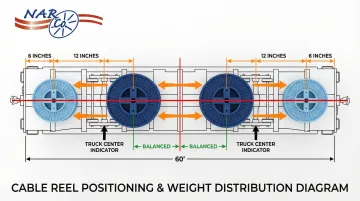
Proper positioning prevents load shifts, derailments, and tipping. The AAR Open Top Loading Rules (OTLR) provide specific figures for cable reel loading. Consult Figure 63 for upright loading and Figures 64 and 66 for crosswise and lengthwise orientations.
Position reels upright with flanges perpendicular to the direction of travel. This "wheel" orientation minimizes rolling forces and leverages the structural strength of the flanges. Horizontal positioning (flanges parallel to the deck) allows excessive movement and cable wrap loosening.
Distribute weight strategically:
- Place heaviest reels over the flat car's truck centers (wheel assemblies) to balance the load
- Maintain 6–12 inches spacing between reels for blocking installation and to prevent reel-to-reel contact
- Center the load laterally to prevent tipping
- For mixed sizes, position larger diameter reels at center/bottom, smaller reels at outer positions
Ensure your total load stays within the car's capacity and maintains proper center of gravity. An unbalanced load creates excessive sway and increases derailment risk.
Step 4: Block, Chock, and Secure Reels to Prevent Movement
Proper securement is critical for preventing cargo damage and liability issues. AAR OTLR Section 2 specifies exact blocking dimensions, materials, and securement methods. Deviation leads to carrier rejection and potential liability.
Blocking specifications from OTLR:
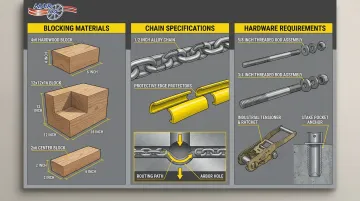
Install hardwood blocking between reel flanges and deck on both sides:
- 4 in. x 6 in. hardwood for side blocking and wedges
- 12 in. x 12 in. x 16 in. hardwood blocks for reels 4 ft diameter and larger
- 2 in. x 6 in. hardwood for center locating blocks
Place steel or heavy-duty rubber chocks fore and aft of reel flanges:
- For reels 90–108 inches in diameter, use welded steel chocks (21 in. high x 26 in. wide x 9 ft 9 in. long)
- Secure with ten 1-inch diameter high-tensile bolts per chock
Secure with chains or straps:
- Use 1/2 in. alloy chain for tie-down assemblies (per OTLR Figures 64-A/B/C)
- Rod assemblies: 5/8 in. diameter for reels ≤25,000 lbs; 3/4 in. diameter for reels >25,000 lbs
- Pass securement through arbor holes or around reel circumference
- Route through stake pockets or attach to approved anchor points
Install edge protectors where chains contact wooden flanges to prevent damage and maintain securement integrity.
Tighten to eliminate slack but avoid over-tightening:
- Over-tightening can crack wooden flanges or cause structural failure
- Include compression units and tensioning devices to maintain force during transit
Fill all vacant space between reels with blocking to prevent any movement. The OTLR emphasizes that gaps allow dangerous shifting during switching operations.
Step 5: Protect Reels and Complete Documentation
Multi-day rail transit exposes cargo to weather, temperature changes, and environmental contaminants. Protect accordingly.
Weather protection:
- Apply weatherproof tarps or shrink wrap over exposed cable surfaces if reels lack protective lagging
- Secure coverings to prevent wind damage; no part of the covering may extend beyond the tarp line
- For high-value cable or extended transit, add moisture barriers and corner protection
NARCo offers reel coverings for export and heat-treated materials for international shipping compliance.
Complete railroad documentation:
- Bill of Lading with accurate commodity description (fiber optic cable, power cable, etc.)
- Correct Standard Transportation Commodity Code (STCC); incorrect codes trigger penalties
- Total weight, reel count, dimensions
- Shipper and recipient information with complete addresses
- Special handling instructions
- Hazardous materials declarations if applicable (per 49 CFR Part 172 Subpart C)
Photograph the loaded flat car from multiple angles documenting reel positioning, securement methods, blocking installation, and overall load condition. These photos provide critical evidence if damage claims or liability disputes arise.
Conduct a final walk-around inspection verifying all securement is tight, blocking is secure, and the load complies with AAR standards before releasing the car to the railroad.
When Should You Use Flat Car Shipping for Cable Reels?
Flat car shipping is not universally optimal—it works best for specific scenarios where its advantages outweigh the longer transit times and coordination requirements.
Ideal use cases:
- Long-distance shipments over 500 miles where rail offers 3–4x better fuel efficiency than trucking
- Multiple large reels to the same destination allowing consolidation onto a single flat car
- Shipments exceeding truck weight limits (flat cars handle 142,000–210,000 lbs vs. 45,000 lb truck limit)
- Project cargo where multiple reels ship together, reducing per-unit costs
When flat car shipping becomes inefficient:
- Small quantities (1-2 reels) where flat car capacity is underutilized
- Time-sensitive deliveries requiring faster transit than rail provides
- Destinations without rail sidings requiring costly truck transloading at the destination
- Shipments under 45,000 lbs that fit comfortably on a single truck
The key decision factor is balancing cost against time. Rail offers lower cost-per-ton-mile but longer transit times. If your customer needs the cable next week, trucking may be the only viable option regardless of cost.

Pre-Shipment Requirements and Common Mistakes to Avoid
Equipment and Compliance Requirements
Success requires the right equipment and strict adherence to carrier-specific protocols.
Mandatory equipment:
- Flat car meeting AAR specifications with current inspection certification
- Hardwood blocking materials (4x4 minimum, 4x6 standard, up to 12x12 for large reels)
- Grade 70 chain or equivalent high-strength straps rated for rail transport forces
- Properly rated connection hardware (shackles, hooks, tensioners)
- Edge protectors for all chain/strap contact points with wooden components
Carrier pre-approval requirements:
Railroad carriers enforce strict pre-shipment coordination. Failure to comply results in rejection fees and delays.
- Norfolk Southern requires NS Damage Prevention approval before shipment (1-800-742-6313). Non-compliant loads face $500-$1,000 inspection fees plus re-blocking costs.
- BNSF requires Load and Ride Solutions team approval and can develop custom loading diagrams for unusual cargo.
- Union Pacific offers Shipment Quality Engineer support for complex load planning.
Common Mistakes That Cause Reel Damage or Shipping Delays
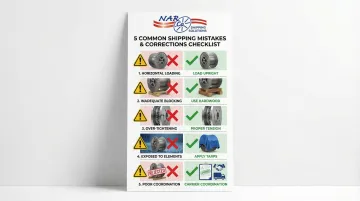
Loading reels horizontally (flanges parallel to deck) is the most frequent error. This orientation allows excessive rolling movement, loosens cable wraps, and makes effective blocking nearly impossible.
Always load upright unless OTLR specifically permits horizontal loading for your reel type.
Using inadequate blocking materials—such as softwood instead of hardwood, undersized dimensions, or insufficient nailing—allows blocking to compress or shift under rail vibration and switching impacts. Follow OTLR specifications exactly; carriers will reject non-compliant loads.
Over-tightening securement chains cracks wooden flanges or causes reel structural failure during transit. Tighten to eliminate slack but stop before you stress the wood. Use edge protectors to distribute force and prevent localized damage.
Failing to protect cable ends and exposed surfaces from weather leads to water penetration, corrosion, and customer rejection after multi-day rail transit. If your reels lack protective lagging, tarping is mandatory.
Ignoring carrier-specific requirements or loading without pre-approval guarantees rejection, delay, and additional fees. Always coordinate with the railroad before loading begins.
Troubleshooting Common Flat Car Shipping Issues
Even with proper planning, three common issues can disrupt flat car shipments. Recognizing the causes early helps you respond quickly and protect your liability.
Here's how to address the most frequent problems:
Reel Shifting or Securement Failure During Transit
Shifting typically results from inadequate blocking, insufficient securement tension, or improper weight distribution.
Address it by:
- Verify blocking material meets OTLR specifications (hardwood, correct dimensions)
- Increase the number of securement points—add additional chains or straps
- Redistribute load to balance weight over truck centers before continuing shipment
- Inspect for compressed or damaged blocking and replace with proper materials
If shifting is discovered in transit, the railroad will typically stop the shipment for re-securing. You'll be responsible for the cost if the original loading was deficient.
Reel or Cable Damage Upon Delivery
Damage usually stems from contact with other reels, inadequate weather protection, or rough rail yard handling.
Take these steps immediately:
- Review loading photographs and shipping documentation to establish liability
- Document damage thoroughly with photographs before unloading—once the reel is off the car, you lose critical evidence
- File freight claim with the carrier promptly per 49 U.S. Code § 11706
- Preserve damaged components and securement materials as evidence
Under federal law, rail carriers are liable for cargo damage unless they can prove the damage resulted from shipper error (inadequate blocking/bracing) or acts of God. Your loading photographs and compliance with OTLR standards become your liability protection.
Railroad Rejection of Load or Loading Method
Railroads reject loads that don't meet AAR standards, exceed car capacity, or violate carrier-specific rules.
Prevent rejection through:
- Consult the railroad's loading guidelines in advance—OTLR Section 2 is the authoritative source
- Request pre-loading inspection if you're uncertain about your loading plan
- Maintain open communication with the railroad loading supervisor throughout the loading process
- Modify your loading pattern if the supervisor identifies deficiencies
Railroad rejection is expensive—you'll pay for the car time, re-loading labor, and potential inspection fees. Prevention through advance coordination is far more cost-effective than fixing issues after rejection.
Frequently Asked Questions
How should industrial cable reels be transported and stored, including when shipping on flat cars?
Transport reels upright with flanges perpendicular to travel direction, using AAR-compliant hardwood blocking (typically 4x6) and Grade 70 chains or equivalent straps. Position reels over flat car truck centers with weather protection for multi-day transit.
How much do cable reels weigh?
Cable reel weights range from under 100 lbs for small reels to over 50,000 lbs for large industrial units. Standard industrial reels (48"–72" flanges) typically weigh 2,000–15,000 lbs when loaded.
What are the weight capacity limits for flat cars used in cable reel shipping?
Standard flat cars handle 200,000–220,000 lbs, while heavy-duty cars support up to 400,000 lbs. Actual capacity depends on the car's stenciled load limit and proper weight distribution over truck centers.
What securement methods are required for cable reels on flat cars?
AAR rules require 1/2 in. alloy chain (Grade 70 or higher) or equivalent straps through arbor holes, combined with hardwood blocking between flanges and deck. Securement must prevent movement during switching, acceleration, and braking.
Can cable reels be stacked on flat cars to maximize shipping efficiency?
Stacking is possible with protective dunnage and clearance below 15 ft 1 in., but only if lower reels can support upper weight without flange damage. Most shippers avoid stacking large industrial reels due to damage risk.
What documentation is required for shipping cable reels by rail?
Required documents include a Bill of Lading with commodity description, STCC code, weight/reel count, shipper/consignee details, and hazmat declarations (if applicable per 49 CFR Part 172). Photographs of loaded cars are recommended for liability protection.