An Approved Wire Reel Vendors List (AVL) solves this by creating a pre-vetted register of suppliers — covering new fabrication, reconditioning, repair, and dynamic balancing — so your team never has to qualify a reel vendor from scratch mid-production surge.
This article covers what a wire reel AVL is, why it matters for production continuity, the specific criteria to use when qualifying vendors, and how to build and maintain the list over time.
Key Takeaways
- A wire reel AVL is a formal register of pre-approved suppliers for reel fabrication, repair, reconditioning, and balancing services
- Unplanned industrial downtime costs $10,000 to $250,000 per hour — reel quality directly affects that exposure
- Qualify vendors on reconditioning capability, in-house welding/machining, dynamic balancing, and wire industry experience
- Review the list at least annually and track vendor performance with reel-specific metrics
- Maintaining two to three approved vendors per category prevents single-vendor dependency
What Is an Approved Wire Reel Vendors List?
An Approved Wire Reel Vendors List is a curated, formally authorized register of suppliers that a wire or cable company has pre-qualified to receive purchase orders for reel-related products and services.
Unlike a general vendor list, it is scoped specifically to the reel supply chain:
- New steel, plastic, and wooden reels
- Used and reconditioned reels
- Bobbins, spools, and drums
- Repair and reconditioning services
- Dynamic balancing and custom fabrication
The qualification criteria are wire-industry-relevant — not generic supplier standards applied to any category.
AVL vs. ASL: What's the Difference in Name?
"Approved Vendor List (AVL)" and "Approved Supplier List (ASL)" are interchangeable terms. In procurement contexts, AVL is more common; in quality management systems, ASL appears more frequently. You'll also see "wire reel supplier register" used in some manufacturing environments.
All three serve the same governance purpose: they control which suppliers your team is authorized to engage, so qualification happens once — systematically, not ad hoc for every purchase order.
Why Wire Manufacturers Need an Approved Vendor List for Reels
The Wire Association International puts it plainly: reels are now "as critical to success as the equipment itself" and must be properly maintained to ensure productivity. Despite this, many procurement teams still treat reel sourcing as a commodity purchase — and pay for it in downtime and defects.
The Cost of Getting It Wrong
Aberdeen Group's asset-performance research estimates industrial unplanned downtime at $10,000 to $250,000 per hour, with approximately $50 billion lost annually across industries. A reel that fails mid-winding — because it was poorly reconditioned or never balanced — stops a production line just as effectively as equipment failure.
Beyond downtime, the risks from unvetted reel vendors include:
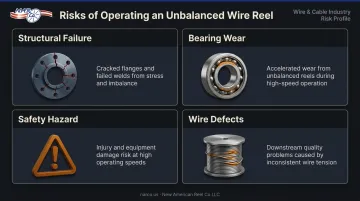
- Cracked flanges and failed welds from improper fabrication or press work
- Accelerated bearing wear and vibration from reels returned to service without dynamic balancing
- Injury and equipment damage in high-speed winding operations when a reel is unbalanced or structurally compromised
- Wire defects downstream caused by inconsistent reel dimensions or surface damage
The Supply Chain Continuity Argument
Wire reel needs span multiple categories — new fabrication, reconditioning, dynamic balancing, custom welding and machining. Without an AVL, procurement teams re-qualify vendors every time a new need arises. Each gap in coverage is a potential delay when production pressure is highest.
An established approved vendor list changes that dynamic. Your team can respond to urgent reel needs or production surges immediately, drawing from pre-vetted suppliers without restarting the qualification process from scratch.
Key Criteria for Qualifying a Wire Reel Vendor
Not every vendor belongs on the list. These are the criteria that separate qualified wire reel suppliers from general metalwork shops or generic reel distributors.
Reconditioning and Repair Capability
A qualified vendor should assess structural reel damage and restore reels to near-original condition , not just clean and repaint them. Look for vendors who perform:
- Flange straightening and press work
- Rim repair and weld repairs
- Drive pin hole repair or replacement
- Arbor tube repair or replacement
- Arbor hole resizing
In-house welding and machining are strong indicators of genuine repair capability. Narco, for example, has offered in-house welding, machining, and reconditioning since expanding its services from its founding in 1999 , handling reels from 3" to 96" (75mm to 2400mm) in diameter.
Dynamic Balancing Capability
For vendors servicing high-speed wire take-up or payoff reels, dynamic balancing is essential. SKF's vibration diagnostics research confirms that unbalanced rotating components increase bearing loads and show up as elevated vibration , accelerating wear and creating wire quality problems.
When evaluating vendors, ask for:
- The balancing standard used (ISO 21940-11 is the relevant rotor balancing reference)
- The rated speed range for balanced reels
- Whether balancing is performed after repair, after new fabrication, or both
- The diameter range their balancing equipment covers
At Narco, dynamic balancing covers reels from 3" to 96" and is a standard step in reconditioning, included rather than priced separately.
Custom Fabrication and Design Capability
Standard catalog reels don't fit every machine configuration. Vendors who can design and manufacture reels to specification (covering different flange types, arbor configurations, drum sizes, and materials) give procurement teams flexibility that commodity suppliers cannot.
Key fabrication capabilities to verify:
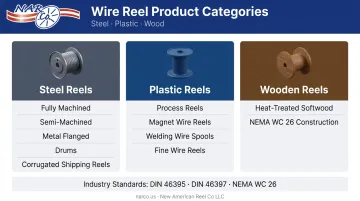
- Steel reel types: fully machined, semi-machined, metal flanged, drums, corrugated shipping reels
- Plastic reels: process reels, magnet wire reels, welding wire spools, fine wire reels
- Wooden reels: heat-treated softwood construction to NEMA WC 26
- Standards compliance: DIN 46395, DIN 46397, NEMA WC 26 as applicable
Industry Experience and Credentials
A vendor with focused experience in wire reel supply understands operational context that general metalwork shops don't : reel interface requirements, winding machine tolerances, and the practical difference between a process reel and a shipping reel.
Wire Association International (WAI) membership is a useful alignment signal — it indicates the vendor follows wire industry developments and engages with relevant technical standards. Verify it directly, but treat it as a baseline indicator rather than a substitute for capability evidence.
Turnaround Time, Capacity, and Logistics
Even a highly capable vendor creates problems if they can't meet your volume or schedule. During qualification, confirm:
- Typical turnaround times for standard reconditioning
- Capacity for volume surges
- Geographic location and shipping logistics for inbound/outbound reel movement
Wire reels are bulky and heavy , and logistics friction adds real cost and time. Vendors in manufacturing-accessible locations — Narco operates from Antwerp, Ohio — simplify the return-reel workflow for Midwest and broader US operations.
How to Build Your Approved Wire Reel Vendors List
Step 1: Identify Your Reel Supply Needs
Before evaluating any vendor, map out your reel requirements by category:
- New reel fabrication (steel, plastic, wood)
- Reel reconditioning and repair
- Bobbin and spool services
- Drum manufacturing
- Custom reel design and modification
Once you know which categories apply to your operation, you can target vendors with the right capabilities — and avoid approving suppliers you'll never actually use.
Step 2: Define Approval Criteria and Score Vendors
Build a standardized scorecard with wire-reel-specific criteria:
| Criterion | Weight | What to Evaluate |
|---|---|---|
| Reconditioning capability | High | Scope of damage types repaired, in-house welding/machining |
| Dynamic balancing | High | Equipment, standard used, size range |
| Custom fabrication | Medium | Materials, configurations, design support |
| Industry experience | Medium | Years in wire reel industry, WAI affiliation |
| Turnaround time | High | Average cycle time, surge handling |
| Logistics | Medium | Location, shipping coordination |
Score each candidate vendor using the same criteria and weights. A consistent scorecard gives you a defensible paper trail — and makes it straightforward to explain why a vendor was approved or declined.
Step 3: Conduct Vendor Verification and Audits
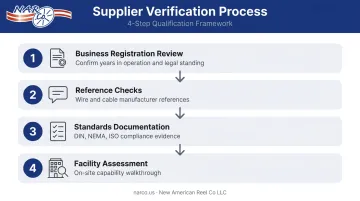
Verification steps should include:
- Business registration review — confirm years in operation and legal standing
- Reference checks — request references from other wire or cable manufacturers specifically
- Standards documentation — ask for evidence of compliance with relevant standards (DIN, NEMA, ISO)
- Facility assessment — when possible, visit or request a capability walkthrough to confirm equipment, capacity, and quality controls match what the vendor claims
Once verification is complete, you have the evidence needed to finalize each vendor's status — and the documentation to support it.
Step 4: Formalize the List and Set Review Cycles
Document each approved vendor with these minimum fields:
- Vendor name and primary contact
- Approved service categories (repair, reconditioning, new fabrication, balancing)
- Standards compliance documentation on file
- Performance rating
- Last audit or review date
- Approval status
Review the list at minimum annually. Interim reviews should trigger automatically when a vendor's performance drops or your production requirements change.
Best Practices for Maintaining Your Wire Reel Vendor List
A static AVL loses value quickly. These practices keep it reliable:
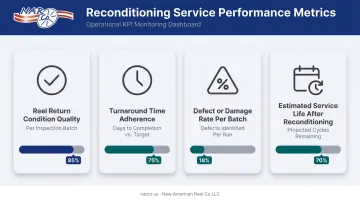
Track reel-specific performance metrics, not just general delivery scores:
- Reel return condition quality
- Turnaround time adherence
- Defect or damage rate per batch
- Estimated service life after reconditioning
Maintain two to three approved vendors per critical category. If your sole reconditioning vendor faces a capacity crunch, your production timeline shouldn't depend on their ability to recover. Single-source dependency is a risk no production schedule can afford.
Re-evaluate your AVL at regular intervals — at least annually, or whenever production volumes or reel specifications change. A vendor qualified three years ago may no longer meet current compliance or capacity requirements.
The reverse is also worth checking. Vendors who were marginal at initial qualification sometimes expand their capabilities significantly. A second look can surface options you've been overlooking.
Frequently Asked Questions
What does it mean to be an approved vendor?
An approved vendor has completed your company's formal qualification process, demonstrating it meets required standards for quality, capability, reliability, and compliance. Once approved, the vendor is officially authorized to receive purchase orders without needing re-evaluation for each transaction.
What is the difference between an approved vendor list and an approved supplier list?
The terms are used interchangeably. "AVL" is more common in procurement contexts; "ASL" appears more often in quality management systems — both describe a pre-vetted, controlled register of authorized suppliers.
What criteria matter most when qualifying a wire reel vendor?
The most critical criteria are reconditioning and repair capability, in-house welding and machining, dynamic balancing equipment and expertise, custom fabrication ability, and demonstrated experience in wire manufacturing. Generic metalwork credentials are not sufficient substitutes.
Can a wire reel reconditioner qualify for an approved vendor list?
Yes — reconditioners are often among the most valuable entries on a wire reel AVL. Vendors who restore reels to near-original condition extend asset life and reduce total ownership costs compared to continuous new-reel procurement.
How often should I update my approved wire reel vendors list?
Annual review is the minimum. Trigger interim reviews when a vendor's performance declines, your reel specifications change, or production volume shifts significantly — any of these can make previously approved vendors the wrong fit.
What's the difference between an approved vendor list and an approved materials list for wire reels?
An AVL covers the suppliers — companies authorized to provide reels or reel services. An Approved Materials List (AML) specifies which reel materials, designs, or components meet your production standards. Both are useful tools, and they should be maintained separately.