The EPA's packaging waste data puts the scale of the problem in context: in 2018, over 11.5 million tons of wood packaging and 2.2 million tons of steel packaging were generated in the U.S., with a significant portion landfilled rather than recovered. Reels are a direct contributor to that waste stream when programs aren't in place to recover them.
A sustainable wire reel program isn't about switching to "greener" materials. It's a structured operational system — covering reel return logistics, inspection, reconditioning, and supplier agreements — designed to extend reel life and reduce the cost and waste of constant replacement.
This guide covers the business case, the five core program components, how to structure a return and reconditioning cycle, reel type selection, common challenges, and how to measure whether your program is actually working.
Key Takeaways
- A sustainable reel program prioritizes extending reel lifespan through repair and reconditioning, not just buying new stock.
- The lifecycle loop — return, inspect, repair, reuse — cuts both material costs and landfill contributions.
- Reel type selection (steel, wood, plastic) should be based on load requirements, environment, and recoverability.
- Unpredictable return timing and demand forecasting are the two biggest operational challenges, and both are solvable with the right tracking systems.
- Track three KPIs: cost per reel cycle, repair-to-replace ratio, and reel return rate.
Why a Sustainable Wire Reel Program Is Worth Building
Reels aren't raw materials in the traditional sense, but they behave like a capital asset. Every reel you fail to recover is a reel you purchase again — at full price, plus freight.
The environmental stakes are equally concrete. Wood and steel packaging discarded after one or two uses feeds directly into the industrial waste stream. Steel packaging has a 73.8% recycling rate in the U.S. — yet that still leaves roughly 470,000 tons of steel packaging still goes to landfill annually — and that's just what's counted in municipal solid waste data, not industrial streams.
The contrast between approaches is straightforward:
- Linear model: Buy reel → ship product → reel discarded or lost → buy replacement
- Circular model: Buy reel → ship product → reel returned → inspect → repair if needed → redeploy
The circular model doesn't just reduce waste. It lowers per-cycle packaging costs each time the reel completes another loop.
That financial case is reinforced by growing pressure from customers and supply chain partners. Major wire and cable manufacturers like Southwire now publish independently verified Environmental Product Declarations (EPDs) across more than 100 products in 55+ categories.
Procurement teams are increasingly asking suppliers to demonstrate documented sustainability practices — not vague commitments, but verifiable programs with clear metrics. A reel return and reconditioning program is exactly the kind of concrete, trackable action that satisfies that requirement.
What Goes Into a Sustainable Wire Reel Program
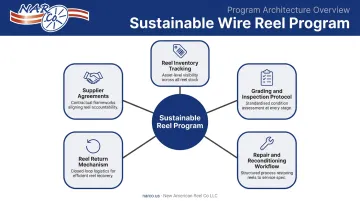
A functional program has five interconnected components. Missing any one of them creates gaps that undermine the others.
- Reel inventory tracking — knowing what you have, where it is, and how many cycles each reel has completed
- Grading and inspection protocol — documented criteria for deciding whether a returned reel goes back into service, gets repaired, or gets retired
- Repair and reconditioning workflow — a consistent process for restoring reels to serviceable condition
- Reel return mechanism — logistics, labeling, contracts, and customer communication that actually gets reels back
- Supplier agreements reflecting circular use — contracts that treat reconditioning as a core service, not an ad hoc request
Reel Inventory and Tracking
Without a clear count of reels in circulation — including location and cycle history — the entire program runs on guesswork. Over-ordering new reels when returns are slow is a direct consequence of poor visibility.
The Keystone Cable case illustrates what's at stake. After tagging approximately 500 wood and steel cable reels with passive UHF RFID, the company reduced reel search time by 90% — from 30–45 minutes per reel down to about 5 minutes. Given that some of those loaded reels weighed up to 5 metric tons, the operational and procurement cost of a misplaced reel is significant.
Tracking options by scale:
| Approach | Best for | Notes |
|---|---|---|
| Spreadsheet log | Small fleets, low complexity | Manual, error-prone at scale |
| Serialized barcodes | Mid-size fleets | Low cost, scan on intake/return |
| Passive UHF RFID | Large fleets, warehouse environments | High upfront cost, major time savings |
| GPS/IoT sensors | High-value reels, long customer hold times | Prysmian's ALESEA service uses this model |
Start with serialized barcodes. Get a count before adding complexity.
Grading and Inspection Protocol
Every returned reel needs a consistent disposition decision. Without documented criteria, that decision depends on whoever happens to be on the floor — which produces inconsistent results and erodes program trust over time.
A standard four-grade system works for most operations:
- Grade A — Return to service as-is
- Grade B — Minor repair needed (bent flange, surface damage)
- Grade C — Major reconditioning required (structural damage, weld failure)
- Grade D — Retire and scrap
NEMA MW 765-2003 (R2018), which covers reclaimed magnet-wire packaging, provides a practical benchmark for physical inspection criteria. Once you've assigned a grade, these are the specific areas to evaluate on each returned reel:
- Flanges — straightness, deformation, crack presence
- Barrel — structural integrity, surface condition
- Welds (steel reels) — crack detection, bond integrity
- Concentricity and balance — out-of-round or unbalanced reels create winding problems downstream
- Arbor hole and drive pins — wear or damage that affects fit on processing equipment
Document these criteria in a written inspection sheet that travels with each reel. Consistent decisions at intake directly determine what flows into your repair workflow — and what gets scrapped before it wastes reconditioning labor.
How to Set Up Your Reel Return and Reconditioning Cycle
Structuring the Return Logistics
The single biggest challenge in reel program management is unpredictable return timing. Industry programs show the range: Southwire Canada's steel reels must return within 12 months or the customer is billed 100% of reel value; wood reels earn a 93% deposit credit within 24 months. Conex Cable offers 100% refund within one year, dropping to 75% within two years.
These policies exist because unpredictability is the norm, not the exception. Build return mechanics into customer contracts from day one:
- Establish return windows — 12 months is a standard expectation for returnable reels
- Use deposit structures — financial incentives move timelines; customers who have money on the line return reels faster
- Assign unique serial numbers or barcodes to every reel — Southwire uses metal tags with unique serial numbers; missing or damaged tags can result in lost credits
- Clarify freight responsibility — who pays for return shipping should be in the sales agreement, not negotiated after the fact
- Designate return points — a single receiving location simplifies intake inspection and reduces handling errors
The Reconditioning Workflow
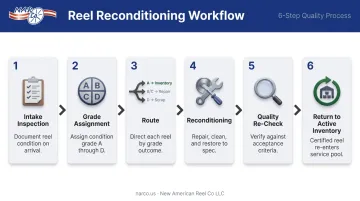
Once reels arrive, a documented workflow prevents bottlenecks as reel volume grows:
- Intake inspection — log reel ID, physical condition, cycle count
- Grade — assign A/B/C/D based on documented criteria
- Route — Grade A to active inventory; Grade B/C to repair queue; Grade D to scrap
- Reconditioning — straightening and press work for flanges, weld repairs, arbor tube repairs, blasting, painting, restenciling, dynamic balancing
- Quality re-check — verify dimensional and functional standards before return to service
- Return to active inventory — update cycle count in tracking system
For manufacturers running steel reel fleets, partnering with a dedicated reconditioning provider like Narco (New American Reel Co.) makes more operational sense than building in-house repair capacity.
Narco handles the full range of steel reel reconditioning — welding, machining, flange straightening, dynamic balancing, and surface treatment — for reel sizes from 3" to 96", without manufacturers needing to invest in specialized equipment themselves.
Managing Inventory Buffer
Because return timing is unpredictable, maintain a calculated safety stock of serviceable reels. Use return rate history to model buffer levels rather than reacting to shortages by ordering new. Academic research on returnable transport item inventory confirms that uncertain returns require a defined safety stock approach — reactive procurement is consistently more expensive than proactive stock management.
Choosing the Right Reel Type and Supplier Partner
Reel Type Comparison
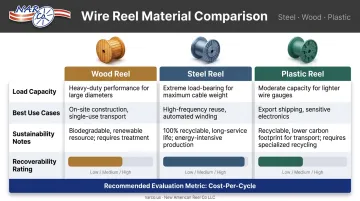
NEMA WC 26-2008 classifies wire and cable packaging into returnable, reusable, and nonreturnable categories — and all three major reel materials fit into that framework differently.
| Reel Type | Load Capacity | Best For | Sustainability Notes |
|---|---|---|---|
| Wood | Mid-range; varies by species and assembly | General purpose and heavy-duty wire shipping | FSC chain-of-custody available; Carris produces FSC-certified reels from Canadian facilities |
| Steel | High; handles heavy industrial cable | Process and shipping of heavy wire, cable, rope | High reuse potential with proper tracking and return programs |
| Plastic | Light to medium | Magnet wire, fine wire, data cable, moisture-prone environments | NEMA MW 765 inspection standards exist for reclaimed plastic spools |
Narco manufactures nailed wood reels to NEMA WC26 specifications in sizes from 20" to 60". Steel reels are supplied through its Midwest agency relationship with Inosym — including fully machined, dynamically balanced reels to DIN 46397 — and plastic reels are available for both process and shipping applications.
The key sustainability question isn't which material — it's how many cycles. A lower-cost reel that fails after one use is not more sustainable than a higher-cost reel that runs ten cycles through a reconditioning program. Evaluate reel selection on cost per cycle, not purchase price.
What to Look for in a Supplier Partner
Beyond product availability, a capable supplier partner for a sustainable program should offer:
- Reconditioning capabilities — welding, machining, dynamic balancing, and surface treatment
- Geographic proximity — return freight is a real cost, and regional suppliers reduce logistics exposure
- Custom fabrication — matching specific dimensional requirements (flange diameter, barrel width, arbor hole size) eliminates workarounds
- Used reel inventory — access to reconditioned stock at lower cost than new, particularly useful when you need buffer inventory fast
Narco's Ohio headquarters provides strong Midwest logistics access. The company maintains warehousing for used steel reels and can help locate inventory for manufacturers adding to their fleet.
On supplier contracts: negotiate stable base pricing with limited adjustment windows, build reconditioning services into the agreement rather than treating them as one-off requests, and qualify at least one backup supplier. Single-source dependency for a critical consumable is operational risk that a sustainable program should eliminate, not create.
Overcoming the Most Common Wire Reel Program Challenges
Every wire reel program eventually runs into the same three friction points. Here's how to address each one before it becomes a bottleneck.
Unpredictable Return Timing
Practical mitigation strategies:
- Deposit systems — financial exposure drives timely returns more reliably than goodwill
- Contractual return windows — 12-month windows are standard; put them in every sales agreement
- Proactive outreach to high-volume customers — a direct call six months after shipment recovers more reels than waiting
- Reel rental models — some manufacturers treat reels as a rental rather than a deposit, which reframes the customer's obligation
Forecasting Demand Accurately
Reel demand can shift week to week based on production schedules. Build a forecasting process using:
- Historical reel usage data (at least 12 months)
- Planned production schedules
- A flexible inventory agreement with suppliers that allows volume adjustments within agreed bounds without penalty
Monitoring Producer Price Index data for lumber (FRED series WPU081) and steel wire drawing (FRED series PCU3312223312225) helps anticipate material cost pressure before it hits your procurement budget.
Supplier Concentration Risk
A single reel supplier creates fragility — particularly when that supplier is far from your operations. Build toward a more resilient configuration by:
- Qualifying at least one backup supplier before you need them
- Prioritizing regional suppliers to cut lead times and return freight costs
- Structuring supplier agreements so volume can flex without penalty
A resilient supply configuration tolerates disruption without halting production. Lowest-cost single sourcing doesn't.
How to Track and Measure Program Success
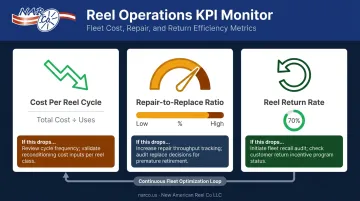
Three KPIs tell you most of what you need to know:
1. Cost per reel cycle Total reel cost (purchase price + freight + reconditioning + losses) divided by number of uses. Each successful reconditioning cycle drives this number down — which is the financial case for the program.
2. Repair-to-replace ratio Percentage of returned reels repaired rather than retired. If this number trends down, look at incoming reel quality first, then revisit your grading criteria.
3. Reel return rate Percentage of deployed reels actually recovered. When this slips, the problem is almost always in customer compliance or logistics — not on the production floor.
Before launching or formalizing your program, establish baselines for all three. The before/after comparison is the most persuasive argument you can bring to operations and finance leadership. Without a baseline, you're reporting numbers without context.
Tracking data should feed back into decisions actively:
- Return rate drops → investigate customer contract compliance and logistics friction
- Repair-to-replace ratio drops → audit supplier reel quality and grading criteria
- Cost per cycle rises → identify where in the workflow costs have increased (freight, repair labor, loss rate)
Programs that track these three numbers consistently tend to catch problems early — before a single bad quarter turns into a structural cost issue.
Frequently Asked Questions
What makes a wire more eco-friendly?
Eco-friendly wire products use recycled content in conductors (such as recycled copper), lower-impact manufacturing processes, and materials that can be recovered at end of life. Sustainable reel and packaging programs contribute to the product's overall environmental footprint as well.
What raw materials are used to make wires?
Conductors are primarily copper or aluminum; insulation and jacketing use PVC, polyethylene, or cross-linked polyethylene (XLPE). Sustainability depends on how these materials are sourced and what end-of-life recovery options exist.
Which cable installation method uses a stationary reel?
The stationary reel method keeps the reel fixed while cable is pulled off it, commonly used in aerial plant installations where vehicles cannot travel the full route. The moving reel method travels the reel along the route as cable is deployed.
How often should steel wire reels be inspected or reconditioned?
Best practice is to inspect every reel on return before redeployment, rather than on a fixed time interval. More thorough reconditioning is triggered by grading outcomes — the condition of the reel determines the work required, not an arbitrary schedule.
What is the difference between reel repair and reel reconditioning?
Repair targets a specific damage point: a bent flange, a broken weld, or a damaged drive pin. Reconditioning is a broader restoration that returns the reel to like-new condition, covering welding, machining, surface blasting, painting, and dynamic balancing as needed.
How does a reel return program reduce costs for wire manufacturers?
Recovered reels re-enter service at a fraction of new reel purchase cost. Each reconditioning cycle lowers the cost per use, reducing both total procurement spend and exposure to supply volatility. The fewer new reels you need to buy, the less your packaging costs fluctuate with material price swings.