This scenario plays out more often than wire and cable manufacturers like to admit. Reels, bobbins, and spools rarely get the maintenance attention that primary production equipment does — until the moment they bring everything to a halt.
This article covers what actually qualifies as a wire reel emergency, what that downtime costs, how to evaluate repair versus replacement quickly, and — most usefully — how to build a program that prevents the worst-case scenario before it arrives.
Key Takeaways
- A wire reel emergency is any unplanned failure or shortage that threatens production continuity or delivery deadlines
- Downtime from secondary equipment like reels triggers direct and indirect costs that compound fast
- Repair is often faster and more cost-effective than sourcing new reels — if the core structure is sound
- Used stock and custom fabrication fill the gap when repair isn't an option
- A proactive reel program replaces reactive crisis spending with budgeted risk management
What Qualifies as a Wire Reel Emergency?
Not every reel problem is an emergency — but the distinction matters. A true wire reel emergency is any unplanned situation where damaged, unavailable, or insufficient reels directly threaten to stop production or delay a committed shipment. At that point, every hour of response time counts.
Common Triggers
- Structural failure from impact damage or overloading beyond the reel's rated capacity (per NEMA WC 26-2008 maximum strength specifications)
- Weld or flange failure discovered during pre-shift inspection — cracked core-to-flange connections, bent flanges, or compromised rims
- Corrosion damage that has progressed to the point where load-bearing capacity is uncertain
- Arbor tube or drive pin damage that prevents the reel from seating correctly on production equipment
- Reels returned from customers in unusable condition, reducing available inventory below operational minimums
- Sudden production scale-up that outpaces reel inventory faster than anticipated
Emergency vs. Near-Miss
The distinction matters for how you respond:
| Situation | Definition | Appropriate Response |
|---|---|---|
| True emergency | Production stopped or imminent shutdown | Immediate contact with repair/replacement provider; parallel-path approach |
| Urgent situation | 2–5 days before impact | Expedited repair or sourcing; inspect full inventory now |
| Near-miss | Issue caught early; buffer time available | Scheduled repair; review inspection program |
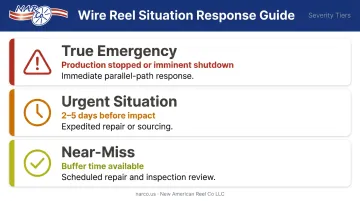
Misreading the severity in either direction has real costs — wasted expedite fees on one end, unplanned downtime on the other. Use the table above to categorize the situation before deciding how to escalate.
The Hidden Costs of Wire Reel Downtime
Reels are classified as secondary equipment in most facilities. That classification leads manufacturers to underestimate what happens when they fail.
Siemens' 2024 True Cost of Downtime report found that large industrial facilities average $253 million in annual unplanned downtime costs, with the average plant experiencing 27 hours of unplanned downtime per month across 25 separate incidents. Wire and cable operations sit in a wide range depending on product complexity and customer commitments — but the cost structure is the same. Those costs fall into two categories: the ones that show up on invoices, and the ones that quietly compound in the background.
Direct Financial Impacts
- Missed delivery deadlines and the penalties that follow — most industrial supply agreements include late delivery clauses
- Overtime labor to recover lost output once production resumes
- Expedited freight charges for emergency materials sourcing
- Scrap and setup losses when lines restart after an unplanned stop
Indirect Costs That Don't Appear on the Invoice
- Damage to customer relationships, particularly with buyers who depend on just-in-time delivery
- Production scheduling disruption that ripples across other orders
- Worker morale and retention effects when recurring crises signal poor planning
- Reputational risk in a specialized industry where on-time performance is a direct competitive factor
The Reactive Premium
Reliable Plant notes that running equipment to failure can cost up to 10 times more than a planned maintenance approach. For reel management, this plays out in hard dollars: companies without emergency protocols pay premium rates for rushed sourcing, emergency freight, and expedited reconditioning. Those with pre-arranged service relationships get faster response at pre-negotiated rates — and avoid the compounding costs that follow every unplanned stop.
Emergency Repair and Reconditioning: The Fastest Path Back to Production
Repair vs. Replace: Knowing Which Option Fits
For many emergency situations, reconditioning a damaged reel is faster and less expensive than sourcing a new one — but only when the reel's core structure remains sound. The decision requires a quick but honest assessment.
Typically repairable:
- Bent or deformed flanges (straightening and press work)
- Damaged rims
- Cracked welds on non-load-bearing areas
- Loose or damaged drive pin holes
- Arbor tube issues (restoration or replacement)
- Surface corrosion without load-bearing compromise
- Dynamic balance problems
Typically requires replacement:
- Cracked core-to-flange connections
- Severe corrosion that has compromised structural capacity
- Catastrophic deformation where dimensional restoration isn't feasible
- Unknown load history on a reel where safe use can't be confirmed
When repair cost approaches 65–70% of replacement cost, sourcing a new reel often makes more financial sense. Weigh that against turnaround time and the decision usually becomes clear.
What the Reconditioning Process Looks Like
Narco (New American Reel Co., based in Antwerp, Ohio) has been reconditioning and repairing steel wire reels and bobbins since 1999. Their documented reconditioning workflow covers the damage types most commonly encountered in production emergencies:
- Assess structural integrity — flanges, arbor fit, weld quality, and corrosion extent
- Straighten and press flanges back to operational tolerances
- Repair rim damage from impact
- Weld and machine — structural repairs, arbor tube restoration or replacement, drive pin hole work
- Blast and paint for surface preparation and corrosion protection
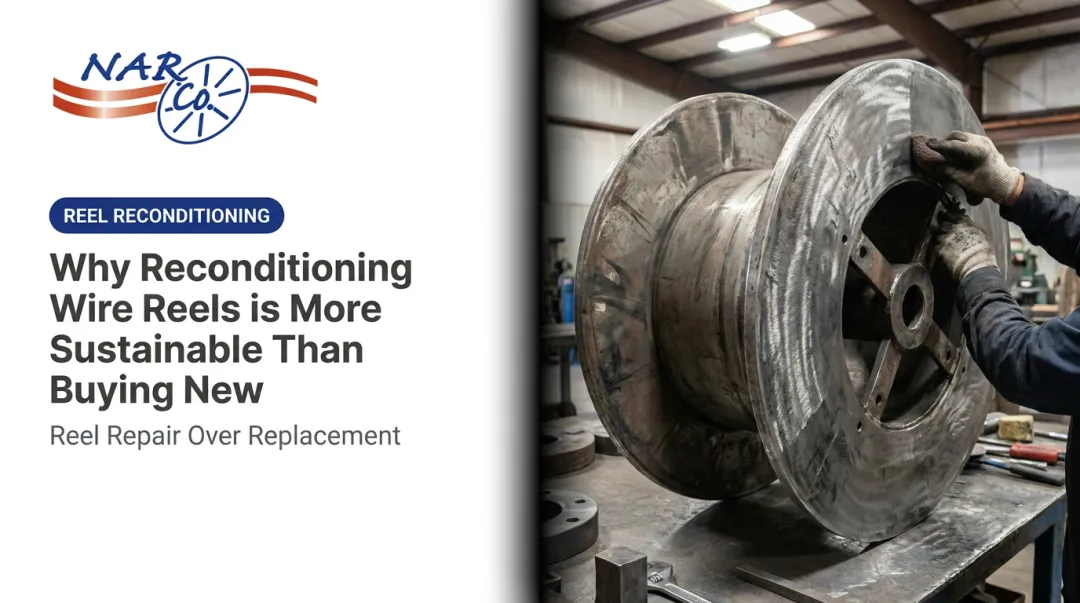
- Dynamic balance — essential for reels running in high-speed drawing, stranding, bunching, or take-up operations
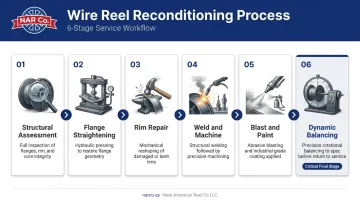
An out-of-balance reel at production speed generates vibration that damages equipment, degrades wire quality, and creates safety risk. Narco includes dynamic balancing as a standard part of reconditioning — not an optional add-on.
One practical note on turnaround: confirm a specific timeline at first contact. Estimates that slip cause downstream delays that are hard to recover from. Ask directly: "What is your committed turnaround, and what could push it out?"
Emergency Reel Replacement: When You Need Stock Fast
Replacement — rather than repair — becomes the right call in three specific scenarios:
- The reel is damaged beyond structural repair
- Production scale-up demands reel volume that repair alone can't cover
- Repair turnaround would cause greater production loss than sourcing a replacement
Three Replacement Pathways
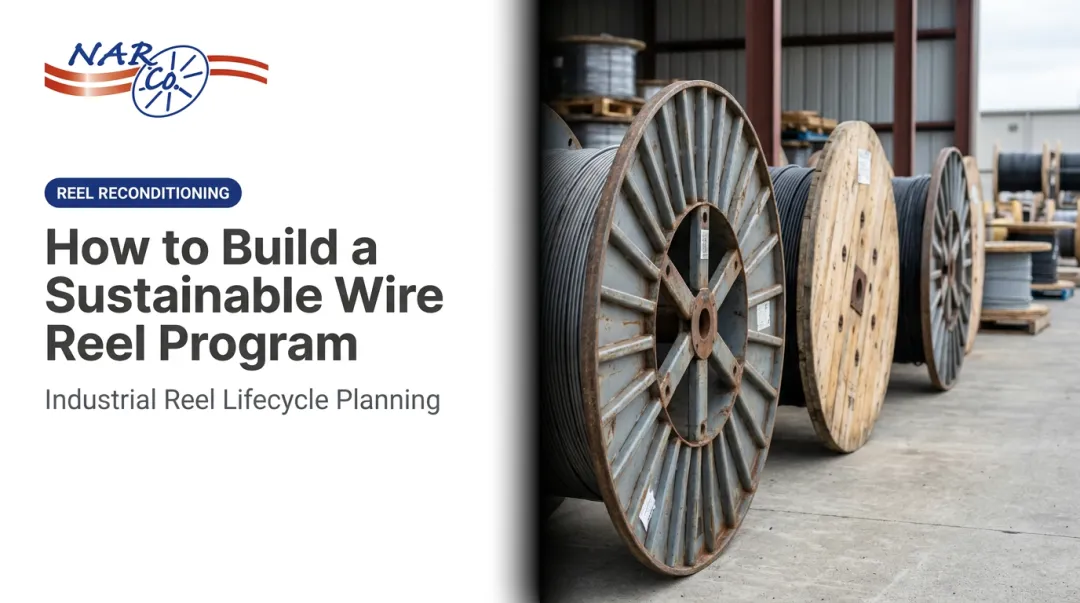
Used/reconditioned inventory — The fastest option when available. Narco maintains connections with facilities across the industry and can locate used steel reels in sizes from 3" to 96" (75mm to 2400mm). If specs match, this is the shortest path to getting reels on the floor.
Custom fabrication — When existing inventory doesn't match your specifications, new fabrication is required. Narco's in-house welding, machining, and design capabilities handle this directly — no outside sourcing. Custom orders are built to your specifications, with drawings provided at the quoting stage to eliminate ambiguity.
Combination approach — Frequently the right call for large-scale disruptions: temporary used reels bridge the production gap while new custom reels are fabricated to exact specifications. This requires a provider who can manage both sides simultaneously, with used inventory access and fabrication capacity under one roof.
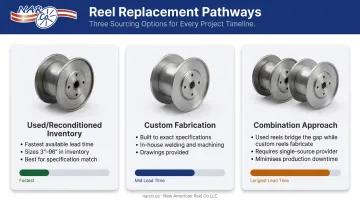
For any replacement scenario, having your reel specifications ready at first contact (flange diameter, traverse, barrel diameter, arbor size, drive pin dimensions) cuts response time at the first call.
Building a Proactive Emergency Wire Reel Program
The goal of a proactive reel program is simple: make every emergency scenario one you've already planned for, so crisis response is execution rather than improvisation.
Core Components
Reel inventory and condition tracking:
- Maintain a reel log with dimensions, weight ratings, and current condition status
- Tag any reel removed from service with reason and date
- Know your minimum viable reel count before operations are at risk
Inspection schedule: Set inspection intervals based on production intensity and reel criticality. For high-use reels in demanding environments, start with monthly visual inspections and structural checks every quarter.
IDCON's maintenance framework recommends setting inspection frequency at roughly half the estimated failure development period: if weld fatigue typically develops over 6 months under your conditions, inspect every 3 months.
What to check during inspections:
- Flange condition (deformation, cracks)
- Weld integrity at core-to-flange connections
- Arbor hole and tube condition
- Corrosion, particularly at joints and contact surfaces
- Balance (vibration during production can indicate developing imbalance)
Pre-arranged vendor relationship: Before a crisis, establish a relationship with a repair and reconditioning provider. Confirm their capabilities, standard turnaround times, and how they handle priority requests. Narco serves wire, cable, and rope manufacturers across the U.S. and is a Wire Association International member — WAI, founded in 1930, is the primary technical society for the global wire and cable industry, and membership signals genuine industry embeddedness rather than general metal fabrication.
The financial case for doing this now: Deloitte research on asset maintenance notes that poor maintenance strategies can reduce productive capacity by 5% to 20% before a full failure occurs. A proactive reel program recovers that capacity loss before it becomes a downtime event.
Choosing the Right Emergency Wire Reel Service Partner
When evaluating a provider, look beyond general metal fabrication capability. The wire reel context is specific enough that industry experience matters.
Key criteria:
- Look for reel-specific experience, not just structural fabrication — failure modes, repair decision criteria, and production tolerances differ significantly from general industrial components
- Confirm all capabilities (repair, reconditioning, new fabrication) are handled in-house — outsourcing any step adds time and coordination risk when hours matter
- Verify dynamic balancing capability — without it, a provider cannot fully restore reels used in high-speed production environments
- Expect an accurate turnaround timeline, not an optimistic one — honest communication is the most useful thing a provider can offer in an emergency
- Check for standards familiarity: NEMA WC 26 for reel sizing and capacity, AWS D1.1 for structural steel weld qualification, and ISO 21940 for balancing procedures
- Prioritize U.S.-based providers — proximity affects both shipping time and the ability to have a direct conversation about your specific situation
Narco, based in Antwerp, Ohio, meets each of these criteria directly. The company has handled wire, cable, and rope reels since 1999, covering sizes from 3" to 96". Services include welding, machining, dynamic balancing, and custom fabrication — all under one roof. Call 419-258-2900 or email mark@narco.us to discuss your situation.
Frequently Asked Questions
What qualifies as a wire reel emergency in a manufacturing environment?
Any unplanned reel failure or shortage that directly threatens production continuity or delivery commitments — from structural damage discovered at shift start to a sudden inventory gap caused by returned or condemned reels. If production is stopped or within hours of stopping, it's an emergency.
How quickly can damaged wire reels be repaired or reconditioned?
Turnaround depends on damage severity and provider capacity, but repair is typically faster than fabricating new reels. Ask for a specific committed timeline at first contact — not a range — so you can make an accurate comparison against replacement options.
Is it more cost-effective to repair or replace wire reels in an emergency?
Repair is usually more economical when the core structure is sound. When repair costs approach 65–70% of replacement cost, or when repair turnaround would cause greater production loss than sourcing a replacement, replacement becomes the better call.
Can reconditioned wire reels perform as well as new ones in production?
Yes — when reconditioned by an experienced provider using welding, machining, and dynamic balancing, a restored reel can return to full operational specifications. Dynamic balancing is particularly critical for reels used in high-speed production environments.
How can manufacturers reduce the risk of unexpected wire reel failures?
Most reel emergencies develop from conditions visible weeks before failure. Reduce that risk by:
- Scheduling regular inspections tied to production intensity
- Maintaining minimum safety stock of critical reel types
- Establishing a relationship with a repair and fabrication partner before a crisis occurs
What details should I have ready when calling an emergency wire reel service provider?
Have the following ready before you call:
- Reel dimensions: flange diameter, traverse, and barrel diameter
- Arbor size and drive pin specifications
- Weight capacity ratings and quantity needed
- A brief description of the damage or shortage situation