The math is direct. Every reel sent to scrap or replaced with a new purchase carries costs that reconditioning avoids entirely — carbon, procurement spend, and waste disposal. This article makes the practical case for reconditioning, grounded in operational outcomes and environmental data that procurement, operations, and sustainability teams can actually measure.
Key Takeaways
- Reconditioning steel wire reels preserves the energy already embedded in the steel, avoiding the carbon cost of new reel manufacturing
- Reconditioning typically cuts reel costs by 30–50% vs. buying new, based on published industrial refurbishment benchmarks
- Repair and reuse rank above recycling in both the EPA waste hierarchy and EU circular economy framework
- Reconditioned reels can directly support Scope 3 emissions analysis and GRI 306 waste-diversion reporting
What Is Wire Reel Reconditioning?
Wire reel reconditioning is the process of inspecting, repairing, and restoring a used steel wire reel or bobbin to functional condition — without manufacturing a new one from raw steel.
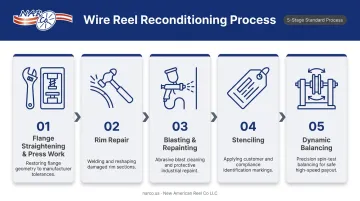
The process addresses both structural and surface restoration. For a provider like Narco (New American Reel Co LLC), standard reconditioning includes:
- Flange straightening and press work
- Rim repair for damaged sections
- Blasting and repainting
- Stenciling of logo, name, and tare weight
- Dynamic balancing
For reels with more significant damage, Narco's custom services extend to welding, machining, arbor tube replacement, drive pin hole repair, and full structural fabrication. These capabilities have been developed over more than 25 years in business, since the company's founding in 1999.
Wire manufacturers, cable manufacturers, rope manufacturers, and shipping operations that cycle large volumes of reels through production and distribution are the primary users of this service. Narco handles reel sizes from 3" to 96" (75mm to 2400mm), covering the range most industrial operations encounter.
Reconditioning goes beyond routine maintenance. Every reel restored delays a new procurement order, eliminates a disposal cost, and reduces the carbon footprint tied to producing new steel — which is exactly why it functions as an asset management strategy, not just a repair service.
Key Sustainability Advantages of Reconditioning Wire Reels
Advantage 1: Avoiding the Carbon Cost of New Steel Manufacturing
Every new steel reel carries embodied carbon — emissions generated during raw material extraction, steelmaking, and fabrication. That carbon is already spent by the time a reel enters service. Reconditioning preserves it rather than discarding it.
According to World Steel Association's 2025 climate data, global steel production generates approximately 2.18 tonnes of CO2e per tonne of steel across Scope 1, 2, and 3 — and the sector accounts for roughly 7–8% of global greenhouse gas emissions. For fabricated steel products specifically, World Steel's life cycle inventory data reports cradle-to-gate global warming potential values between 1.58 and 2.67 kg CO2e per kilogram of steel, depending on the product type.
Reconditioning bypasses a new manufacturing cycle. Instead of triggering raw material extraction and steelmaking, the reel is restored through welding, machining, and structural repair — processes that consume a fraction of that energy. According to Quant's January 2025 analysis of industrial spare parts refurbishment, repairing one industrial component instead of buying new can reduce CO2 emissions by up to 50%, driven by the elimination of new raw material and manufacturing demand.
For companies with sustainability reporting obligations, this translates to measurable Scope 3 reductions. GHG Protocol classifies purchased goods and services under Category 1 and capital goods under Category 2 — both areas where reconditioned reels, replacing new purchases, can reduce reported supply chain emissions.
KPIs this affects: Carbon footprint per unit produced, Scope 3 supply chain emissions, energy consumption per reel lifecycle.
When it matters most: High-volume operations cycling hundreds or thousands of reels annually, and companies under ESG reporting pressure from customers, investors, or regulators.
Advantage 2: Cost Savings That Make Sustainability Economically Rational
Steel wire reels are capital assets. At scale, replacement costs accumulate quickly — and unlike many operational expenses, reel procurement offers a clear alternative: convert capital replacement into a lower-cost maintenance expenditure.
Published industrial refurbishment benchmarks consistently support significant savings. Quant's 2025 analysis reports that component refurbishment is typically 40–50% cheaper than buying new. The EU-funded Remanufacturing Market Study found remanufactured and refurbished industrial goods commonly sell for 30–40% less than comparable new products, with some categories reaching 40–50% savings.
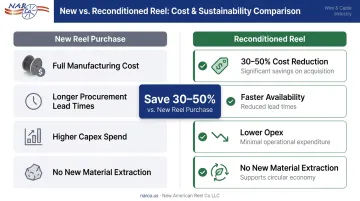
Wire reel reconditioning follows the same logic: worn or damaged reels return to service at a fraction of new reel purchase price.
There is also a procurement timing argument. ISM's August 2024 Manufacturing Report on Business recorded average lead times of 167 days for capital expenditures and 79 days for production materials. The Federal Reserve's April 2025 Beige Book noted that some key metal procurement lead times reached 50–100 weeks in certain districts. Reconditioning reduces exposure to those timelines — a reconditioned reel from an existing asset is available faster than a new one on order.
The practical result: reconditioning reduces cost exposure and shortens procurement timelines while also cutting emissions — the environmental and financial case points the same direction.
KPIs this affects: Cost per reel per year, total cost of ownership for reel inventory, capex vs. opex ratio, procurement budget.
When it matters most: Operations with high reel volumes, companies experiencing supply chain delays on new orders, and facilities where reactive purchasing has become a recurring cost problem.
Advantage 3: Waste Reduction and Circular Economy Alignment
Scrapping a damaged reel discards more than metal: it discards the energy and labor already embedded in it. Reconditioning keeps the reel in active service, deferring waste generation and reducing demand for virgin raw materials.
This distinction matters when measuring sustainability outcomes. Both the EPA's non-hazardous materials management hierarchy and the EU waste hierarchy rank source reduction and reuse above recycling. Recycling still requires energy to melt and reprocess steel. Reconditioning bypasses that cost entirely by restoring the reel to function without breaking it down — a better circular economy result than recycling.
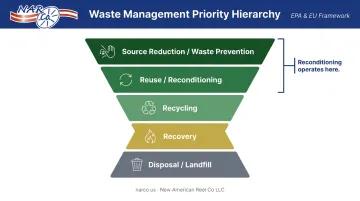
Quant's 2025 industrial analysis estimates that repairing one component instead of replacing it can reduce waste by up to 30% per component, by eliminating new manufacturing inputs and reducing scrap volume.
For ESG reporting, this has concrete implications. GRI 306: Waste 2020 (effective for reports published from January 2022) requires organizations to report:
- Waste prevention actions taken
- Waste diverted from disposal, including preparation for reuse
- Tracked volumes and diversion rates by waste stream
Reconditioned reels re-entering service instead of scrap streams are directly reportable under this framework.
A 2022 peer-reviewed study of 94 European companies found that while 90% referenced circular economy in sustainability reports, only 29% reported both targets and indicators for circular economy objectives.
Documented reel reconditioning programs — with tracked volumes and diversion rates — can close that reporting gap.
KPIs this affects: Industrial waste per production cycle, waste diversion rate, raw material consumption, GRI 306 reporting metrics.
When it matters most: Companies pursuing sustainability certifications, operations looking to reduce scrap disposal costs, and manufacturers reducing raw material supply chain dependence.
What Happens When Reconditioning Is Overlooked
Defaulting to a "replace rather than recondition" approach has compounding costs that tend to go unexamined until they become significant:
- Rising procurement costs — reel replacement spending accumulates continuously rather than cycling through lower-cost reconditioning
- Unpredictable reel condition — without scheduled inspection, failures during production increase, driving unplanned downtime and reactive purchasing at higher cost
- Growing scrap disposal expenses — scrapped reels generate disposal costs that a functioning reconditioning program largely eliminates
- Sustainability reporting gaps — companies that can't demonstrate waste reduction or circular practices face growing supply chain scrutiny, and skipping reconditioning leaves measurable improvements off the record
Those costs add up — and external data puts the stakes in perspective. Siemens' 2024 True Cost of Downtime report estimated unplanned downtime costs the world's 500 largest industrial companies $1.4 trillion annually, or roughly 11% of revenues. For steel wire reel operations, that risk shows up as reel failures mid-production cycle — the kind a planned inspection and reconditioning schedule prevents before they happen.
How to Get the Most Value from Wire Reel Reconditioning
Reconditioning delivers the most value when it is treated as a scheduled maintenance practice, not a reactive fix. That shift requires two things: a defined inspection interval and basic visibility into reel inventory.
Practically, this means:
- Set inspection intervals — schedule reels for assessment at defined cycle points, not only after visible damage occurs
- Track reel inventory — maintain a running log of which reels are in service, due for inspection, or at end of useful life
- Partner with a capable provider — structural work like arbor tube replacement, drive pin hole repair, and welding requires machining and fabrication capability, not just surface restoration
Narco (New American Reel Co LLC), operating since 1999, provides reconditioning, repair, welding, and machining services for steel wire reels and bobbins in sizes from 3" to 96". Their service range covers standard reconditioning — straightening, rim repair, blasting, painting, dynamic balancing — as well as custom fabrication work for heavily damaged reels.
For wire manufacturers, cable manufacturers, rope manufacturers, and shipping operations looking to build a systematic program rather than a reactive one, Narco provides the technical depth to make that a consistent practice.
Conclusion
Reconditioning wire reels delivers on sustainability and operational practicality at the same time. Each restored reel means:
- Lower carbon emissions by preserving the embodied steel already in use
- Reduced procurement costs by converting capital replacement into maintenance expenditure
- Less industrial waste by keeping materials in active service longer
The advantages compound over time. Every reel restored is one that doesn't need to be manufactured new or scrapped before its time. For operations cycling significant reel volumes, the cumulative impact across a year — or several years — adds up quickly.
Frequently Asked Questions
What are the benefits of reconditioning wire reels instead of buying new?
Reconditioning is significantly cheaper than purchasing new reels — published industrial benchmarks commonly support savings of 30–50% — and avoids the carbon cost of new steel manufacturing. That combination makes reconditioning easy to justify on both cost and environmental grounds, with no trade-off between the two.
Why is reconditioning better for the environment than recycling or buying new?
Reconditioning preserves the energy already embedded in the reel without breaking it down. Recycling still requires energy to melt and reprocess the steel, making repair and reuse a higher-order outcome — one that both the EPA and EU waste hierarchy explicitly rank above recycling.
What does the wire reel reconditioning process typically involve?
Standard reconditioning covers flange straightening, rim repair, blasting, painting, stenciling, and dynamic balancing. Custom work extends to welding, machining, arbor tube and drive pin hole replacement, and full structural fabrication for heavily damaged reels.
How many times can a steel wire reel be reconditioned before replacement?
Steel reels can undergo multiple reconditioning cycles when properly maintained. The practical limit depends on damage severity and reconditioning quality — well-maintained reels routinely outlast what a single-use replacement cycle would provide.
Does a reconditioned wire reel perform as well as a new one?
Yes. A professionally reconditioned reel performs as well as a new one. Structural integrity, balance, and dimensional accuracy are all restored to standard as part of a proper reconditioning.