
Introduction
When a steel wire reel shows wear—bent flanges, surface corrosion, or bearing issues—most companies automatically order a replacement. This instinct costs manufacturers thousands in unnecessary capital expenses.
Refurbishment offers a smarter alternative. The approach delivers comparable performance at a fraction of the cost, often with faster turnaround times than ordering new equipment.
Industry experience shows refurbishing existing reels costs 40-70% less than buying new equipment while delivering comparable or even improved performance. With unplanned downtime costing manufacturers between $10,000 and $500,000 per hour, the refurbish-versus-replace decision becomes critical.
This article explains the financial and operational advantages of reel refurbishment, when it makes sense, and how to maximize value from reconditioning services.
Key Takeaways
- Save 40-70% over replacement costs while maintaining full performance
- Extend reel service life by 5-10+ years with professional reconditioning
- Get reels back in 1-2 weeks vs. 4-6 weeks for new custom manufacturing
- Repair flange damage, bearing wear, and balance issues cost-effectively
What Is Cable Reel Refurbishment
Cable reel refurbishment is the process of restoring used or damaged steel wire reels, bobbins, and spools to functional condition through repair, reinforcement, and reconditioning.
This comprehensive service goes far beyond simple cosmetic fixes to address the root causes of failure and restore structural integrity.
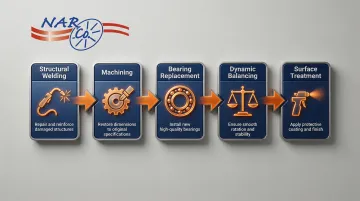
Professional refurbishment typically includes several critical processes:
- Structural welding to repair cracks and reinforce weak points
- Machining of worn surfaces to restore proper geometry and dimensions
- Bearing and bushing replacement for smooth rotation
- Dynamic balancing to eliminate vibration during high-speed operations
- Surface treatment including sandblasting, painting, and protective coatings
Professional refurbishment takes a comprehensive approach that goes beyond basic repairs. Rather than simply patching visible damage, experienced specialists like NARCo (in business since 1999) fix underlying structural issues and often incorporate improvements that extend reel life beyond original specifications.
Common enhancements include:
- Reinforcing flanges to handle heavier loads
- Upgrading to sealed bearings for harsh environments
- Applying advanced coating systems for superior corrosion protection
Key Financial Benefits of Refurbishment
Cost Savings Compared to Replacement
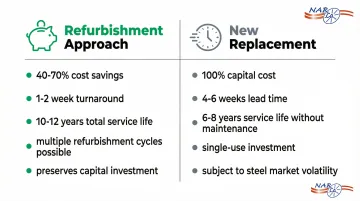
The most compelling financial argument for refurbishment is direct cost savings. Industry data shows that companies can achieve 40-70% savings on capital expenditure by repairing equipment instead of replacing it. This substantial reduction preserves the capital already invested in your existing reel inventory rather than writing off damaged equipment as a total loss.
The savings come from preserving the reel's existing steel structure—particularly the drum and flanges, which constitute the bulk of the weight and cost. You're essentially paying only for the restoration work and replacement of worn components, not for entirely new materials and manufacturing.
Additional cost advantages include:
- Lower shipping costs since you're sending existing equipment for refurbishment rather than purchasing and transporting new inventory
- Protection from steel market volatility that affects new reel pricing
- Reduced disposal costs for damaged equipment that would otherwise be scrapped
Faster Return to Service
Speed matters in manufacturing environments where equipment shortages directly impact production capacity. Refurbishment offers significant time advantages:
- Refurbishment: 1-2 weeks for comprehensive reconditioning including dynamic balancing
- New custom reels: 4-6 weeks for manufacturing and delivery, potentially longer for complex specifications
This 60-75% faster turnaround translates directly to maintained production capacity and avoided revenue loss. When 44% of industrial leaders report equipment-related interruptions at least monthly, the ability to return critical equipment to service quickly becomes a competitive advantage.
Extended Equipment Lifespan
Properly refurbished reels often outlast their original service life because reconditioning addresses weaknesses that develop during use.
Service life comparison:
- Refurbished reels: 10-12 years total service life
- New builds (without maintenance): 6-8 years
The economic model becomes even more attractive when you consider that reels can be refurbished multiple times throughout their lifecycle. This creates a "buy once, refurbish multiple times" approach that maximizes return on your initial capital investment. Each refurbishment cycle resets the asset's useful life at a fraction of replacement cost.
Reduced Inventory Carrying Costs
The faster turnaround times enabled by refurbishment create another financial advantage: reduced inventory requirements.
Companies can maintain smaller spare reel inventories since damaged units return to service quickly. Rather than keeping excess backup equipment to cover for reels under repair or awaiting replacement, you can operate with leaner inventory levels.
The working capital benefits are substantial—cash that would otherwise be tied up in excess backup equipment remains available for other operational needs. This improved asset utilization ensures reels remain in circulation rather than sitting idle or damaged in storage yards.
Improved Budget Predictability
Establishing a refurbishment program creates predictable maintenance budgets rather than unpredictable large capital expenditures for emergency replacements. This stability makes financial planning more accurate and insulates your operations from the disruption of unexpected equipment failures.
Additionally, refurbishment costs are often easier to expense rather than capitalize, simplifying accounting treatment and improving cash flow management compared to major capital purchases.
How Refurbishment Improves Performance
Structural Integrity Restoration and Enhancement
Professional welding repairs cracks and reinforces weak points, often adding structural elements beyond the original design. Worn or damaged flanges can be machined flat or replaced entirely, eliminating wobble and ensuring proper cable winding.
Structural improvements during refurbishment can actually increase load capacity beyond original specifications. Reels that have experienced repeated stress in specific areas can be reinforced with additional welding or thicker materials in those zones.
The result: a stronger asset than the original reel.
Dynamic Balancing for Smoother Operation
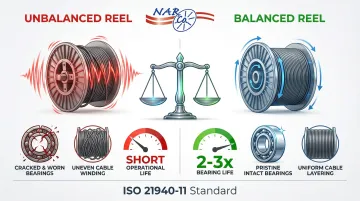
Dynamic balancing corrects uneven mass distribution in two planes, eliminating centrifugal forces that cause vibration during rotation. This process follows ISO 21940-11 standards (formerly ISO 1940-1), which define Balance Quality Grades for rotating machinery.
The performance benefits are substantial:
- Extended bearing life by 2-3x through reduced vibration stress
- Lower maintenance costs on winding machinery
- Improved cable quality by preventing uneven tension during winding
- Higher-speed operation without excessive vibration
Many manufacturers never properly balanced reels during initial production, so refurbishment provides an opportunity to achieve better performance than originally delivered. Unbalanced reels generate rotating forces that can destroy bearings in weeks; proper balancing extends bearing life from months to years.
Bearing and Rotation Component Upgrades
Since vibration reduction directly impacts bearing longevity, refurbishment is the ideal time to upgrade these critical components. Replace worn bearings, bushings, and axles with higher-quality alternatives suited to your specific operating environment. Common upgrades include sealed bearings for dusty or corrosive conditions, or materials optimized for high-temperature applications.
Improved rotation components deliver multiple benefits:
- Reduced friction and lower energy consumption
- Extended service intervals between maintenance
- Better performance in harsh environments (outdoor storage, chemical exposure)
- Smoother operation that reduces stress on cable products
Surface Treatment and Corrosion Protection
Beyond internal mechanical improvements, refurbishment addresses external protection through modern coating systems that outperform original finishes. Proper surface preparation—including grit blasting to SSPC SP-6 or SP-10 standards (commercial or near-white blast cleaning)—creates the sharp angular profile necessary for excellent coating adhesion.
Advanced coating systems typically include:
- Epoxy primers offering excellent adhesion and corrosion resistance
- Polyurethane topcoats providing UV resistance and weathering protection
- Performance exceeding 500 hours in salt spray tests
These protective treatments extend reel life significantly, particularly for reels used in outdoor storage or harsh manufacturing environments where corrosion would otherwise compromise structural integrity and contaminate cable products.
Custom Modifications During Refurbishment
Refurbishment provides an ideal opportunity to modify reels for changing operational needs. Experienced refurbishment specialists offer custom fabrication capabilities that allow for tailored solutions including:
- Changing arbor hole sizes to accommodate different shaft requirements
- Adding or relocating lifting points for improved handling
- Modifying flange designs for different cable sizes
- Reinforcing structures for increased load capacity
These modifications would be costly or impossible with new reel purchases that follow standard specifications. Refurbishment transforms existing assets to meet new requirements without the expense of custom-manufactured new equipment.
When to Refurbish vs. Replace Your Cable Reels
Damage Assessment Criteria
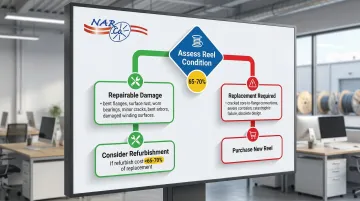
Most structural damage can be cost-effectively repaired if the core drum structure remains sound. Understanding which damage types are repairable versus those requiring replacement is essential for making informed decisions.
Repairable damage includes:
- Bent or damaged flanges (correctable via press work)
- Surface rust and coating deterioration
- Worn bearings, bushings, and rotation components
- Minor cracks in non-critical areas
- Bent arbors (correctable through straightening)
- Damaged winding surfaces (correctable through machining)
Conditions typically requiring replacement:
- Cracked core-to-flange connections compromising structural integrity
- Severe corrosion throughout the structure affecting load-bearing capacity
- Catastrophic structural failure with multiple critical damage points
- Obsolete designs that no longer meet current operational needs
A practical decision framework: if refurbishment cost exceeds 65-70% of replacement cost, replacement may be more economical.
This threshold, commonly used in industrial maintenance policies, provides a clear economic trigger for decision-making.
Age and Service History Considerations
Reel age alone doesn't determine whether refurbishment makes sense—service conditions and maintenance history matter far more.
A 15-year-old reel with good maintenance records and moderate use may be an excellent refurbishment candidate, while a 5-year-old reel subjected to abuse and overloading might have hidden damage making refurbishment uneconomical.
Consider these factors when evaluating candidates:
- Maintenance history: Well-maintained reels with documented service records are ideal candidates
- Usage patterns: Reels used within rated capacity typically have sound core structures
- Operating environment: Reels from controlled environments generally have less hidden corrosion
- Previous repairs: Multiple previous repairs may indicate underlying structural issues
Operational Requirements and Timing
Beyond assessing physical condition and service history, your operational timeline plays a key role in the refurbish-or-replace decision.
Urgent equipment needs favor refurbishment due to faster turnaround compared to new reel procurement. When production schedules can't accommodate 4-6 week lead times for new equipment, the 1-2 week refurbishment cycle becomes critical.
Refurbishment also makes practical sense when:
- Custom specifications or non-standard sizes make sourcing new equivalents difficult or expensive
- Standardized reel fleets benefit from maintaining consistency across equipment
- Seasonal demand spikes require rapid equipment availability
Economic Threshold Analysis
Calculate total cost of ownership rather than focusing solely on upfront costs. The formula should include:
TCO = (Refurbishment Cost + Shipping + Downtime) / Expected Additional Service Life
Compare this to:
New Reel TCO = (Purchase Cost + Shipping + Downtime) / Expected Total Service Life
Factor in the cost of downtime using your facility's specific hourly rate. According to industry research, 83% of decision-makers estimate unplanned downtime costs at least $10,000 per hour.
Even small differences in turnaround time significantly impact the economic comparison.
Getting Started with Cable Reel Refurbishment
Working with experienced refurbishment specialists is critical for achieving the performance and cost benefits outlined above.
Look for partners who understand wire reel engineering and offer complete capabilities including welding, machining, and dynamic balancing services.
Key qualifications to seek:
- Extensive experience (ideally 20+ years in reel reconditioning)
- Custom fabrication capabilities for modifications beyond standard repairs
- Dynamic balancing equipment and expertise
- Ability to handle your specific reel sizes and types
- Understanding of industry standards (DIN 46395, DIN 46397, NEMA WC 26)
When evaluating potential partners, companies like NARCo demonstrate these qualifications through 25+ years of specialization in steel wire reel reconditioning. Services spanning reels from 3" to 96" in diameter, structural welding, flange straightening, and custom modifications provide the complete solution needed from initial assessment through final delivery.
To launch your refurbishment program:
- Assess your inventory - Review current reels to identify refurbishment candidates
- Prioritize strategically - Focus on high-value reels with repairable damage and critical operational importance
- Calculate potential ROI - Estimate cost savings versus replacement for prioritized reels
This systematic approach maximizes return by directing resources where they deliver the greatest impact.
Frequently Asked Questions
What is the purpose of a cable reel?
Cable reels (also called wire reels, bobbins, or spools) store, transport, and dispense wire, cable, and rope products during manufacturing and shipping. They protect the product from damage while enabling efficient handling, preventing tangling, and maintaining proper tension during winding operations.
Are cable reels safe to use after refurbishment?
Refurbished reels meet or exceed original safety standards when properly reconditioned. Structural repairs, dynamic balancing, and load testing ensure safe operation. Reputable refurbishment specialists follow industry standards and inspection protocols to verify structural integrity before returning equipment to service.
How much does cable reel refurbishment cost compared to replacement?
Refurbishment typically costs 40-70% less than purchasing new reels, with exact savings depending on damage extent and reel size. Lower shipping costs and faster turnaround further reduce total expenses.
How long does a refurbished cable reel last?
Properly refurbished reels last 5-10+ additional years and can be refurbished multiple times. Well-maintained refurbished reels reach 10-12 years of total service life, compared to 6-8 years for new builds without maintenance.
What types of damage can be repaired on cable reels?
Most damage is repairable: structural cracks, bent flanges, worn bearings and bushings, surface corrosion, balance issues, damaged arbors, and worn winding surfaces. Only catastrophic structural failure (cracked core-to-flange connections or severe load-bearing corrosion) requires replacement.