
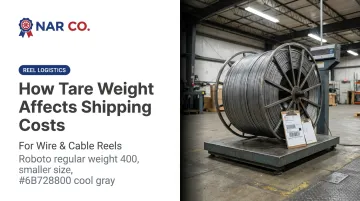
Introduction: Why Tare Weight Is a Hidden Driver of Shipping Costs
Most shippers focus on what's inside the reel — the wire, the cable, the product moving from one facility to another. Freight carriers bill on gross weight, which means every pound of steel reel you're shipping costs you money whether wire is wound on it or not.
Steel shipping reels aren't light. A single large reel can weigh several hundred pounds before any wire is loaded on it. When you're moving hundreds of reels annually, that tare weight adds up fast — and it shows up directly in your freight bill.
This article covers the essentials:
- What tare weight is and how it fits into freight billing calculations
- How carriers actually use gross weight to set charges — including LTL weight breaks, ocean VGM requirements, and air freight
- What steel reel tare weight looks like in practice
- How inaccurate tare documentation creates compliance and cost exposure
- Practical steps to control tare weight across your reel fleet
Key Takeaways
- Tare weight is the empty reel weight — carriers include it in gross weight when calculating freight charges
- LTL carriers bill by weight bracket; a heavier reel can push a shipment into a higher rate tier
- Ocean freight VGM rules require accurate tare figures by law — non-compliance carries real penalties
- Damaged reels often weigh more than their stenciled tare spec — outdated markings create documentation gaps
- Keeping reels reconditioned and tare markings current are among the most direct ways to control freight costs
What Tare Weight Is and How It Fits Into Shipping Calculations
The Three-Weight Formula
Maersk's shipping weight guide defines the relationship clearly:
- Gross Weight = Net Weight + Tare Weight
- Net Weight = Gross Weight – Tare Weight
Tare weight is the empty container, packaging, or carrier used to transport goods — not the product itself. In wire and cable shipping, that means the weight of the empty reel, drum, or spool before any wire is wound on it.
U.S. Customs and Border Protection reinforces this in 19 CFR 159.22, which defines net weight as gross weight minus actual or schedule tare — the same arithmetic applied to customs duty calculations.
A Simple Reel Example
Say you're shipping a steel reel where:
- Wire (net weight): 800 lb
- Empty reel (tare weight): 400 lb
- Total gross weight billed by carrier: 1,200 lb
That 400-lb reel isn't just a container — it's 33% of your billable freight weight. On a single shipment, that's manageable. Across a fleet moving hundreds of loads per year, that percentage compounds into a significant freight cost line item.
Tare Weight Isn't Fixed
That 400-lb figure from the example above assumes a reel in original condition. In practice, tare weight isn't a constant — it shifts based on:
- Reel diameter and flange thickness
- Construction material (steel vs. wood vs. plastic)
- Accumulated damage and repair work over multiple reuse cycles
Older reels in active rotation may weigh meaningfully more than their original stenciled spec. A steel reel that's been welded and patched across several cycles can easily gain 20–50 lb — enough to shift your billed gross weight and trigger discrepancies between documented tare and what the carrier actually weighs at the dock.
How Tare Weight Directly Affects Freight Billing
LTL Weight Brackets and Rate Jumps
LTL (less-than-truckload) carriers don't charge a smooth per-pound rate. They use weight brackets — and the rate per hundredweight (CWT) typically decreases as shipment weight increases, but only within the same bracket. Cross into a new bracket and your rate class can shift significantly.
Published LTL class-rate examples use brackets such as:
| Weight Range | Bracket Label |
|---|---|
| Under 500 lb | L5C |
| 500–999 lb | M5C |
| 1,000–1,999 lb | M1M |
| 2,000–4,999 lb | M2M |
| 5,000–9,999 lb | M5M |
| 10,000–19,999 lb | M10M |
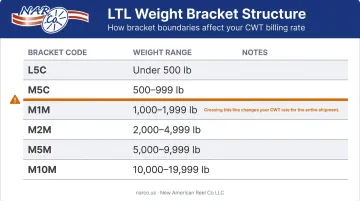
A shipment at 990 lb gross that a heavier reel pushes to 1,010 lb doesn't just add 20 lb — it crosses a bracket boundary and changes the CWT rate for the entire shipment. XPO's tariff confirms that LTL gross price is calculated as negotiated rate multiplied by shipment weight, including packaging and pallets.
Ocean Freight VGM — A Legal Requirement
For ocean shipments, IMO SOLAS regulations require shippers to declare a Verified Gross Mass (VGM) before a packed container is loaded onto a vessel. Under Method 2, the VGM calculation adds:
- Cargo items
- Packages and pallets
- Dunnage and securing materials
- Container tare mass
Reel tare weight is included in this calculation. A container without a VGM declaration cannot legally be loaded. Accurate tare figures are a compliance requirement under SOLAS, and carriers will reject containers that lack a valid VGM declaration.
Air Freight: A Double Exposure
IATA's air freight billing rules state that carriers charge based on whichever is greater: actual gross weight or volumetric weight, with volumetric weight calculated as volume in cubic centimeters divided by 6,000.
Large steel reels create a problem on both dimensions — high actual gross weight and significant volume. When both metrics run high, even modest reductions in reel tare weight can shift the billable weight calculation and meaningfully lower air freight costs.
Tare Weight of Steel Wire Reels: What Shippers Need to Know
Real Steel Reel Weight Data
Steel reels carry significant tare weight by design — they're built for multi-cycle durability. Tare varies based on flange diameter, traverse width, barrel diameter, and construction style.
From Southwire's published reel packaging specifications, steel S-series reels in the 60–68-inch flange range show:
| Model | Flange Diameter | Tare Weight |
|---|---|---|
| S-62 | 60 in | 340 lb |
| S-77 | 66 in | 400 lb |
| S-99 | 68 in | 444 lb |
For wood reels, Northern Cables' published specifications show a 60-inch flange wood reel weighing approximately 165 kg (363 lb) — not far off from a comparably sized steel reel, though wood is more variable with moisture content. Plastic reels occupy a different category entirely, with typical weights ranging from under 1 kg to 30 kg for standard process reel sizes.
How Reels Gain Weight Over Time
Steel reels in active circulation don't stay at original spec. Forklift contact, rim damage, and repair welding all add material weight without updating the stenciled tare. A reel that came out of fabrication at 340 lb and has gone through multiple repair cycles may be running heavier, while the shipping documents still reflect the original number.
That gap creates two distinct risks:
- Compliance exposure: Underdeclared gross weight on customs and VGM documents
- Planning errors: Inaccurate figures in freight cost estimates that compound across high-volume shipments
Tare Weight Stenciling and Accurate Marking
Carriers and customs authorities rely on the marked tare weight to calculate gross weight on incoming documentation. When that number doesn't match reality — because the reel has been repaired or modified since it was originally marked — billing discrepancies follow.
Narco's standard reconditioning process addresses this directly. Tare weight stenciling is applied after all structural work and surface preparation are complete, which includes:
- Flange straightening and rim repairs
- Blasting and painting
- Re-marking with current, verified weight data
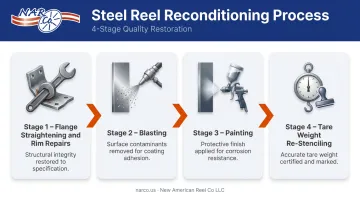
For shippers running returnable reel programs, that updated marking keeps documentation aligned with actual reel weights across every subsequent shipment cycle.
Reel Material Trade-Offs
Material choice directly affects the tare weight number on that stencil — and by extension, every freight calculation tied to it. No single material wins on every metric:
| Material | Tare Weight Profile | Durability | Best Fit |
|---|---|---|---|
| Solid-welded steel | Heaviest | Highest — many reuse cycles | High-frequency returnable routes |
| Corrugated steel | Lighter than solid steel | Good — moderate reuse | Mid-frequency returnable programs |
| Wood | Variable (moisture-dependent) | Lower than steel | One-way or short-cycle shipments |
| Plastic | Lightest | Application-dependent | Process reels; lighter-duty use |
The right choice depends on route frequency, reuse expectations, and total cost per cycle — not just what weighs least per shipment.
How Inaccurate Tare Weight Documentation Creates Hidden Costs
Tare weight errors create exposure on both sides of the ledger:
- Overbilling: If documented tare is higher than actual, you're paying freight on weight that doesn't exist
- Underbilling: If documented tare is lower than actual, carriers may audit and issue adjustment charges — or customs may flag the discrepancy
What the Regulations Require
CBP's commercial invoice requirements state that invoices must include quantities in weights and measures. If a commercial invoice lacks the weight data needed to determine duties, the importer of record bears the cost of obtaining that information before customs releases the shipment. For ocean freight, a missing or incorrect VGM means the container will not be loaded — carriers require it before any container goes aboard.
Best Practices for Tare Weight Documentation
- Weigh reels before each shipment cycle rather than relying on original stamped specs — especially for reels that have been in service for multiple years
- Update stenciling after any repair or modification that changes the reel's actual weight
- Maintain a reel inventory log tracking verified tare weight per reel, not just reel type or model
Narco includes tare weight stenciling as a standard step in the reconditioning process, which means every reel that comes through its facility for repairs goes back into circulation with current, accurate weight markings.
Practical Ways to Reduce the Impact of Tare Weight on Shipping Costs
Right-Size the Reel to the Load
Shipping wire on a reel that's larger than the load requires adds unnecessary tare weight relative to the net weight being transported. A smaller reel carrying the same footage improves the net-to-gross ratio and reduces the share of the freight bill attributable to the empty reel.
Recondition Rather Than Replace — and Restore Original Spec
Damaged reels that have accumulated repair welds or structural additions weigh more than their original spec. Reconditioning through Narco — which handles steel reels from 3 inches to 96 inches in diameter — includes flange straightening, rim repairs, blasting, painting, and tare weight re-stenciling.
The goal is restoring structural geometry and accurate documentation. Every subsequent shipment that reel makes benefits from the corrected weight, so one reconditioning cycle reduces freight costs across all future loads.
Match Reel Material to Route Frequency
The right reel material depends on route frequency — a total-cost-per-cycle calculation, not a per-shipment comparison:
- Steel reels on high-frequency returnable routes amortize tare weight cost over many cycles and hold up to repeated handling
- Wood or corrugated steel options cut per-shipment tare cost on lower-frequency or one-way shipments where reuse economics don't apply
Audit Your Reel Fleet
Physically weighing reels and comparing to stenciled tare weights often surfaces reels running heavier than documented. That discrepancy creates two problems:
- Underdeclaring gross weight on shipping documents (compliance risk)
- Using inaccurate figures in freight quotes (planning risk)
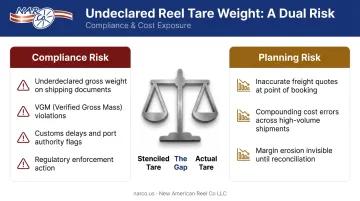
Regular audits close the gap before it triggers a carrier adjustment or a customs delay.
Consolidate Loads
Fewer reels carrying more product per load improves the net-to-gross ratio. When shipment volumes allow, consolidating wire and cable quantities onto fewer reels reduces the number of empty reels contributing tare weight to the total gross figure.
Frequently Asked Questions
How does tare weight affect shipping costs?
Tare weight is included in gross weight, which is what carriers use to calculate freight charges. Every extra pound of empty reel adds directly to billable weight, and that effect compounds quickly across high-volume programs moving dozens or hundreds of loads per year.
Does size or weight matter more for shipping?
Carriers charge based on whichever is greater — actual gross weight or dimensional (volumetric) weight. For loaded wire reels, actual gross weight is typically the controlling factor, making tare weight a dominant variable in the final freight charge.
What is the tare weight of a steel shipping reel?
Tare weight varies by reel diameter, flange thickness, and construction — published Southwire data shows steel S-series reels in the 60–68-inch flange range running 340–444 lb empty. The tare weight is stenciled on the reel body and should be verified before each shipment cycle.
How do I calculate gross weight for a wire reel shipment?
Use: Gross Weight = Net Weight (wire/cable) + Tare Weight (empty reel). Every reel in the shipment contributes its tare weight to the total, so accurate per-reel tare figures are essential for both freight cost estimation and customs documentation.
Can reconditioning a reel reduce its tare weight?
It depends on the reel's condition. Accumulated repairs and structural additions can increase a reel's actual weight above its original spec. Reconditioning that addresses those structural changes — and includes updated tare stenciling — can bring documented and actual weight back into alignment.
What happens if tare weight is inaccurate on shipping documents?
Inaccurate tare documentation can trigger customs delays, carrier billing adjustments, and VGM compliance violations on ocean shipments. Under-declared gross weight risks enforcement action; over-declared weight means paying freight on pounds that don't exist.