Introduction
Picture this: production is mid-run, orders are due Friday, and a delayed reel shipment just shut the line down. Whether it's a vendor quality failure or a supplier who can't scale fast enough, reel sourcing decisions carry real operational consequences — and the wrong strategy makes disruptions like this more likely.
The core tension comes down to control versus coverage. A single supplier simplifies the relationship and tends to deliver more consistent quality. Multiple suppliers spread your risk and create pricing competition. The right call depends on how specialized your reels are, how much downtime your operation can absorb, and what your procurement team can realistically manage.
This article breaks down both approaches with specific guidance for wire, cable, and rope manufacturers making real sourcing decisions.
Key Takeaways
- Single supplier: one trusted source, streamlined procurement, stronger partnerships — but vulnerable to disruptions
- Multiple suppliers: spreads risk and creates pricing competition — but adds management complexity and can compromise quality consistency
- Choose single sourcing when reels require precise customization, proven supplier performance, and full lifecycle support
- Consider multiple suppliers when products are interchangeable, volume is high, or past disruptions revealed over-dependence
- Product criticality is the deciding factor — the more specialized the reel, the more strategic the supplier relationship needs to be
What Is a Single Supplier Strategy?
CIPS defines single sourcing as deliberately selecting one supplier for a specific product even when alternatives exist — a voluntary strategic choice, not a market constraint. This is distinct from sole sourcing, where only one supplier is available due to proprietary specs or a monopolistic market.
The operational appeal is practical: one invoice cycle, one contract, one point of contact. Over time, a well-managed single supplier relationship produces consistent specifications, faster issue resolution, and a supplier who understands your production requirements well enough to anticipate problems rather than react to them.
CIPS identifies several concrete advantages:
- Price stability and reduced lead times
- Lower administrative costs through consolidated procurement
- Stronger trust enabling flexible terms and priority service
- Easier system integration between buyer and supplier operations
The Real Risks to Know
Single sourcing carries two risks that manufacturers need to plan around.
The first is supplier dependency. If your supplier faces a capacity constraint, logistics failure, or financial instability, there is no backup, and production stops. The 2018 Meridian Magnesium fire forced Ford to temporarily lay off 3,600 workers and threatened another 4,000 — a clear example of how a single-component disruption cascades through an entire manufacturing operation.
The second risk is complacency. A supplier with no competition has less incentive to improve. Periodic benchmarking — even without switching suppliers — keeps pricing honest and service standards high.
When benchmarking confirms your supplier is performing, those risks become manageable. That's where single sourcing shifts from a liability into a strategic asset.
When Single Sourcing Makes Sense for Wire Reels
Single sourcing works best when the product requires precision that not every supplier can match. Wire reels built to specific flange dimensions, dynamic balance tolerances, or industry standards like DIN 46397 or NEMA WC 26 aren't interchangeable commodities — they're engineered production inputs.
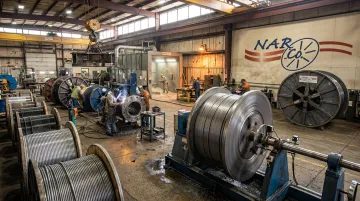
Narco shows how this works in practice. Operating since 1999, the company handles custom reel fabrication, reconditioning, dynamic balancing, and repair under one roof — covering steel reels from 3" to 96" in diameter across steel, plastic, and wood.
That range means a wire manufacturer can manage the entire reel lifecycle through a single relationship, from arbor tube replacement to full reel refurbishment, without fragmenting procurement across multiple vendors.
What Is a Multiple Supplier Strategy?
Multiple sourcing means contracting with two or more suppliers for the same or similar product, distributing volume to reduce dependency on any one vendor.
The primary appeal is risk distribution. BCI reported that nearly 80% of organizations experienced supply chain disruption in 2024, and Resilinc documented a 38% year-over-year growth in supply chain disruptions that same year. In that environment, a second qualified supplier is standard continuity planning, not overcaution.
The secondary appeal is pricing tension. Competing suppliers are incentivized to offer better terms, faster lead times, or improved service quality to win a larger share of your volume.
The Costs You Don't See Up Front
Multiple sourcing isn't free. APQC benchmarks the median cost to process a purchase order at $55.00, based on data from 4,625 companies. Those costs compound quickly across multiple vendors:
- Separate contracts and compliance reviews for each supplier
- Different quality standards that require independent monitoring
- Staggered delivery schedules that complicate production planning
- Reduced supplier loyalty — vendors sharing your account have less incentive to prioritize you during capacity crunches or offer flexible terms
When Multiple Sourcing Makes Sense for Wire Reels
Multiple sourcing is the right call when:
- The required product is interchangeable across suppliers (standard wooden shipping reels, for example)
- Your operation spans multiple regions and geographic diversification reduces logistics risk
- High production volume justifies splitting orders to hedge against seasonal capacity constraints
- Past disruptions have already demonstrated the cost of over-dependence on a single source
Single vs. Multiple Supplier Strategy: Head-to-Head Comparison
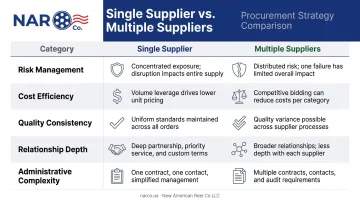
| Dimension | Single Supplier | Multiple Suppliers |
|---|---|---|
| Risk Management | Higher dependency risk; one failure stops production | Risk distributed, but coordination required to prevent gaps |
| Cost Efficiency | Volume pricing, price stability, lower admin overhead | Competitive tension can lower unit cost; admin burden may offset savings |
| Quality Consistency | More uniform over time; supplier learns your specs | Requires active monitoring; tolerance variation across vendors is a real issue |
| Relationship Depth | True partnership; tailored service and priority treatment | Broader but shallower; less incentive for a supplier to go the extra mile |
| Administrative Complexity | Single contract, single contact, streamlined invoicing | Multiple contracts, staggered schedules, higher management overhead |
Neither column is automatically the right answer. The better fit depends on what you're sourcing, how tolerant your operation is to disruption, and how much management bandwidth you can realistically dedicate to supplier relationships. For wire and cable manufacturers, where reel availability directly affects production continuity, those factors carry real weight.
Which Strategy Fits Your Wire Manufacturing Operation?
Start with three questions before choosing a direction:
- How specialized is the reel? Can another supplier match your dimensional tolerances, balance specs, or material requirements on short notice?
- What does an unplanned production stoppage actually cost? Siemens reported in 2024 that Fortune Global 500 companies lose approximately $1.5 trillion annually to downtime — equal to 11% of annual revenue. For smaller manufacturers, the proportional impact hits just as hard.
- Are your orders predictable enough to justify an exclusive relationship, or does demand variability make flexibility more valuable than commitment?
Situational Guidance
Choose single supplier when:
- Reels require custom specifications — specific flange dimensions, arbor configurations, dynamic balance tolerances
- The supplier has a proven delivery and quality track record
- The relationship provides access to repair, reconditioning, and lifecycle management that reduces total reel costs
- Simplifying procurement overhead matters to your operation
Choose multiple suppliers when:
- The product is standardized and interchangeable across qualified vendors
- Your operation spans regions where geographic diversification reduces logistics exposure
- You've experienced supply disruptions that demonstrated the cost of over-dependence
- Volume is high enough to maintain real pricing competition between suppliers
The Hybrid Model Most Manufacturers Actually Use
Many wire manufacturers land on a primary-plus-backup approach: one preferred supplier handles the bulk of volume, with one backup supplier qualified and ready for emergency orders. This keeps the quality consistency and relationship depth of single sourcing intact, without the exposure that comes from full dependency on one source.
For highly specialized reels, the backup doesn't need to be active. It just needs to be pre-qualified, with approved drawings and known lead times on file, so you can move quickly if your primary source goes down.
Real-World Application: What Goes Wrong Without the Right Strategy
The Single Supplier Disruption Scenario
A wire manufacturer running full production through peak season relies on one reel supplier for a custom-spec steel reel with specific arbor dimensions. The supplier hits a capacity constraint — a key piece of fabrication equipment goes down for two weeks.
With no backup qualified, the manufacturer faces a choice: halt production, rush-source a non-spec reel that requires line reconfiguration, or pay premium freight to pull inventory from a distant alternative.
The cost isn't just the reel price. It's the downtime, the expediting fees, the production rescheduling, and — if deliveries slip — the customer relationship damage. The wire and cable industry has documented this pattern directly: Lapp Tannehill identified shortages of ancillary materials including wooden spools, plus transportation and logistics failures, as active supply chain disruptions in the sector.
The Multiple Supplier Quality Scenario
A manufacturer splits reel orders across two suppliers to reduce dependency. Both suppliers nominally meet spec — but dimensional tolerances vary slightly between the two. Reels from Supplier B run marginally wider at the flange, causing calibration drift on the winding line. Catching and correcting the problem requires line downtime, inspection overhead, and a quality audit that costs more than the pricing savings that motivated the split order in the first place.
This isn't a hypothetical edge case. Quality Magazine notes that supplier measurement data, tolerance analysis, and GD&T validation are essential to preventing exactly this kind of production issue when sourcing the same component from multiple vendors.
What Both Scenarios Confirm
The sourcing strategy has to match the product. The decision generally breaks down like this:
- Standard, interchangeable reels: Multiple sourcing is manageable with consistent quality controls and dimensional validation in place
- Custom-engineered reels (specific dimensions, balance tolerances, material specs): A single supplier with fabrication depth — including reconditioning, repair, and dynamic balancing — typically delivers better long-term value than splitting volume across generalist vendors
Narco has offered custom wire reel fabrication, reconditioning, repair, and dynamic balancing since 1999, serving wire, cable, and rope manufacturers across the United States. Whether you're evaluating a single-source strategy for specialized reels or need a qualified backup supplier in your network, contact Narco at 419-258-2900 or mark@narco.us to discuss your reel sourcing requirements.
Frequently Asked Questions
What are the pros and cons of using a single supplier versus multiple suppliers?
Single suppliers offer simpler procurement, stronger relationships, and volume-based cost advantages, but carry dependency risk if the supplier is disrupted. Multiple suppliers add resilience and pricing competition but require more management effort and can create quality inconsistencies without rigorous oversight.
When should a manufacturer switch from single to multiple supplier sourcing?
Switching makes sense when a single supplier has repeatedly failed on quality or delivery, or when the business has grown to a point where any supply disruption would trigger unacceptable production losses. If qualified alternatives exist, diversifying is worth the added management effort.
What is the difference between single sourcing and sole sourcing?
Single sourcing is a deliberate choice to use one supplier even when alternatives exist. Sole sourcing is a market condition — only one supplier is available, typically because of proprietary specifications or a monopolistic market. One is a strategic decision; the other is a constraint.
How does supplier dependency affect production continuity in wire manufacturing?
When a single reel or component supplier faces disruption — whether from logistics failures, capacity issues, or equipment downtime — manufacturers with no backup source face production stoppages, rush-order costs, and potential delivery failures to their own customers.
Can a single supplier handle custom or specialized wire reel requirements?
Yes. Suppliers with in-house fabrication, machining, and reconditioning capabilities can cover custom builds to DIN or NEMA standards, repairs, and full lifecycle management from a single relationship.
How do I evaluate supplier reliability before committing to a sourcing strategy?
Review on-time delivery history, quality certifications, financial stability, and response to expedited orders. A supplier that performs under normal conditions but stalls in a crunch is only half-qualified for a single-source role.