The core question is straightforward: single layer and double layer bobbins are both standard across industrial wire operations, but they serve different machine configurations, wire gauges, and line speeds. Getting that match right directly affects wire quality, machine uptime, and cost per unit of output.
This article breaks down how each design works, where each fits, and how to determine which is the right call for your operation.
Key Takeaways
- Single layer bobbins are simpler, lower-cost, and well-suited for heavier gauge wire or moderate-speed lines.
- For high-speed winding, finer wire gauges, or greater capacity per run, double layer bobbins are the better fit.
- The core differences come down to structural design, winding capacity, speed compatibility, and maintenance demands.
- Neither design is universally better — the right choice depends on wire diameter, line speed, and production volume.
- Both types can be reconditioned rather than replaced, cutting operating costs significantly.
Single Layer vs. Double Layer Bobbin: At a Glance
A quick reference for operations teams comparing the two:
| Factor | Single Layer | Double Layer |
|---|---|---|
| Structural Design | I-reel or H-reel form; one winding zone between two flanges | Reinforced core and barrel; built for multi-layer winding and higher centrifugal loads |
| Winding Capacity | Defined volume within a single winding pass | Greater wire capacity per bobbin; handles additional layers without flange stress |
| Speed Compatibility | Suited for moderate-speed take-up | Engineered for high-speed drawing lines where dimensional stability under load is critical |
| Upfront Cost | Lower fabrication cost; simpler to inspect | Higher initial investment; more complex inspection and balancing requirements |
| Maintenance | Easier to recondition; fewer critical tolerances | Dynamic balance must be re-verified after any repair work |
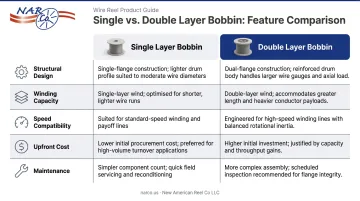
Exact specs vary by manufacturer, wire application, and machine model — this table is a reference point, not a universal spec.
What Is a Single Layer Bobbin?
A single layer bobbin is an industrial winding reel designed to take up wire in a single controlled layer between two flanges, with the barrel surface serving as the winding base.
You'll find them across wire drawing, stranding, and payoff applications wherever operating conditions don't demand multi-layer winding or high-RPM precision.
Structural Simplicity
The design is intentionally simple. Fewer components, standard flange configurations, and a conventional barrel make single layer bobbins easier to fabricate, inspect, and repair. For maintenance teams managing a large bobbin fleet, that simplicity means faster turnaround when a bobbin comes in for reconditioning.
These bobbins are most commonly fabricated from welded steel plate, though flange thickness, barrel diameter, and net width vary by wire product and machine compatibility. Metallic bobbins built to DIN 46397 cover flange diameters from 100 to 1000 mm across drawing, stranding, and bunching applications, giving a practical dimensional reference for the range these designs span.
Where Single Layer Bobbins Perform Well
Their operational sweet spot is moderate machine speeds with heavier wire gauges — applications where high-RPM precision isn't the primary constraint:
- Rod breakdown and intermediate drawing lines where wire gauge is larger and speed demands are moderate
- Stranding machines for heavier gauge products such as steel wire rope or large-diameter conductors
- Wire armouring lines: DIN 46395 metallic process bobbins are specifically used as take-up reels on these machines
- Payoff stations where consistent payout tension matters more than maximizing wire volume per bobbin
Capacity is the trade-off. Because wire winds in a single layer, volume per bobbin is inherently lower than double layer designs. On high-volume production lines, that translates to more frequent bobbin changes, and each changeover adds up across a shift.
Industries Where Single Layer Is the Standard Choice
- Steel wire rope manufacturing
- Spring steel wire production
- Armor wire and structural wire applications
- Operations where handling simplicity and lower per-bobbin cost outweigh the throughput value of higher capacity
What Is a Double Layer Bobbin?
A double layer bobbin winds wire across multiple layers on the same barrel. It sounds like a simple extension of the single layer concept, but the engineering demands are substantially different.
As wire layers build up, radial load and lateral pressure on the flanges compound. The bobbin structure, fabrication tolerances, and dynamic balance must all account for forces that a single layer design isn't built to handle.
Engineering Requirements
The construction reflects those demands: heavier flanges, reinforced core, tighter dimensional tolerances, and MIG welding with precision machining throughout. Wire-drawing bobbins built to this standard are machined for operation at 40 m/sec, with optional dynamic balancing to ISO 1940 for speeds up to 60 m/sec — precision requirements that simply don't apply at lower speeds.
Any out-of-balance condition at operating speed creates vibration that translates into winding defects or equipment stress. That's why dynamic balancing is treated as a baseline requirement, not an upgrade.
Performance Advantages
All that structural engineering pays off in throughput. Higher wire capacity per bobbin means fewer changeovers per shift — on fine wire drawing lines and high-speed copper operations, each interruption carries real cost in downtime and restart scrap.
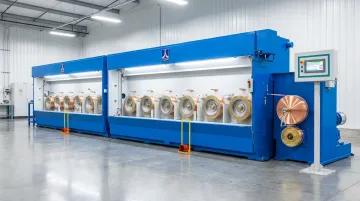
The speed and gauge compatibility of double layer bobbins covers the fine and ultra-fine wire range. The Niehoff MMH 112/RM 202, for example, operates at a maximum production speed of 40 m/s with finished wire diameters from 0.10 to 0.70 mm — an operating envelope where bobbin structural integrity and balance determine output quality.
Trade-offs to Know
- Higher fabrication cost than single layer equivalents
- More complex inspection after use : flanges, welds, and barrel dimensions all require closer attention
- Dynamic balance must be re-verified after any reconditioning work — this isn't optional, and it's why choosing a qualified reconditioning partner matters
Where Double Layer Bobbins Are Used
- Take-up spools on fine wire drawing machines (copper, steel, alloy wire in the 0.07–0.5 mm range)
- High-speed annealing and enameled wire production lines
- Bunching and stranding machines for communications cable
- Tire cord and cutting wire applications where precision and speed both apply
Single Layer vs. Double Layer: Which Is Right for Your Operation?
The decision comes down to three factors: wire gauge and product type, line speed, and total cost of ownership across the full service life of the bobbin fleet.
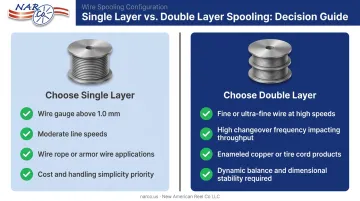
Decision Guide
Choose single layer when:
- Wire gauge is above approximately 1.0 mm
- Line speeds are moderate and high-RPM precision isn't a constraint
- The application is wire rope, structural steel wire, or armor wire
- Per-bobbin cost and handling simplicity are priorities over maximizing capacity per run
Choose double layer when:
- You're running fine or ultra-fine wire drawing at high line speeds
- Bobbin changeover frequency is affecting throughput on a critical line
- The product is enameled copper wire, tire cord, communications cable components, or precision fiber-adjacent wire
- Dynamic balance and dimensional stability at speed are non-negotiable
The Reconditioning Factor
Regardless of which type you operate, steel wire bobbins of both designs can be reconditioned rather than replaced — restoring flange integrity, dimensional accuracy, and dynamic balance at a fraction of new-unit cost. According to Narco's published data, reel refurbishment reduces costs by 40–60% compared to outright replacement.
Narco has specialized in this work since 1999. Reconditioning services cover steel wire bobbins from 3" to 96" (75 mm to 2,400 mm) and include:
- Welding, machining, and flange straightening
- Rim repairs and arbor tube replacement
- Dynamic balancing and full dimensional restoration
Both bobbin types are supported. For double layer bobbins specifically, dynamic balancing is a standard step in every reconditioning job — not an add-on.
When Manufacturers Switch Bobbin Types
The operational signals that typically prompt a review of bobbin type aren't subtle:
- Bobbin changes on a high-volume fine wire line that break production rhythm and add labor time
- Vibration or winding defects tracing back to balance issues at operating speed
- Flange wear patterns inconsistent with normal use, suggesting a mismatch between bobbin design and machine envelope
When a wire manufacturer running a high-speed fine wire line transitions from single layer to double layer bobbins, the metrics that improve are changeover frequency, wire defect rate, and equipment vibration levels.
On a heavier-gauge line at moderate speed, the added cost of double layer bobbins doesn't pay back — the switch doesn't make sense there. But when operating conditions demand it, a mismatch between bobbin design and machine requirements creates problems that maintenance alone won't fix.
If you're dealing with recurring flange damage, dynamic balance failures, or winding defects, Narco's team can assess whether reconditioning your existing bobbins — or switching bobbin type — is the more cost-effective path. Call 419-258-2900 or email mark@narco.us.
Conclusion
Single layer bobbins serve reliable, cost-efficient roles in heavier-gauge and moderate-speed wire operations. Double layer bobbins are the engineered answer for high-speed, high-volume fine wire production. Neither is universally superior. Each reflects a specific set of operational priorities.
Regardless of which design you run, proper maintenance and timely reconditioning determine how long that investment holds up. A well-maintained bobbin fleet — single or double layer — reduces unplanned downtime, protects wire quality, and keeps total operating costs predictable. Shops like Narco that specialize in bobbin reconditioning see this play out consistently: the design choice matters at the start, but keeping that fleet in specification is what protects output quality over the long run.
Frequently Asked Questions
Are all bobbin sizes the same?
Bobbin dimensions are not standardized across manufacturers or machine types — flange diameter, barrel diameter, and net width all vary based on wire gauge, machine model, and production requirements. Standards like DIN 46397 and DIN 46395 provide reference frameworks, but machine-specific compatibility still needs to be confirmed separately.
What is a double layer bobbin used for?
Double layer bobbins are used in high-speed fine wire drawing, copper wire manufacturing, enameled wire production, tire cord, and communications cable component applications. They're designed for operating environments where higher winding capacity and precision at elevated line speeds are both required.
Can a single layer bobbin be used on a high-speed fine wire drawing machine?
Not reliably. Single layer bobbins lack the structural reinforcement and dynamic balance precision that high-speed fine wire machines require. Running them at elevated line speeds risks vibration, winding defects, or flange failure — any of which can damage wire product or the machine itself.
How do I know when a bobbin needs reconditioning instead of replacement?
Watch for flange deformation, visible weld cracking, dimensional drift on barrel or arbor dimensions, or a failed dynamic balance check. Reconditioning by a qualified specialist typically restores the bobbin to spec at 40–60% less than replacement cost, based on Narco's experience.
What is the difference between a bobbin, a spool, and a reel in wire manufacturing?
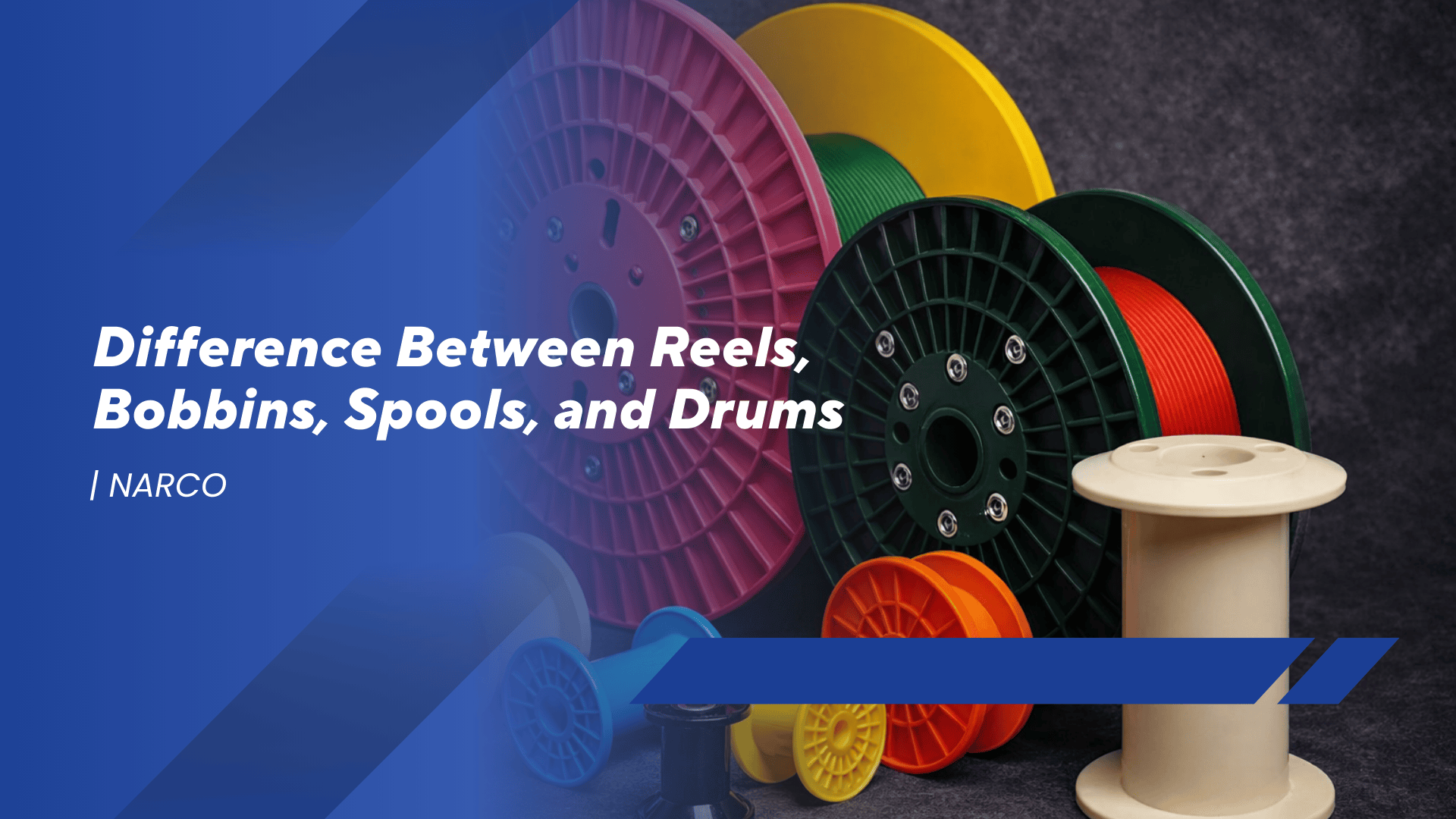
The terms are used interchangeably across the industry, but bobbins and spools typically refer to smaller winding units used on production machines, while reels or drums are larger and more commonly associated with finished product storage and shipping. Exact usage varies by manufacturer and region.
What materials are industrial wire bobbins typically made from?
Steel is the standard for any production-machine application — high-speed wire drawing bobbins are fabricated from welded steel plate and tube, then machined for precision. Plastic (ABS) reels suit certain fiber optic and lower-speed uses, and wooden spools appear in wire rope shipping, but neither replaces steel in production environments.