
Key Takeaways
- Corrugated (fluted) cable drums use ridged wall geometry to add structural rigidity without extra steel weight — outperforming flat-panel drums in heavy-duty applications
- Key specs to define before buying: flange diameter, barrel diameter, traverse width, arbor hole size, and load capacity
- The U.S. wires and cables market was valued at $31.93 billion in 2024, with 5.9% CAGR projected through 2030 — drum supply reliability directly affects operations
- Steel drums outperform wooden reels in heavy-load, moisture-exposed, and high-cycle applications
- A supplier offering custom fabrication and reconditioning delivers more flexibility and lower total cost than one who only sells new
What Are Corrugated Cable Drums?
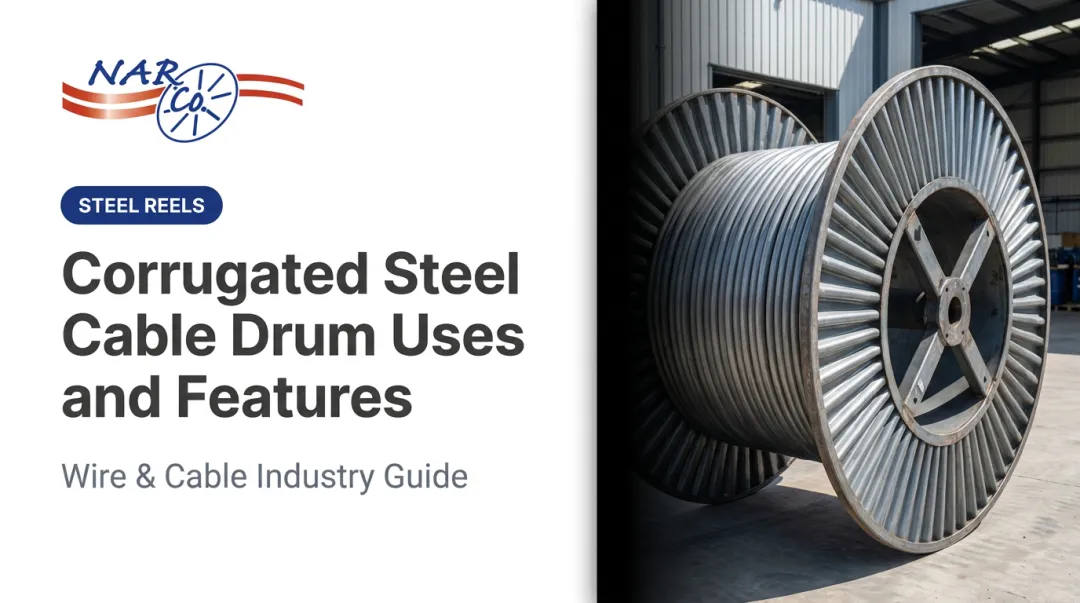
A corrugated cable drum is a flanged, barrel-style steel reel used to wind, store, and transport wire, cable, or rope. Its defining feature is the ridged or wave-patterned surface on its flanges or barrel walls — what gives it the "corrugated" label. You may also hear these called fluted reels, which is the terminology used in NEMA WC 26, the North American standard for electrical wire and cable packaging.
Anatomy of a Drum
Reel geometry follows a standardized format: Flange × Inside Traverse × Barrel/Drum, for example, 96 × 48 × 56 inches. The key components are:
- Barrel (drum core) — the winding surface; its diameter determines minimum cable bend radius
- Flanges — the side discs that contain and protect the wound product
- Arbor hole — the center hole used for spindle mounting, pay-off equipment, and lifting
- Drive holes — holes in the flange that engage drive mechanisms on winding equipment
- Inside traverse — the usable winding width between flanges
Each of these dimensions must be specified precisely. A drum that fits the diameter requirement but has the wrong arbor hole size or traverse width will create equipment fit problems that no amount of reconditioning will fix.
The Role of Corrugation
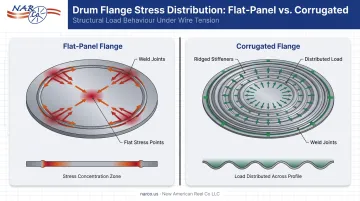
On a flat-panel steel drum, load stress concentrates at predictable weak points — typically at the weld joints and across unsupported flat sections. Corrugation changes that. The ridged pattern distributes stress across the surface geometry rather than letting it accumulate at flat stress points. A 2025 MDPI study on corrugated plate behavior confirmed that corrugated plates provide measurable out-of-plane stiffness and function as continuous stiffeners. In practical terms, that's why corrugated flanges resist bowing under cable load better than flat-panel alternatives.
Given how much dimensional precision matters, Narco manufactures corrugated shipping reels in RM and RMT types to NEMA WC 26 standards. Every order is built to customer specifications, with drawings provided at the quote stage so dimensional requirements are locked in before production begins.
Corrugated vs. Standard Steel Drums: Key Structural Advantages
The structural advantages of corrugated drums come down to geometry. Here's how those differences play out in real operating conditions:
Strength Without Added Weight
Corrugation adds rigidity through shape, not through heavier steel. A corrugated flange achieves greater stiffness than a flat flange of the same steel gauge, which means manufacturers can build a high-capacity drum without simply using heavier steel plate. For operations that move drums frequently (in and out of winding equipment, onto transport vehicles, through warehouses) that weight difference matters.
Resistance to Deformation
Flat-panel flanges bow under high-tension winding, especially with heavy wire gauges or braided rope. Corrugated flanges resist this deformation because the ridged geometry spreads the load rather than allowing it to concentrate on a single plane. According to CED Engineering's power cable reel guide, steel fluted reels use corrugated flanges specifically to add rigidity and prevent flange deformation under heavy loads.
Performance in Demanding Environments
Steel drums (corrugated or otherwise) hold clear advantages over wooden reels in certain conditions:
| Factor | Corrugated Steel | Wooden Reel |
|---|---|---|
| Moisture resistance | Superior when coated or galvanized | Capacity varies by species, assembly method, and moisture content |
| Reusability | Suitable for returnable/reusable classification (NEMA WC 26) | Generally lower reuse potential in heavy-load environments |
| Load capacity | Geometry-enhanced rigidity | Dependent on wood quality and construction |
| Repairability | Weldable, straightenable, recoatable | Limited structural repair options |
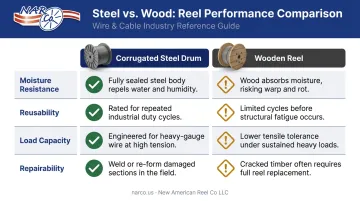
One important note: no universal public data source specifies an exact cycle-life comparison between steel and wooden drums. The accurate claim is that steel drums are better suited to heavy-duty, high-cycle, and moisture-exposed applications when properly specified — not that they always outlast wood by a fixed number of cycles.
Machinery Compatibility
Corrugated steel drums are typically engineered to standard arbor sizes and flange dimensions that align with wire pay-off and take-up equipment. When drums are designed and documented to NEMA WC 26 geometry, retrofitting needs drop considerably. That spec covers flange, traverse, barrel, arbor hole, and drive hole dimensions.
The Manufacturing Process: What Makes a High-Quality Corrugated Cable Drum
Drum quality shows up in the details: material grade, fabrication sequence, and post-build inspection. These are the variables that determine whether a drum holds up under load or fails ahead of schedule.
Material Selection
The steel grade sets the ceiling on everything else: load capacity, corrosion resistance, weldability, and how well the drum responds to reconditioning later. Common reference points:
- ASTM A36 — carbon structural steel for welded construction; a baseline for many fabricated drum applications
- ASTM A653 — zinc-coated (galvanized) sheet steel; relevant when corrosion resistance is a priority
Ask any supplier for a material certificate, not just a stated nominal thickness. A drum described as "steel" without grade documentation is unverifiable.
Fabrication Steps
The manufacturing sequence for a corrugated steel drum typically follows this path:
- Steel sheet forming — corrugations are pressed or roll-formed into flat sheet stock, progressively shaping the ridged profile through successive roller dies
- Flange cutting — flanges are cut to specified diameter with drive holes and arbor hole punched or machined to tolerance
- Barrel forming — the barrel section is shaped and prepared for assembly
- Welding — flanges are welded to the barrel; this joint is the most structurally critical point in the drum
- Finishing — painting, powder coating, or galvanizing depending on the application environment
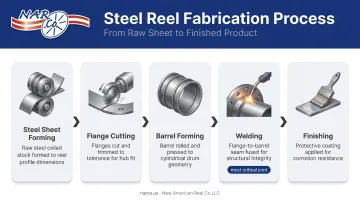
Weld quality at the flange-barrel joint deserves close attention. AWS D1.1 is the structural welding code that governs procedure qualification, welder qualification, and inspection acceptance criteria for structural steel — ask suppliers whether their welding follows documented procedures.
Custom Fabrication vs. Catalog Sizes
This distinction matters more than buyers often realize. A catalog-only supplier can fill straightforward orders quickly, but cannot accommodate non-standard traverse widths, unique arbor hole sizes, or load ratings outside their standard range.
Narco builds all drum and reel orders to customer specifications and provides drawings with every quote to confirm dimensional alignment before fabrication begins. The size range spans 3" to 96" (75mm to 2400mm), from fine-wire precision reels to large heavy-load shipping drums.
Quality Control
After fabrication, a properly built drum should go through:
- Dimensional verification — confirming flange diameter, traverse, barrel, and arbor hole against spec
- Weld inspection — checking the flange-barrel joints for defects
- Dynamic balancing — critical for drums used at high rotation speeds; an out-of-balance drum causes vibration, bearing wear, and inconsistent winding tension
Narco includes dynamic balancing as a standard part of its reconditioning process, and it's built into both fully machined and semi-machined reel product lines.
Industries and Applications That Depend on Corrugated Cable Drums
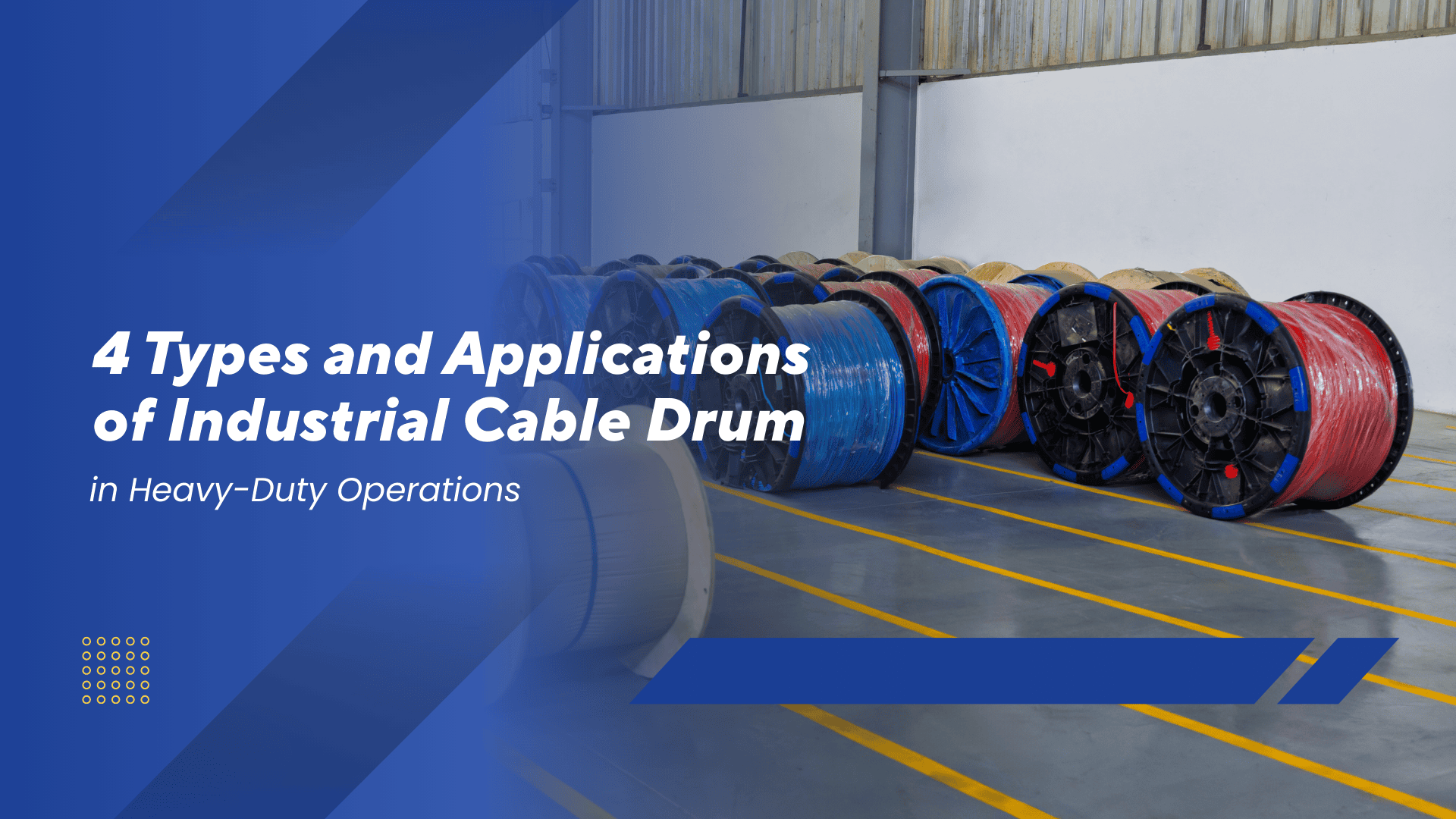
The primary consumers of heavy-duty steel cable drums cluster around industries that handle long continuous products at scale:
- Wire and cable manufacturing — the largest segment; drums used for process winding, storage, and finished product shipping
- Rope manufacturing — large-diameter drums required for steel rope and synthetic rope of significant length and weight
- Electrical utilities and power distribution — transmission cable, armored cable, and underground cable all require drums capable of supporting significant load during installation
- Telecommunications infrastructure — fiber optic and copper cable for network buildout
- Industrial shipping and logistics — returnable steel drums for transporting wire and cable products between manufacturing facilities and end users
Application Drives Specification
Drum specifications should be determined by the product being wound. A few examples:
- Fine-gauge wire manufacturing: smaller drums, precision-balanced, close arbor tolerances for high-speed winding equipment
- Heavy armored cable or steel rope: large flanges, reinforced barrel-flange welds, high load rating, often requires verified balancing
- Long-distance shipping: NEMA WC 26 RM or RMT corrugated reels designed for returnable use with moisture protection
Why Demand Is Growing
The U.S. wires and cables market reached $31.93 billion in 2024 with a projected 5.9% CAGR through 2030. Grid modernization, EV charging infrastructure, and 5G network expansion are all fueling that growth.
5G alone accounted for 1.6 billion connections at end-2023, forecast to reach 5.5 billion by 2030. Higher cable output puts direct pressure on drum supply — which means specification, sourcing, and reconditioning all need to keep pace.
What to Look for in a Corrugated Cable Drum Manufacturer or Supplier
Not every drum supplier can serve every application. These are the criteria that separate a capable partner from a catalog vendor:
Custom Fabrication Capability
Standard sizes work for standard applications. If your cable product has a minimum bend radius requirement, a non-standard winding width, or a specific arbor configuration, you need a manufacturer who designs to spec. Request a full dimensional drawing covering flange, traverse, barrel, arbor hole, drive holes, and overall width before committing to an order.
Repair and Reconditioning Services
A supplier who offers both new fabrication and drum reconditioning gives you more leverage over total cost of ownership. Instead of replacing every damaged drum, you can return worn units for straightening, rewelding, and recoating at a fraction of replacement cost.
Narco has built this dual capability since 1999. Our reconditioning services cover:
- Flange straightening and press work
- Rim repair and arbor tube replacement
- Drive pin hole repairs or replacement
- Blasting, repainting, and stenciling
- Dynamic balancing post-repair
- Welding, machining, and fabricating for complete refurbishment
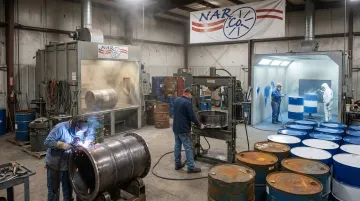
For wire manufacturers or shippers managing a large drum fleet, this one-stop model simplifies vendor relationships and keeps usable drums in service longer.
Material and Weld Standards
Ask specifically:
- What steel grade is used for the flanges and barrel?
- Is a material certificate available?
- What welding process is used at the flange-barrel joint?
- Is there post-weld inspection, and to what standard?
Turnaround and Supply Reliability
For operations running on continuous drum cycles, lead time matters. Get specific answers before placing an order:
- What is the standard lead time for new fabrication vs. reconditioning?
- Are common sizes stocked for faster turnaround than full build-to-order?
- What happens if a rush order comes in mid-cycle?
A supplier who can answer these questions concretely — not just "it depends" — is one you can actually plan around.
Storage, Handling, and Maintenance Best Practices
A well-built drum can still be damaged in an hour of poor handling. The three areas below — storage, handling, and maintenance — cover the most common failure points worth enforcing at the warehouse level.
Storage
- Store drums upright on their flanges, not on their sides — side storage shifts cable load and stresses the barrel unevenly
- Use a level, dry surface; concrete indoors is preferable to outdoor ground storage
- Protect weld seams and cut edges from prolonged moisture exposure to prevent rust
- For long-term storage (beyond three months), check and tighten barrel bolts and rotate drums 90 degrees quarterly to prevent flat-spotting
Handling
- Insert forklift tines fully under both flanges — partial contact risks tipping and flange crushing
- Never lift a drum by the flange alone; this can break the flange from the barrel
- Use a steel pipe through the arbor hole for controlled lifting, or use spindle-mounted handling equipment
- Avoid dragging or dropping — corrugated flanges can deform from impact even when they appear undamaged
Maintenance and Reconditioning
Inspect drums periodically for:
- Flange warping or bowing
- Weld cracks at the flange-barrel joint
- Surface rust at seams or edges
- Arbor hole wear that affects fit on winding equipment
Drums showing early-stage damage are strong reconditioning candidates. Professional reconditioning typically involves: rewelding, straightening, blasting, and repainting. This process restores structural integrity at lower cost than new drum procurement, particularly for larger, higher-specification drums. Narco handles all four steps in-house, which keeps turnaround tight and quality consistent.
Frequently Asked Questions
What is a cable drum?
A cable drum is an industrial reel — with a central barrel and two flanged side discs — used to wind, store, and transport wire, cable, or rope. Corrugated steel versions are built for heavy-duty applications requiring high load capacity and repeated use cycles.
What is the difference between corrugated and standard steel cable drums?
Corrugated drums use a ridged wall pattern on the flanges or barrel to increase structural rigidity through geometry rather than added material weight. This makes them more resistant to flange deformation under high-tension winding than flat-panel steel drums of comparable steel thickness.
How much does a cable drum cost?
Cost varies widely based on drum size, steel grade, load capacity, finish type, and whether it's a standard or custom-fabricated unit. Contact manufacturers directly with your dimensional and load specifications — a quote without drawings and specs is rarely reliable for custom applications.
How do you store and maintain a cable drum?
Store drums upright on their flanges on a level, dry surface away from prolonged moisture. Inspect periodically for flange warping, weld cracks, and rust.
Can corrugated cable drums be reconditioned or repaired?
Steel drums — corrugated or standard — can typically be reconditioned through rewelding, flange straightening, arbor tube repair, and recoating. Reconditioning is a cost-effective alternative to replacement for drums with repairable structural damage. Contact Narco at 419-258-2900 to discuss specific damage scenarios.
What is the HTS code for cable drums?
Steel wire and cable reels most commonly fall under HS heading 7326 (other articles of iron or steel), with U.S. CBP precedent classifying steel reels under HTSUS 7326.90.8588. Classification varies by material, construction, and end use. Confirm the applicable code with a licensed customs broker before import or export.