Introduction
A cable drum that fails mid-shipment — or collapses under stacked weight in a warehouse — doesn't just delay a project. It damages product, wastes labor, and sends replacement costs straight to the bottom line. For wire manufacturers, cable distributors, and field installation crews, poor reel selection is one of the most preventable sources of operational loss.
Corrugated steel cable drums are the engineered answer to these problems. Built for heavy-duty, repeat-use environments, they protect cable throughout its entire lifecycle: from production line to warehouse shelf to installation site.
This article covers what makes corrugated steel drums structurally distinct, their key features, where they're used across industries, how to select the right one, and how to extend service life through proper maintenance.
Key Takeaways
- Corrugated steel drums use ridged geometry to achieve greater rigidity without adding unnecessary steel weight
- They're standard equipment on wire drawing lines, in cable warehouses, and with field installation crews
- NEMA WC 26 and DIN standards govern key dimensions, so confirming compatibility with your equipment before purchasing is essential
- Steel outperforms wood and plastic for high-load, repeat-use applications despite higher upfront cost
- Professional reconditioning can restore drums to near-original performance at a fraction of replacement cost
What Is a Corrugated Steel Cable Drum?
A corrugated steel cable drum is a cylindrical steel reel with a ridged, fluted surface pattern pressed into the barrel or flanges. It's designed to wind, store, transport, and dispense wire, cable, or rope in industrial settings.
The "corrugated" element — alternating ridges and grooves formed into the steel — separates these drums from flat-walled steel alternatives. That ridged geometry serves a structural purpose, not an aesthetic one.
Terminology Worth Knowing
The industry uses several overlapping terms for the same basic product:
- Corrugated steel drum — most common general term
- Fluted reel — used in NEMA WC 26, which classifies these as "steel fluted returnable reels"
- Corrugated bobbin or corrugated wire spool — common in supplier catalogs and wire manufacturing contexts
- Wire drawing reel — used for in-process production reels built to DIN 46397 or DIN 46395
Narco's explainer on the differences between reels, bobbins, spools, and drums is a useful reference if you're navigating procurement specs.
Standards That Govern These Drums
Two standards frameworks are most relevant:
- DIN standards (European/international): DIN 46391-1:2014-05 covers delivery drums from 710 mm to 2,800 mm for cable transport. DIN 46397-11 and 46397-22 cover wire-production spools with rectangular and conical flanges.
- NEMA WC 26 (North American): Defines dimensional and load ratings for steel fluted returnable reels — general-purpose reels are rated up to 20,000 lb; heavy-duty reels up to 30,000 lb.
Standardization matters because it determines whether a drum will fit your winding machine, payoff stand, or transport equipment. A drum that's dimensionally incompatible costs you time before it ever holds a foot of cable.
Key Features of Corrugated Steel Cable Drums
Structural Strength from Corrugation
The engineering principle behind corrugation is simple but effective. Pressing ridges and grooves into a flat steel sheet changes how the material responds to bending loads. Instead of concentrating stress across a flat surface, the corrugated geometry distributes it along the ridges.
Cold-formed steel research from Missouri S&T confirms that corrugated sheet provides greater stiffness and rigidity per pound of material than flat sheet, with flexural load capacity depending on corrugation size, shape, and sheet width. The same principle explains why corrugated roofing handles snow loads that would buckle flat panels of equal thickness.
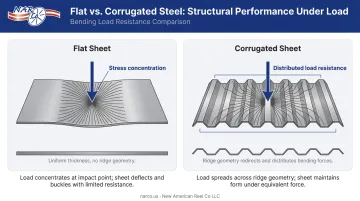
For cable drums, this translates to flanges that resist deformation under heavy cable payloads — without simply adding more raw steel mass.
High Load Capacity With Reduced Weight
The strength-to-weight advantage of corrugated geometry means manufacturers can build a structurally capable drum without the bulk of a solid, flat-walled alternative. For logistics and handling, that matters — every pound of empty drum weight is weight that doesn't carry cable.
NEMA WC 26 heavy-duty steel fluted reels are rated up to 30,000 lb maximum strength capacity, with flange diameters from 36 to 120 inches. That's the working range for serious industrial applications.
Corrosion and Wear Resistance
Steel drums are typically finished with one of several protective treatments:
- Hot-dip galvanizing — covered by ASTM A123/A123M, provides long-term zinc protection for exposed or outdoor environments
- Paint systems — selection guided by ISO 12944 environment classifications (indoor warehouse vs. outdoor job site vs. marine/chemical exposure)
- Epoxy coatings — used where chemical resistance or impact protection is the priority
Coating choice should match the drum's storage and use environment — hot-dip galvanizing for outdoor or utility yard exposure, a basic paint system for covered warehouse storage.
Flange and Barrel Design for Controlled Winding
The flanged ends of the drum serve a specific function: they keep cable on the barrel during winding and unwinding, preventing lateral slippage under tension.
Barrel diameter is equally critical — and often underappreciated. Southwire's cable packaging guide states that minimum drum diameter is calculated as B = D × F, where B is the minimum drum diameter, D is cable outside diameter, and F is a construction-specific multiplier. NEMA WC 26 lists multipliers ranging from 6× cable diameter for building wire up to 24× for power cables rated 5,001–35,000 V.
Wind cable onto a barrel that's too small and you risk permanent kinking, insulation cracking, or conductor damage — particularly in shielded or armored cables.
Reusability and Long Service Life
Unlike wooden or plywood drums, which are typically single-use or limited-cycle, corrugated steel drums are designed to return. NEMA WC 26 formally classifies steel fluted reels as returnable reels — the standard assumption is that they'll come back and be reloaded.
For manufacturers and distributors cycling through large cable volumes, that reusability converts what looks like a higher upfront cost into a lower per-cycle cost over time.
Primary Uses and Applications of Corrugated Steel Cable Drums
Wire and Cable Manufacturing
On production lines, corrugated steel drums serve as take-up reels — they collect finished wire or cable at the output end of drawing, extrusion, stranding, or annealing equipment.
At production speeds, static load capacity is only part of the picture. Pentre's BP wire drawing reels, built to DIN 46397 or DIN 46395 with flange diameters from 400 mm to 1,250 mm, are dynamically balanced to ISO 1940 and rated for operation above 40 m/s, with optional designs up to 60 m/s. An out-of-balance drum at those speeds creates vibration that damages both the equipment and the product.
Narco offers dynamic balancing as part of its standard reconditioning services for steel reels up to 96 inches (2,400 mm) in diameter.
Cable Storage and Inventory Management
A loaded corrugated steel drum organizes cable that would otherwise pile into tangled, kinked coils on the warehouse floor. The benefits are practical:
- Eliminates tangles and kinking during storage
- Reduces trip hazards in high-traffic facilities
- Enables vertical or horizontal stacking when drum geometry allows
- Keeps cable accessible and identifiable without unspooling
For high-SKU cable inventories, drums also make quantity tracking far simpler — labeled tare weights and footage markers on the barrel surface provide quick visual reference.
Shipping and Transportation
Loaded corrugated steel drums are designed to handle freight stresses that would compromise lighter containers. ASTM D4169-23 covers shipping-unit hazards including handling impacts, warehouse stacking, vehicle vibration, and rail-switching shock — the physical gauntlet a loaded drum faces in transit.
Practical handling features that matter for logistics:
- Axle holes (arbor holes) for spindle-mounted payoff or winding
- Forklift-compatible flanges — both flanges should be supported during lifting
- Structural flanges that resist deformation when drums are transported upright
Prysmian's reel handling guidance notes that drums should not be laid on their sides and should be rotated periodically in storage to prevent flat spots.
Electrical and Telecommunications Cable Installation
Field installation crews use corrugated steel drums on payoff stands or cable trailers to dispense power cable, communication cable, or fiber during infrastructure work. A drum on a properly tensioned payoff stand feeds cable without twist or excessive tension, protecting both the cable and the installation.
For high-voltage cable (5,001–35,000 V), NEMA's 24× minimum drum-diameter multiplier means the barrel diameter is a cable-protection specification, not just a capacity number. Undersizing that dimension in the field is an expensive mistake.
Rope and Specialty Wire Applications
Beyond electrical cable, corrugated steel drums handle:
- Steel wire rope and guy wire
- Welding wire
- Specialty bare wire for industrial processes
That range explains why corrugated steel drums show up in construction, utilities, and general manufacturing — the structural durability and handling compatibility translate directly regardless of what's wound on them.
Corrugated Steel Cable Drums vs. Other Drum Types
| Feature | Corrugated Steel | Plywood/Wood | Plastic |
|---|---|---|---|
| Load capacity | High (up to 30,000 lb NEMA rated) | Moderate | Low to moderate |
| Reusability | High — purpose-designed returnable | Low — typically one-way | Moderate |
| Durability | Excellent | Susceptible to moisture | Susceptible to cracking under load or cold |
| Upfront cost | Higher | Lower | Moderate |
| Weight (empty) | Heavier | Lighter | Lightest |
| Best for | High-load, repeat-use, harsh environments | One-way shipping of lighter cables | Light-duty, controlled environments |
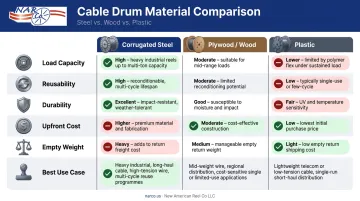
Eland Cables notes that cable drum material choice depends on cable weight, cable type, and whether the drum is expected to be returned or reused — which frames the steel vs. wood decision well.
Steel costs more upfront and weighs more empty — that's the real trade-off. For one-way shipment of lighter cables where return logistics aren't practical, plywood makes sense. For industrial-scale, high-load, repeat-use operations — particularly outdoors or in harsh environments — steel delivers lower total cost across repeated use cycles.
How to Choose the Right Corrugated Steel Cable Drum
Three Primary Dimensions
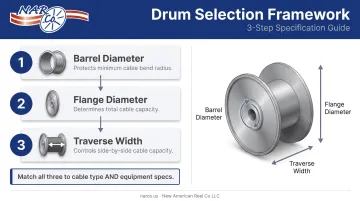
Every drum selection starts with three dimensional parameters:
- Barrel (drum) diameter — determines minimum bend radius for the cable being wound; this is a cable-protection parameter first, a capacity parameter second
- Flange diameter — determines total cable capacity; larger flanges hold more cable
- Traverse (width between flanges) — determines how much cable fits side by side on the barrel
These dimensions must match both the cable type and the equipment the drum will run on — payoff stands, winding machines, and transport spindles all have specific bore and flange requirements.
Load Rating and Steel Gauge
Heavier cable payloads require heavier gauge steel, particularly for larger-diameter drums where flange stresses increase. Under-specifying drum gauge is a common and costly mistake; the drum may handle the load initially but deform prematurely, damaging cable on subsequent windings.
NEMA WC 26's strength-capacity tables provide a practical reference: general-purpose steel fluted reels cover 1,000–20,000 lb capacity, while heavy-duty reels cover 3,000–30,000 lb. Match the drum's rated capacity against the actual cable weight before purchasing.
Equipment Compatibility
Confirm that your drum's dimensions fit your existing equipment. Two measurements are critical:
- Arbor hole (bore) size — must match your payoff stand or winding machine spindle
- Flange diameter — must clear your equipment's frame and transport constraints
Narco manufactures corrugated shipping reels to NEMA WC 26 (RM and RMT types) and produces reels to DIN 46395 and DIN 46397 standards where applicable. All orders are manufactured to customer specifications, with drawings provided at quote stage to confirm fit before production begins.
Maintaining and Extending the Life of Your Corrugated Steel Cable Drum
Routine Inspection
Corrugated steel drums should be inspected regularly, particularly after heavy transport cycles. Key checkpoints:
- Flanges — cracks, bends, or deformation at flange edges and weld points
- Barrel surface — dents or deformation that could cause uneven winding
- Coating condition — rust, peeling paint, or bare metal exposure
- Arbor tubes and drive pin holes — wear or elongation that affects centering on equipment
Catching damage early protects cable during subsequent winding and unwinding cycles — a flange crack that catches cable under tension can destroy a significant length of product. If inspection turns up structural issues, the next question is usually whether the drum needs to be replaced or simply reconditioned.
Reconditioning as a Cost Alternative to Replacement
Many corrugated steel drums don't need to be scrapped — they need to be reconditioned. Narco's steel reel reconditioning services, offered since the company's founding in 1999, cover the full scope of typical drum wear:
- Flange straightening and press work
- Rim repairs and rewelding
- Arbor tube and drive pin hole repair or replacement
- Blasting and repainting
- Dynamic balancing for production-line drums
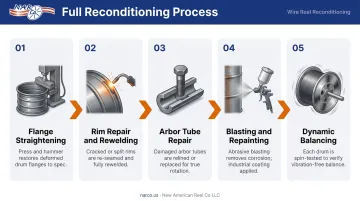
For drums that are structurally sound but cosmetically degraded, reconditioning restores near-original performance at a fraction of replacement cost. A wire manufacturer cycling through dozens of drums per month can recover substantial spend by reconditioning instead of ordering new.
Frequently Asked Questions
What is a corrugated steel drum for cable?
A corrugated steel cable drum is a steel reel with a ridged (fluted) barrel or flange surface used to wind, store, and transport wire or cable in industrial settings. The corrugated geometry adds structural rigidity without extra steel weight, enabling heavy payloads and repeated industrial use.
What are the different types of cable drums?
The four main types are wooden, plywood, plastic, and steel. Wood and plywood suit one-way shipment of lighter cables; plastic works for light-duty environments. Corrugated steel is the choice for high-load, repeat-use, or harsh-environment applications where durability and return logistics justify the investment.
What is a cable drum used for?
Cable drums organize and protect wire or cable during storage, enable safe transport through freight handling, and dispense cable in a controlled manner during manufacturing or field installation.
How much does a corrugated steel cable drum cost?
Pricing varies widely based on drum size, steel gauge, coating type, and order quantity — there's no single price point. Reconditioned drums cost significantly less than new, especially for high-volume operations where drums cycle through repair regularly.
How long do corrugated steel cable drums last?
With proper maintenance and periodic reconditioning, corrugated steel drums can remain in service for many years — well beyond the useful life of wooden or plastic alternatives. High-cycle industrial operations typically find steel drums deliver significantly lower per-use cost over time despite higher initial purchase prices.
Can corrugated steel cable drums be repaired or reconditioned?
Yes. Steel drums can typically be reconditioned through structural inspection, flange straightening, rewelding, and recoating. Narco — which has specialized in steel wire reel reconditioning since 1999 — handles drums from 3 inches to 96 inches in diameter, restoring them to near-original performance at a fraction of replacement cost.