
This guide cuts through the confusion. It covers the four main drum types and their real trade-offs, the factors that actually determine the right choice, how drum sizing works, and when reconditioning a steel drum makes more financial sense than buying new.
Key Takeaways
- Wooden drums suit medium-load production and regional distribution, but aren't built for high-tension or continuous outdoor use
- Steel drums are the only practical choice for HV power cable, armored conductors, and steel wire rope
- Barrel diameter must meet or exceed the cable's minimum bend radius (MBR) — no exceptions
- Drum sizing requires cable OD, total length, weight per meter, MBR, and equipment interface specs before any calculation starts
- Reconditioning makes sense when damage is limited to flanges, arbor tubes, or surface corrosion on an otherwise sound steel drum
The 4 Main Cable Drum Types: Characteristics and Trade-offs
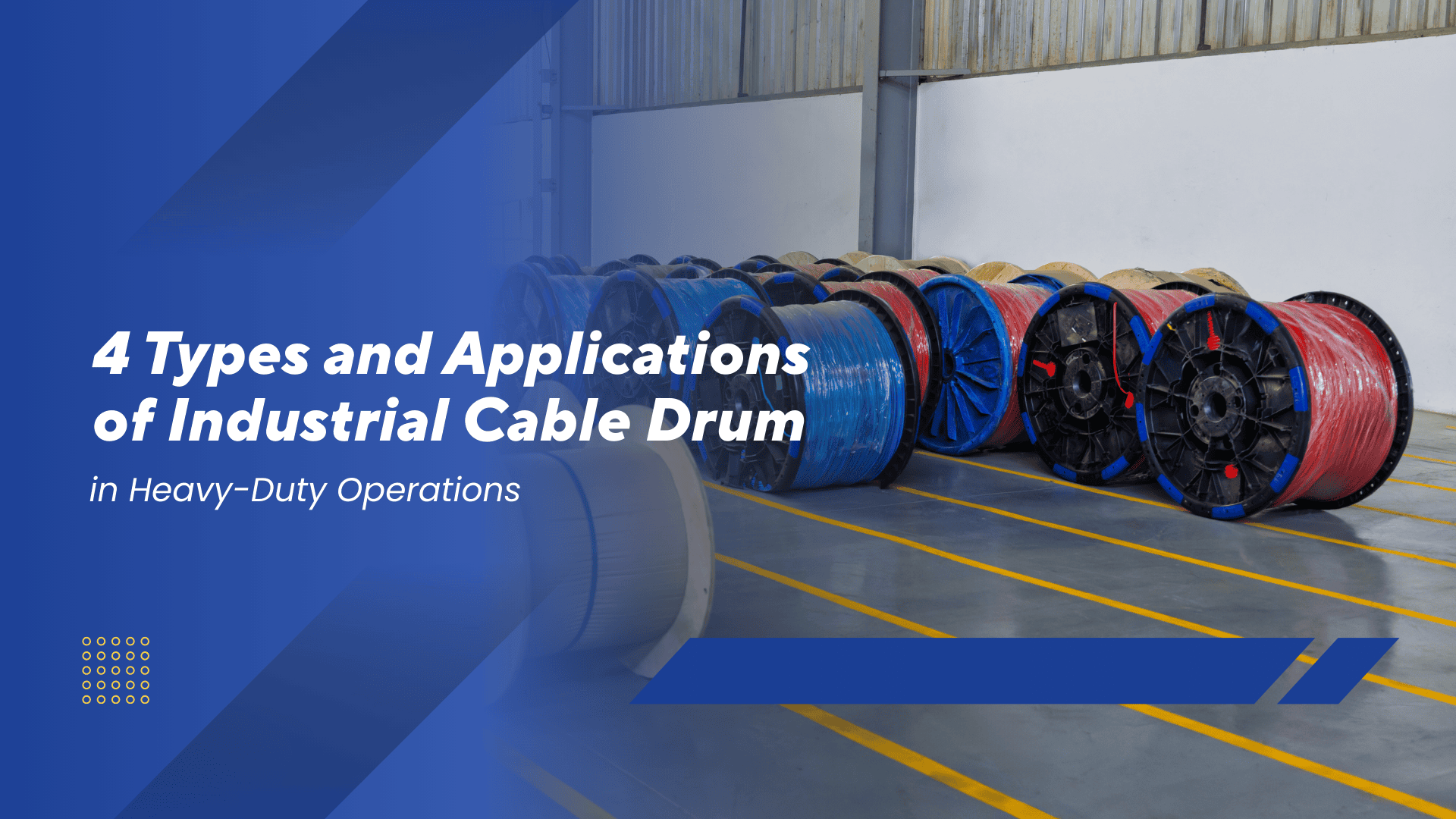
Cable drums are manufactured in four primary forms (wooden, plywood, plastic, and steel), each suited to specific load conditions, environments, and duty cycles. Corrugated steel variants (NEMA WC 26 RM/RMT) are a sub-category within steel drums, designed for high-capacity shipping rather than in-process handling.
Wooden Cable Drums
Solid or engineered wood construction gives wooden drums a practical combination of moderate load capacity and lower freight cost compared to steel. For international export shipments, heat-treated wooden drums must carry the IPPC certification mark confirming ISPM-15 compliance — a requirement enforced at U.S., Canadian, and UK ports of entry.
Best applications: Medium-voltage power cables, copper conductors, telecom cables, rope, and flexible tubing in production and regional distribution.
Limitations:
- Susceptible to moisture damage under prolonged outdoor exposure
- Reduced reuse life under rough handling conditions
- Not suited for high-tension or continuous-duty winding lines
Narco manufactures nailed wooden reels from heat-treated softwoods (Southern Yellow Pine, Spruce, Pine, or Fir) in sizes from 20" to 60" diameter, built to NEMA WC 26 and made to customer dimensional specifications.
Plywood Cable Drums
Plywood drums use layered flange construction with wood, board, aluminum, or plastic core options. They're lightweight, low-cost, and purpose-built for single-use or limited-reuse logistics — particularly one-way export shipments where return freight isn't cost-effective.
Best applications: Optical fiber, LAN cables, low-voltage conductors, and thin-wall tubing for short production runs or project-based deliveries.
Limitations: Not suitable for heavy cables, armored conductors, high-tension operations, or prolonged outdoor exposure. Note that ISPM-15 may exempt processed plywood from treatment requirements where the manufacturing process eliminates pest risk — verify with your destination country's plant protection authority.
Plastic Cable Drums
Plastic drums are corrosion-resistant, moisture-resistant, and lightweight — a practical fit for controlled environments where contamination prevention matters. Many modern variants support recycling programs. Narco's plastic reel line (supplied through Inosym Reels) is manufactured from ABS plastic and available for both process and shipping applications.
Best applications: Synthetic rope, small-gauge wire, patch cables, low-voltage conductors, welding wire spools, and fine wire.
Limitations:
- Thermal sensitivity in high-temperature processing environments
- Lower structural rigidity under stacking loads
- Inadequate load capacity for armored or heavy-power cables
Steel Cable Drums
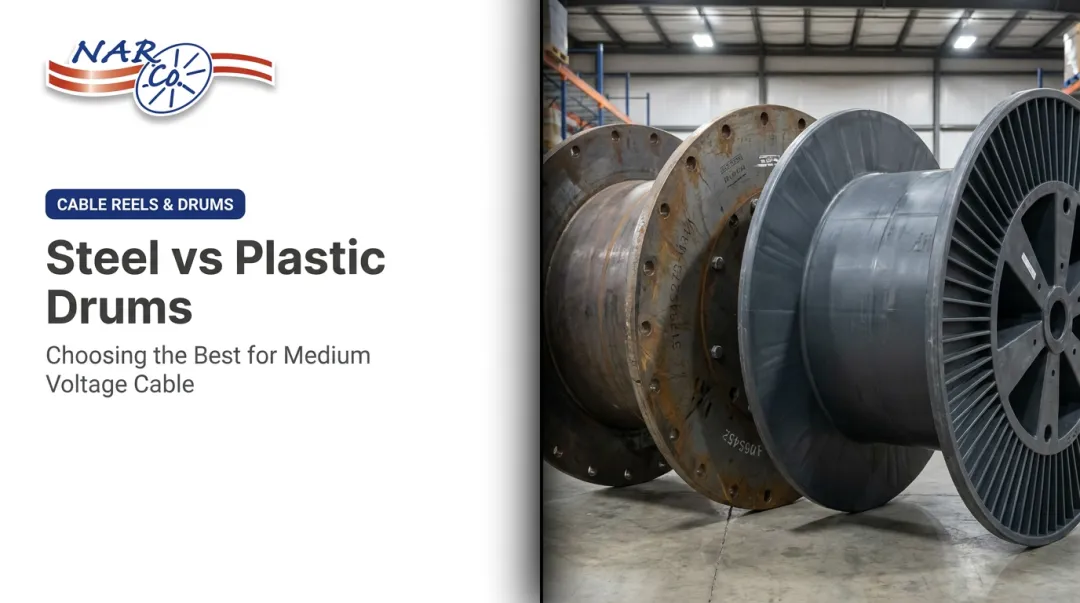
Steel drums are fabricated for dimensional stability under heavy static and dynamic loads: winding torque, braking forces, and transport shock loads. They support multi-year reuse, integrate with automated payoff systems, and hold up to the abuse that field installation routinely inflicts.
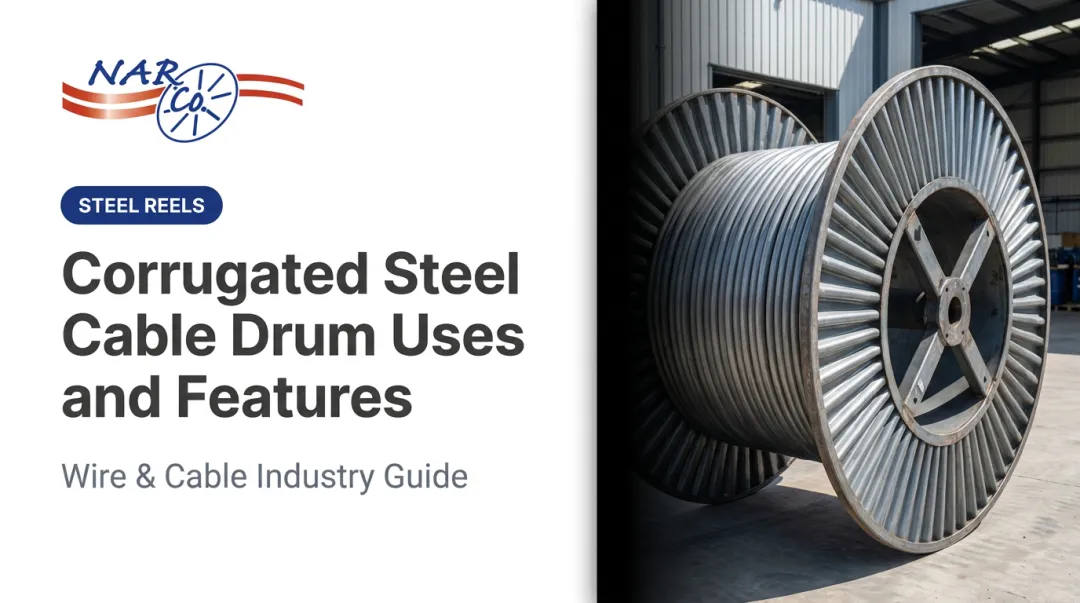
Corrugated variants (NEMA WC 26 RM/RMT), sometimes called fluted reels, add a lightweight, high-capacity shipping option within the steel category.
Best applications: High-voltage power cables, steel wire rope, armored conductors, extrusion lines, drum twisting, and heavy infrastructure projects.
Limitations: Higher upfront cost, heavier freight requiring forklift or crane handling, and more complex logistics planning relative to wood or plastic alternatives.
Key Factors When Selecting a Cable Drum
Load Rating: Static Isn't the Whole Picture
Load rating must account for more than cable weight at rest. Winding torque, braking forces, and transport shock loads all multiply the stress on flanges and arbor tubes. NEMA WC 26 defines "maximum strength capacity" by reel size and construction — use reel-specific capacity tables from your supplier, not generic material-type estimates.
For high-voltage cable and steel rope applications, flange deflection under dynamic load is the failure mode to design against, not just static overload.
Barrel Diameter and Minimum Bend Radius
This is where most specification errors happen. The barrel diameter must meet or exceed the cable's minimum bend radius (MBR). Undersized barrels concentrate stress on inner layers, causing conductor flattening, insulation micro-cracking, and tubing ovality — failures that often don't surface until well after installation.
MBR requirements vary significantly by cable type:
| Cable Type | Typical MBR Reference |
|---|---|
| MV tape-shielded single-conductor | 14× cable OD (Southwire/NEMA WC 26) |
| 11–33 kV single-core unarmoured | 20× OD dynamic / 15× OD static (Prysmian) |
| Fiber optic (≤216 fibers) | 20× OD during installation / 10× OD installed (Corning) |
| Steel wire rope | Varies by rope construction — use rope-maker specs |
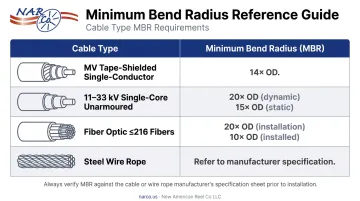
Verify MBR against the cable manufacturer's spec sheet before confirming drum specifications.
Flange Diameter, Width, and Stiffness
Insufficient flange stiffness causes telescoping and edge damage on high-speed extrusion and rewinding lines. Drum width must accommodate the required cable length without excessive layering or uneven distribution. Both conditions accelerate payout problems.
Controlled flange geometry — achieved through manufacturing to DIN 46397 and dynamic balancing to ISO 1940-1 — directly enables high pay-off speeds (up to 40 m/s in wire drawing applications) while minimizing flange distortion and maintaining uniform traversing. Dynamic balancing is a capability Narco offers for process reels as part of its fabrication and reconditioning services.
Rotational Balance
Unbalanced drums at high RPMs cause vibration, bearing wear, and speed variation that reduces winding accuracy and increases scrap. This matters most in drum twisting and extrusion lines, where the consequences include:
- Dimensional inconsistency in the finished product from speed fluctuation
- Accelerated bearing wear from sustained vibration
- Reduced winding accuracy that increases scrap rates
ISO 1940-1 provides the balance quality framework. Dynamically balanced process reels specify residual unbalance limits to keep bearing loads within equipment tolerances.
How to Calculate Cable Drum Size
Drum sizing follows a logical sequence: barrel diameter first (driven by MBR), then drum width (based on cable length and layering), then maximum flange diameter (based on total cable volume).
Work through the four steps below before committing to a specification. Complex applications — unusual cable constructions, heavy loads, tight transport constraints — often benefit from a second set of eyes before finalizing.
Step 1: Gather the Required Inputs
Missing any one of these leads to undersized or oversized drums:
- Cable OD and minimum bend radius (MBR) — both from the cable manufacturer's spec sheet
- Total cable length to be wound
- Cable weight per meter
- Equipment interface constraints — mandrel bore size, forklift/crane lifting point requirements
Step 2: Calculate Barrel Diameter
Southwire's packaging guide describes the relationship as B = D × F, where minimum drum diameter is driven by cable diameter and a construction-specific factor. The barrel diameter must be at or above the MBR value — this is a floor, not a target.
Step 3: Calculate Layering and Drum Width
The number of layers a drum can hold depends on:
- Drum width ÷ cable OD = cables per layer
- Usable flange height (flange radius minus barrel radius, minus safety margin) ÷ cable OD = number of layers
Exceeding the designed layer count risks layer collapse, unstable payout, and flange overload — especially with heavy cables on steel drums. Tools like Carris's reel capacity calculator use traverse length, fill diameter, barrel diameter, and wire diameter to estimate capacity at 100%, 90%, and 75% of perfect wind.
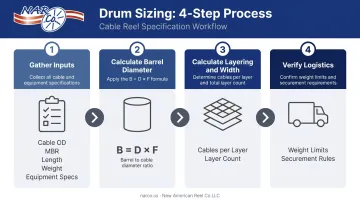
Step 4: Verify Against Logistics Constraints
Drum size directly affects freight costs, storage density, and transport compliance. Before finalizing specs, confirm the loaded drum weight and dimensions meet:
- Transport equipment ratings at your facility
- Federal road limits: 80,000 lb gross vehicle weight, 20,000 lb single-axle, 34,000 lb tandem-axle maximum (per 23 CFR Part 658)
- Cargo securement requirements under 49 CFR 393.106, which require aggregate tiedown working load limit of at least half the cargo weight, with drums restrained against rolling
If your application involves non-standard cable constructions or unusually tight transport constraints, Narco's team can review your specs before you commit. Reach out at 419-258-2900 or mark@narco.us.
New vs. Reconditioned Steel Cable Drums: How to Decide
What Reconditioning Actually Covers
Reconditioning is a practical alternative to replacement when structural damage is limited to components that can be restored to spec. Narco has been performing steel reel reconditioning since 1999, handling drums from 3" to 96" (75mm to 2400mm).
Standard reconditioning services:
- Flange straightening and press work
- Rim repairs
- Blasting and painting
- Stenciling (logo, name, tare weight)
- Dynamic balancing
Custom reconditioning services:
- Drive pin hole repair or replacement
- Arbor tube repair or replacement
- Arbor hole resizing
- Welding, fabricating, and machining to specification
The steel reel refurbishment page outlines these services in detail. Narco also maintains connections with facilities managing surplus steel reels and can help locate used drums or provide warehousing for reel inventory transitions.
When to Recondition vs. Replace
Reconditioning makes sense when damage is localized and the barrel structure is sound. Replacement is the right call when:
- Barrel is severely deformed and cannot be pressed back to tolerance
- Structural welds are cracked in load-bearing areas
- Arbor wear exceeds machinable tolerance: the bore cannot be restored to spec without compromising wall thickness
- The drum has exceeded its designed reuse cycle count, with no remaining service cycles available under the original design spec
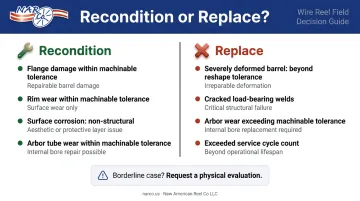
For a borderline case, request a detailed evaluation from your reconditioning provider before committing to either path.
Lifecycle Cost — What to Actually Track
Once you've assessed the drum's structural condition, the decision also comes down to dollars. Procurement teams that skip the reconditioning evaluation routinely pay more than necessary. The cost comparison should include:
- Reconditioning cost vs. new drum price
- Estimated remaining service cycles after repair
- Turnaround time vs. lead time for new drums
- Cost of downtime if a prematurely failed reconditioned drum pulls a line
Tracking these metrics per drum — not per order — is what enables data-driven decisions. Narco can provide pricing and turnaround estimates based on your specific drum condition and volume, which makes that comparison concrete rather than theoretical.
Frequently Asked Questions
How do I calculate cable drum size?
Drum sizing requires five inputs — cable OD, MBR, total length, weight per meter, and equipment interface requirements — which determine barrel diameter, drum width, and flange diameter. Most manufacturers provide sizing worksheets. Contact Narco at 419-258-2900 for help with your specific application.
What is the difference between a cable drum and a cable reel?
The terms are often used interchangeably. "Drum" typically refers to larger, heavier-duty storage and shipping units used in field installation, while "reel" more commonly refers to in-process winding equipment used in manufacturing — though exact usage varies by industry.
What drum type is best for high-voltage or heavy-duty cable?
Steel cable drums are the standard choice for HV power cables, armored conductors, and steel wire rope. No other material matches their load-bearing capacity, flange stiffness, and resistance to handling abuse in continuous-duty or outdoor environments.
Can cable drums be reused across multiple projects?
Steel drums are designed for multi-year reuse and can be reconditioned between cycles. Wooden drums may be reused depending on load history and handling conditions. Plywood and plastic drums are generally optimized for single-use or limited reuse.
What standards apply to industrial cable drums?
Key standards include:
- NEMA WC 26 — wire and cable packaging, including RM/RMT corrugated reels
- DIN 46395 — pressed/metal-flanged steel reels for process and shipping
- DIN 46397 — fully machined, dynamically balanced process reels
- ISPM-15 — heat-treated wood packaging for international export
- ISO 1940-1 — balance quality for process reels
Confirm which standards apply to your cable type and shipping destination before specifying.
How do I know when a steel drum needs reconditioning instead of replacement?
Recondition when damage is limited to flanges, surface corrosion, or arbor tube wear that can be machined back to spec. Replace when the barrel is severely deformed, load-bearing welds are cracked, or the drum has exceeded its service cycle count. If the call is unclear, get a physical evaluation before deciding.