Introduction
Steel wire reels are built to last — but they're not built to be ignored. In wire and cable manufacturing, reels endure heavy wire loads, continuous rotation, repeated loading and unloading cycles, and exposure to moisture, coatings residue, and industrial atmospheres. Those conditions degrade even well-built steel structures over time.
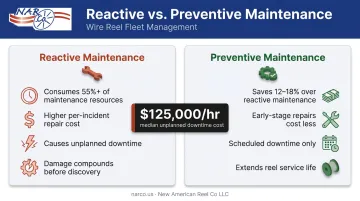
According to ABB's 2023 survey, unplanned industrial downtime costs a median of $125,000 per hour. Equipment condition contributes directly to that exposure — through line stoppages, spooling defects, and safety incidents that trace back to reels that weren't maintained.
This guide covers four things:
- Why reel maintenance matters for production quality, safety, and cost
- The four maintenance types and when to apply each
- Physical and operational warning signs that a reel needs attention
- A practical inspection and maintenance schedule you can apply to your operation
Key Takeaways
- Routine cleaning, inspection, and fastener checks cost far less than repairs or full reel replacement
- Key warning signs: flange damage, abnormal vibration, uneven wire spooling, surface corrosion near welds
- Increase maintenance frequency as usage intensity and environmental severity rise
- Dynamic imbalance is a leading cause of vibration and uneven tension at higher winding speeds
- Structural damage (cracked flanges, worn arbor tubes, bent rims) often calls for professional reconditioning rather than full replacement
Why Wire Reel Maintenance Matters
The Production Case
Wire reels in active manufacturing face mechanical stress from multiple directions: tensile load from wound wire, compressive force during stacking and storage, impact shock from handling equipment, and rotational stress during high-speed take-up and pay-off. None of these stresses disappear between production cycles — they accumulate.
When a reel degrades without intervention, the production effects show up before the physical damage becomes obvious:
- Uneven wire tension during pay-off, contributing to breakage and inconsistent diameter
- Poor spooling geometry that causes bird-nesting or tangles downstream
- Line stoppages from reel wobble or arbor fit problems
- Increased scrap from tension instability
A 2024 systematic review of electrical wire manufacturing confirms that improper tension control causes wire breakage, inconsistent thickness, machine stoppages, and material waste. Reel condition is one variable in that tension equation — and often an overlooked one.
The Safety Case
Structurally compromised reels carry real hazard potential. OSHA's machine-guarding requirements treat revolving drums and containers as safety-critical equipment, and OSHA accident records include incidents where reels struck employees during handling. Cracked flanges, bent arbors, and loose hardware on rotating equipment aren't cosmetic problems — they're injury risks.
The Cost Case
Plant Engineering's 2018 maintenance study found that aging equipment caused unscheduled downtime for 44% of respondents. The DOE's Operations & Maintenance Best Practices guide puts the economics directly: reactive maintenance consumes over 55% of maintenance resources in an average facility, while preventive maintenance saves 12–18% over reactive approaches.
For wire reels, those numbers translate directly to the reconditioning-versus-replacement decision. Professional reconditioning — structural repair, blasting, repainting, and dynamic balancing — restores a reel to near-original specification at a fraction of new fabrication cost. The savings are most pronounced for larger steel reels, where raw material costs and lead times make replacement expensive. Reel size and damage extent determine the final ratio, but reconditioning consistently delivers the better return on investment.
Types of Maintenance for Wire Reels
Reel maintenance isn't one fixed protocol. The right approach depends on reel age, how frequently it runs, the loads it carries, and what the operating environment looks like.
Routine / Preventive Maintenance
This is the baseline — scheduled upkeep that keeps problems from developing in the first place.
Standard tasks include:
- Visual inspection of flanges, arbor area, and rims for early damage
- Removal of wire debris, coating residue, and surface contamination
- Paint touch-up on exposed bare steel to stop rust before it starts
- Fastener and bolt checks for tightness, especially after transport
Routine maintenance is sufficient when reels show no structural concerns and are operating normally. For high-use reels in continuous production, these checks should happen each production cycle or at minimum monthly. A few minutes per reel per cycle is typically all it takes to catch developing issues before they reach repair-level severity.
Corrective / Reactive Maintenance
Corrective maintenance kicks in when inspection or production problems reveal actual damage: a cracked flange from forklift contact, a dented rim, stripped hardware, or corrosion that has broken through the coating into the steel.
The risk of a purely reactive approach is timing. By the time damage becomes critical enough to notice, it has often already affected production quality and requires more costly intervention — welding, machining, or full reconditioning — than early-stage correction would have. Reactive-only programs also tend to surface problems during production rather than between cycles, which means unplanned downtime.
Trigger corrective maintenance immediately when any of these are present:
- Visible cracks in flanges or welds
- Denting or deformation from impact
- Arbor tube damage affecting fit on the machine shaft
- Corrosion that has penetrated below the paint surface
Predictive / Condition-Based Maintenance
Rather than waiting for visible damage or a production problem, condition-based maintenance tracks measurable indicators over time to catch degradation early.
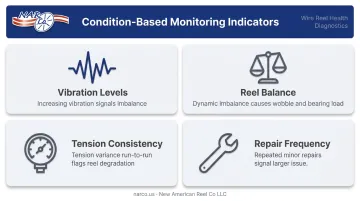
For wire reels, the key monitoring points are:
- Vibration levels during winding or pay-off — increasing vibration suggests developing imbalance or structural deformation
- Reel balance — dynamic imbalance occurs when a reel's mass distribution creates unequal forces during rotation, causing wobble and bearing load at operating speed
- Tension consistency — tracking whether wire tension varies run-to-run on the same reel
- Frequency of minor issues — a reel that requires repeated small repairs is signaling a larger problem
Dynamic imbalance is particularly relevant for high-speed winding applications. Per ISO 21940-11:2016, the current standard for rigid rotor balancing, imbalance creates forces that load bearings, increase friction, reduce efficiency, and shorten component life.
Periodic balancing checks on production reels — not just after reconditioning — are a practical condition-monitoring step for any high-speed operation.
Major Reconditioning / Overhaul
When damage is beyond routine correction, full reconditioning restores a reel to near-original specification. This is the maintenance tier that determines whether a reel stays in service or gets scrapped.
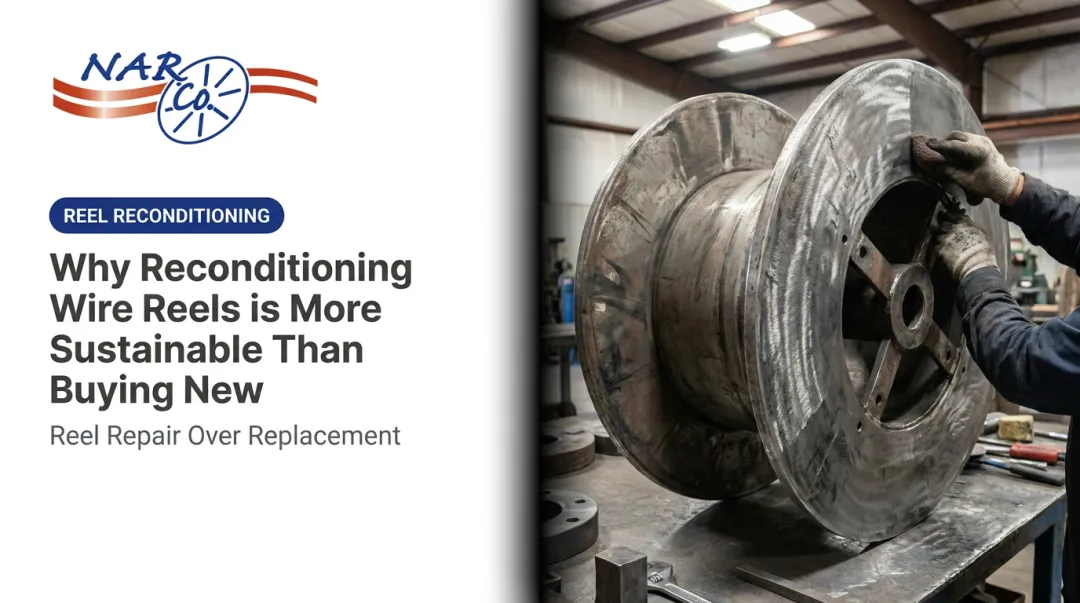
Narco's reconditioning process covers:
- Flange straightening and press work
- Rim repairs for damaged edges
- Weld repair and machining for structural damage (custom service)
- Repairs or replacement of drive pin holes and arbor tubes
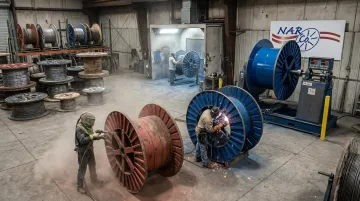
- Blasting and repainting for full surface protection
- Dynamic balancing to restore smooth rotation
- Stenciling to restore identification markings
Reconditioning is warranted when reels show significant structural damage, have accumulated multiple compounding issues, or have been in heavy service for several years. New American Reel Co. (Narco), operating since 1999, specializes in exactly this scope of work — handling steel wire reels and bobbins from 3" to 96" in diameter across the full reconditioning workflow.
How to Check If Your Wire Reel Needs Maintenance
Use this as a practical checklist for production teams and reel managers. Early detection is cheaper than late-stage repair.
Performance and Output Changes
Production-level signals often appear before physical damage is visible:
- Wire not spooling evenly or building up unevenly on the reel
- Inconsistent tension during pay-off that doesn't track back to the wire itself
- Increased wire breaks or tangles that seem position-dependent
- Changes in line speed or take-up performance on a previously stable reel
If these issues track to a specific reel rather than a wire batch or machine setting, the reel is the first place to inspect. Physical inspection often confirms what performance data already suggested.
Visible Wear, Structural Damage, or Corrosion
Cosmetic issues — addressable with routine maintenance:
- Surface paint fading or minor scratching
- Light surface rust with no pitting
- Mild coating or residue buildup
Structural concerns — require professional repair:
- Bent, cracked, or dented flanges (especially near welds or rim edges)
- Deformed arbor tube or worn arbor hole affecting shaft fit
- Loose, stripped, or missing fasteners
- Corrosion with visible pitting, particularly around welds and joints
- Paint failure exposing bare steel in multiple areas
Steel corrosion in severe industrial or marine atmospheres can exceed 200 micrometers per year — enough to turn a surface coating issue into a structural failure within a single season in humid or chemical-exposure environments.
Abnormal Vibration or Operational Irregularities
These signs should be escalated without delay:
- Vibration or wobble during rotation that wasn't present before
- Difficulty seating the reel on the machine shaft (arbor fit issues)
- Uneven rotation or rocking under load
- Unusual noise during winding that tracks to the reel, not the wire or machine
Running an out-of-balance reel under load accelerates bearing wear, causes uneven wire tension, and creates a safety hazard on the production floor. If vibration is observed, pull the reel from service immediately and have it professionally inspected.
Wire Reel Maintenance Schedule
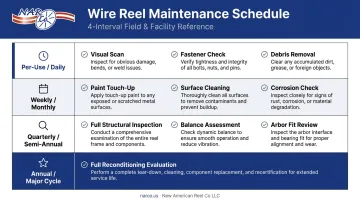
No universal interval standard exists for industrial steel wire reels. The schedule below uses OSHA rotating-equipment guidance, manufacturer recommendations, and storage exposure benchmarks as its framework. Adjust based on your specific usage intensity, reel load class, and environment.
| Interval | Tasks |
|---|---|
| Per-use / Daily | Visual scan for obvious damage; confirm fastener integrity; remove debris and coating buildup |
| Weekly / Monthly | Paint touch-up on exposed metal; surface cleaning; check for early-stage corrosion, especially near welds |
| Quarterly / Semi-Annual | Full structural inspection; check for flange deformation; assess rotation and balance; review arbor fit |
| Annual / Major Cycle | Full reconditioning evaluation — determine if welding, machining, balancing, or full overhaul is needed |
Notes on adjusting frequency:
- High-use / continuous production reels should move to the more frequent end of each interval — monthly structural checks rather than quarterly, and reconditioning evaluation at each major production campaign
- Storage or low-cycle reels can follow lighter schedules, but Southwire's handling guidelines recommend inspection after any storage period exceeding 3 months, covering flanges, bolts, and protective packaging
- Harsh environments — wet, chemical, outdoor, or high-humidity storage — require more frequent corrosion and coating checks; shift to monthly checks rather than quarterly when reels are stored or operated outdoors or near chemical exposure
- High-speed winding applications should include dynamic balance checks as part of quarterly inspections, not just post-reconditioning
Conclusion
Wire reel maintenance is an asset management discipline, not a housekeeping task. The reels running in your facility represent capital investment, and their condition directly affects output quality, line uptime, and safety.
A structured approach — routine checks, condition monitoring, and periodic professional reconditioning — keeps maintenance costs manageable while protecting reel service life and production reliability.
Waiting for a failure is the most expensive path forward. Repair costs, downtime exposure, and the compounding damage a degraded reel inflicts on downstream equipment and wire quality all add up fast.
If your facility has reels that need assessment or reconditioning, Narco has been handling full-cycle steel reel work since 1999 — structural repair, machining, dynamic balancing, and surface protection across sizes from 3" to 96". Reach out at 419-258-2900 or mark@narco.us to discuss what your reels need.
Frequently Asked Questions
How much does it cost to respool or recondition a reel?
Costs vary based on reel size, damage extent, and whether custom work — arbor replacement, machining, or welding — is needed on top of standard blasting, painting, and balancing. A direct assessment from a reconditioning specialist like Narco is the most reliable way to get an accurate estimate.
Do industrial wire reels come with any service or warranty coverage?
Warranty and service terms vary by reel manufacturer and supplier. Most coverage applies to manufacturing defects rather than operational wear or impact damage. Contact your reel supplier or a reconditioning specialist like Narco to clarify what repair and service terms apply to your specific equipment.
What are the most common types of damage to steel wire reels?
The most frequent issues are flange denting or cracking from forklift and handling impacts, surface corrosion from moisture or wire coating exposure (particularly around welds and joints), and arbor wear from repeated load cycles. Flange deformation and rim damage are the most common triggers for professional reconditioning.
How do I know if a wire reel needs reconditioning versus full replacement?
Localized damage — a cracked flange, worn arbor, or rim deformation — with an intact core frame generally favors reconditioning over replacement. Widespread corrosion, severe structural failure, or damage that can't be restored to dimensional and balance specs typically warrants fabricating a new reel.
How does dynamic balancing affect wire reel performance?
An out-of-balance reel vibrates during high-speed winding, causing uneven wire tension, accelerated bearing wear, and safety risks. Dynamic balancing corrects mass distribution so the reel runs smoothly at operating speed — it's a standard step in professional reconditioning and especially critical for high-speed applications.
How often should industrial wire reels be professionally inspected?
Reels in regular production use should receive a full structural inspection at least annually. High-cycle or high-load applications warrant more frequent assessment — quarterly structural checks are a reasonable baseline. After any significant impact event (forklift contact, dropped load), inspect the reel before returning it to service regardless of the scheduled interval.