The costs of neglect add up fast: bent flanges from forklift contact, corrosion from outdoor storage, balance problems that cause wobble during winding, and unplanned downtime when a damaged reel fails mid-production. According to NIST's manufacturing maintenance research, roughly one-third of all maintenance costs in manufacturing are unnecessary or improperly carried out — a statistic that reflects what happens when reactive repair replaces planned upkeep.
This guide covers why maintenance matters for steel reel fleets, the four main types of maintenance and when to use each, the warning signs that tell you a reel needs attention, and a practical inspection schedule you can apply immediately.
Key Takeaways
- Steel reels are reusable assets — consistent maintenance lowers total cost per cycle
- Maintenance falls into four types: routine, corrective, predictive, and major overhaul
- Key warning signs: flange deformation, active corrosion, balance problems, and bore fit issues
- A structured daily, monthly, and annual schedule prevents costly reactive repairs
- Reconditioning — flange straightening, rim repair, repainting, dynamic balancing — restores reels to spec without full replacement
Why Maintaining Your Steel Wire Reels Matters
Steel wire reels are engineered to cycle repeatedly through production winding, loaded shipping, and return handling. Each cycle puts mechanical stress on flanges, rims, arbor bores, and coatings.
Without regular maintenance, that stress compounds. A small rim ding becomes a structural deformation. Surface rust becomes pitting. A flange that's slightly out of true causes uneven cable laydown that damages the product on the reel.
The Performance Connection
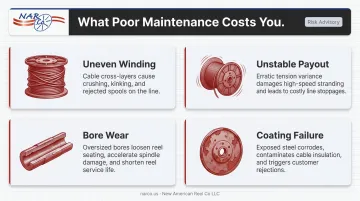
Poorly maintained reels create downstream problems that go beyond the reel itself:
- Uneven winding caused by warped flanges leads to cable crossovers and tension inconsistencies
- Unstable payout from a reel with balance issues introduces vibration into high-speed wire handling equipment
- Bore wear or distortion makes reels difficult to seat correctly on take-up or payoff arbors
- Coating failure accelerates corrosion, which weakens structural welds over time
Southwire's wire and cable handling guidelines specifically identify that forklift contact with cable or protective wrap causes damage — a reminder that reel handling and product quality are directly linked.
Proactive vs. Reactive Cost
The financial argument for proactive maintenance is straightforward. Flange straightening, rim repair, and recoating cost a fraction of fabricating a new reel. But when minor damage is ignored, it escalates — a flange that needed press work becomes a flange that needs full replacement. A surface rust spot that needed recoating becomes pitting that compromises structural integrity near weld points.
Narco has handled reel repair and refurbishment since 1999, covering exactly these scenarios: flanges, rims, arbor tubes, drive pin holes, coatings, and dynamic balancing. Each service is designed to restore a structurally sound reel to operational spec at a fraction of replacement cost.
Types of Maintenance for Steel Wire Reels
Steel reel maintenance isn't a single activity. It spans a range of approaches, each with different cost implications, timing, and triggers. Understanding which type applies to your fleet — and when — is what separates a managed reel program from a reactive one.
Routine / Preventive Maintenance
Routine maintenance covers the checks that happen before each use or shipping cycle:
- Visual scan for new dents, rim damage, or coating wear
- Confirming flanges are straight and not visibly deformed
- Checking arbor bore dimensions fit the mounting equipment correctly
- Inspecting rim integrity for dings or deformation from prior handling
This approach works well in controlled environments where reels are handled carefully and stored indoors. Its real value is catching minor problems — surface rust, small rim dings, early coating lift — before they become structural ones. A reel that gets a five-minute visual check before mounting is far less likely to fail mid-production than one that doesn't.
Corrective / Reactive Maintenance
Corrective maintenance is unplanned repair triggered by visible failure: a bent flange from forklift impact, a cracked rim, severe corrosion, or wobble that appears during winding. By the time a failure is visible, the repair scope is usually larger than it would have been with earlier intervention.
When a reel fails during production, the consequences extend beyond the repair itself: scheduling disruptions, potential cable damage, and equipment downtime all compound the cost. Relying solely on corrective maintenance is almost always the more expensive long-term approach.
Predictive / Condition-Based Maintenance
Condition-based maintenance shifts the trigger from time or crisis to observable data. For steel reels, this means:
- Scheduling inspections at defined cycle count thresholds, not just when problems appear
- Flagging recurring deformation patterns tied to specific handling routes or storage sites
- Running balance checks based on plant rotation speed requirements before wobble develops
- Gauging coating replacement intervals by storage environment (indoor, outdoor, coastal, dry)
This approach is particularly relevant for high-speed winding applications, where dynamic balance issues create vibration that affects both equipment and product quality. Narco's dynamic balancing service restores balance to reels used in high-speed wire handling once they've accumulated wear through normal use.
Major / Overhaul Maintenance
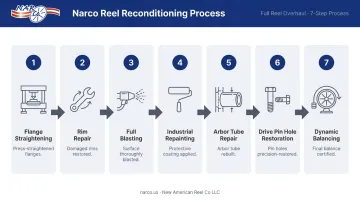
A full overhaul is appropriate when a reel's structure is sound but its surfaces and geometry have degraded from extended use. Narco's reconditioning process covers:
- Flange straightening and press work to restore geometry
- Rim repair for structural damage from handling impacts
- Full blasting to remove rust and degraded coatings
- Industrial-grade repainting for corrosion protection
- Arbor tube repair or replacement when the central bore structure is damaged
- Drive pin hole restoration to restore proper equipment engagement
- Dynamic balancing to eliminate vibration at operating speeds
When the core structure — barrel, main welds, and frame — is intact without cracks or severe deformation, reconditioning is more cost-effective than buying a new reel. Narco handles reels from 3 inches to 96 inches (75mm to 2400mm), and their work references NEMA WC26, DIN 46395, and DIN 46397 standards.
How to Check If Your Steel Reel Needs Maintenance
The goal of any inspection is to catch problems during routine handling — not during production or in transit when a failure causes real damage. Here's what to look for.
Physical and Structural Indicators
Structural warning signs:
- Bent or warped flanges that are visibly out of plane
- Rim deformation from forklift contact or stacking pressure
- Cracks or stress fractures near weld points — particularly where flanges meet the barrel
- Loose or missing drive pin inserts that affect equipment engagement
- Arbor bore distortion that prevents correct seating on the arbor
Coating and corrosion checks:
- Rust streaking or paint lifting, especially near rim and flange edges
- Exposed bare metal in areas where coating has worn through
- Pitting that indicates corrosion has moved past the surface into the steel
Surface rust caught early is a recoating job. Pitting that's been left to develop can compromise weld integrity near structural joints.
Performance and Operational Indicators
Not all damage is visible — some only surfaces once the reel is running:
- Wobble or vibration during winding or payout, which signals lost dynamic balance
- Uneven cable laydown, suggesting a flange isn't holding true under load
- Difficulty seating the reel on take-up or payoff equipment, pointing to bore wear or distortion
- Flanges that flex under load rather than holding rigid
Post-impact inspections matter too. After any drop, forklift contact, or rough transit event, pull the reel for inspection before returning it to production. Impact damage often shows up as bore distortion or balance problems that aren't visible on the surface.
Documentation and History Indicators
Reel history is a valid trigger for inspection even when a reel looks fine. Schedule inspection when:
- A reel has completed a defined number of production or shipping cycles
- It has returned from a long or rough shipping route
- It has been in outdoor storage for more than three months
Southwire's storage guidelines recommend the three-month threshold for outdoor storage — rotating reels and checking flanges, bolts, end caps, and protective wraps for condition.
Steel Reel Maintenance Schedule
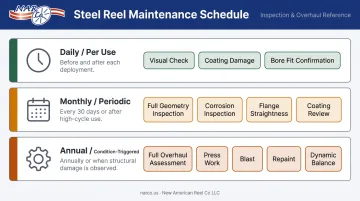
Maintenance frequency depends on three variables: how intensively the reel is used (high-cycle production vs. lower-cycle shipping), where it's stored (indoor vs. outdoor), and what handling environment it moves through (controlled plant floor vs. field shipping yards). Use the table below as a baseline framework.
| Frequency | Scope | Key Triggers |
|---|---|---|
| Daily / per use | Visual check for new dents, coating damage, loose components; confirm bore fit before mounting | Before every production mount or outbound ship |
| Monthly / periodic | Full surface and geometry inspection; corrosion assessment; flange straightness check; coating integrity review | After high-cycle production periods or any impact event |
| Annual / condition-triggered | Full overhaul assessment — flange press work, rim repair, blast and repaint, dynamic balance check | Based on cycle count threshold or visible wear accumulation |
Environmental Adjustments
Not every fleet operates under the same conditions. Adjust the baseline schedule when:
- Outdoor or coastal storage — increase corrosion checks to every 4–6 weeks; inspect for paint lift and rim rust more frequently
- Chemical or high-humidity environments — check coating integrity monthly at minimum; pitting accelerates faster in these conditions
- High-speed winding applications — schedule dynamic balance verification more frequently than for reels used only in shipping; vibration from an out-of-balance reel causes cumulative damage to both the equipment and the product
- Long-haul or rough transit routes — inspect bore fit and flange geometry on every return, not just periodically
Match inspection frequency to actual exposure. A reel with low cycle counts in a controlled indoor environment needs far less attention than one rotating through outdoor staging yards — and over-inspecting low-risk reels wastes time better spent on the ones that actually accumulate wear.
Conclusion
Steel wire reels are long-life assets when they're treated like ones. A structured maintenance approach — routine visual checks, condition-based inspections, and periodic reconditioning — consistently delivers lower cost per cycle than running reels until they fail.
Two decisions drive the most value: matching inspection frequency to actual usage conditions, and choosing reconditioning over replacement when the reel's core structure is intact. Neither takes as much effort as most fleet managers expect, and both pay back quickly in avoided scrap costs and reduced downtime.
Narco's team works with steel reel fleet managers to assess reconditioning and repair options for their specific reels. Services include:
- Flange straightening and dynamic balancing
- Arbor tube repair and rim work
- Full blasting and repainting
- Fabrication of new reels
Reach out at 419-258-2900 or mark@narco.us to discuss your fleet's needs.
Frequently Asked Questions
How should steel cable reels be stored?
Store reels upright with flanges perpendicular to the ground, on a smooth, flat, well-drained hard surface — concrete works best. If stored outdoors, tarp them and elevate them off the ground to prevent corrosion from ground moisture. Keep them away from chemicals, standing water, and heat sources.
How long do steel wire reels typically last?
Lifespan varies, but steel reels are built for repeated use across many production and shipping cycles. How long they last depends on handling conditions, storage environment, and whether they receive periodic reconditioning — recoating and flange repair in particular — before damage accumulates.
How often should steel wire reels be inspected?
A visual check should happen before every use or outbound shipping cycle. A more thorough structural inspection is warranted monthly or after any impact event. A full reconditioning assessment should occur at least annually, or when a defined cycle count threshold is reached.
What are the signs that a steel reel needs repair rather than continued use?
Pull a reel from service if you see bent or warped flanges, visible rim damage, active rust or coating failure, wobble during rotation, or a bore that no longer fits the mounting equipment. Any one of these warrants a full inspection before the reel returns to use.
Can a damaged steel wire reel be reconditioned instead of replaced?
Yes — when the core structure is intact, reconditioning is the right call. Flange straightening, rim repair, blasting, repainting, and dynamic balancing restore a reel to operational specification at a fraction of replacement cost. The qualifier: the barrel and primary welds must be structurally sound.
What causes steel wire reels to fail prematurely?
The most common causes are improper forklift handling (side-loading or single-flange contact), outdoor storage without corrosion protection, skipping routine inspections so minor damage accumulates, and using reels in applications that exceed their rated capacity. Addressing even one of these factors consistently extends reel service life.