Both industrial and commercial cable reels store and manage wire or cable, but they're built for fundamentally different demands. Commercial reels prioritize portability and convenience for light-duty indoor use. Industrial reels are engineered for high loads, harsh environments, and repeated mechanical stress across many operational cycles.
This guide covers the definitions, types, structural differences, and practical selection criteria for both — with specific focus on wire manufacturing, bulk cable shipping, and production environments where reel selection directly affects cable integrity and operational costs.
Key Takeaways
- Commercial reels are lightweight, non-metallic, and suited for clean indoor environments with infrequent use
- Industrial reels are heavy-duty steel (or engineered plastic), rated for high loads, harsh conditions, and repeated use cycles
- Key differences span construction material, load capacity, environmental ratings, and lifecycle cost
- Industrial steel reels can be reconditioned, repaired, and dynamically balanced — extending service life significantly
- Reel selection depends on cable OD, total weight, bend radius, operating environment, and compliance requirements
Industrial vs. Commercial Cable Reels: Quick Comparison
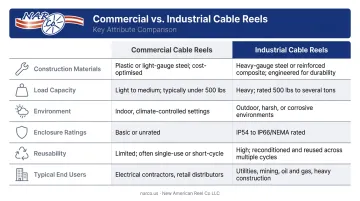
| Attribute | Commercial Cable Reels | Industrial Cable Reels |
|---|---|---|
| Construction | PVC, ABS plastic, thermoplastic; some 304L stainless | Steel (powder-coated/galvanized), engineered plastics, wood |
| Load Capacity | Light-duty (15–20 A typical); not rated by cable weight | Up to 100,000 lb per NEMA WC 26 standards |
| Environment | Indoor, dry, controlled | Outdoor, wet, chemical, hazardous, extreme temp |
| Available Types | Manual, retractable, cord storage, open, lighted | Flanged steel drums, motor-driven, hazardous-location, live connection, paralleling |
| Enclosure Ratings | UL Type 1 (indoor only); minimal protection | NEMA Type 3/4/7/9/12; IP54–IP67+ |
| Typical End Users | Offices, retail, event spaces, commercial facilities | Wire/cable manufacturers, construction, mining, refineries |
| Reusability | Typically replaced, not repaired | Designed for multi-cycle reuse; reconditionable |
A Note on Terminology
The table above uses "reel" throughout, but supplier catalogs and spec documents — including NEMA WC 26, which treats "reel" and "spool" as equivalent packaging terms — aren't always consistent. Some practical distinctions are worth knowing:
- Spool often refers to smaller units or exhausted cores after cable has been paid out
- Drum typically refers to the largest industrial units, or specifically to the barrel/hub dimension within a reel assembly
- Reel is the broadest general term for full wire or cable packaging assemblies
Knowing which term a supplier uses — and what they mean by it — helps avoid spec mismatches when sourcing or ordering replacements.
What Are Commercial Cable Reels?
Commercial cable reels are designed for light-duty power cord management in clean, controlled, indoor environments — offices, retail stores, classrooms, hospitality venues, and event spaces. They prioritize portability and ease of use over structural durability.
Construction and Materials
Most commercial reels use non-metallic materials: thermoplastic housings, ABS or PVC frames, lightweight open or enclosed designs for dry, low-abrasion environments. For hygiene-sensitive environments, 304L stainless steel commercial reels exist — Hubbell's stainless line, for example, is rated for food processing, pharmaceutical, and water treatment facilities under UL 355 and CSA C22.2 No. 21.
Electrical ratings are product-specific, not universal. Documented examples include:
- 25 ft, #14/3 SJO, 15 A, 125 VAC, UL Type 1 (indoor, GFCI-equipped)
- 45 ft, #12/3 SJO, 20 A, 125 VAC, UL Type 1 (heavier commercial/facility use)
Common Commercial Reel Types
- Manual/hand-winding reels — basic, portable, light-duty cord storage
- Retractable cord reels — spring-loaded auto-retraction for cord management in workshops or garages
- Cord storage reels — storage only; must be fully unwound before energizing to prevent heat buildup
- Open cord reels — accessible design for easy maintenance in dry environments
- Lighted cord reels — built-in task lighting for portable work applications
Use Cases and Limitations
Commercial reels are well-suited for a narrow range of applications:
- Temporary power at trade shows and event spaces
- Cord organization in retail back-of-house areas
- Overhead cord drops in commercial service garages
- General extension cord storage in low-traffic settings
They are not rated for high-amperage industrial loads, continuous-duty operation, or environments with moisture, vibration, chemicals, or temperature extremes. Deploying them outside these parameters creates real safety risks.
OSHA requires extension cords to be 3-wire grounded types, but commercial cord reels carry no ratings for the load profiles common in industrial settings — making compliance a concern the moment they leave their intended context.
What Are Industrial Cable Reels?
Industrial cable reels are heavy-duty assemblies engineered for wire manufacturing lines, bulk cable shipping, construction sites, mining, refineries, and automated production environments. They're built to handle significant cable weight, repeated mechanical stress, and exposure to harsh operating conditions over many use cycles.
Construction and Key Components
The standard for North American industrial reel sizing is NEMA WC 26 (the Binational Wire and Cable Packaging Standard), which defines maximum strength capacity, minimum drum diameter ratios, and key dimensions including flange diameter, traverse, and drum diameter.
Primary materials:
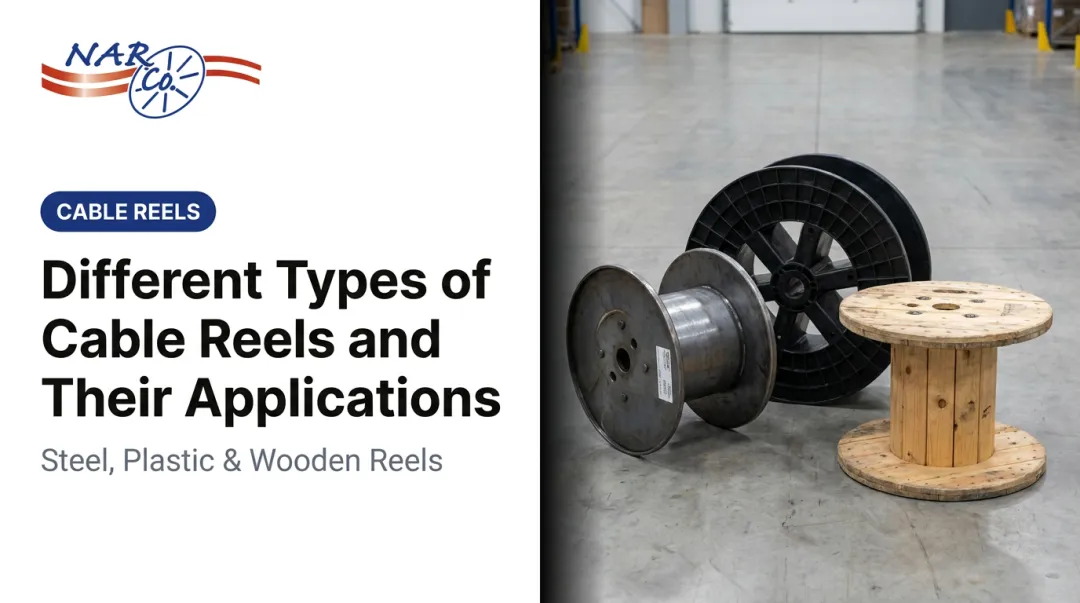
- Steel — powder-coated or galvanized; the go-to for wire manufacturing and shipping thanks to superior load bearing and long-term reusability
- Engineered plastics — suited for pharmaceutical, food processing, and data cable applications where hygiene or weight reduction matters
- Wood — a lower-cost choice for short-term or lighter-duty use, though prone to warping over time
Key structural elements include flanges, a barrel/drum, and an arbor hole for axle-based cable payout.
Industrial Reel Types
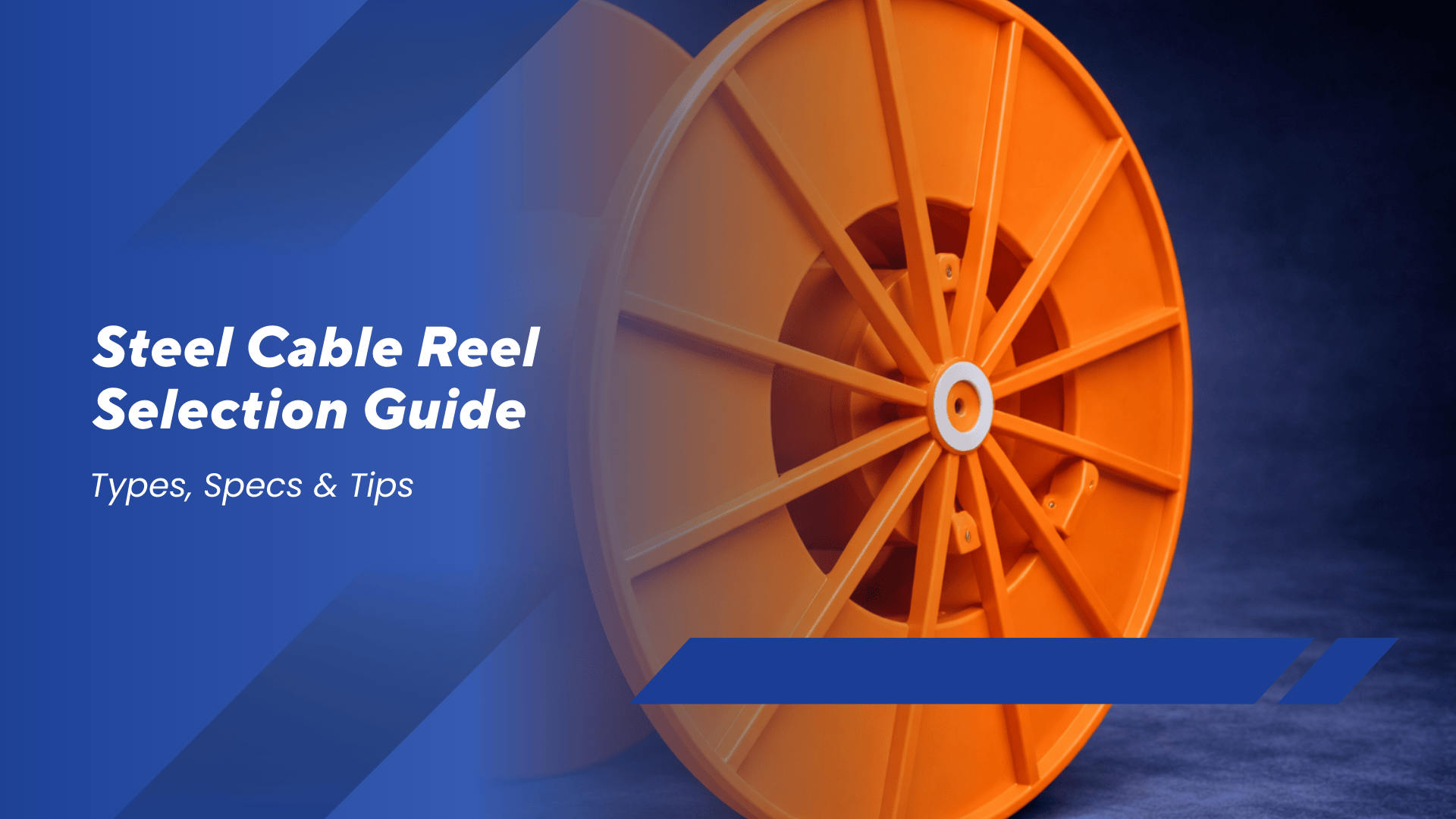
- Standard flanged steel drums: the workhorse of wire manufacturing and bulk cable shipping, available in NEMA WC 26-compliant RM and RMT corrugated (fluted) types
- Motor-driven reels: electric, hydraulic, or pneumatic retraction for large cables and continuous-duty applications where manual operation isn't practical
- Hazardous-location/explosion-proof reels: UL-listed for Class I/II/III Division 1 environments (e.g., Conductix-Wampfler's 1500 Series covers Groups C/D, E/F/G, NEMA 4/IP56, and NEMA 9 — compliance is product-specific, not universal)
- Stainless steel industrial reels: for food processing, pharmaceutical, and washdown environments needing corrosion resistance and sanitation compliance
- Live connection reels: use slip ring assemblies for continuous power transfer during cable movement, common in cranes, AGVs, and automated conveyor systems
- Paralleling reels: multiple cable compartments on a single reel for efficient multi-cable pulls during electrical installation
Load Capacity: The Numbers Matter
NEMA WC 26 gives concrete capacity benchmarks:
| Reel Type | Maximum Strength Capacity |
|---|---|
| Plywood reels/spools | 100–1,000 lb |
| Class 1 steel fluted returnable reels | 1,000–10,000 lb |
| Gas-tight returnable steel shipping reels | 10,000–100,000 lb |
Beyond raw weight, reel sizing must account for minimum bend radius. NEMA WC 26 Table 3-1 specifies minimum drum diameters:
- 12x cable diameter for non-shielded power cable
- 18x cable diameter for shielded power cable
- 24x cable diameter for control cable
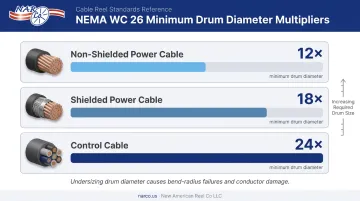
A reel that can carry the weight may still be unsuitable if the barrel diameter is too small for the cable type — undersizing creates bend-radius failures that shorten cable lifespan.
These specs directly shape which reel fits a given application — something worth keeping in mind as you evaluate options.
Narco's Industrial Reel Capabilities
Narco (New American Reel Co., based in Antwerp, Ohio) has manufactured and reconditioned industrial steel reels since 1999, covering sizes from 3" to 96" (75mm to 2400mm). Their product range includes:
- Fully machined reels to DIN 46397
- Semi-machined reels with double-wall curled flanges
- Metal flanged (buncher) reels to DIN 46395
- Enhanced metal flange reels for heavy cable and rope
- Steel drums for extrusion and drum-twisting processes
- NEMA WC 26-compliant corrugated shipping reels
Custom configurations, including collapsible bobbins, are available to customer specifications with drawings provided at the quoting stage.
Key Differences Between Industrial and Commercial Cable Reels
Material and Build Quality
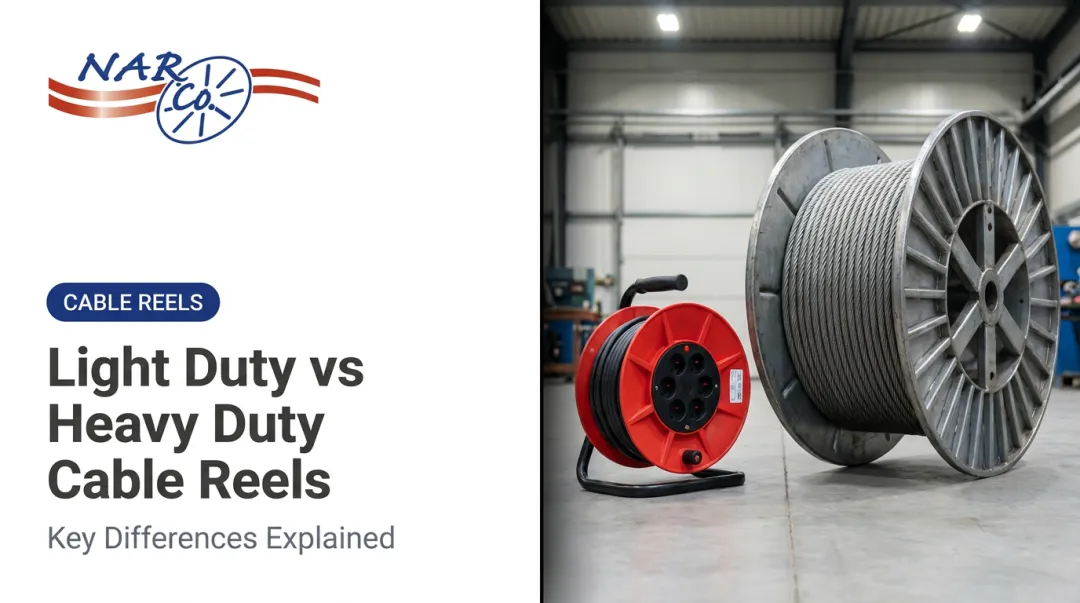
Steel industrial reels withstand repeated mechanical loading, outdoor conditions, and transit stress across many cycles. Commercial plastic reels are optimized for low-load indoor use and are not designed to survive the same conditions.
For wire manufacturers reusing reels across multiple shipping cycles, material choice directly affects product protection. A commercial reel deforming under transit load doesn't just fail — it can damage the cable it's carrying.
Environmental Durability and Ratings
Commercial reels generally carry UL Type 1 ratings (indoor, dry) or no formal enclosure rating. Industrial reels are specified using NEMA enclosure types and IEC IP ratings matched to their operating environment:
| Rating | Protection | Typical Use |
|---|---|---|
| NEMA Type 1 | Falling dirt, indoor only | Non-washdown indoor facilities |
| NEMA Type 4 | Hose-directed water, splashing | Wet locations, washdown |
| NEMA Type 7/9 | Hazardous locations (gas/dust) | Refineries, processing plants |
| IP65 | Dust-tight + water jets | Outdoor industrial |
| IP67 | Dust-tight + temporary immersion | Submersion risk environments |
Retraction and Operational Mechanisms
Commercial reels use manual cranks or torsion spring retraction — adequate for lightweight cords in stable settings. Industrial reels may use:
- Electric motor drives for heavy cables and automated systems
- Hydraulic or pneumatic retraction for high-tension or explosion-risk environments
- Spring-driven mechanisms rated for heavier cable weights than commercial equivalents
Lifecycle Cost and Reusability
NEMA WC 26 formally distinguishes returnable, reusable, and nonreturnable reel types — and this distinction has real cost implications. Steel industrial reels are designed for multi-cycle reuse and can be reconditioned rather than replaced.
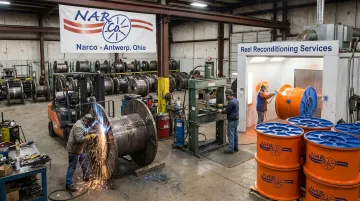
Narco's reconditioning process addresses the most common failure modes in industrial steel reels:
- Flange straightening and press work
- Damaged rim repair
- Drive pin hole repair or replacement
- Arbor tube repair or replacement
- Dynamic balancing
- Blasting, painting, and stenciling
Commercial reels are typically replaced rather than repaired. For wire and cable manufacturers running high reel volumes, a steel reel reconditioned five or more times costs a fraction of replacing disposable reels every cycle — a gap that widens quickly at scale.
Choosing the Right Cable Reel: Situational Guidance
When to Choose Commercial
Use commercial cable reels for:
- Indoor cord management in dry, controlled environments
- Light-duty, infrequent use (offices, retail, event spaces)
- Portable task lighting or basic cord storage
- Applications with no compliance requirements beyond UL 355
When to Choose Industrial
Industrial reels are the right choice when:
- Cable weight, OD, or bend radius drives reel sizing
- The environment involves moisture, chemicals, dust, temperature extremes, or explosion risk
- The reel needs NEMA or IP-rated environmental protection
- Operations are continuous-duty or high-frequency
- The reel will be reused across multiple shipping or production cycles
- Compliance with NEMA, UL hazardous-location, or ATEX standards is required
Practical Decision Checklist
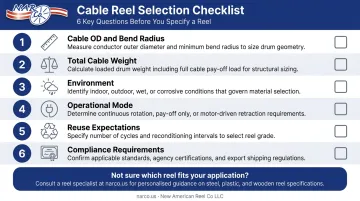
Before selecting a reel, answer these questions:
- Cable OD and bend radius — What is the minimum drum diameter required? (Use NEMA's 12x/18x/24x multipliers as a starting point)
- Total cable weight — Does the reel's maximum strength capacity exceed the loaded cable weight?
- Environment — Indoor/dry vs. outdoor/wet/chemical/hazardous?
- Operational mode — Storage only, or live connection under load?
- Reuse expectations — Single use or multiple cycles across manufacturing or shipping?
- Compliance requirements — NEMA WC 26, UL, ATEX, or other standards applicable?
A Common Scenario in Wire Manufacturing
A wire manufacturer shipping medium-weight cable on wooden reels may initially choose them for cost reasons. Over time, a predictable pattern emerges: flanges warp under load during transit, cable arrives at the customer with kinks from reel distortion, and replacement frequency climbs as wooden reels don't survive enough return cycles to justify the logistics.
Switching to steel industrial reels — particularly NEMA WC 26-compliant corrugated shipping reels — addresses all three problems. The reels survive transit intact, cable arrives undamaged, and units can be reconditioned and returned for reuse rather than discarded after each cycle.
That same logic applies across reel selection decisions generally — the right specification upfront avoids downstream costs. For wire manufacturers and cable companies evaluating reel needs — whether new fabrication, reconditioning of existing reels, or custom design — Narco can match the right reel configuration to the specific wire product and operational requirement. Reach us at 419-258-2900 or mark@narco.us.
Conclusion
Neither industrial nor commercial cable reels are universally "better" — the right choice depends entirely on the operating environment, cable specifications, load requirements, and reuse expectations. Wire manufacturers and cable shippers will almost always require industrial-grade steel reels. Commercial facilities managing power cords in controlled settings are well served by lighter options.
That selection decision carries real operational weight. The wrong reel type leads to cable damage in transit, unplanned downtime from structural failure, and higher long-term costs when replacement outpaces reconditioning. For industrial reels especially, repair and reconditioning — rather than outright replacement — is often the more cost-effective path once a reel has completed its first lifecycle. Companies like Narco specialize in exactly this: extending the working life of steel reels through reconditioning, welding, and custom fabrication, so the per-use cost drops with each additional cycle.
Frequently Asked Questions
What are those giant spools called?
Large cable and wire spools are commonly called cable reels, cable drums, or cable spools — the terms are used interchangeably. "Drum" typically refers to the largest industrial units used in bulk shipping, while "spool" often describes smaller units or empty cores after cable has been paid out.
What is the difference between domestic cable and industrial cable?
Domestic (commercial) cable is designed for stable indoor environments with predictable temperatures and minimal mechanical stress. Industrial cable is built for harsh conditions — moisture, vibration, temperature extremes, and chemical exposure — and requires correspondingly more robust reel specifications for safe storage and transport.
Can industrial cable reels be repaired or reconditioned?
Yes. Steel reels can be reconditioned through flange straightening, rim repair, dynamic balancing, arbor tube replacement, and welding — a cost-effective alternative to full replacement. Narco has handled this work since 1999, servicing reels from 3" to 96" in diameter.
What is the difference between a cable reel and a cable spool?
The terms are often interchangeable, but in industrial contexts "reel" or "drum" typically refers to the full assembly used for cable storage, transport, and payout. "Spool" may refer to smaller units or the empty core remaining after cable has been fully deployed.
What materials are industrial cable reels typically made from?
Steel dominates industrial applications for its strength and reusability. Wood is a lower-cost option for lighter-duty use but prone to warping. Engineered plastics suit specialty environments — pharmaceutical, food processing, or data cable handling — where hygiene or weight matter.
How do I choose the right size cable reel for a wire manufacturing operation?
Start with four inputs: cable outer diameter, total weight, minimum bend radius, and required cord length. NEMA WC 26 publishes steel reel sizing standards based on these parameters. A reel specialist like Narco can match dimensions to your specific wire or cable product.