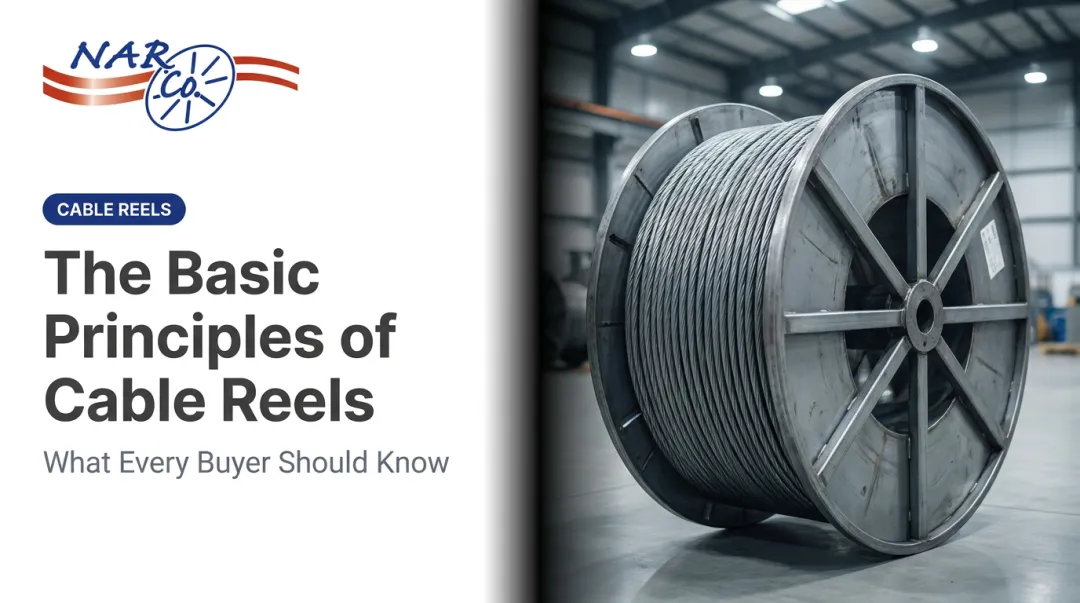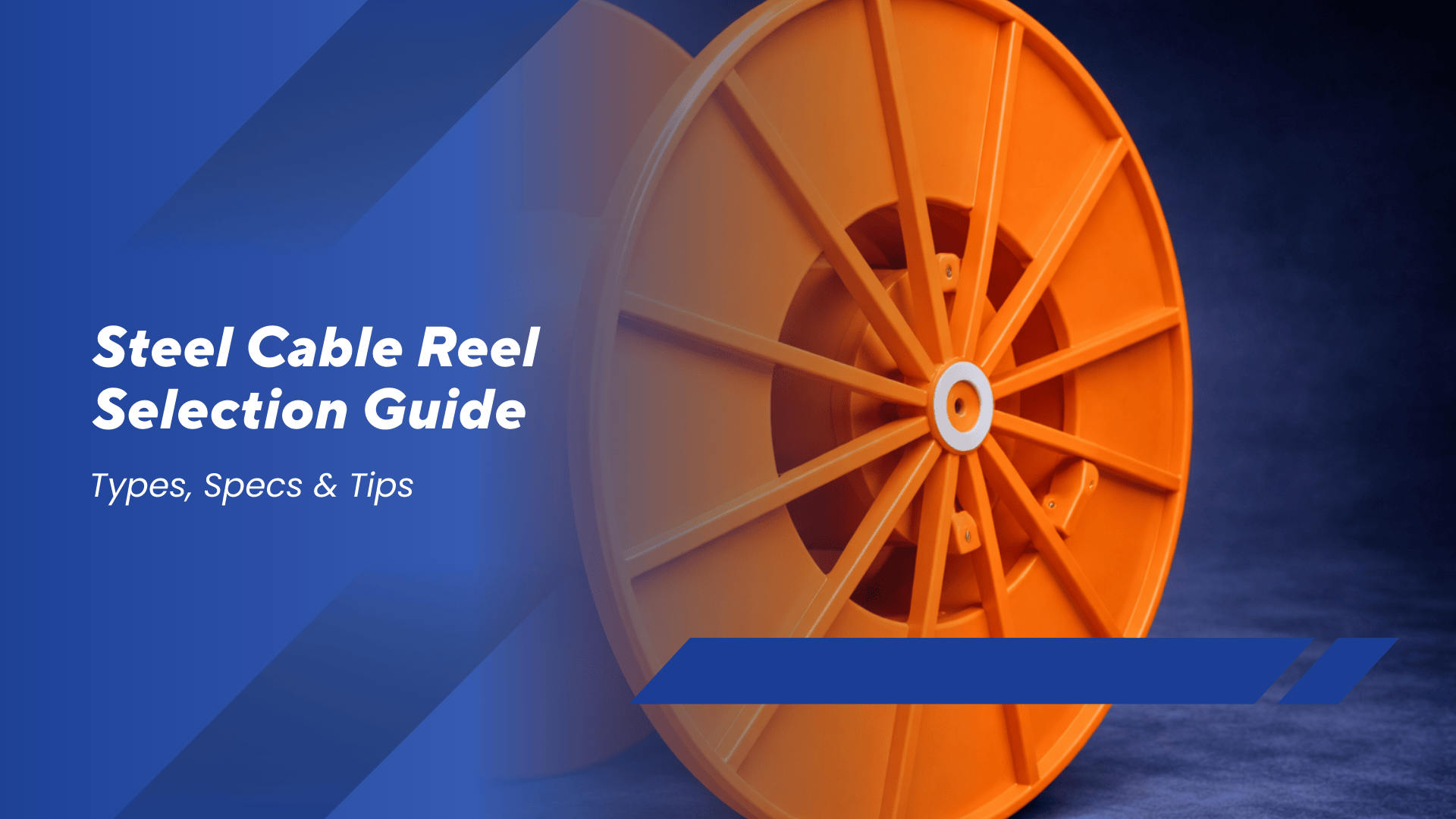
In wire manufacturing, electrical distribution, and industrial shipping, the reel is not just packaging. It protects the product, enables safe payout, and affects total cost across every trip it takes. Choose the wrong type and the consequences show up as damaged cable, delayed installations, or disposal headaches the end customer never expected.
This guide covers the three main cable reel types — wooden, steel, and plastic — what makes each one different, and how to match the right reel to the right application.
Key Takeaways
- Cable reels consist of a drum, two flanges, and an arbor hole — designed for controlled winding, transport, and payout of wire and cable
- Wooden reels are cost-effective for single-use or short-haul shipping of wire, cable, and rope
- Steel reels offer the highest durability and are the standard choice for high-volume, returnable fleet operations with reconditioning programs
- Plastic reels suit lighter data, telecom, and fiber optic cables where corrosion resistance and low weight matter more than load capacity
- The right choice depends on cable weight, reuse expectations, environmental conditions, and total cost of ownership
What Is a Cable Reel?
A cable reel is a cylindrical spool-like device built to hold, protect, and allow controlled unwinding of wire, cable, or rope. Every reel shares the same three core components, as described by Kris-Tech Wire:
- Drum (barrel) — the central cylinder that holds the wound cable
- Flanges — the side discs that guide and protect the cable during winding and transit
- Arbor hole — the lengthwise hole through the drum center, used to mount the reel on an axle or mandrel for payout
In practice, "cable reel," "cable spool," and "cable drum" are used interchangeably across the industry — this guide treats them as equivalent. Some manufacturers reserve "spool" for smaller units or depleted packaging, while "reel" and "drum" tend to describe larger, heavier-duty units.
Cable reels appear at every stage of the wire and cable supply chain, from initial winding at the manufacturing facility through internal staging, outbound shipping, and final payout at the installation site. The material, size, and design of the reel varies considerably depending on where it fits in that chain.
Why the Type of Cable Reel Matters
The reel type you choose directly affects cable integrity — and mismatches show up as physical damage, not just inefficiency.
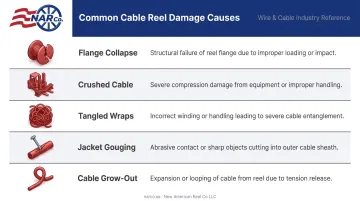
According to handling guidance from Prysmian and ScaleFibre Americas, common damage mechanisms include:
- Flange collapse or separation from lifting by the wrong point on the reel
- Crushed cable or distorted flanges from improper forklift use
- Tangled or displaced wraps when a drum is stored flat on its side
- Jacket gouging from protruding nails or steel strapping during payoff
- Cable grow-out and tangling when reels aren't held in proper payoff stands
Under-built reels fail under load. Over-engineered reels for lightweight applications waste freight budget and complicate handling. Matching reel construction to the cable's weight, flexibility, and payoff method is where the right choice actually starts.
Types of Cable Reels and Their Applications
Cable reels are not interchangeable. Material, construction, and load capacity each tell you something specific about where a reel belongs in your supply chain.
Wooden Cable Reels
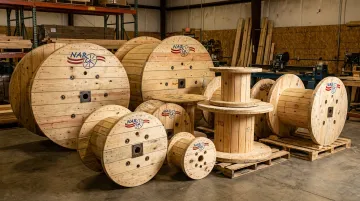
Wooden reels — including nailed wood and plywood variants — are constructed from timber or layered wood veneer. Nailed wood reels use dimensional lumber fastened together; plywood versions use bonded veneer layers. Both feature a round drum, two flanges, and a central arbor hole.
NEMA WC 26 recognizes both reusable wood reels and nonreturnable plywood reels in its wire and cable packaging standard — a reflection of how widely this format is used across North American distribution.
Best suited for:
- Single-use shipping of electrical cable, wire, and rope to job sites or end customers
- Internal product staging and cable storage within manufacturing facilities
- Applications where the reel will not return to the manufacturer after use
Key strengths:
- Lowest upfront cost of any common reel type
- Customizable to traverse length and flange diameter
- Compatible with standard reel-handling equipment
- Widely available and fast to source
Limitations:
- Wood warps when exposed to moisture and temperature variation, shortening operational life
- Nailed wood reels are generally not designed for repeated reuse
- Disposal at the customer facility creates waste management costs
- Strength varies by wood species, moisture content, and assembly method — NEMA specifically notes that published capacity values should be used as a guide, not absolutes
Narco manufactures nailed wooden reels to order using heat-treated softwoods — Southern Yellow Pine, Spruce, Pine, or Fir — in sizes from 20 to 60 inches in diameter, built to NEMA WC26 standards and customer dimensional specifications.
Steel Cable Reels
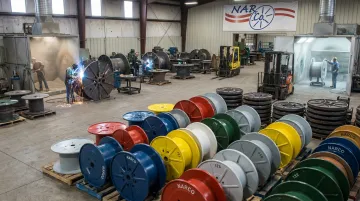
Steel cable reels are fabricated from welded or stamped steel. Their rigid construction handles repeated loading, payout, and handling cycles without losing structural integrity. Depending on the application, they may include staved drums for cable ventilation, reinforced arbor holes, and bolted or welded flanges.
High-speed manufacturing applications require dynamically balanced process reels. In wire drawing operations, even minor imbalance causes vibration, uneven winding, and premature equipment wear.
Best suited for:
- High-volume wire and cable manufacturing operations that reuse reels internally
- Shipping applications where reels make multiple round trips
- Heavy or large-diameter cable: power cable, steel wire rope, industrial conductors
- Process applications requiring dynamic balancing for high-speed winding equipment
Key strengths:
- Highest structural durability of any common reel type
- Supports full reconditioning — damaged reels can be repaired rather than scrapped
- Dynamic balancing available for high-speed winding and payout applications
- Resistant to arbor hole and flange deformation under sustained load
Limitations:
- Higher upfront cost than wooden reels
- Significantly heavier, which increases freight cost and requires appropriate handling equipment
- Not practical for single-use shipping to customers who cannot return them
Narco has specialized in steel wire reel reconditioning and repair since 1999, handling reel sizes from 3" to 96" (75mm to 2400mm). Standard services include:
- Flange straightening and press work
- Damaged rim repair, blasting, and painting
- Stenciling and dynamic balancing
- Arbor tube replacement and drive pin hole repair
- Arbor hole resizing, welding, fabricating, and machining to specification
Narco also manufactures new steel reels across several configurations:
- Fully machined reels to DIN 46397
- Semi-machined reels with double-wall curled flanges
- Metal flanged and enhanced metal flange reels
- Steel drums
- Corrugated shipping reels built to NEMA WC 26 standards
Plastic Cable Reels
Plastic cable reels are molded from materials such as ABS or polypropylene. They are lightweight, manufactured to tight dimensional tolerances, and available in a range of flange sizes suited to lighter wire and cable products.
Unlike wood or steel, plastic reels resist moisture, decay, and pest infestation without any coating or treatment. Some variants are manufactured from post-consumer recycled materials and are fully recyclable — a meaningful factor for operations with sustainability targets.
Best suited for:
- Data cable, telecom wire, fiber optic cable, and specialty conductors
- Environments with strict cleanliness requirements (medical-adjacent or food-adjacent facilities)
- Manufacturers seeking recyclable finished-product packaging
Key strengths:
- Lightweight and easy to handle without mechanical lifting equipment
- Inherently corrosion-resistant
- Available in stackable and collapsible designs for efficient storage
- Recyclable options support circular economy goals
Limitations:
- Load capacity is significantly lower than steel — not suitable for heavy industrial cable
- Cannot be repaired after structural damage; replacement is the only option
- Cost per unit can exceed basic nailed wood reels at comparable sizes
Narco supplies plastic reels through its role as the Midwest sales agent for Inosym Reels. Available types include process reels, magnet wire reels, big bore plastic reels, welding wire spools, fine wire reels, and data cable spools, all made from new ABS plastic in black, natural, or custom-specified colors.
How to Choose the Right Type of Cable Reel
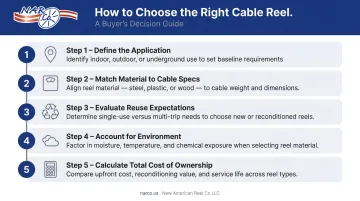
Getting this decision right comes down to five factors:
1. Define the application first A process reel for high-speed wire drawing carries entirely different specifications than a one-way shipping reel headed to a construction distributor. Where the reel is going — and what it does when it gets there — should drive the decision.
2. Match reel material to cable specifications Heavy or large-diameter cable — power cable, wire rope, industrial conductors — needs steel. Lighter or more sensitive cable — data, fiber optic, telecom — is often better handled by plastic, which reduces the risk of damage from excess weight during handling.
3. Evaluate reuse expectations If reels move through a closed-loop system and return to your facility, steel is almost always the better long-term investment, especially when a reconditioning program is in place. Single-use or open-loop shipping to end customers typically favors wood.
4. Account for the operating environment Outdoor exposure, high humidity, and temperature extremes accelerate wood degradation. Plastic handles moisture without treatment. Steel, with appropriate coatings, is the most resilient option across the widest range of environments.
5. Calculate total cost of ownership — not just unit price A wooden reel used once and discarded costs less per unit but adds up quickly across large orders. A steel reel cycled through reconditioning multiple times carries a much lower per-use cost — often a fraction of what continuous new-reel purchasing runs annually.
What to Check Before Finalizing Your Reel Selection
These checks prevent the most common — and costly — ordering mistakes:
- Don't over-engineer single-use applications. Heavy steel construction adds freight cost and handling complexity without delivering value to a recipient who has no way to return the reel.
- Price in disposal costs. Wood and plastic reels discarded at the job site or customer facility create waste management costs and environmental liability. Confirm whether a returnable or recyclable program makes sense before committing.
- Verify equipment compatibility. Flange diameter, arbor hole size, and overall reel weight must work with the axles, mandrels, and lifting equipment already in use. An incompatible reel means unexpected infrastructure costs.
Narco offers custom fabrication services to address compatibility issues, including arbor hole resizing, custom flange dimensions, and traverse length modifications. Drawings are supplied at the quote stage to confirm specifications before production begins.
Conclusion
Wooden, steel, and plastic reels are each built for a specific role. Wooden reels make sense for single-use shipping where cost efficiency matters more than longevity. Plastic suits lighter cable products in cleaner environments. Steel handles the heavy work and pays back that higher upfront cost through repeated use and reconditioning.
For wire manufacturers and cable operations running high volumes of steel reels, partnering with a specialist in reconditioning, repair, and custom fabrication — like Narco — is a direct way to control reel costs over time. A structured reconditioning program extends service life and reduces per-use cost without compromising the structural integrity that protects the cable wound on it.
Frequently Asked Questions
Who buys wooden spools?
Wooden spools and reels are primarily purchased by wire manufacturers, electrical cable producers, rope manufacturers, and electrical distributors who need a cost-effective, single-use format for shipping finished products to customers or job sites. They are the standard choice when the reel will not be returned after delivery.
What is the difference between a cable reel and a cable spool?
The terms are largely interchangeable in the industry. Some manufacturers use "spool" to refer to smaller units or empty packaging after cable has been consumed, while "reel" or "drum" typically describes larger, heavier-duty units used in industrial and shipping applications. NEMA WC 26 uses both terms within its packaging standard.
How long do steel cable reels last?
Steel reels in active reconditioning programs outlast wood or plastic alternatives by many cycles of repeated use. Regular reconditioning — addressing flange damage, arbor wear, and structural deformation — extends service life far beyond what any single-use reel can offer.
Can damaged cable reels be repaired instead of replaced?
Yes. Steel wire reels can be repaired through welding, machining, flange straightening, and arbor tube replacement — substantially cheaper than buying new, especially for operations managing large returnable fleets.
What size cable reel do I need for my wire or cable?
Reel sizing depends on the cable's outer diameter, total length being wound, minimum safe bending radius, and overall load weight. NEMA WC 26 publishes capacity formulas and standard reel dimensions that serve as a reliable baseline for North American applications.
Are plastic cable reels suitable for heavy industrial wire?
Plastic reels are not recommended for heavy industrial cable. Their load capacity is suited to lighter wire, data cable, fiber optic, and specialty filament applications where weight savings and corrosion resistance are the primary requirements. For heavy cable, steel is the appropriate choice.