Introduction
Cable reels are easy to overlook. Buyers in wire and cable industries spend considerable energy specifying conductors, insulation, and jacket materials — then ship everything out on whatever reel is available. That decision gets expensive fast.
The wrong reel creates problems that compound quickly:
- A poorly matched reel stresses cable beyond its minimum bend radius during winding
- A damaged flange lets cable slip off mid-transport
- A mismatched arbor hole makes mounting impossible — or causes dangerous wobble during payoff
Southwire's handling and storage guidelines identify reel mishandling as a leading cause of cable insulation and jacket damage. OSHA has recorded reel accidents resulting in serious injuries when improperly secured reels detached from storage racks.
This guide covers the components that matter, how to match a reel to a specific application, and when reconditioning is smarter than buying new — for wire manufacturers, cable producers, rope manufacturers, and shipping operations alike.
Key Takeaways
- A cable reel winds, stores, transports, and pays out wire, cable, rope, or hose in controlled, layered fashion
- Key components: drum, flanges, arbor hole, traverse system — each with specifications that must match the cable
- Three main materials: steel (heavy-duty), wood (mid-range), plastic (light/data/fiber)
- Reel selection starts with cable OD, weight, minimum bend radius, and total run length
- Always move loaded reels flange-side down using forklifts — never drag or flip
- Cracked welds, dished flanges, or arbor damage make a steel reel a reconditioning candidate — not scrap
What Is a Cable Reel — and How Is It Different from a Spool or Bobbin?
A cable reel is a rotating cylindrical device designed to wind wire, cable, rope, or hose in controlled, layered wraps. It consists of a central drum flanked by two side plates (flanges) that contain and protect the wound material.
In industrial wire and cable contexts, size and application separate these three terms — even when they're used loosely as synonyms:
| Term | Typical Use | Scale |
|---|---|---|
| Bobbin | Fine-wire and textile manufacturing | Smallest — often a few inches in diameter |
| Spool | Lighter-gauge wire, consumer cable | Mid-size |
| Reel | Heavy industrial cable, power conductors, bulk wire runs | Largest — flange diameters from roughly 10 in to 144 in or more |
NEMA WC 26-2008, the primary North American wire and cable packaging standard, addresses reel and spool terminology and defines maximum strength capacity as the total conductor or cable weight a reel can carry.
The distinction between a reel and simply coiling cable on the ground matters operationally. A reel allows long, heavy cable runs to be wound under consistent tension, transported without tangling or kinking, and dispensed smoothly at the installation point.
Loose coils don't offer that control. Attempting a long cable run without a reel typically results in cable twist, crossover knots, or insulation damage.
Key Components of a Cable Reel
Understanding these five components helps buyers specify reels correctly and identify damage before it becomes a problem.
The Drum (Barrel)
The drum is the cylindrical center section where cable wraps. Drum diameter is a critical specification, not a rough guideline.
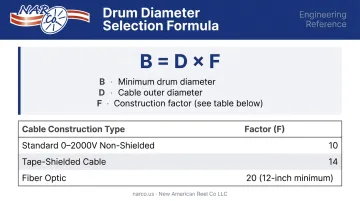
Winding cable too tightly around an undersized drum stresses the conductor, can crack insulation, and may permanently deform the cable's geometry. Southwire's packaging guide uses the formula B = D × F, where B is minimum drum diameter, D is cable outer diameter, and F is a construction factor from NEMA WC 26. The factor varies by cable type: 10 for standard 0–2000V non-shielded cable, 14 for tape-shielded, and 20 for fiber optic (with a 12-inch minimum). Prysmian specifies a minimum bending radius of at least 15× the cable's outer diameter.
The Flanges
The two circular side plates extending outward from the drum contain wound cable, prevent spill-off during transport, and determine maximum cable capacity. Flange diameter sets the outer boundary of how much cable fits.
Flanges are also the component most frequently damaged. CED Engineering identifies flange cracking and barrel deformation among the most common reel damage modes. Dishing (a concave warp caused by uneven weight or dragging) is a structural weakness that can allow cable to migrate off the edge during payoff, creating both safety hazards and cable damage.
The Arbor Hole (Center Bore)
The arbor hole is the opening through the reel's central axis where a spindle, rod, or axle is inserted during mounting and payoff. Size must match the equipment being used precisely. A bore that's too large creates dangerous wobble during unwinding; one that's too small makes mounting impossible without machining.
Narco's reconditioning services include arbor hole resizing and arbor tube repair or replacement — a common need when reels are transferred between facilities running different spindle specifications.
The Traverse and Layering System
Traverse refers to how cable is distributed across the drum's width during winding. Even, controlled layering is essential: cable wound in uneven layers, with crossover points, or packed beyond the design capacity creates problems during payoff and can permanently deform the drum under load pressure.
High-speed industrial winding operations use precision traverse guides to control layer placement. For reels used across repeated winding cycles, maintaining proper traverse is as important as maintaining the reel structure itself.
The Slip Ring (On Live-Connection Reels)
Some reels must maintain an active electrical connection while continuously rotating on cranes, mining equipment, and automated conveyor systems. A slip ring (also called a rotary electrical joint) mounts on the reel's axle and allows the drum to rotate and pay out cable without the cable itself twisting or accumulating torsional stress.
Slip ring specifications are highly application-specific. Cavotec's motorised reel assemblies, for example, include collector assemblies rated up to 30 kV and 2,400 A for heavy industrial applications. For buyers in standard wire manufacturing or shipping, slip rings rarely come into play. In any dynamic, powered application, though, they are a required component — the reel simply cannot function safely without one.
Types of Cable Reels: Finding the Right Fit
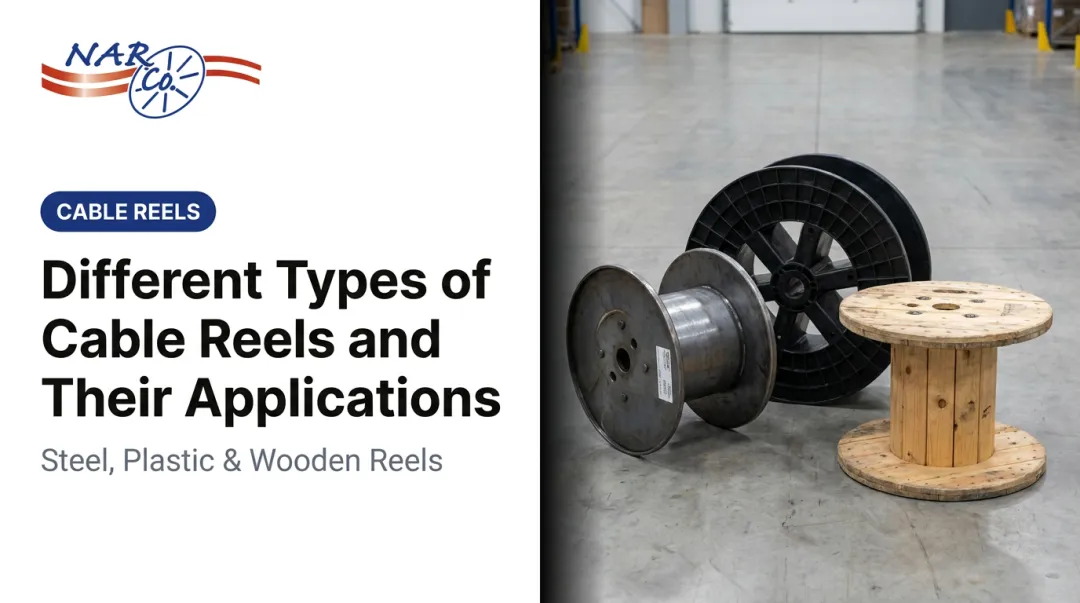
By Material
| Material | Best For | Watch Out For |
|---|---|---|
| Steel | Heavy cable, high-tension applications, repeated use cycles | Weight; requires corrosion protection |
| Wood/Plywood | Mid-range construction and electrical cable, cost-sensitive applications | Moisture absorption weakens structural capacity; NEMA WC 26 notes capacity varies with moisture content |
| Plastic | Data cable, fiber optic, contamination-sensitive applications | Not suited for heavy loads or high-tension winding |
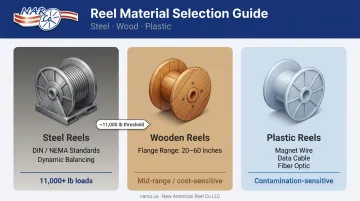
Southwire's guidance places the steel/wood threshold at roughly 11,000 lb cable weight — steel for heavier loads, wood for lighter. Plastic reels are common in fine wire, magnet wire, and data cable applications where contamination control and lighter handling matter more than load capacity.
Narco's reel offerings cover all three material categories:
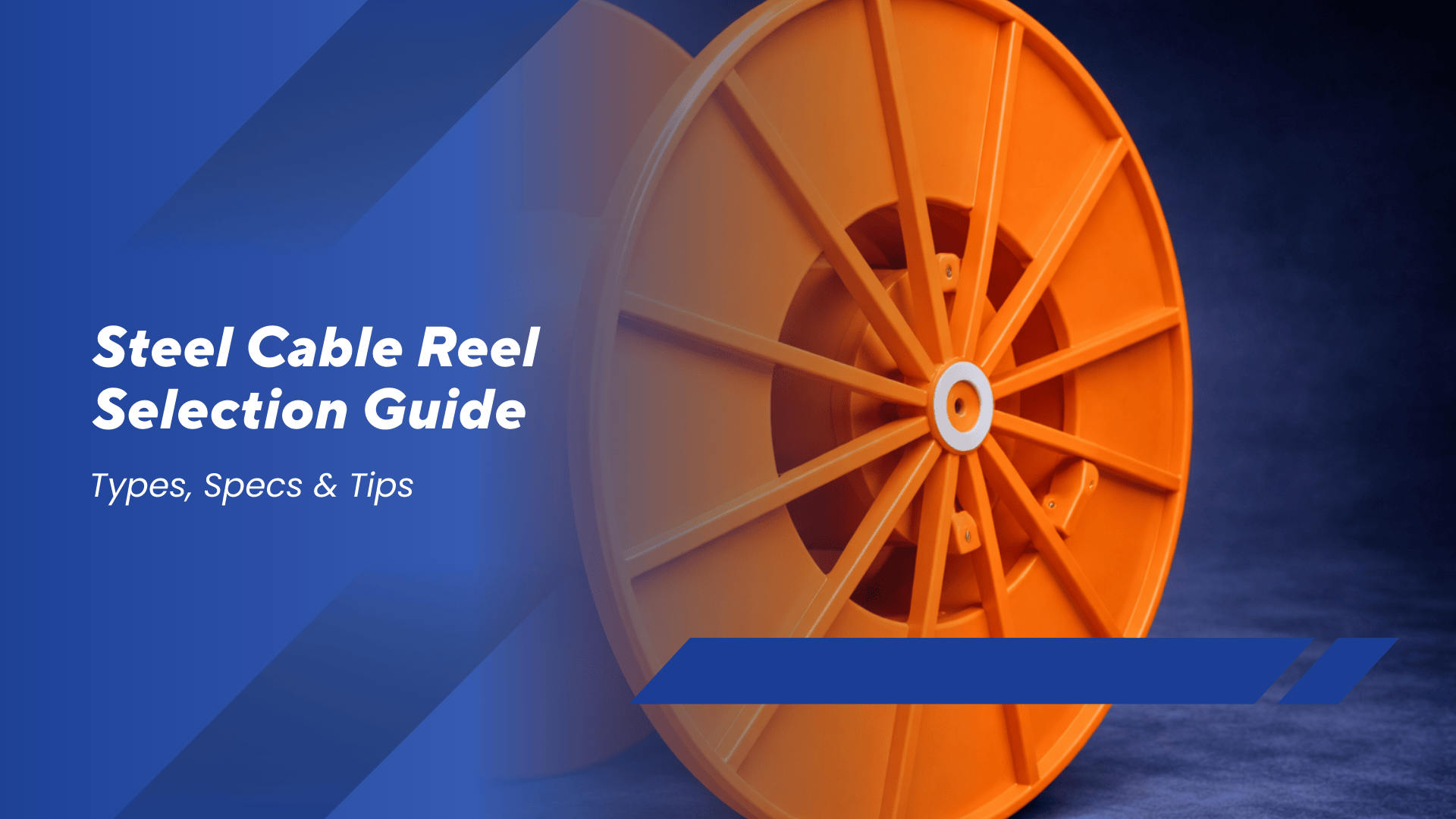
- Steel reels: Built to DIN 46395, DIN 46397, and NEMA WC 26 standards; fully or semi-machined with dynamic balancing
- Wooden reels: Built to order from heat-treated softwoods (Southern Yellow Pine, Spruce, Pine, or Fir) in flange diameters from 20 to 60 inches
- Plastic reels: Narco serves as the Midwest sales agent for Inosym, covering process reels, magnet wire reels, welding wire spools, and data cable spools
By Drive Mechanism
- Spring-loaded reels: Use stored spring tension for auto-retract. Common in light-duty and portable applications. Cavotec's spring reel line lists tension ranges from 150 N to 2,500 N with IP65/66 protection ratings.
- Motor-driven reels: Electric, hydraulic, or compressed-air motors for controlled industrial winding. Cavotec's motorised systems reach speeds up to 300 m/min with drum diameters up to 9.2 m — standard in port and mining applications.
- Gravity/counterweight reels: A counterweight supplies winding force, adjustable for different cable types. PTE's gravitational reversible systems can serve moving devices up to 300 m.
By Application Type
Static reels (shipping and storage) simply hold cable during transit. Dynamic reels must pay out cable under tension while equipment operates — and require proper slip rings, tension-control mechanisms, and dynamic balance verification.
Substituting a static shipping reel in a dynamic application skips those safeguards entirely — expect premature failure, cable damage, or both.
How to Choose the Right Cable Reel for Your Application
Start with the cable's specifications, not the reel catalog.
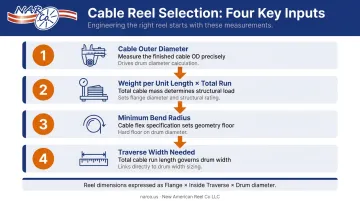
The four numbers that drive reel selection:
- Cable outer diameter — determines minimum drum diameter using the appropriate construction factor
- Weight per unit length × total run length — determines required flange diameter and structural rating
- Minimum bend radius — sets a hard floor on drum diameter; go smaller and you're damaging the cable
- Traverse width needed — total cable length and winding layers determine how wide the drum must be
Reel dimensions are expressed as Flange × Inside Traverse × Drum diameter, accompanied by carrying capacity in lb or kg. Undersizing any dimension creates risk — a drum too narrow forces over-stacking, a flange diameter too small won't hold the full cable weight, and a drum too small violates bend radius.
Material selection framework:
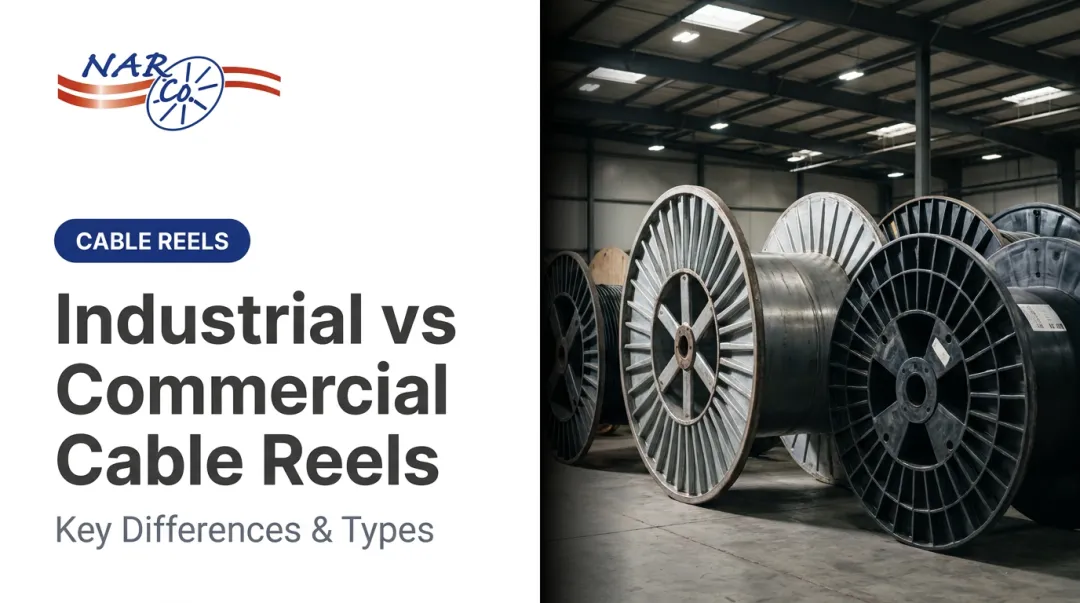
- Steel when the reel will see repeated cycles, heavy loads, or needs to last years under industrial conditions
- Wood when cost is the primary driver and exposure to moisture can be controlled
- Plastic when the application involves fine wire, data, fiber, or contamination-sensitive environments — and when outdoor or marine conditions rule out untreated wood
Static vs. dynamic use also drives the spec. A reel paying out cable while energized or under tension needs dynamic balance, proper slip rings, and tension-control mechanisms — none of which apply to a reel used purely for storage or shipping. Identify the application type before finalizing any reel order.
Once the spec is locked in, total cost of ownership matters as much as upfront price. For buyers sourcing heavy steel reels for repeated manufacturing or shipping cycles, Narco's steel reel repair services — including flange straightening, arbor tube replacement, welding, machining, and dynamic balancing — can extend reel service life substantially. When the core drum structure is sound, reconditioning typically costs less than buying new.
Proper Handling and Storage Best Practices
Moving Loaded Reels
Loaded reels should always travel with flanges touching the ground — never on their side. Use a forklift, crane, or hoist:
- Forklift: Insert forks fully under both flanges; never lift by a single flange or the drum
- Crane: Keep the angle between support bar and lifting rope under 60 degrees (per EFC guidelines)
- Never: Drag, slide, flip, or pull a loaded reel by hand
Strapping and chocking are required during transport. Ties go around the reel structure — never over the cable itself.
Pre-Use Inspection
Before deploying any reel, check for:
- Cracked or dished flanges — dishing (concave warp) is a structural warning, not cosmetic wear
- Drum deformation — bent or collapsed sections cause uneven winding and cable crossover
- Arbor hole or tube damage — leads to mounting instability and wobble during operation
- Corrosion on structural welds — surface rust is acceptable; rust penetrating weld joints is not
Prysmian's handling guidelines warn that dropping drums from a truck causes unacceptable flange damage. An OSHA investigation documented a 250 lb reel dislodging from a 9-foot rack and injuring a worker — the cited cause was unsecured equipment. Any reel that fails inspection should be pulled from service and flagged for reconditioning or replacement before use.
Storage Conditions
Long-term storage introduces its own risks — moisture, shifting, and heat damage accumulate gradually and are easy to miss until a reel fails in service. Follow these guidelines:
- Store upright on both flanges, chocked against rolling
- Keep reels at least 4 inches off the ground and away from flooding risk
- Rotate drums 90 degrees every three months for long-term storage (per Prysmian North America)
- Avoid stacking reels on heat sources, vibrating surfaces, or irregular ground
- Wooden reels stored outdoors or in damp environments absorb moisture — NEMA WC 26 notes this directly degrades structural capacity
Reel Maintenance and Reconditioning: Extending Reel Life
Cosmetic Wear vs. Structural Damage
Not everything that looks wrong needs immediate professional repair — but knowing the difference matters.
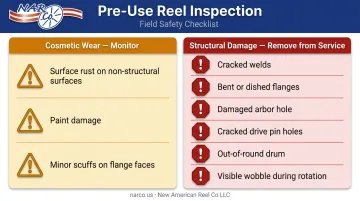
Cosmetic wear (monitor, don't panic):
- Surface rust on non-structural surfaces
- Paint damage or faded markings
- Minor scuffs on flange faces
Structural damage (get it assessed):
- Cracked welds anywhere on the reel
- Bent, dished, or deformed flanges
- Damaged or misaligned arbor hole or tube
- Drive pin holes that are cracked or elongated
- Out-of-round drum sections
- Visible wobble during rotation
Catching structural damage before a winding cycle — not after — is what separates planned maintenance from emergency cable loss. Once you've identified structural issues, professional reconditioning is the path forward — and it goes well beyond straightening and repainting.
The Reconditioning Process
A complete reconditioning process includes:
- Inspection and assessment — documenting all damage before any work begins
- Flange straightening and press work — restoring flange geometry
- Weld repair — addressing cracked or broken structural connections
- Arbor tube and drive pin hole repair or replacement — restoring mounting precision
- Machining — restoring dimensional tolerances on contact surfaces
- Industrial blasting and painting — surface preparation and corrosion protection
- Dynamic balancing — verifying the reel runs true under load at operating speed
Dynamic balancing — governed by ISO 1940-1:2003 for rigid rotor components — is especially critical for high-speed winding operations. Imbalance that seems minor at slow speeds becomes a serious vibration problem at production speeds, degrading winding quality and shortening bearing life.
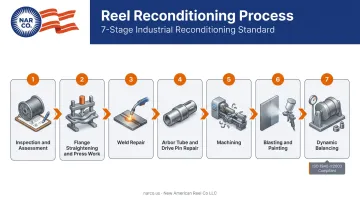
Narco has handled reel reconditioning since 1999, working on reels from 3 inches to 144 inches in diameter. Where applicable, reconditioning work aligns with NEMA WC 26 (industry standard for reel dimensions and construction) and DIN 46395/46397 (the equivalent German standards widely referenced for metric reels).
Recondition or Replace?
The math tips strongly toward reconditioning when:
- The drum's core structure (barrel and welds) remains sound
- Damage is concentrated in flanges, arbor components, or drive pins
- The reel is heavy-gauge steel that would cost significantly more to replace new
- A qualified reconditioning provider is accessible
Replacement makes more sense when the drum itself is out-of-round beyond economical correction, corrosion has compromised structural welds throughout, or the reel is a low-cost wood or plastic unit where repair cost approaches replacement cost.
Frequently Asked Questions
What is a cable reel used for?
Cable reels wind, store, transport, and dispense wire, cable, rope, or hose in an organized, damage-free manner. Applications span wire and cable manufacturing, construction, utilities, mining, telecommunications, and product shipping.
How does a cable reel work without twisting the wire?
Reels designed for live or continuous-rotation use incorporate a slip ring (rotary electrical joint) on the reel's axle. This allows the drum to rotate and pay out cable while maintaining an uninterrupted electrical connection; the cable itself doesn't rotate or accumulate twist.
What is the difference between a cable reel, a spool, and a bobbin?
All three wind linear material onto a central drum with flanged sides, but differ in scale. Bobbins handle fine-wire and textile work, spools cover lighter wire and consumer cable, and reels are the largest format — built for heavy industrial cable, power conductors, and bulk wire runs.
What materials are cable reels typically made from?
The three most common materials are steel (heavy-duty industrial use), wood or plywood (mid-range construction and electrical cable), and plastic (light-duty, data, fiber optic, and contamination-sensitive applications). Each offers different tradeoffs in weight, durability, cost, and repairability.
How do you know when a cable reel needs reconditioning or replacement?
Key indicators include cracked welds, dished or bent flanges, damaged arbor sections, and out-of-balance rotation. Steel reels showing these signs are strong candidates for professional reconditioning rather than outright replacement, provided the core drum structure is still intact.