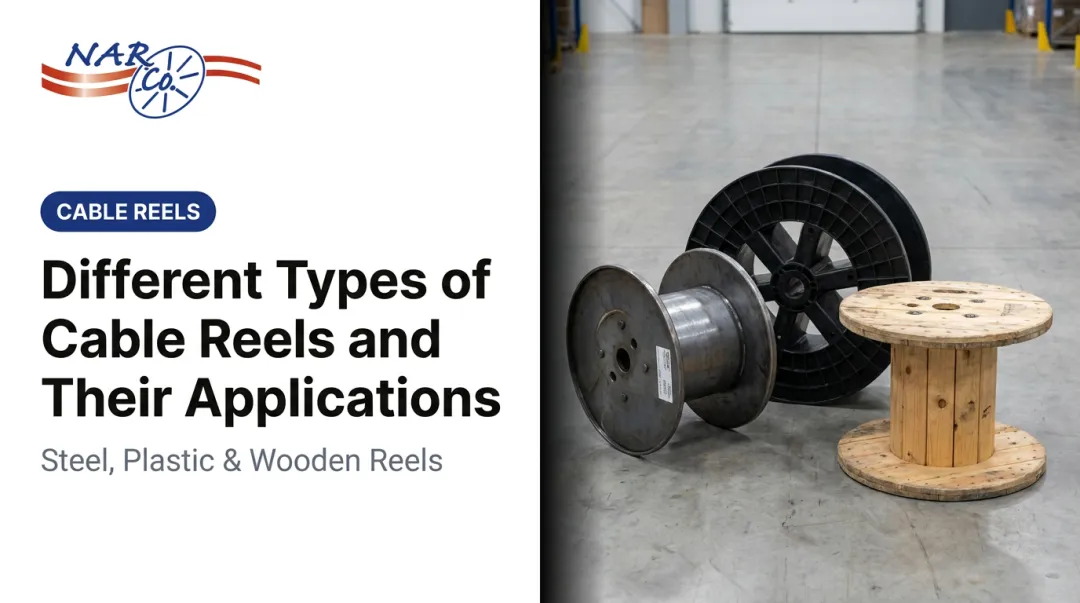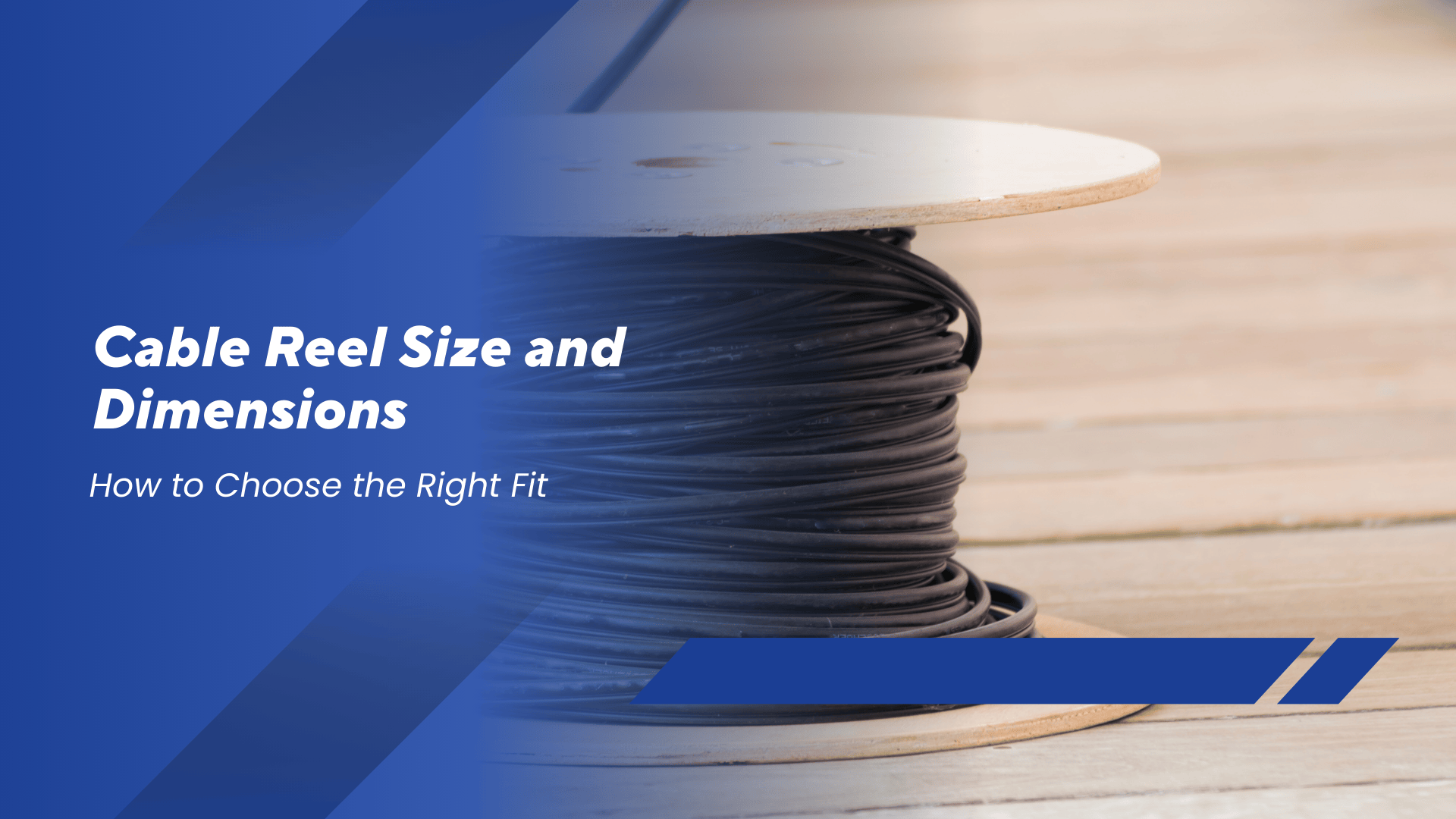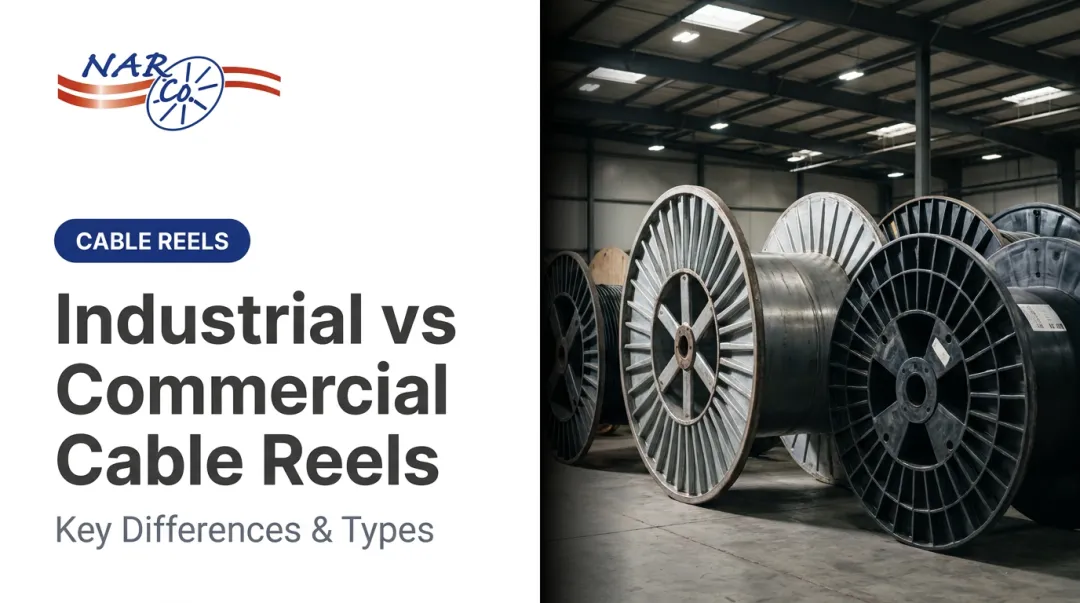
The challenge is that "light duty" and "heavy duty" get used loosely in the industry. NEMA WC 26-2008 doesn't even define a formal "light duty" class — it uses General Purpose, Heavy Duty, and Extra Heavy Duty designations with specific load ratings attached to each. That distinction matters when you're comparing equipment.
This article breaks down the real differences: materials, load capacity, retraction mechanisms, environmental resistance, and — critically — which type actually fits your operation.
Key Takeaways
- Light duty reels suit lower-weight wire, smaller gauges, and clean controlled environments — often plastic or thin stamped steel construction
- Heavy duty reels handle large-diameter cable, high-cycle operations, and harsh conditions where a failure stops the line
- NEMA-rated heavy duty steel reels handle 3,000–25,000 lb cable loads; general-purpose reels start at 100–500 lb
- Key failure modes from misapplication: flange bending, drum deformation, wire kinking, spring burnout
- Reconditioning worn steel reels restores structural integrity at a fraction of full replacement cost
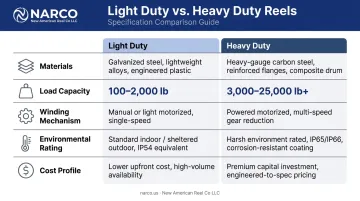
Light Duty vs. Heavy Duty Cable Reels: Quick Comparison
| Factor | Light Duty | Heavy Duty |
|---|---|---|
| Materials | Plastic, thin-gauge stamped steel | Thick-gauge or powder-coated steel, reinforced flanges |
| Load Capacity | 100–2,000 lb cable weight (NEMA plywood class) | 3,000–25,000 lb+ (NEMA heavy duty steel class) |
| Winding Mechanism | Basic torsion spring or hand crank | Ratchet lock, motor-driven, pneumatic-assist |
| Environmental Rating | Clean, dry indoor use | IP55–IP66, NEMA 4, –40°C to +60°C rated options |
| Cost Profile | Lower upfront, shorter service life under stress | Higher upfront, significantly better return in heavy-use settings |
What Are Light Duty Cable Reels?
"Light duty" describes the structural rating of the reel — not the wire it carries. A light duty reel may hold perfectly functional wire, but the reel itself is not engineered for repeated mechanical stress, heavy loads, or rough handling.
Materials and Construction
Light duty reels typically use:
- Plastic housings — functional for light wire, but susceptible to cracking under impact or UV exposure
- Thin-gauge stamped steel — adequate for lower loads, but prone to flange deflection when overloaded
- Lightweight aluminum — used in some configurations, good for weight reduction but limited structural ceiling
These materials have a defined durability ceiling. They are not designed for repeated lateral loads, outdoor exposure, or high-frequency industrial cycling.
Load and Capacity Limits
Per NEMA WC 26-2008, plywood reels and spools — which represent the lower end of the capacity spectrum — are rated for 100–2,000 lb cable weight with flange diameters from 12–48 inches. Sonoco's heavy-duty plastic taper reels cap out at 1,000 lb carrying capacity. Those numbers define the upper boundary of what "light duty" means structurally.
Retraction Mechanisms
Light duty reels use basic torsion springs or hand-crank systems. These work at lower cycle rates and for lighter cables. Push them into high-frequency industrial use and spring fatigue accelerates. The mechanism was never rated for that duty cycle.
Use Cases for Light Duty Reels
Light duty reels genuinely fit these scenarios:
- Small-gauge wire packaging lines with moderate throughput
- Office or warehouse power cord management
- Retail, trade show, or event applications
- Low-volume cable shipping where load stress is minimal
- Prototype or short-run production environments
Step outside those boundaries, though, and the risk profile changes quickly. When a light duty reel gets used beyond its ratings — stacked under heavier loads, run through continuous shifts, or exposed to plant floor conditions — the failure sequence is predictable: flange bending first, then drum deformation, then wire kinking from loss of geometry.
The result is lost product and unplanned downtime, not just a worn-out reel.
What Are Heavy Duty Cable Reels?
Heavy duty reels are industrial-grade spool systems engineered for large-diameter wire, high-tension cable, heavy rope, and daily high-cycle operation in demanding environments.
Construction Differences
Each structural component ties directly to a specific operational outcome:
- Thick-gauge or hot-rolled steel drums resist deformation under heavy cable loads that would collapse a lighter drum
- Reinforced flanges prevent lateral deformation when reels are stacked, transported, or handled with forklifts
- Heavy-duty axle assemblies handle the rotational load of large cable payoff without bearing failure
- Protective coatings: powder coat (chip-resistant, rust-inhibiting) for standard plant use; hot-dip galvanizing or stainless steel for seaside and chemically aggressive environments
Steel Cable Reels' one-piece welded high-voltage reels illustrate the upper range: corrugated hot-rolled steel construction, built to NEMA specifications, sized 48–185 inches, rated up to 40 metric tons loading capacity.
Winding and Retraction Mechanisms
Heavy cables can't rely on basic torsion springs. The mechanism options scale with the application:
- Ratchet lock systems lock the spring-wound reel in position and prevent uncontrolled payoff
- Motor-driven winding (electric, hydraulic, or pneumatic) handles continuous operation — Conductix motor-driven reels are rated for 24/7 harsh-environment use with slip rings at 100% duty cycle and gearbox lubrication life of 5 years or 15,000 hours
- Magnetic coupler or VFD-driven systems suit large-spool applications that require precise tension control
For reference, Conductix PowerReel spring reels — on the higher end of spring-type mechanisms — are rated for up to 50,000 retraction cycles without wear, handling cables up to 1.5 inches in diameter.
Environmental and Safety Ratings
Verified ratings from major OEMs show what properly specified heavy duty reels can handle:
- IP55 or higher (Conductix PowerReel) — protected against dust and water jets
- IP65/66 (Cavotec spring reels) — full dust-tight, high-pressure water resistant
- NEMA 4 (Conductix welding reel) — indoor/outdoor, watertight
- –40°C to +60°C operating range (Conductix motor-driven Series HL/HD)
Narco's Custom Fabrication and Reconditioning
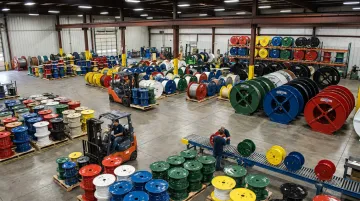
For operations that need reels built or restored to exact dimensional specifications, Narco (New American Reel Co.) designs and fabricates heavy-duty steel wire reels from the ground up — handling sizes from 3" to 96" (75mm to 2400mm) across multiple construction types:
- Fully Machined Reels (DIN 46397) — dynamically balanced, precision-machined
- Semi Machined Reels — double wall curled flanges, machined on all product contact surfaces
- Enhanced Metal Flange Reels — built for the most demanding applications involving heavy cable, wire, or rope
- Steel Drums — suited for extrusion, drum twisting, and lay-up processes
All custom orders are manufactured to customer specifications with drawings supplied at quote stage. Narco also reconditions worn steel reels — straightening flanges, repairing rims, replacing arbor tubes, blasting, painting, and dynamically balancing — which restores structural integrity at a fraction of full replacement cost.
Use Cases for Heavy Duty Reels
Heavy duty is the appropriate choice when:
- Large-diameter power cable is being manufactured or shipped
- Industrial wire rope production involves continuous winding under tension
- Underground or high-voltage cable laying requires reels that can handle rough site conditions
- Production lines run continuous shifts where reel failure halts the entire operation
- Outdoor storage or chemical exposure demands corrosion-resistant construction
Specifying the wrong reel — undersized hub diameter, incorrect bend radius, or an inadequate rotation mechanism — creates handling problems, storage inefficiencies, and unplanned downtime. Getting the spec right the first time is the more cost-effective path.
Light Duty vs. Heavy Duty: Which One Do You Actually Need?
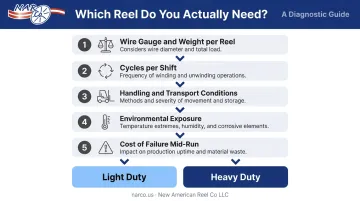
Before defaulting to either option, run through these diagnostic questions:
- What is the wire gauge and total weight per reel? If you're at or above 2,000 lb cable weight, you're out of light-duty territory by NEMA benchmarks.
- How many cycles per shift? Basic torsion spring mechanisms wear faster under industrial cycle rates than their specs suggest.
- What are the handling and transport conditions? Forklift handling, stacking, outdoor staging — each adds mechanical stress that light-duty construction isn't rated for.
- What is the environmental exposure? Moisture, chemicals, temperature swings, or plant floor contamination all shorten the life of lighter materials.
- What is the cost of a reel failure mid-run? If the answer is "significant," that factor alone shifts the calculus toward heavy duty.
Clear If/Then Framework
Choose light duty if:
- Wire is smaller gauge with lower total reel weight
- Your operation runs lower volumes in controlled, clean environments
- Upfront cost is a priority and cycle frequency is low
- Reels won't be subject to rough handling or stacking
Choose heavy duty if:
- Wire is large-diameter or high-tension
- Your operation runs continuous shifts with high cycle rates
- Reels are exposed to outdoor conditions, chemical environments, or forklift handling
- Reel failure carries meaningful downtime risk
The Gray Zone: Outgrown Light Duty, Not Ready for Full Replacement
Some operations land in a middle state: light-duty reels are clearly failing faster than they should, but a complete heavy-duty fleet replacement feels steep. This is where reel reconditioning is worth a serious look.
For steel reels where the core structure is still sound, reconditioning targets the specific failure points: straightening bent flanges, repairing damaged rims, replacing arbor tubes, and rebalancing. That work extends usable life without scrapping inventory that still has value. EFC's wire and cable reel guide notes that reel return programs typically recover 90–100% of initial deposit value when reels come back in reusable condition.
The Hidden Cost Trap
Repeatedly replacing worn light-duty reels in a heavy-use environment is almost always more expensive over a 3–5 year horizon than investing in properly rated equipment from the start. The unit cost looks lower, but replacement frequency, production disruptions, and wire damage costs accumulate fast.
Sonoco's EcoReel program tracked nearly 2 billion pounds of reels cycled through reconditioning over one five-year period and reported more than $36 million in disposal-cost savings. That number reflects how much lifecycle cost is recoverable when reel decisions are treated as a system rather than one-off purchases.
Conclusion
Light duty reels are the right tool in the right context — low-volume lines, small-gauge wire, clean environments, modest cycle rates. There's no reason to over-specify when the application doesn't demand it.
But when production loads are high, wire is heavy, shifts run continuously, or reels take real physical abuse, heavy-duty construction is the only sound investment. The structural ratings exist for a reason, and ignoring them doesn't save money. It defers the cost until it surfaces as a production problem.
The more useful question for any wire or cable operation isn't just "light or heavy?" It's whether the reels currently on the floor are actually rated for the job they're doing.
If flange damage, drum wear, or spring failure is appearing ahead of schedule, that's a sign the spec doesn't match the application — and the right time to address it is before a reel fails mid-run.
Narco has been fabricating and reconditioning steel wire reels since 1999. Whether the right path is a custom-fabricated heavy-duty reel built to your exact dimensional specs or reconditioning your existing steel reel inventory, contact Narco at 419-258-2900 or mark@narco.us to evaluate your options.
Frequently Asked Questions
Should I use a light-duty or heavy-duty reel for my cable plant?
The answer depends on wire gauge, daily production volume, and handling conditions. Heavy-duty reels are appropriate for continuous high-cycle operations with large-diameter cable; light-duty suits lower-volume lines with smaller wire in controlled environments.
What does 'light duty' mean for reels, and how does it compare to medium- and heavy-duty?
"Light duty" describes the structural and load rating of the reel. NEMA WC 26-2008 defines General Purpose, Heavy Duty, and Extra Heavy Duty classes; light duty is not a formal NEMA term but generally covers lower-load, lower-cycle applications. Heavy duty is built for continuous industrial use with large cable and harsh conditions.
What materials are heavy-duty cable reels typically made from?
Heavy-duty reels are primarily built from thick-gauge or hot-rolled steel, with reinforced flanges and drum cores. Protective finishes include powder coat for standard plant environments and hot-dip galvanizing or stainless steel for corrosive or outdoor applications.
How long do light-duty cable reels last in a manufacturing environment?
Service life depends heavily on cycle frequency and load. Light-duty reels pushed beyond their ratings typically show flange bending, spring fatigue, or drum deformation — sometimes within months in high-cycle wire manufacturing settings.
Can a worn reel be repaired instead of replaced?
Yes, when the core steel structure is still sound. Reconditioning (straightening, welding, repainting, and rebalancing) extends service life at a fraction of replacement cost. Narco's reconditioning services cover reel sizes from 3" to 96".
What load capacity should I look for when choosing a reel for industrial wire production?
Focus on maximum wire weight, required drum and flange diameter for your wire gauge, and daily cycle count. NEMA heavy-duty steel reels are rated for 3,000–25,000 lb cable weight. Consult a reel specialist to match the spec to your actual load.