This guide breaks down what each reel type actually does, how they differ structurally and functionally, what materials and sizes to look for, and how a proper maintenance program extends reel life and controls costs.
Key Takeaways
- Process reels run on machinery at high speed — precision, concentricity, and dynamic balance are non-negotiable
- Finished wire ships on delivery reels — load capacity, transit durability, and smooth payout are what matter
- Steel dominates both applications for durability and repairability; wood and plastic serve specific lighter-duty roles
- Size a reel by starting with the wire's minimum bending radius, then build outward to traverse width and flange diameter
- Reconditioning extends steel reel life significantly — retiring repairable reels prematurely wastes capital
What Are Process Reels in Wire Manufacturing?
Process reels — also called machine reels — are precision components used directly within wire drawing, stranding, bunching, and rod breakdown lines. Unlike storage reels, they must perform consistently under continuous mechanical stress at high rotational speeds.
Functional Demands
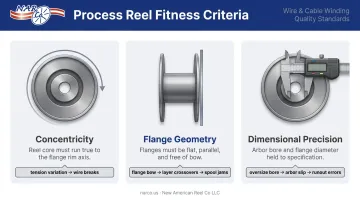
Three properties define whether a process reel is fit for production:
- Concentricity — the reel must spin true, with no wobble. Any runout creates tension variation in the wire, leading to dimensional inconsistency or breaks
- Flange geometry — flanges must be flat and straight to ensure uniform wire laydown and prevent crossover or kinks
- Dimensional precision — the reel must fit spooler and pay-off equipment correctly; incorrect arbor hole dimensions or flange spacing cause feeding errors that stop production
Why Dynamic Balance Matters
At the speeds common in wire drawing, even minor weight imbalance creates vibration. Research published in Wire Journal International confirms that vibrations during fine wire drawing are undesirable and can lead to wire breaks and surface defects. The fix is dynamic balancing — a process that measures weight distribution around the reel and corrects imbalances so it spins cleanly at operating speed.
Narco includes dynamic balancing as a standard part of its reconditioning services, covering steel reels from 3 to 96 inches in diameter. This makes it possible to restore a used process reel to original production specifications rather than replacing it outright.
Structural Requirements
Process reels must survive not just one high-speed run, but hundreds of production cycles. Steel is the material of choice for this reason — it holds tight tolerances under centrifugal and tensile loads and can be welded, machined, and reconditioned multiple times without losing dimensional integrity.
Process reels stay in the plant — owned and managed by the wire manufacturer, never shipped to customers. That means a cracked flange, bent barrel, or worn arbor hole doesn't affect packaging. It stops a production line.
What Are Delivery Reels in Wire Manufacturing?
Delivery reels — also called shipping or distribution reels — are the reels on which finished wire is wound and sent to end customers or distributors. Unlike process reels, their sole job is product protection: keeping wire intact through loading, transit, unloading, and payout at the customer's site.
Functional Demands
The criteria that matter for delivery reels are different from process reels:
- Load capacity — the reel must hold the correct wire length for the customer order without exceeding weight limits
- Transit durability — flanges and barrel must survive forklift handling, stacking, and road or rail transit without collapsing or deforming
- Smooth payout — flange geometry must allow the customer to unwind wire cleanly during installation, without kinks or snags
- Minimum drum diameter — the barrel must be large enough relative to the cable outside diameter to prevent damage from overbending during storage or shipment
The standard benchmark for steel delivery reel sizing in the U.S. and Canada is NEMA WC 26-2008 / EEMAC 201-2008, the Binational Wire and Cable Packaging Standard. It governs minimum drum diameters, capacity values, and size conventions used across the North American wire and cable industry.
These physical requirements directly shape how delivery reels are managed across their full service life — which, for steel reels, can span dozens of trips.
The Reel Return Cycle
Steel delivery reels are capital assets, not disposable packaging. The typical lifecycle runs:
- Wire manufacturer winds finished wire onto the reel
- Reel ships to customer or distributor
- Customer pays out wire during installation
- Empty reel returns to the manufacturer
- Reel is inspected and reconditioned if needed
- Reel re-enters service
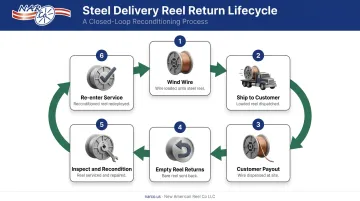
This cycle means reel condition and tracking directly affect packaging costs. Reels that are lost, damaged beyond repair, or never returned must be replaced at full new-reel cost. Steel returnable reels carry a higher upfront cost than single-use wood reels. For manufacturers shipping heavy or specialty wire regularly, though, the cost-per-trip across multiple cycles is considerably lower.
Process Reels vs. Delivery Reels: Key Differences at a Glance
| Factor | Process Reels | Delivery Reels |
|---|---|---|
| Where used | On production machinery | Shipping to customers |
| Critical properties | Concentricity, dynamic balance, dimensional precision | Load capacity, transit durability, smooth payout |
| Speed requirement | High RPM operation | Static load and handling |
| Standards | DIN 46395, DIN 46397, ISO 1940 | NEMA WC 26-2008 / EEMAC 201-2008 |
| Ownership | Manufacturer-owned, stays in plant | Returnable asset, travels to customer |
| Reconditioning path | Balance, concentricity, arbor repair, machining | Flange straightening, coating, re-stenciling |
When a Process Reel Becomes a Delivery Reel
A reel that no longer meets dynamic balance requirements for production may still serve as a delivery reel — but only after a structural inspection confirms it meets dimensional and load requirements for that role. A retired process reel with sound flanges and a straight barrel has real value as packaging, and the inspection cost is minimal compared to sourcing new.
The reverse situation is much riskier. Using undersized or damaged delivery reels as process reels to cover a shortage is a common and costly mistake. Dimensional inconsistencies cause wire defects and can damage spooler equipment. The cost of scrap wire and downtime far exceeds the cost of sourcing a proper process reel.
Reel Materials: Choosing the Right Construction
Steel
Steel is the go-to material for high-volume wire manufacturing operations — on both the production floor and the shipping dock. Its advantages:
- Maintains concentricity under load across many cycles
- Can be welded, machined, and reconditioned multiple times
- Holds tight tolerances through both high-speed production and transit stress
- Accepts coatings for corrosion resistance during outdoor storage
For companies managing a reel fleet, steel's long-term cost-per-trip is typically lower than wood, despite higher upfront cost. Narco manufactures steel reels to NEMA WC 26, DIN 46395, and DIN 46397 specifications, with custom fabrication available for sizes and configurations outside standard ranges.
Wood
Wood reels are widely used for lighter or one-way delivery applications. Carris Reels notes that returnable nailed wood reels typically last 5–10 uses, depending on travel distance and weather exposure. Wood absorbs moisture, warps over time, and cannot be reconditioned to the same standard as steel. Narco manufactures nailed wooden reels in heat-treated softwoods — Southern Yellow Pine, Spruce, Pine, or Fir — in sizes from 20 to 60 inches in diameter, built to NEMA WC 26 and customer specifications.
Plastic
Plastic reels are suited for lighter wire gauges — automotive wire, magnet wire, data cable, and welding wire. Sonoco reports that plastic drawing, bunching, and stranding reels can cost and weigh one-third less than steel alternatives and hold 12% more wire for shipping. Narco supplies plastic reels through its Inosym partnership, including process reels, magnet wire reels, fine wire reels, and data cable spools made from ABS plastic.
Each material has environmental limits worth factoring into your selection: steel tolerates the widest range of conditions, wood requires protection from moisture, and plastic performs poorly in extreme cold or sustained high heat.
Reel Sizing and Selection Criteria
The Key Dimensions
Every reel is defined by five measurements that must match both the wire being wound and the equipment being used:
- Flange diameter — determines how much wire the reel holds
- Barrel (drum) diameter — must meet the wire's minimum safe bending radius
- Traverse — the inside width between flanges, setting the wound wire width
- Arbor hole diameter — must fit the spooler shaft or pay-off mandrel
- Out-to-out measurement — total width, governs equipment clearance
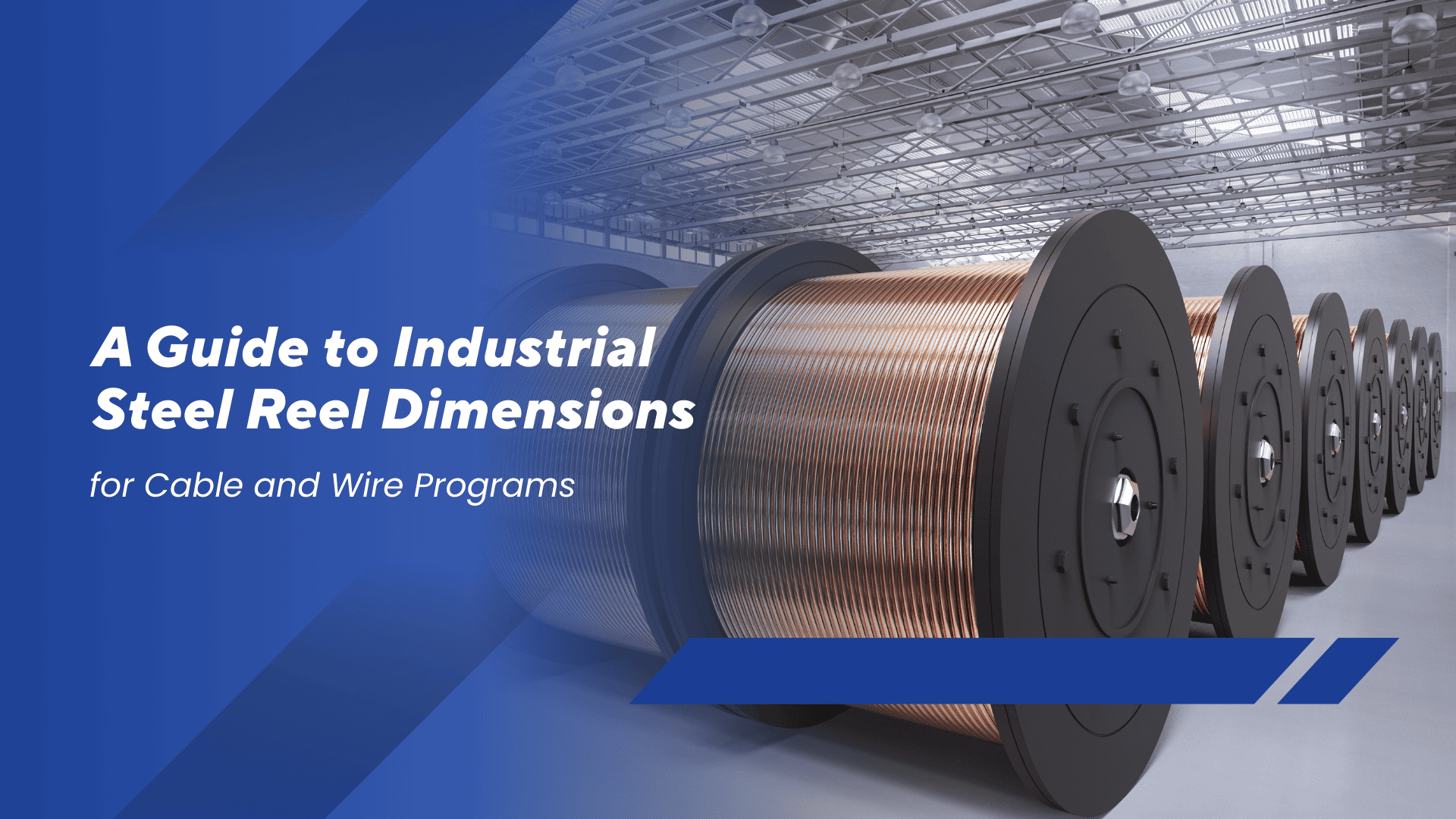
Standard notation in North America, per Okonite and Nexans references to NEMA WC 26, is Flange × Traverse × Drum (for example, 96 × 48 × 56).
How to Size a Reel Correctly
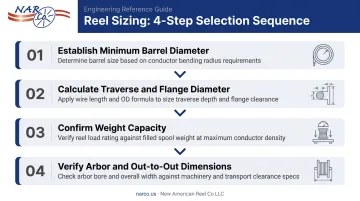
The selection process follows a logical sequence:
- Establish the minimum barrel diameter based on the wire's minimum safe bending radius — this protects the conductor during winding and storage
- Calculate traverse and flange diameter from the required wire length per reel and the wire's outside diameter
- Confirm the reel's rated weight capacity against the total conductor weight it will carry
- Verify arbor hole and out-to-out dimensions against both the winding machine and the customer's payout setup
Consistency Across the Fleet
When all reels in a plant share consistent dimensions, changeovers are faster, operators make fewer errors, and inventory tracking is simpler. Standard sizes handle most applications, but when a wire product falls outside those ranges — or a customer's installation equipment has specific clearance or arbor requirements — custom fabrication is the practical solution. Narco builds custom reels to customer specification, supplying drawings at quote and on order to confirm exactly what's being built.
Extending Reel Life Through Maintenance and Reconditioning
Why It Matters Financially
A steel reel is a capital asset. Its cost is amortized across every trip it completes, so a reel retired prematurely — over cosmetic damage that could be repaired — directly raises per-unit packaging costs. Continuing to run a structurally compromised reel risks wire damage, equipment damage, or a safety incident. Objective criteria — not guesswork — should drive every retire-or-recondition call.
What Reconditioning Involves
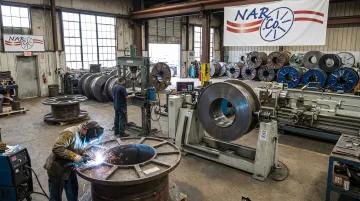
A full reconditioning job at Narco covers:
- Dimensional inspection of flanges, barrel, and arbor hole
- Flange straightening, rim repair, and press work
- Arbor tube and drive pin hole restoration or replacement
- Welding and machining of damaged areas
- Blast cleaning, repainting, and re-stenciling
- Dynamic balancing after all structural repairs are complete
Narco has specialized in steel wire reel reconditioning since 1999 and handles reels from 3 to 144 inches in diameter. That range of capabilities means most reels can be restored to near-new functional specifications at a significantly lower cost than replacement.
Recondition vs. Replace: A Practical Guide
| Condition | Recommendation |
|---|---|
| Bent flanges, repairable | Recondition |
| Minor rim damage | Recondition |
| Worn markings or coating | Recondition |
| Out-of-balance after prior use | Dynamic balance and return to service |
| Cracks through load-bearing welds | Evaluate case by case; often retire |
| Barrel collapse beyond dimensional tolerance | Retire |
| Severe structural compromise | Retire |
If you're uncertain about a specific reel condition, Narco can help establish objective go/no-go criteria matched to your reel designs and operating requirements.
Frequently Asked Questions
What is the difference between a spool and a reel?
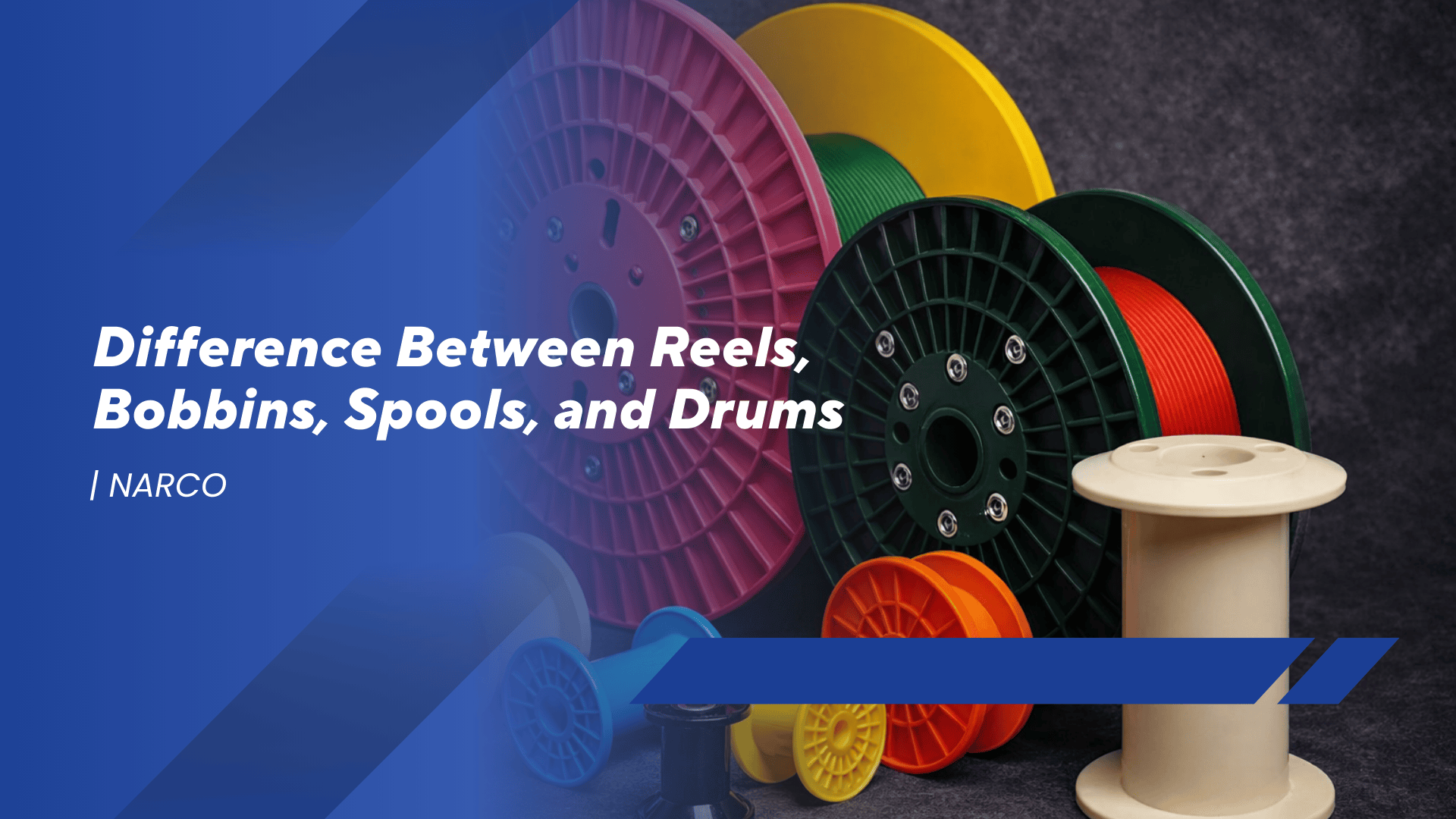
In general usage, a reel refers to larger units used in manufacturing and shipping, while a spool refers to smaller units. "Bobbin" is another term for a small spool, typically used for fine wire or precision winding. No single industry-wide standard defines all three terms consistently.
What is the difference between a process reel and a delivery reel?
Process reels are designed for use on wire manufacturing machinery, where precision, dynamic balance, and high-speed performance are the priorities. Delivery reels are designed to hold finished wire for shipment to customers, where load capacity, transit durability, and smooth payout matter most.
What materials are wire reels made from?
The three primary materials are:
- Steel — most durable; preferred for process reels and heavy-duty delivery reels
- Wood — lower cost; common for lighter or single-use delivery applications
- Plastic — lightweight; used for lighter wire gauges and specialty environments such as magnet wire or data cable
What is dynamic balancing of a wire reel, and why does it matter?
Dynamic balancing corrects weight distribution around a reel so it spins without vibration at high operating speeds. Unbalanced process reels cause wire quality issues and accelerate machine wear — which is why balancing is especially important after any reel repair or reconditioning.
When should a wire reel be reconditioned rather than replaced?
Reels with repairable damage — bent flanges, minor cracks, worn coatings, or arbor tube wear — are strong reconditioning candidates, since the repair restores function at a fraction of replacement cost. Reels with severe structural damage or barrel collapse beyond dimensional tolerance are better replaced outright.