Industrial plastic spools are simplifying cable handling for wire, cable, and tubing manufacturers by combining lightweight construction with superior durability, reducing labor hours and handling-related cable damage.
For industries in Ohio, Georgia, South Carolina, and Tennessee, these spools improve throughput metrics, optimize storage density, and protect high-value cables, ropes, and tubing during transport and field installation. Selecting the correct spool type directly impacts uptime, material loss, and ROI.
This article examines the structural components, measurable industrial plastic spools benefits, and optimized handling strategies to help engineers, procurement teams, and operations managers achieve maximum efficiency in production and installation workflows.
Key Takeaways
ABS and PP industrial plastic spools reduce labor fatigue and freight cost by enabling manual handling and higher pallet density than steel or wood.
Reinforcement ribs, hubs, and flange geometry prevent flex and payout instability on high-speed winding and installation lines.
Chemical, corrosion, UV, and moisture resistance allow plastic spools to perform reliably in outdoor, humid, and chemically exposed environments.
Custom flange diameters, drum widths, arbor sizes, and color coding reduce installation errors and improve inventory control.
Reusability and impact resistance lower scrap rates, replacement frequency, and total cost of ownership across high-volume cable operations.
7 Core Components That Define Industrial Plastic Spool Performance
Industrial plastic spools are designed to store, transport, and operate cables, ropes, and tubing efficiently while minimizing damage and handling effort.
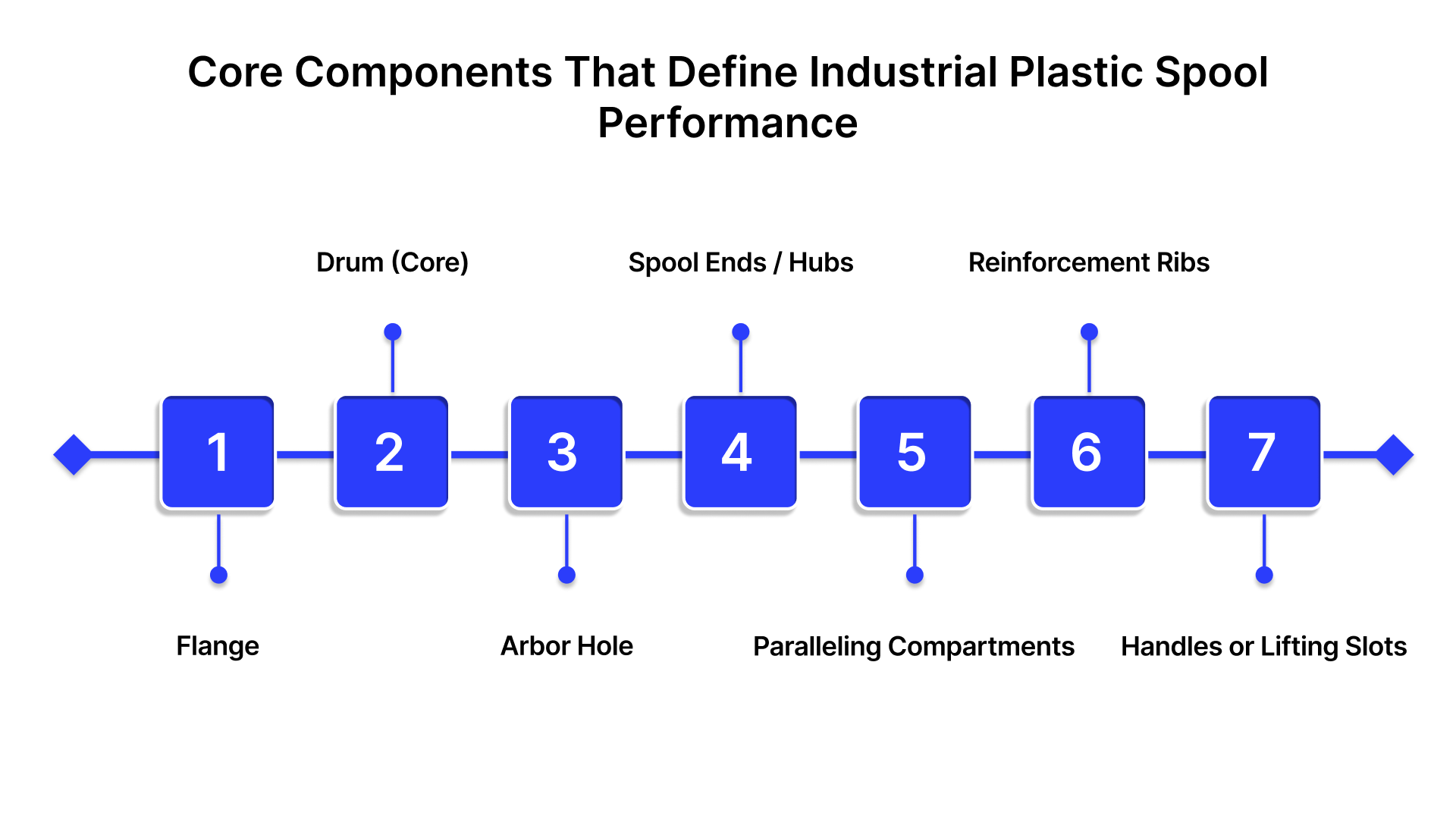
Flange
Circular plates fixed at either end of the spool core. They provide structural stability and prevent cable deformation during transport and payout.
Drum (Core)
The central cylinder that holds the cable or tubing. It can include integrated staves or internal flanges to create multiple compartments for organized winding.
Arbor Hole
A central hole for inserting an axle or mandrel. This allows controlled rotation during payout using reel stands or lifting equipment.
Spool Ends / Hubs
Reinforced sections connecting the flanges to the drum. They enhance load-bearing capacity and maintain spool alignment under tension.
Paralleling Compartments
Optional internal flanges divide the drum into sections. They allow multiple cable types or layers to be wound without tangling.
Reinforcement Ribs
Raised ribs along the drum or flanges. They improve structural rigidity, reduce flex under heavy loads, and extend spool life.
Handles or Lifting Slots
Integrated cutouts for manual handling or machine lifting. They simplify movement in warehouses, factories, and construction sites.
Inconsistent payout, flange deflection, and handling damage often result from generic or underspecified plastic spools. Narco supplies Process Reels, Magnet Wire Reels, Big Bore plastic reels, Fine Wire reels, and Data Cable Spools manufactured from new ABS plastic. These plastic spools are built to customer specifications and aligned with DIN 46395, DIN 46397, and NEMA WC 26, ensuring controlled payout and compatibility with high-speed winding and installation systems.
Next, we’ll explore the ten key benefits of industrial plastic spools.
10 Benefits of Industrial Plastic Spools Across Production and Installation
Industrial plastic spools offer a range of advantages that improve handling, durability, and efficiency across cable, tubing, and rope operations. Understanding these industrial plastic spools benefit manufacturers and project teams by helping them optimize installation, storage, and transport workflows.
1. Lightweight and Durable
PP plastic spools are significantly lighter than wooden or steel alternatives, making them easier to handle, transport, and store across manufacturing and field operations. They provide superior impact resistance, protecting cables, ropes, and tubing during movement and storage, reducing deformation over repeated use.
Handling Efficiency: Reduced manual lifting effort decreases worker fatigue and accelerates installation and staging operations in production lines or construction sites.
Transport Optimization: Lighter spools allow higher pallet density and more efficient vehicle loading, cutting freight costs and improving supply chain KPIs.
Damage Reduction: Impact-resistant construction minimizes cable abrasion and insulation damage, lowering scrap rates and rework costs.
Who Does It Benefit:
Plant Engineers: Managing high-volume cable or tubing production.
Project Managers: Overseeing construction, telecom, or infrastructure installations requiring rapid spool handling.
Procurement Teams: Monitoring cost per installed meter and minimizing freight overhead.
2. Chemical Resistance
PP plastic spools resist a wide range of acids, bases, and solvents, making them ideal for industrial environments with exposure to corrosive materials. This chemical stability ensures the spool maintains structural integrity, protecting cables, ropes, and tubing from degradation. They are especially suitable for industries handling lubricants, cleaning agents, or chemical-based coatings.
Corrosion Protection: Prevents material weakening or surface damage when exposed to harsh chemicals.
Extended Service Life: Reduces frequency of spool replacement, lowering lifecycle costs and downtime.
Safe Material Storage: Maintains cable and tubing integrity even in chemically aggressive environments.
Who Does It Benefit:
Manufacturing Engineers: Handling chemical-resistant cables, tubing, or coated conductors.
Quality Assurance Teams: Ensuring product integrity through storage and transport.
Maintenance Managers: Reducing replacement costs and minimizing process interruptions.
3. Weather Resistance
PP plastic spools withstand UV radiation, extreme temperatures, and moisture, making them ideal for outdoor cable installations and storage. They maintain structural stability even under prolonged exposure to sun, rain, or freezing conditions. This ensures consistent cable performance across telecommunication networks, power distribution, and renewable energy projects.
UV Protection: Prevents cracking, brittleness, or color fading under prolonged sunlight exposure.
Temperature Tolerance: Maintains dimensional integrity across extreme hot or cold environments.
Moisture Resistance: Prevents water absorption that can compromise cable insulation and spool strength.
Who Does It Benefit:
Project Managers: Setting up outdoor telecommunication, electrical, or renewable energy infrastructure.
Site Engineers: Maintaining consistent cable performance in variable weather conditions.
Operations Teams: Reducing replacement cycles and downtime due to environmental damage.
4. Recyclability
PP plastic spools are fully recyclable, providing an environmentally friendly solution for cable, rope, and tubing operations. At the end of their lifecycle, they can be reprocessed into new spools or industrial products, reducing waste and carbon footprint.
Sustainable Operations: Enables manufacturers to meet ESG goals and reduce landfill waste.
Cost Recovery: Recycled material can offset raw material expenses in spool production.
Regulatory Compliance: Supports adherence to state and federal environmental standards in industrial operations.
Who Does It Benefit:
Procurement Teams: Implementing sustainable sourcing and cost-effective material reuse.
Environmental Compliance Officers: Ensuring operations meet local and national recycling regulations.
Plant Managers: Reducing industrial waste while promoting eco-friendly practices.
5. Customization and Design Flexibility
PP plastic spools can be tailored in dimensions, flange design, drum width, and core size to accommodate specific cable, rope, or tubing types. Custom color options aid in cable identification and inventory organization across production, storage, and installation sites.
Tailored Dimensions: Optimizes spool size for varying cable gauges, lengths, and load requirements.
Color Coding: Improves cable tracking, reduces installation errors, and simplifies inventory management.
Design Adaptability: Supports integrated features like multiple compartments, staves, or reinforcement ribs for specialized operations.
Who Does It Benefit:
Manufacturing Engineers: Matching spool design to product line requirements for high efficiency.
Project Managers: Simplifying on-site cable identification and installation workflows.
Procurement Teams: Reducing costs associated with mismanaged inventory and installation errors.
6. Corrosion Resistance
PP plastic spools resist rust and chemical-induced corrosion, unlike steel alternatives, ensuring reliable cable storage and usage in humid or chemically active environments. This extends service life and maintains spool structural integrity under industrial conditions.
Rust Prevention: Protects metal components and prevents contamination of sensitive cables.
Durable Performance: Maintains shape and strength even in high-humidity storage or chemical-exposed sites.
Maintenance Reduction: Reduces cleaning, coating, or replacement requirements over the spool lifecycle.
Who Does It Benefit:
Plant Engineers: Preserving spool integrity in cable and rope production.
Facility Managers: Minimizing maintenance tasks and downtime in storage areas.
Procurement Teams: Lowering replacement costs and extending operational ROI.
7. Reduced Handling Costs
Lightweight PP spools reduce labor and equipment requirements during transport, installation, and storage. They streamline warehouse workflows and on-site implementation, contributing to measurable operational efficiency.
Labor Efficiency: Less manual lifting decreases worker fatigue and injury risk.
Equipment Savings: Reduced dependence on forklifts, cranes, or heavy-duty handling tools.
Faster Installation: Improves installation speed, reducing project timelines and labor hours.
Who Does It Benefit:
Project Managers: Accelerating implementation in construction and telecom projects.
Safety Officers: Reducing strain injuries and ergonomic risks.
Operations Teams: Improving KPI metrics on labor productivity and material handling.
8. Hygienic Properties
Plastic spools are ideal for environments requiring strict hygiene, such as medical, pharmaceutical, or food-grade cable installations. They resist bacterial growth, are easy to clean, and prevent contamination of sensitive materials.
Easy Cleaning: Smooth surfaces simplify sanitation procedures for controlled environments.
Contamination Prevention: Limits exposure to dust, moisture, or microbial buildup.
Compliance Support: Meets hygiene and regulatory standards in sensitive industrial settings.
Who Does It Benefit:
Medical Facility Engineers: Ensuring clean cable installation in sensitive environments.
Quality Assurance Teams: Maintaining compliance with ISO and safety standards.
Project Managers: Protecting sensitive cable materials from contamination.
9. Enhanced Safety
Plastic spools reduce sharp edges, splinters, and heavy lifting hazards associated with wood or steel alternatives.
They improve operator safety across storage, transport, and installation workflows.
Injury Reduction: Smooth edges and a lightweight design minimize cuts, bruises, and strains.
Stable Handling: Maintains structural integrity under stress, reducing risk of accidental rollouts.
Ergonomic Benefits: Simplifies manual handling, reducing repetitive strain injuries in high-volume operations.
Who Does It Benefit:
Safety Officers: Lowering workplace accident rates and OSHA reportable incidents.
Project Managers: Reducing on-site safety risks during installation.
Warehouse Teams: Easier and safer spool handling in storage and staging.
10. Long-Term Cost Savings
Despite higher upfront costs compared to simple disposable spools, PP plastic spools save money through durability, reusability, and reduced material damage.
They offer measurable ROI across cable, rope, and tubing projects.
Reduced Replacement Costs: Durable design reduces the frequency of spool procurement.
Lower Scrap Rates: Protects cables and tubing from damage during handling.
Operational Efficiency: Faster implementation and handling lowers labor and downtime costs.
Who Does It Benefit:
Procurement Teams: Improving total cost of ownership metrics and ROI.
Plant Engineers: Maintaining production throughput while reducing material waste.
Project Managers: Optimizing installation costs on large-scale infrastructure and telecom projects.
Now, let’s examine the handling equipment required for the proper installation of these spools.
Choosing Industrial Plastic Spools Handling Equipment for Installation
Efficient handling of industrial plastic spools requires the right equipment to maintain cable integrity, reduce labor costs, and improve setup speed. Selecting suitable tools ensures spools rotate smoothly, pay out evenly, and prevent damage during installation.
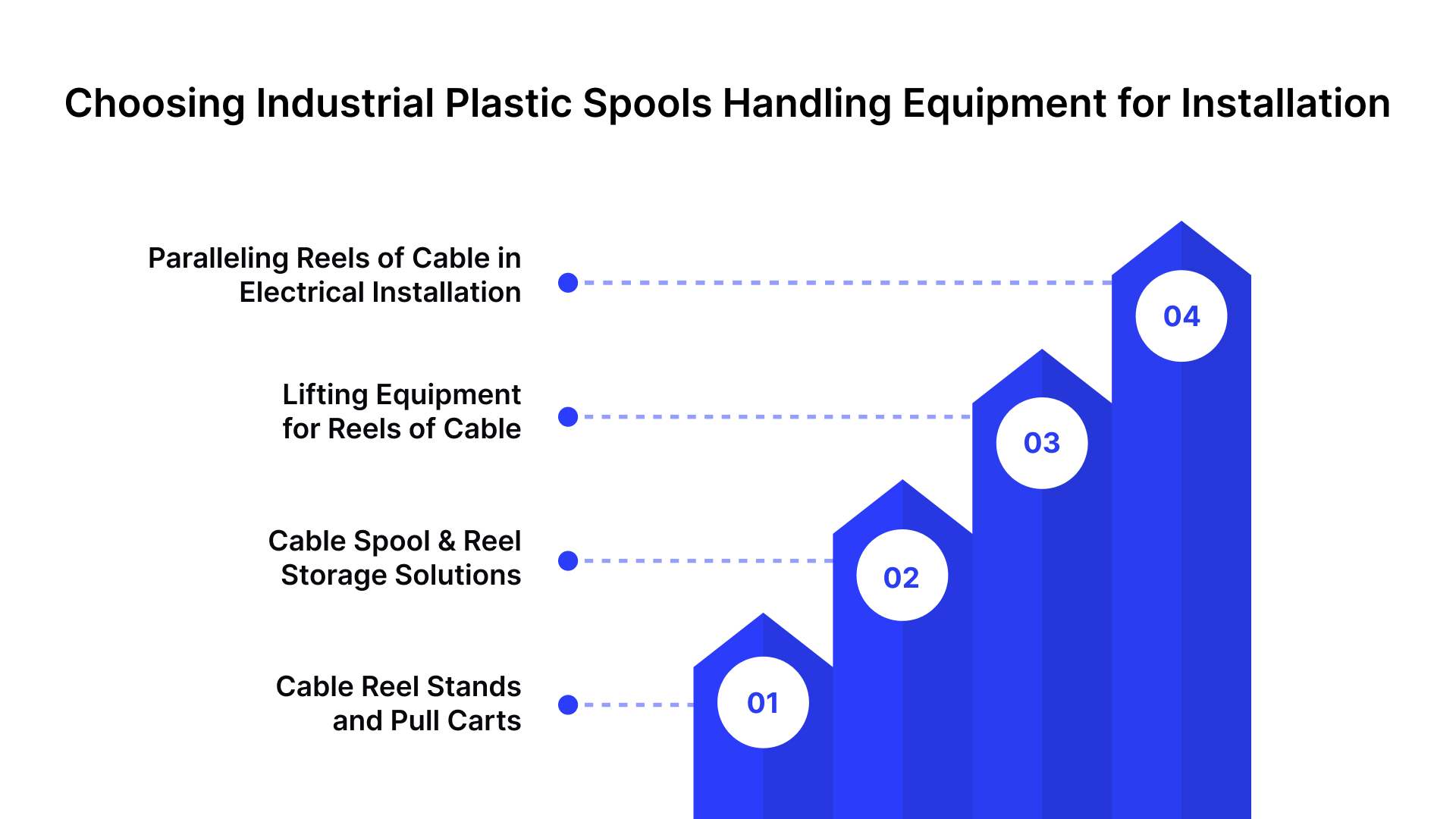
1. Cable Reel Stands and Pull Carts
Function: Supports spools during controlled payout or transport across factory floors or field sites.
Benefit: Reduces manual lifting, prevents spool deformation, and maintains consistent tension during setup.
Use Case: Ideal for high-volume cable production lines or outdoor telecom installations where speed and accuracy matter.
2. Cable Spool & Reel Storage Solutions
Function: Racks, shelving, or vertical storage systems designed for spool organization.
Benefit: Maximizes warehouse space, protects cables from crushing, and improves inventory visibility.
Use Case: Wire and cable manufacturers in Ohio or Georgia can store multiple spool sizes safely and accessibly.
3. Lifting Equipment for Reels of Cable
Function: Forklift attachments, hoists, or cranes are used to move heavy spools safely.
Benefit: Prevents worker injury, reduces handling time, and avoids damage to the spool or cable.
Use Case: Essential for steel or large plastic spools in metal processing, power transmission, or infrastructure projects.
4. Paralleling Reels of Cable in Electrical Installation
Function: Multiple spools mounted together for simultaneous payout of parallel cables.
Benefit: Improves installation efficiency, ensures synchronized cable placement, and minimizes tangling or crossovers.
Use Case: Critical in data centers, power distribution systems, and high-capacity telecom networks.
Now let’s see how Narco turns these industrial plastic spools benefits into measurable operational gains.
Turn the Industrial Plastic Spools Benefits Into Measurable Operational Gains with Narco
Industrial plastic spools only deliver real value when they’re engineered, specified, and supported correctly across their full lifecycle. That’s where Narco brings a distinct advantage for manufacturers managing throughput, quality, and cost pressure. With decades of reel engineering expertise and direct access to plastic reels, Narco helps teams reduce handling risk, extend asset life, and standardize performance. For wire, cable, rope, and tubing operations, this means fewer failures, faster installs, and better ROI per spool in production and shipping environments.
How Narco’s Products Support Industrial Plastic Spool Performance
Plastic Reels & Spools: ABS plastic reels and spools engineered for process and shipping use, available in custom colors for inventory control and line-side identification.
Process & Magnet Wire Reels: Designed for consistent payout, dimensional stability, and compatibility with high-speed winding and extrusion lines.
Big Bore & Data Cable Spools: Optimized arbor sizing and flange geometry to reduce deformation and protect insulation during storage and transit.
Custom-Built to Standards: Manufactured to customer specifications and aligned with DIN 46395, DIN 46397, and NEMA WC 26 where applicable.
Integrated Steel & Plastic Strategy: Ability to pair plastic spools with steel reels or drums for mixed-load, hybrid production environments.
Reel Lifecycle Support: Repair, refurbishment, modification, warehousing, and inventory support to lower the total cost of ownership.
If you’re scaling cable production in Ohio, optimizing telecom implementations in Georgia, or managing infrastructure supply chains across the Southeast, Narco helps you fully realize the benefits of industrial plastic spools without compromising durability, compliance, or performance.
Conclusion
Industrial plastic spools offer a combination of durability, lightweight design, and chemical and weather resistance, delivering measurable efficiency gains in cable, rope, and tubing operations. From optimized storage and handling to safer installation workflows, understanding the industrial plastic spools benefits helps manufacturers and project teams reduce downtime, material loss, and labor costs.
By selecting the right spool type, understanding component design, and pairing with proper handling equipment, such as reel stands, pull carts, and lifting systems, industrial operators in Ohio, Georgia, South Carolina, and Tennessee can improve throughput, protect high-value cables, and maximize ROI.
Many manufacturers adopt industrial plastic spools but still rely on aging steel reels that introduce imbalance, misalignment, and downtime. Narco supports Plastic Spools, Plastic Reels, Steel Drums, Fully Machined Steel Reels, Semi-Machined Reels, and Metal Flanged Reels, enabling a coordinated reel strategy across process and shipping operations. With flexible balancing, arbor tube repair, flange straightening, and custom fabrication, Narco helps reduce scrap, extend reel life, and stabilize throughput KPIs.
Contact Narco for custom process reels, magnet wire reels, big bore plastic spools, and hybrid steel-plastic reel systems with full technical support.
FAQs
1. What factors should manufacturers consider when selecting plastic spools for high-voltage cables?
Consider load capacity, flange diameter, drum width, environmental exposure, chemical resistance, and compatibility with automated payout systems to prevent insulation damage and maintain safety standards.
2. How do plastic spools impact installation efficiency in large-scale telecom or power projects?
Lightweight design reduces manual handling, improves payout speed, and minimizes downtime, enabling faster installation while lowering labor costs and improving operational KPIs.
3. Are PP plastic spools suitable for corrosive or chemical-rich industrial environments?
Yes. PP plastic resists acids, bases, and solvents, maintaining structural integrity and protecting sensitive cables and tubing in chemical processing or metal fabrication facilities.
4. Can industrial plastic spools be reused across multiple projects?
Absolutely. Durable design allows repeated use without deformation, reducing procurement costs, minimizing material waste, and improving lifecycle ROI for high-throughput manufacturing or construction sites.
5. How do plastic spools integrate with existing reel handling equipment?
Standard arbor holes and hub dimensions allow compatibility with reel stands, pull carts, cranes, and lifting systems for controlled payout and safer transport.