Introduction
Wire manufacturers, cable makers, and shipping companies depend on steel reels to move product safely through production and distribution. But not all steel reels are built the same — and the structural steel used to fabricate them varies considerably in grade, composition, and traceability.
That variation has real consequences. A reel built from substandard steel may hold up through a few cycles before developing cracks, deforming under load, or failing during handling — especially on larger drums rated for loads above 5,000 lbs. The cost isn't just the reel itself. It's downtime, product damage, and potential safety incidents.
Material Test Reports (MTRs) are the primary tool for verifying that the steel in your reels meets the specifications you ordered. This guide walks through how to read them, what each section tells you, and which red flags should stop a shipment before it reaches your floor.
Key Takeaways
- An MTR is a quality document certifying a steel product's chemical composition and mechanical properties, issued by the producing mill
- Key sections cover material identification, heat number, chemical composition, mechanical properties, and certifying signature
- For steel reels, tensile strength, yield strength, and hardness matter most
- A missing heat number or certifying signature is an immediate red flag
- Always verify MTRs before accepting a steel reel shipment — not after
What Are Steel Wire Reels and Why Steel Quality Matters
Steel wire reels are the structural backbone of wire and cable manufacturing and distribution. They carry conductors, rope, and cable through production lines and out to end users — sometimes at loads that stress the reel repeatedly across its service life.
NEMA WC 26-2008 defines multiple steel reel construction types, including Class 1 general-purpose and Class 2 heavy-duty classifications, with "maximum strength capacity" defined as the total weight of conductor or cable a reel can carry. That capacity is only as reliable as the steel behind it.
How Steel Grade Affects Reel Performance
The steel grade and composition of a reel determine three things directly:
- Load capacity — whether the reel can handle the weight it's rated for without permanent deformation
- Fatigue resistance — how well the reel holds up through repeated loading, unloading, and reconditioning cycles
- Weldability and repairability — whether the material can be welded without introducing cracks or brittleness
Common structural grades like ASTM A36 (yield strength Fy = 36 ksi, tensile strength Fu = 58 ksi) and ASTM A572 Grade 50 (Fy = 50 ksi, Fu = 65 ksi) represent meaningfully different performance levels. Using a lower-grade steel where a higher-strength specification was required isn't always detectable by visual inspection alone — MTRs provide the traceable proof that the steel meets spec.
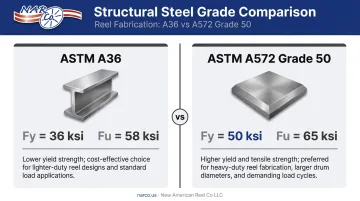
Poor-quality or misspecified steel shortens reel life, increases reconditioning frequency, and can make a reel unviable for refurbishment well before its expected retirement.
Wire and cable manufacturers sourcing new steel reels should request MTRs before accepting any shipment. Narco (New American Reel Co.) has been designing, fabricating, and reconditioning steel wire reels since 1999 to standards including NEMA WC 26 and DIN 46395/46397 — so the documentation comes with the reel.
What Is a Material Test Report (MTR)?
An MTR is a quality assurance document certifying a metal product's chemical composition and mechanical properties. It's issued by the mill or manufacturer that produced the steel, and it travels with the material through the supply chain as proof that the product meets the ordered specification.
You may see it called several things:
- Mill Test Report
- Mill Certificate or Mill Cert
- Certified Mill Test Report (CMTR)
- Metallurgical Test Report
These terms all refer to the same type of document. The terminology varies by supplier, industry, and region, but the content and purpose are consistent.
Standard MTR vs. Certified MTR
A standard MTR records test results from the producing mill's own laboratory. A certified MTR (or CMTR) adds an authorized signature — and in some cases third-party verification — confirming the data's accuracy. Nucor-Yamato Steel, for example, issues CMTRs in compliance with EN 10204 Type 3.1, with mechanical testing performed by an independent quality testing lab before material release.
EN 10204:2004 defines four inspection document types: 2.1, 2.2, 3.1, and 3.2. Type 3.2 requires independent third-party validation.
For critical applications, that distinction matters. A 2.2 declaration carries far less contractual and legal weight than a 3.1 or 3.2 certificate.
Who Can Issue an MTR
Only the steel mill or an accredited manufacturer can issue a legitimate MTR. AISC's guidance on material identification confirms that each heat of steel is tested at the mill, with results recorded on an MTR provided to the fabricator.
Treat the following as red flags when reviewing an MTR:
- Issued by a distributor with no direct relationship to the producing mill
- No clear identification of the originating mill or manufacturer
- Heat number or test data that can't be traced back to a specific production run
When sourcing steel reels, always request the MTR upfront and verify it traces back to the producing mill. That paper trail becomes critical during quality audits, regulatory reviews, and any post-failure investigation.
Key Sections of a Steel Reel MTR
Material Identification
This section lists the steel type, grade, alloy designation, dimensions, and applicable standards (such as ASTM A36/A36M or A572/A572M). It's the first thing to check: does the grade on the MTR match what you ordered?
Per ASTM A6/A6M-21, finished structural steel products must be legibly marked with heat number, grade, size, thickness, and the manufacturer's identity. When reviewing this section, confirm two things:
- The grade listed on the MTR matches your purchase order
- The physical marking on the reel material aligns with what's documented
If either check fails, stop and investigate before the material moves forward.
Heat Number
The heat number is a unique identifier assigned to a specific batch of molten steel during production. It's the central traceability reference on any MTR.
The heat number on the document must match the marking physically stamped or stenciled on the reel material and on the shipping documents. AISC identifies three levels of traceability — lot, piece-mark, and individual piece — with the heat number as the common thread across all of them. A mismatch anywhere in that chain means material identity cannot be confirmed — and the material should not be used until it is.
Chemical Composition
This section reports elemental percentages for carbon, manganese, phosphorus, sulfur, silicon, and other elements depending on the alloy. ASTM A36/A36M-19 specifies heat analysis for all of these elements, and ASTM A751-25 governs the testing methods and reporting standards.
Why it matters for reels:
- Carbon content affects hardness and weldability — higher carbon increases strength but reduces weldability
- Manganese improves toughness and tensile strength
- Phosphorus and sulfur are controlled as impurities; elevated levels reduce ductility and can cause weld cracking
Every value should fall within the specified range for the ordered grade. A value right at the boundary deserves a note and possibly additional testing.
Mechanical Properties
This section reports the results of physical testing — typically:
| Property | Test Standard | Why It Matters for Reels |
|---|---|---|
| Tensile strength | ASTM E8/E8M-22 | Ultimate load resistance |
| Yield strength | ASTM E8/E8M-22 | Load capacity without permanent deformation |
| Elongation | ASTM E8/E8M-22 | Ductility and impact resistance |
| Hardness | ASTM E18-22 | Wear and surface durability |
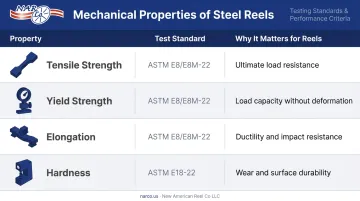
Tensile and yield strength determine how a reel performs under load — a direct concern for reels rated for heavy cable, wire, or rope. Elongation is the relevant figure when reels see impact loading or rough handling. Hardness becomes particularly important for reels that cycle through reconditioning multiple times.
Certifying Signatures and Compliance Statements
This section contains the authorized signature from the mill or manufacturer certifying that the reported data is accurate. It's what makes the document commercially and legally binding.
Before accepting the material, verify:
- The document carries a legible, authorized signature
- A recognized standard is cited (ASTM, ASME, or EN 10204)
- The compliance statement matches the grade and test results reported
If any of these are missing or unclear, contact the issuing mill directly before putting the material into service.
How to Read and Verify an MTR
Step 1: Cross-Reference the Heat Number
Match the heat number on the MTR against:
- The physical marking on the steel reel material
- The heat number on the shipping documents
Any mismatch — even a single digit — must be investigated before the material is accepted or put into production. This is non-negotiable. ASTM A6/A6M-21 requires physical marking precisely so this check is possible.
Step 2: Check Values Against Specifications
Go through each reported chemical and mechanical property and confirm it falls within the specified range for the ordered grade. A useful approach:
- Flag any value at or near the boundary of the acceptable range
- Look for consistency across related properties (chemistry should logically support the reported mechanical results)
- If anything looks unusual, request clarification from the mill before use — not after fabrication
Step 3: Verify Issuer Credentials
Once the numbers check out, the next question is who is standing behind them. Confirm the MTR originates from an accredited mill or recognized manufacturer, and check whether any referenced certifications are current and applicable to the specific grade. A document from an unverifiable distributor offers no traceability — if the chemistry or mechanical data is later disputed, there's nothing to fall back on.
Step 4: Retain All Documentation
File every MTR alongside the corresponding purchase order and shipping records. Under ISO 9001:2015 record-keeping requirements, organizations are expected to maintain records that demonstrate effective control of processes — and MTRs are central to that.
The practical payoff shows up when problems arise. If a reel fails in service, or comes in for reconditioning and the question is whether it's worth refurbishing, the original MTR gives you a baseline. Without it, that decision is a guess — and guesses cost time and money.
Red Flags to Watch For in an MTR
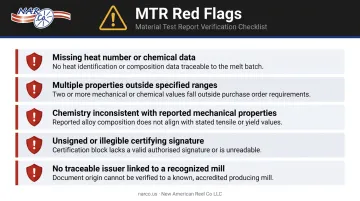
A legitimate MTR should always contain five things: material identification, heat number, chemical composition, mechanical test results, and a certifying signature. When any of these are missing, set the material aside until the gap is resolved.
Specific red flags to watch for:
- No heat number, missing chemical data, or mechanical results without test method references
- Multiple properties outside specified ranges across chemistry and mechanical results — one outlier may be normal variation; several suggests mislabeled or substandard material
- Chemical composition that doesn't support the reported mechanical properties (for example, very low carbon paired with unusually high hardness)
- Unsigned or illegible signature — undocumented certification has no standing
- No traceable issuer — if the document can't be linked to a recognized mill or accredited manufacturer, treat it as unverified
The U.S. Department of Justice reported a case where a former lab director was sentenced to prison for falsifying steel test results for Navy submarine parts. The NRC documented a separate case involving falsely marked steel and fraudulent documentation bearing other companies' letterheads. The BSSA has also warned that EN 10204 certificates are sometimes re-issued or modified and presented as originals — a form of misuse that can allow non-compliant material into critical applications.
Buy from established suppliers, cross-reference heat numbers with shipping documents, and independently verify properties on any shipment where something doesn't add up.
Frequently Asked Questions
How do you check a steel test report?
Verify the heat number on the MTR against the physical marking on the material and against the shipping documents. Then confirm all chemical and mechanical property values fall within the specified ranges for the ordered grade. Finally, check that an authorized certifying signature is present.
What is a metallurgical test report?
A metallurgical test report is an informal name for a Material Test Report (MTR) or Mill Test Report — one that documents the chemical composition and mechanical properties of a metal product to confirm it meets the required specification and applicable industry standards.
What steel properties matter most for wire reels?
Three properties stand out:
- Tensile and yield strength — determines how well the reel handles heavy loads without deforming
- Hardness — affects surface durability through reconditioning cycles
- Elongation — indicates ductility, which matters when reels face impact loading or rough handling
What is a heat number on a material test report?
A heat number is a unique code assigned to a specific batch of steel melted during production. It links every piece of material back to its MTR and is the primary reference for confirming that a physical reel component matches its documentation.
Can a Material Test Report be falsified?
Yes, though it's rare. MTR fraud has led to criminal prosecutions — including a case involving falsified steel test results for U.S. Navy submarine components. Purchasing from established suppliers, cross-referencing heat numbers, and independently testing suspect material are the best practical defenses.