Introduction
Wire and cable manufacturers face constant pressure to maximize uptime while keeping costs in check. Line speed, throughput targets, and OEE scores get daily attention. Wire reel condition rarely does — until something breaks.
That's the pattern: reels get treated as passive containers rather than production components, and their condition only becomes a priority when a stoppage, a scrap event, or an equipment repair forces the issue. By then, the cost has already landed.
This article breaks down how wire reel quality drives three measurable production outcomes: line availability, wire quality consistency, and equipment health. It also covers what proactive reel management looks like when it's built into daily operations rather than triggered by failure.
Key Takeaways
- Structurally sound reels reduce unplanned stoppages that erode OEE availability
- Out-of-spec reel geometry creates tension spikes, wire kinks, and scrap that silently degrade the OEE quality factor
- Imbalanced or defective reels accelerate bearing and spindle wear through nonlinear load increases
- High-performing cable factories target unplanned downtime below 3% of total machine hours, and reel failures eat directly into that margin
- Schedule regular inspection, reconditioning, and dynamic balancing to keep reels performing reliably
What Is Wire Reel Quality?
Wire reel quality means the degree to which a reel's structural components — flanges, hub, core, barrel, and hardware — meet the dimensional and mechanical specifications required for consistent, safe operation on a production line.
Those specifications matter at every stage of production:
- Wire drawing — reels as take-up points under continuous tension
- Stranding and bunching — pay-off reels that must feed smoothly at speed
- Insulating and jacketing — take-up drums handling increasing cable diameter
- Shipping and distribution — reels that protect finished product through transit
Standards like DIN 46395 for machine spools and NEMA WC 26 for packaging reels exist because reel geometry and capacity are recognized engineering variables — not background details.
A reel that is out of spec doesn't just look wrong. Flange warp, hub runout, or an undersized barrel can cause uneven tension, wire crossovers, or reel failure mid-run — problems that compound across every meter of product on that reel.
Key Advantages of Wire Reel Quality
The benefits of maintaining high-quality wire reels aren't abstract. They map directly to KPIs that plant managers and production teams track every shift.
Advantage 1: Fewer Unplanned Stoppages and Higher Line Availability
Structurally sound reels — with true flanges, secure cores, and intact hardware — allow wire to feed and collect smoothly. When reels degrade, that smoothness disappears fast.
Common failure modes that cause stoppages:
- Warped flanges create uneven wire layering, leading to wire jumps and birdnesting
- Loose or broken hardware can jam pay-off stands mid-run, requiring a full shutdown to clear
- Out-of-round flanges on pay-off reels generate tension surges that trip tension-sensitive line controls
OEE availability is calculated as Run Time divided by Planned Production Time, and every unplanned stop counts against it. UL Solutions benchmarks high-performing cable factories at unplanned downtime below 3% of total machine hours, with Nett OEE in the 90% to 95% range for continuous operations. A single reel-caused line stop per shift can erode that margin within a week.
KPIs affected: Machine availability rate, OEE availability factor, MTBF for line stoppages, changeover time
When it matters most: High-volume continuous operations — wire drawing, stranding, and take-up lines where any stoppage has an outsized cost and drum changes are already a planned downtime driver.
Advantage 2: Consistent Wire Quality and Lower Scrap Rates
Reel geometry controls how wire winds and unwinds. Flange concentricity, barrel surface condition, and correct traverse width all affect tension consistency — and tension consistency directly determines wire quality.
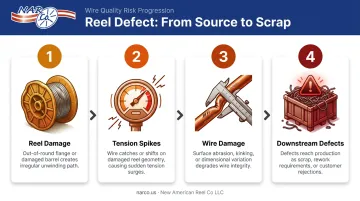
The failure sequence looks like this:
- Out-of-round flange or damaged barrel surface creates an irregular unwinding path
- Tension spikes occur as wire catches or shifts
- Wire surface abrasion, kinking, or dimensional variation results
- Defects move downstream, surfacing as scrap, rework, or customer rejections
UL Solutions defines the OEE quality factor as good product length versus total length manufactured — the difference being scrap. Reel-induced defects degrade this ratio without triggering a machine alarm. The line keeps running while scrap accumulates undetected.
When wire enters a die at an inconsistent angle due to poor feed geometry, deformation concentrates unevenly — initiating surface shear cracks that lead to breakage.
KPIs affected: Scrap rate, first-pass yield, OEE quality factor, customer return rate, material waste cost per run
When it matters most: Fine wire and precision conductor operations where tension tolerances are tight, and in any operation where reels run multiple production cycles without inspection between them.
Advantage 3: Equipment Protection and Operator Safety
Wire reels interact directly with machine spindles, bearings, brakes, and traverse systems. A reel that is out of balance or dimensionally incorrect transfers mechanical stress into equipment with every rotation.
Per bearing load-life engineering, eccentric unbalance in rotating components directly affects bearing loads and vibration. SKF's bearing life calculations use a load-life exponent of 3 for ball bearings and 10/3 for roller bearings. Because bearing life changes nonlinearly with load, even a modest imbalance running across multiple shifts compounds into significantly accelerated wear.
That accelerated wear creates a safety exposure, not just a maintenance cost. OSHA 1910.212 requires guarding against hazards from rotating parts, revolving drums, and containers — and a structurally compromised reel running at production speed is a projectile hazard.
Real-world failure modes include:
- Imbalanced reels generating vibration that accelerates bearing wear on pay-off and take-up stands
- Cracked or deformed hubs shifting under load and damaging spindle seats
- Structural reel failure mid-run creating flying debris near operators
KPIs affected: Maintenance cost per machine, bearing/spindle replacement frequency, safety incident rate, equipment lifespan
When it matters most: High-speed wire drawing and stranding operations; large drum applications where imbalance forces amplify; multi-shift environments where degradation accumulates between scheduled maintenance windows.
What Happens When Wire Reel Quality Is Neglected
Poor reel condition doesn't create one visible problem — it creates several compounding ones:
- Inconsistent wire tension during processing produces defects that only surface during customer quality checks, turning process control into reactive quality inspections.
- Unplanned stoppages pull operators and supervisors away from production goals and into clearance and re-threading work.
- Gradual bearing and spindle wear from reel-induced vibration accumulates inside maintenance budgets without being traced back to reel condition — the root cause stays hidden.
- Rising scrap and rework costs are difficult to attribute without tracking reel-related defect events specifically.
- Adding throughput or extra shifts when reel inventory is in poor condition amplifies existing reliability and quality problems rather than solving them.
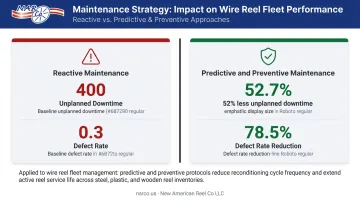
Research on maintenance maturity in manufacturing shows that organizations relying on predictive and preventive maintenance experienced 52.7% less unplanned downtime and 78.5% fewer defects compared to reactive-maintenance counterparts. For reel fleets, that means regular condition assessments and scheduled reconditioning — before a degraded reel becomes a line stoppage or a scrap spike.
How to Get the Most Value from Wire Reel Quality
Maximizing reel value means treating reels as production assets with a defined inspection and maintenance cycle — not passive containers replaced only when visibly broken.
Build a Regular Inspection Protocol
Before each production run — or at defined intervals — check:
- Flange trueness: Any warp or run-out that would create uneven wire layering
- Core and barrel condition: Surface damage that could abrade wire during winding
- Hardware integrity: Drive pins, arbor tubes, and fasteners that should be secure and undamaged
- Structural welds: Visible cracking or separation at high-stress joints
Catching these issues early prevents wire damage, winding defects, and unplanned downtime mid-run.
Use Dynamic Balancing to Verify Rotational Performance
Visual inspection doesn't catch imbalance. Dynamic balancing identifies uneven weight distribution and confirms that a reel rotates within acceptable vibration limits at operational speeds. For larger drums especially, this step is not optional — imbalance forces scale with both reel size and rotational speed.
Narco provides dynamic balancing for new reels and for reels already in service that may have shifted out of tolerance through use or repair.
Evaluate Reconditioning Before Defaulting to Replacement
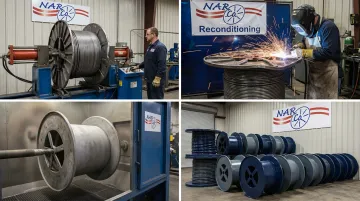
When reels show wear or dimensional drift, reconditioning is often the more cost-effective path. Narco's reconditioning services cover:
- Flange straightening and press work
- Damaged rim repairs
- Drive pin hole and arbor tube repair or replacement
- Welding, machining, and hardware replacement
- Blasting, painting, and stenciling
Reconditioning makes sense when the core structure is sound and damage is limited to flanges, hardware, or surface condition. When structural integrity is compromised beyond repair, replacement is the right call — and that determination should come from a professional assessment of weld integrity, dimensional accuracy, and load capacity.
Narco has handled wire reel reconditioning and repair since 1999, working with steel reels from 3" to 96" in diameter across wire drawing, stranding, extrusion, and shipping applications.
Conclusion
Wire reel quality is a direct input into production availability, wire consistency, and equipment health — and its effects compound when left unmanaged.
The effects of reel condition show up in the KPIs operations teams already track:
- OEE availability — downtime tied to reel failures reduces machine uptime directly
- Scrap rate and first-pass yield — dimensional drift and surface damage translate to wire defects
- Maintenance cost per machine — worn reels accelerate wear on payoff equipment and guides
Reel-driven losses appear in those numbers whether or not anyone has connected them to reel condition.
Consistent inspection, timely repair, and reconditioning before reels drift out of spec is what keeps production running at target — not recovering from failures after the fact.
Frequently Asked Questions
Why does cable length matter?
Longer cable runs introduce greater electrical resistance and voltage drop, which reduces the performance of connected equipment. In production contexts, cable length from reel to machine also affects tension and feed consistency — longer unsupported runs can introduce slack or tension variation that affects winding quality.
What can cause interference in a cable?
Common sources include electromagnetic interference from nearby equipment, damaged or degraded shielding, poor connector quality, and physical damage such as kinks or sharp bends. Poor reel handling and damaged reel surfaces can introduce or worsen several of these, particularly kinking and shielding abrasion during winding.
What are the signs that a wire reel needs repair or reconditioning?
Visible signs include warped or cracked flanges, damaged hub seats, loose or missing hardware, and uneven wire layering during winding. Less obvious indicators — abnormal vibration and recurring tension spikes on the line — often trace back to reel condition before any physical damage becomes apparent.
How does dynamic balancing improve wire reel performance?
Dynamic balancing corrects uneven weight distribution, reducing vibration at operational speeds and protecting machine bearings from nonlinear load increases. The result is more consistent wire tension during unwinding and longer service life for both the reel and the equipment it runs on.
When does it make more sense to recondition a wire reel rather than replace it?
Reconditioning makes sense when the reel's core structure is intact and damage is limited to flanges, hardware, or surface condition. For most reels without catastrophic structural failure, a professional assessment of weld integrity and dimensional accuracy will confirm that reconditioning restores full performance at a fraction of replacement cost.