Introduction
Material handling incidents cost U.S. businesses over $12.63 billion annually, with overexertion injuries alone accounting for 21.76% of all disabling workplace injuries. For wire and cable operations, these risks intensify when handling heavy, cylindrical reels.
"Struck by object or equipment" incidents add another $5.66 billion in annual costs, while "caught in or compressed by equipment" injuries contribute $2.19 billion more—categories directly tied to dropped loads, crushing injuries, and forklift accidents.
The operational consequences are immediate: lost workdays disrupting production schedules, damaged cable inventory, reel replacement costs, and OSHA citations reaching six figures.
A Texas reel manufacturer faced $107,952 in fines for amputation hazards. A wire producer paid $47,000 following a worker fatality involving rotating equipment.
The combination of substantial weight, awkward cylindrical geometry, and high-value cable creates significant risk when proper procedures are bypassed. This guide provides actionable protocols to protect personnel, preserve product integrity, and maintain operational efficiency.
Key Takeaways
- Document flange damage, loose cable ends, and impact evidence with photos before signing delivery receipts
- Lifting equipment must contact flanges only (forklifts) or use steel bars through arbor holes (cranes)—never touch cable surfaces
- Always roll in winding direction and clear paths of debris to prevent cable loosening
- Upright storage on level surfaces protects reels—keep flanges vertical and away from moisture/temperature extremes
- Reseal cable ends immediately after cutting; secure to flanges before moving
Receiving and Inspecting Reels
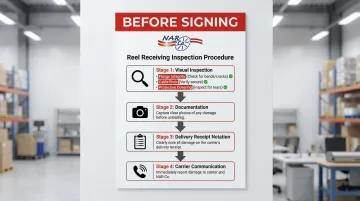
The receiving stage is your first (and only) opportunity to establish carrier liability for shipping damage. Accepting damaged reels without proper documentation transfers financial responsibility to your facility and creates downstream safety hazards during handling and installation.
Critical Inspection Points Before Accepting Delivery:
- Flange integrity - Check for cracks, breaks, or warping on both flanges
- Cable end security - Verify ends are properly fastened to flanges and sealed
- Protective covering condition - Inspect wrapping for tears, removal, or water damage
- Impact evidence - Look for dents, gouges, or deformation indicating dropping
- Pallet damage - Examine support structures for breakage or weakness
- Reel positioning - Confirm reels are upright (flanges vertical), not lying flat
Hidden Damage Indicators:
Surface inspection alone isn't always enough. Certain delivery conditions require immediate detailed inspection beneath cable layers:
- Reels delivered flat on their sides (flanges horizontal)
- Evidence of dropping or severe impact
- Stacked reels or freight piled on top
- Removed or severely damaged protective covering
- Nails driven into flanges to secure shipping blocks
Documentation Requirements:
Carriers explicitly reject "subject to inspection" notations as valid damage claims. To preserve your right to recover costs:
- Document damage immediately - Take photos showing specific issues (broken flanges, exposed cable, impact marks)
- Note all damage on the delivery receipt - Be specific before signing, not general
- Report damage to the carrier - Contact them immediately upon discovery
- Inspect beneath protective layers - If covering is damaged, inspect then replace before storage
Proper documentation at delivery protects your facility financially and prevents damaged reels from entering your workflow, where they pose increasing safety risks during subsequent handling operations.
Safe Handling Methods
Improper handling causes the majority of reel damage, cable waste, and workplace injuries in wire product facilities. Safe reel movement requires matching the correct equipment and technique to reel size, weight distribution, and movement requirements.
All personnel must understand weight dynamics, pinch points, and momentum risks before attempting to move reels.
Lifting with Forklifts
Forklifts are the most common reel-moving equipment but represent a critical failure point when used incorrectly. Proper technique prevents crushing damage and ensures operator safety.
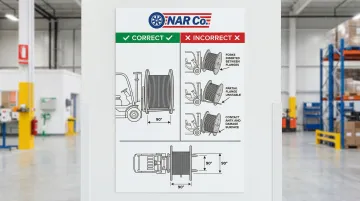
Proper Forklift Technique:
- Fork placement: Forks must extend fully under both flanges at a 90-degree angle to the reel
- Fork length: Forks must be long enough to make complete contact with both flanges simultaneously
- Lift position: Always lift from the sides when the reel is upright (flanges vertical)
- Horizontal reels: If lifting a reel on its side, place forks under the bottom flange only—never lift by the top flange
Prohibited Practices:
- Don't insert forks between flanges—this crushes cable layers
- Avoid fork contact with cable surface or protective wrapping
- Never use forks to push reels sideways
- Forks must fully support both flanges, not just touch the edges
OSHA regulations require written manufacturer approval for any forklift modifications, including specialized reel attachments that affect capacity or safe operation.
Lifting with Cranes or Overhead Devices
When reels exceed forklift capacity or access limitations require overhead lifting, crane operations demand even stricter rigging protocols to prevent structural failure and flange damage.
Required Equipment:
- Steel lifting bars of suitable diameter inserted through the arbor hole
- Spreader bars or lifting yokes to prevent side pressure on flanges
- Daily rigging inspection by a competent person before use (OSHA 1910.184)
Critical Requirements:
Direct chain or cable contact with flanges causes crushing damage that renders reels unusable and unsafe. Lifting by the top flange alone or using undersized diameter bars can cause flange separation or rod failure under load.
Rolling Reels
Manual rolling often provides the most efficient movement method for short distances but creates significant crushing hazards without proper controls.
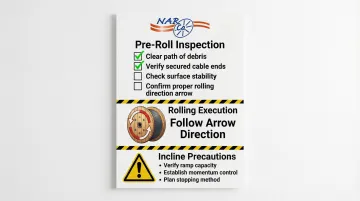
Rolling Direction Rules:
Always roll reels in the direction indicated by arrows on the flanges (typically opposite the winding direction). This tightens cable layers. Rolling in reverse loosens layers, creating tangles and overlaps.
Pre-Roll Checklist:
Before rolling any reel:
- Clear the path of rocks, blocks, pipes, and debris
- Verify cable ends are secured to flanges
- Ensure flanges will not straddle objects that could damage cable
- Confirm the surface can support reel weight without sinking
Incline Safety:
Ramps and slopes demand additional precautions:
- Verify ramp load-bearing capacity and width—both flanges must fit with safety margin
- Establish momentum control method before releasing the reel, as rolling speed increases rapidly on inclines
- Plan your stopping method using flanges only, never by contacting cable surface
- OSHA requires chocks or restraints for stored reels where accidental rolling is possible
Proper Storage Practices
Storage conditions directly determine reel lifespan, cable integrity, and handling safety when reels eventually move to production. Poor storage creates hidden damage that manifests during installation or subsequent handling.
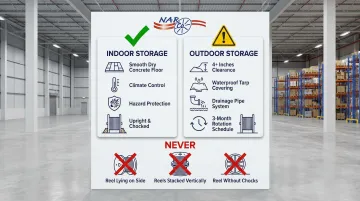
Indoor and Outdoor Storage Guidelines
Ideal Indoor Storage:
Store reels indoors on smooth, hard, dry surfaces away from:
- High-traffic areas and falling object zones
- Chemical or oil spill areas
- Welding operations and open flames
- Excessive heat sources
Outdoor Storage Requirements:
When indoor space is unavailable:
- Surface: Hard, level surface or support system (timbers, pallets) to prevent flanges sinking into ground
- Elevation: Minimum 10 cm (4 inches) above ground level
- Protection: Weatherproof covering to protect cable from UV degradation and wood from moisture
- Drainage: Ensure water cannot pool around or under reels
Storage Position and Stability
Critical Positioning Rules:
- Reels must always be stored upright with flanges vertical—never on sides
- Never stack reels on top of each other
- Chock from both sides to prevent rolling
- Maintain clearance from walls and other equipment for inspection access
Maintenance for Stored Reels:
- Bolt tightening: Check and tighten flange bolts at regular intervals
- Rotation schedule: Roll reels 90 degrees every three months for long-term storage to prevent warping
- Cable end sealing: Immediately reseal and secure any cut cable ends to prevent moisture entry
- Regular inspection: Monthly checks for deterioration, rot, or structural weakness
When storage inspections reveal damage, reconditioning becomes a cost-effective alternative to replacement. Reels showing flange damage, imbalance, or deterioration from extended storage can often be reconditioned through professional repair services rather than being scrapped. Companies such as NARCo specialize in reconditioning, dynamic balancing, and welding repairs to extend reel life and restore structural integrity.
Efficient Cable Removal and Unwinding
Proper cable unwinding protects your investment and prevents costly damage. While cable can be unwound from either the top or bottom of a reel, reel-to-reel rewinding demands careful setup to avoid reverse bending and internal cable damage.
Reel-to-Reel Setup Process
- Support both reels on jacks or stands with bars through arbor holes for easy turning
- Maintain minimum 20 feet between reel flanges to allow cable straightening before rewinding
- Position reels to follow the cable's natural cast—reverse bending causes internal damage
- Never pull cable over reel flanges or sides—this produces kinks and twists that compromise performance
Once your reels are properly positioned, maintaining correct bend radius during unwinding is critical.
Bend Radius Specifications
Following bend radius limits maintains cable electrical and physical properties. Use these minimum requirements during all unwinding operations:
| Cable Type | Minimum Bend Radius |
|---|---|
| Single-conductor shielded cables | 12× overall cable diameter |
| Unshielded cables | 8× overall cable diameter |
| Type MC armored cables | 7× overall cable diameter |
Exceeding these limits causes permanent internal damage. This damage shows up later as difficult installations and premature cable failure.
Common Mistakes That Compromise Safety and Efficiency
Even experienced operators make handling errors that damage equipment and create safety hazards. Here are the most critical mistakes to avoid:
Avoid these common reel handling errors:
- Dropping reels during delivery or crane operations — Even minor drops create internal damage to cable layers and micro-cracks in flanges that lead to failure under load
- Using inadequate lifting equipment — Short forks, lifting by top flange only, or skipping spreader bars with cranes crushes flanges and causes reel collapse, often resulting in total cable loss
- Rolling reels in the wrong direction or over debris — Loosens cable layers causing tangles, or damages cable surfaces through abrasion that may not be visible until installation
- Storing reels on their sides or in damp conditions — Causes wooden reel rot, cable degradation, and moisture penetration that compromises electrical properties and creates failures months after installation
- Failing to reseal cable ends after cutting — Allows moisture entry into conductors and creates unwinding hazards when loose ends catch on equipment or personnel
The cost of proper handling equipment and techniques is always less than replacing damaged reels and cable. When reels sustain damage, reconditioning services can often restore them to service rather than requiring complete replacement.
Conclusion
Reel handling safety and efficiency depend equally on proper equipment, correct techniques, and consistent adherence to procedures across receiving, handling, storage, and unwinding stages. The financial and human costs of shortcuts—ranging from scrapped cable inventory to disabling injuries and six-figure OSHA citations—far exceed the time required to follow proper protocols.
Make reel handling protocols standard operating procedures with regular team training, not optional guidelines production pressures tempt you to skip. Every person who touches a reel must understand weight dynamics, equipment limitations, and the consequences of improper techniques.
Proper handling also extends reel life—whether you're working with new steel reels or reconditioned units, consistent protocols protect your investment and keep operations running smoothly.
Frequently Asked Questions
What is the most common cause of reel damage during handling?
Improper forklift use—specifically forks contacting cable or lifting between flanges—and dropping reels are the leading causes. Both are entirely preventable through correct equipment procedures and proper rigging techniques.
Can I store cable reels outdoors long-term?
Yes, if reels are elevated 4+ inches on hard surfaces, covered with weatherproof material, and cable ends are sealed. Rotate reels 90 degrees every three months for extended storage.
Why does rolling direction matter for cable reels?
Rolling in the winding direction tightens cable layers, while reverse rolling loosens them. Loosened layers create tangles and overlaps that cause installation problems and may require re-spooling or scrapping affected sections.
How long can cable remain on reels in storage?
There's no established shelf life if properly protected from moisture and sunlight. However, rotate reels 90 degrees every three months during extended storage to prevent warping and cable set.
What should I do if I receive a damaged reel?
Document damage immediately with photos showing specific issues. Report to the carrier before signing the delivery receipt, noting all damage specifically (not "subject to inspection"). Inspect cable beneath protective layers if covering is damaged.
When should a damaged reel be replaced versus repaired?
Minor flange damage, structural imbalance, or weld failures can often be reconditioned through welding, straightening, and dynamic balancing. Reconditioning typically costs significantly less than replacement.